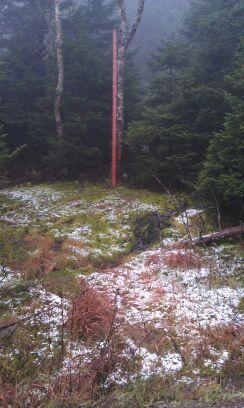
October 22, 2011: The fabled stake atop Mt. Mansfield, picking up the first accumulating snow for Vermont's Green Mountains this season
I was reading the Northern New England Thread on the New England Regional Forum at American Weather, and just got the word that Mt. Mansfield received its first accumulating snow of the season. Thanks to Powderfreak for passing along the message, and including a picture of the snow at the Mt. Mansfield Stake, which I’ve included here. As far as I’m aware, this is the first accumulating snow in the Green Mountains of Vermont this season due to the fairly warm October. It does look like the weather is going to cool down this coming week, so there will likely be more chances for snow in the high country. We’ll keep our eyes on the mountains, weather forecasts, and weather boards to see if any of the white stuff shows up in the near future, but as we approach November, the season of snow and skiing is certainly close at hand.
After our initial round of frosty weather back in mid September, more substantial freeze warnings and frost advisories are back for the start of October.
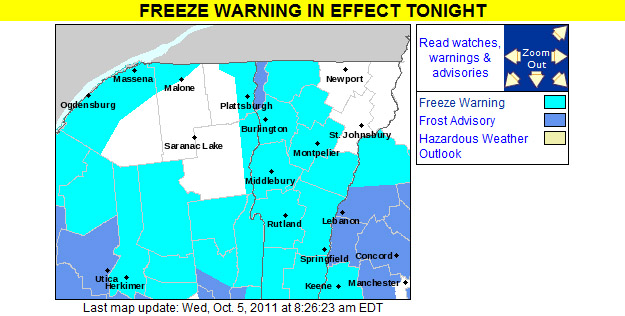
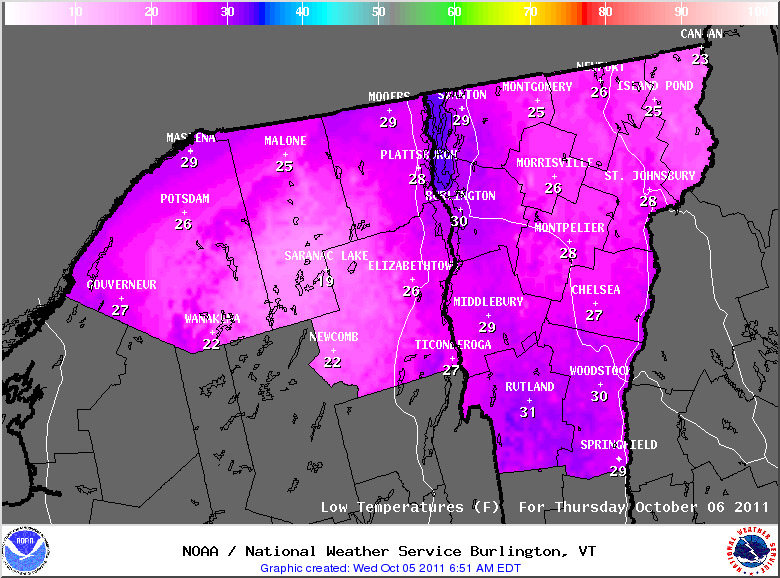
We’ve got another batch of cold air moving in over the next couple of days, so the National Weather Service Office in Burlington has put up freeze warnings throughout the area. Temperatures should be colder than last round with most areas in the 20s F, but since we’re into October now, that’s not all that surprising. For those areas like the Northeast Kingdom and the Adirondacks that don’t have warnings up, it’s because they aren’t needed; for those colder areas with early dates for the typical first frost, the growing season is considered to be over already. This is bad news for farmers in that area. Unfortunately, the weather cannot be changed. This will probably impact the crops of many farmers. To prevent this from happening next year, some farmers may want to take some extra precautions. Some may want to visit https://shrinkwrapcontainments.com/t-reinforcedblackout.aspx, for example, to purchase some light deprivation tarp. This is currently being used by full-time farmers in other areas who are trying to extend the growing season by creating artificial growing conditions. This tricks the crops, allowing them to continue growing for longer. Hopefully, this should help more farmers to have a successful growing season next year.
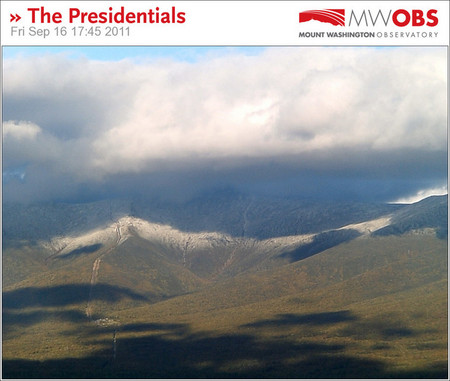
As the afternoon wore on and the clouds dissipated, images from the Mt. Washington web cams began to reveal the white of fresh September rime and snow in the higher elevations
In association with our coldest weather of the season thus far, the mountains of Northern New England saw some snow today. In Vermont, I heard about the frozen precipitation on Mt. Mansfield in a post from Powderfreak at Americanwx.com, and over in the Presidential Range of New Hampshire there were some visible accumulations above the 3,500’ to 4,000’ elevation level. A great video from TheAutoRoad with scenes of snow falling along the Mt. Washington Auto Road was posted, and can be viewed below. Even in the valleys the weather was quite cool today, with highs only in the 50s F, so the look and feel of fall was all around us. Enjoy the video!
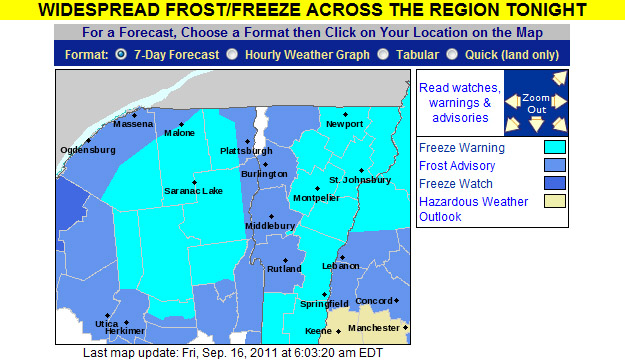
Freeze Warnings and Frost Advisories have been posted for the entire state of Vermont.
The National Weather Service office in Burlington has posted a freeze warning for our area, and indeed the entire state of Vermont is under either freeze warnings or frost advisories, so cover up vegetation as necessary. This may also be a good time to look into local furnace maintenance services as you want to be sure your current furnace can meet the demands of this cold weather. Companies like CJS Heating offer such services. Why now? Well, furnaces have to work much harder when the weather is colder and so some may struggle to keep up. The last thing you’d want is for it to stop working whilst temperatures are so low. Though the first frost for valley locations in the Central and Northern Green Mountains does typically happen in September, the average date for the occurrence is toward the end of the month (September 27th for Morrisville and September 30th for Montpelier) so this is a bit on the earlier side. Yesterday in the Northern New England thread at Americanwx.com, Powderfreak posted the chart from the National Weather Service that shows the average dates and ranges for first frost at some of our Vermont climate locations – mid September is in the 10th – 25th percentile. Take a look at that post for more information about average dates of 32 F temperatures around the state.
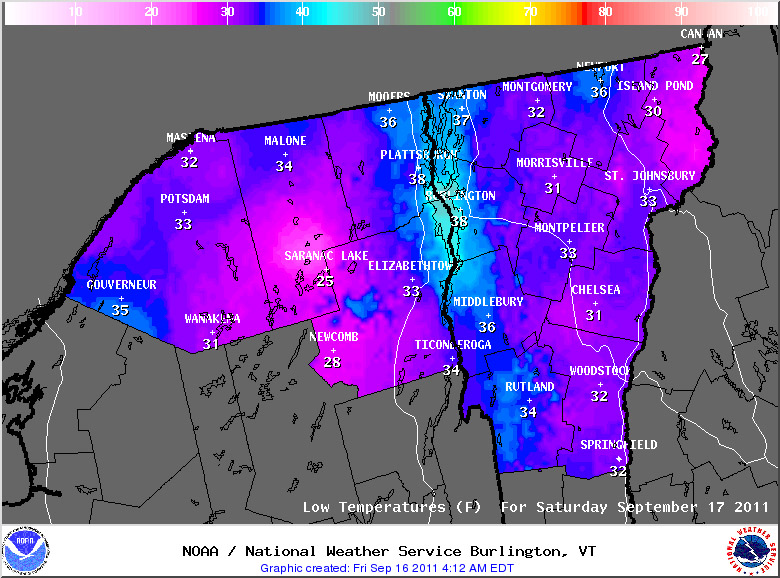
Low temperatures are going to be down in the 20s F in some locations overnight as the first frosts and freezes hit the North Country of Vermont and New York.
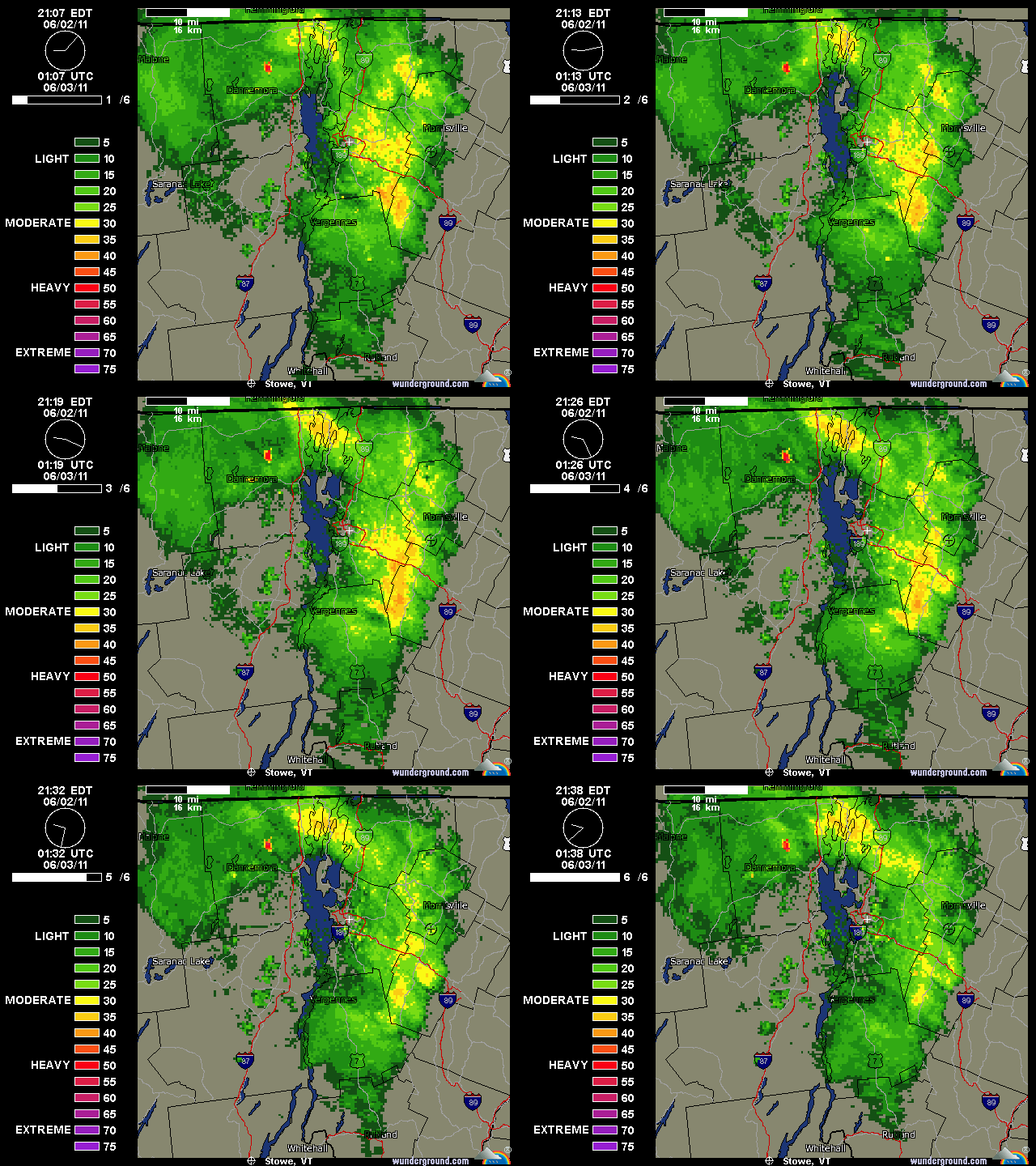
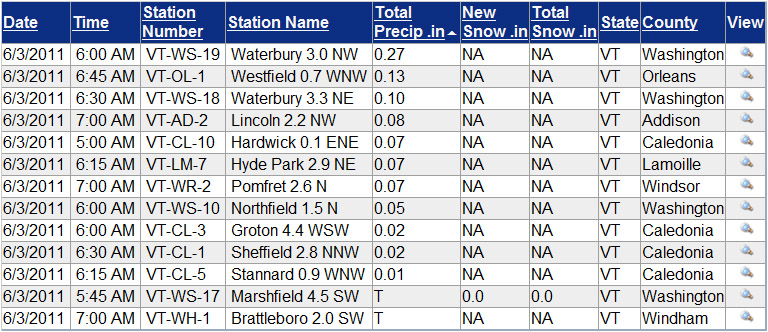
After drying out to amazing low humidity on Wednesday, temperatures got really cool on Thursday and we got into a classic Northern Vermont upslope flow. There was actually some snow falling in the highest elevations of the Greens, and certainly over in the Whites. There were just a few spits of rain in Burlington when I left yesterday afternoon, but of course I got to the house and it was a steady light rain with a tenth or two of an inch already in the gauge. This morning the gauge contained 0.27” of liquid in it and I thought, heck, that’s a half foot of upslope snow right there when the temperatures are appropriate. I was looking at the radar image posted by Powderfreak at Americanwx.com and could see how at one point it exploded with 35 db and even a few 40 db echoes over our area at the junction of I-89 and the Chittenden/Washington county line, and then dissipated on the east side of the mountains once it dropped its payload:
June upslope rain and snow hitting the Northern Green Mountains
When I submitted my report to CoCoRaHS this morning, I took a quick look at what some of the other stations had reported. I sorted the list below from around 7:00 A.M. by total precipitation, but even without that, it was pretty easy to see the locations that got the liquid:
I haven’t been able to check out the local peaks to see if they have any white on them because they’ve been socked in, but Mt. Washington got some new snow and they must have been whitened. It’s 26 F up there now with freezing fog and 50+ MPH winds. With such a good-looking forecast for tomorrow, we may head over for some turns, but these past couple of days certainly should have been good for snow preservation.
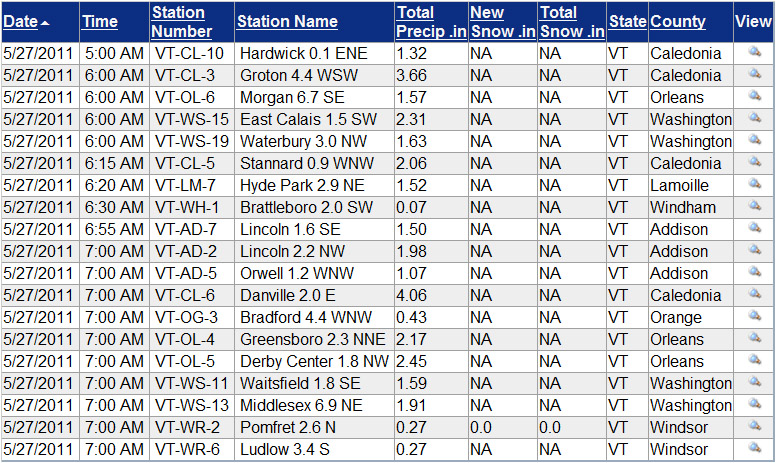
It didn’t seem like it rained a lot last night, but I found 1.63” in the gauge this morning, so it obviously added up. We had some losses of power similar to what Powderfreak noted – a couple short ones in the evening, and then it went back out again around 8:00 P.M. and it was gone for the night. It came back on early this morning at some point. I didn’t stay awake for it, but apparently we had thunder and lightning pretty continuously through about 2:00 A.M. This morning I was surprised to see the Winooski way back up to a level even with our local V.A.S.T. bridge and hogging almost the entire valley in our area, just like back in mid April when the snowpack was starting to melt. I think it may have even been a bit higher this time, as the typically flooded residences and farmland west of the Cider House seemed quite inundated with water. The water was probably the closest I’ve seen it to washing over Route 2 in that area – I think another foot of depth and there would have been water on the road. I was surprised it got so high relative to the amount of water I recorded in the gauge, but then I checked the CoCoRaHS maps and saw that one observer over in Caledonia County reported 3.66” of water with this event. I don’t think they are actually in our drainage, but clearly someone out to our east got a load of water from these storms overnight. Our bus was late this morning due to road closures in the Montpelier area, so things have certainly been disrupted by the water. I added an image of the VT CoCoRaHS table of Daily Precipitations Reports as of ~7:30 A.M. this morning, and it indicates that someone over in Danville got over 4 inches of liquid from these storms, so there are reports of some large amounts of liquid coming in from Caledonia County.
Some Vermont rain totals from the thunderstorms that came through the area overngight - some areas of Caledonia County to our east had over 4 inches of rain
It was ~41 F at the house this morning, so I suspected that the snow level was still a bit high for new powder in the easily accessible elevations, but I checked in at Bolton on the way in to Burlington this morning to get a handle on where things were at in terms of base and new snow. I could tell that it wasn’t yet a huge hit below 2,500’ yet because the cars coming down the road didn’t have snow on them, but the precipitation certainly looked like snow up high. Here’s the vertical temperature profile I observed on the Bolton Valley access road around 7:00 A.M. with comments on the precipitation/accumulation; hopefully it will be useful for other mountain recreationalists:
As you can see from the above list, snow wasn’t accumulating until I reached the village at 2,100’, but it seemed to be accumulating on most surfaces other than the pavement, and there was probably ¼ inch down when I was there. Skier’s left of Beech Seal showed a couple of breaks in coverage, as I suspected it would based on my Sunday observations, but it was still pretty close to continuous.
Even back down in the valley, there were some bouts of moderate precipitation, so hopefully that continues to hit the mountains. Roger Hill was thinking that the snow level would rise a bit during the day today, so that may have to be factored in as well.
I haven’t seen any snow with this system, but last night’s precipitation seems worthy of note because we had 2.30 inches of liquid and the Winooski is back up even with our local VAST bridge as it was on the 11th, despite the fact that most of the snow has already melted in the lower elevations. Some area schools are closed due to road access issues with this event. I just summed my CoCoRaHS numbers for April and with this latest event the total liquid is right at 8.00 inches for the month thus far. While I had that open I grabbed a few additional liquid numbers. For the 2011 calendar year up to this point at my reporting location the liquid precipitation is at 20.46 inches, for the 2010 calendar year the total was 54.17 inches, and for the ’10-’11 snowfall season as it currently stands (October 15th, 2010 – April 16th, 2011), the total was 28.09 inches.