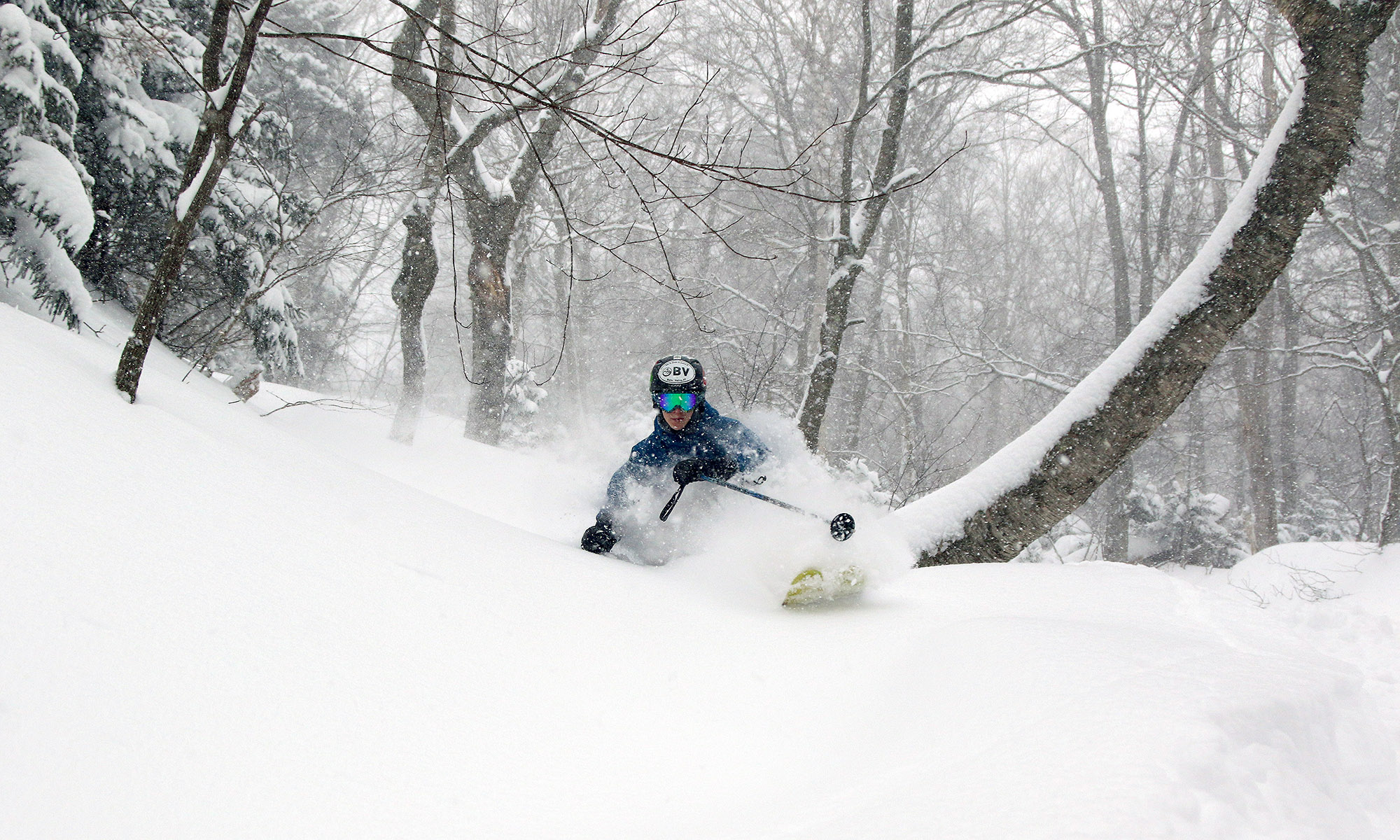
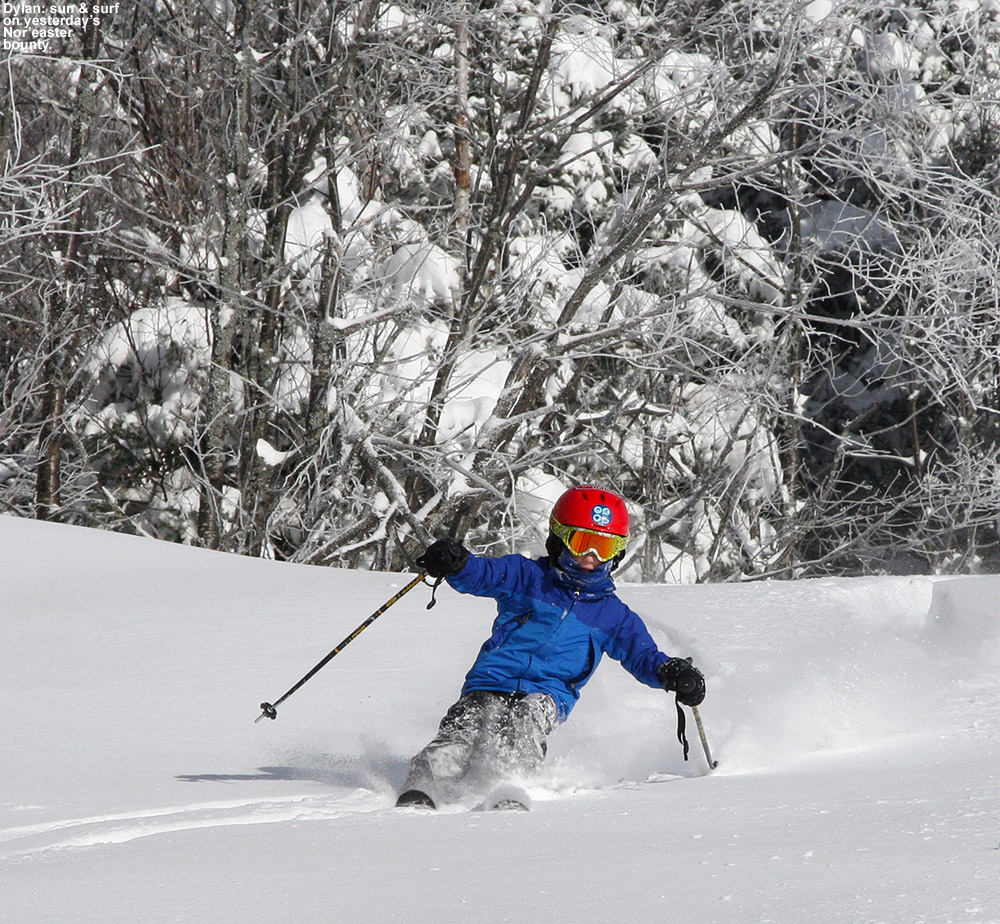
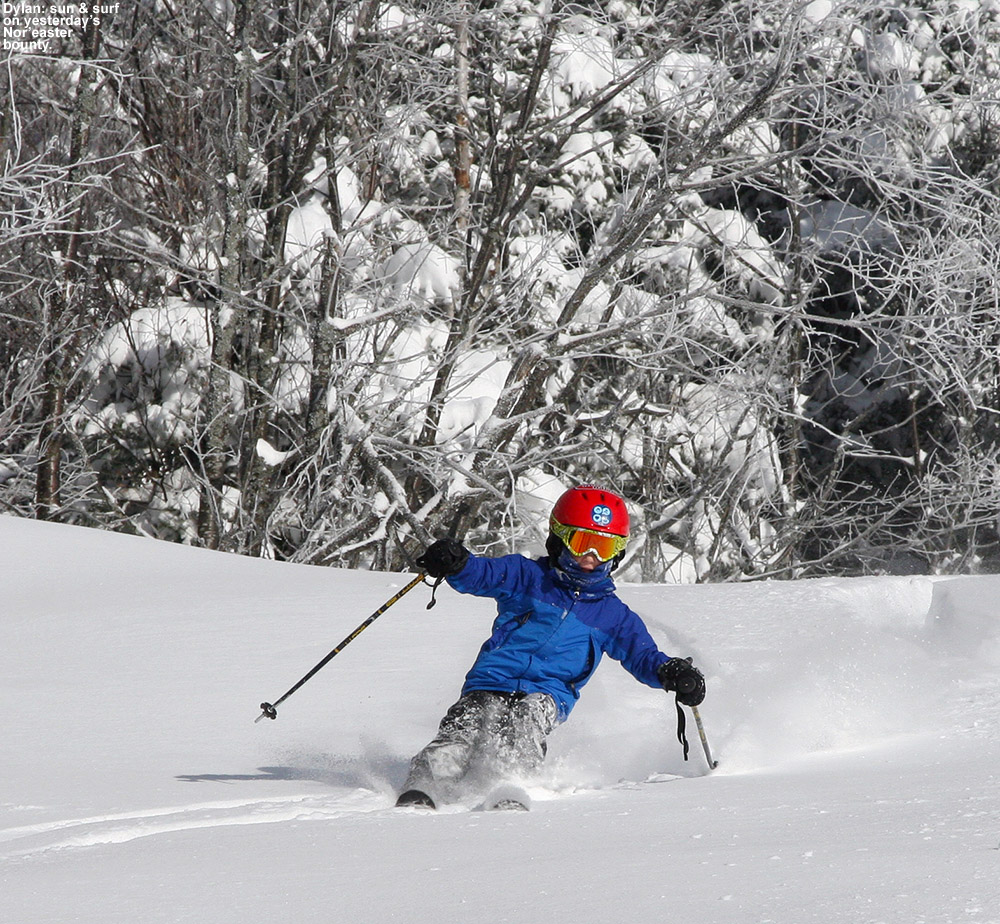
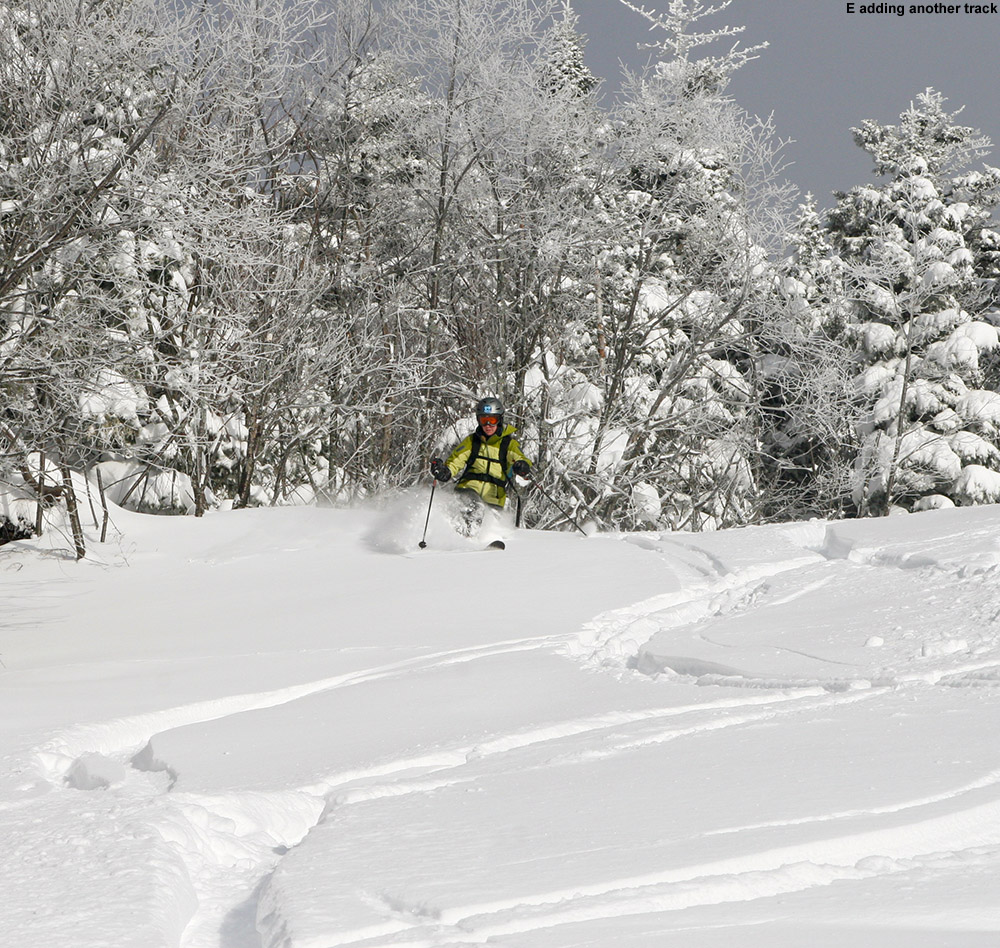
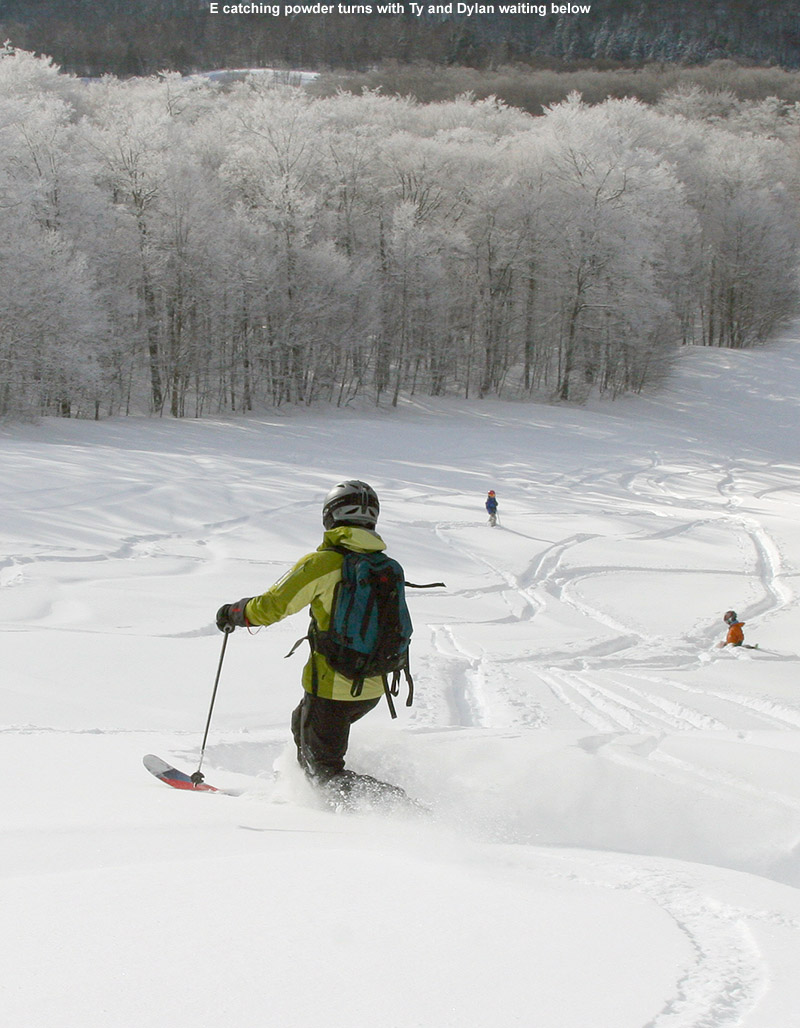
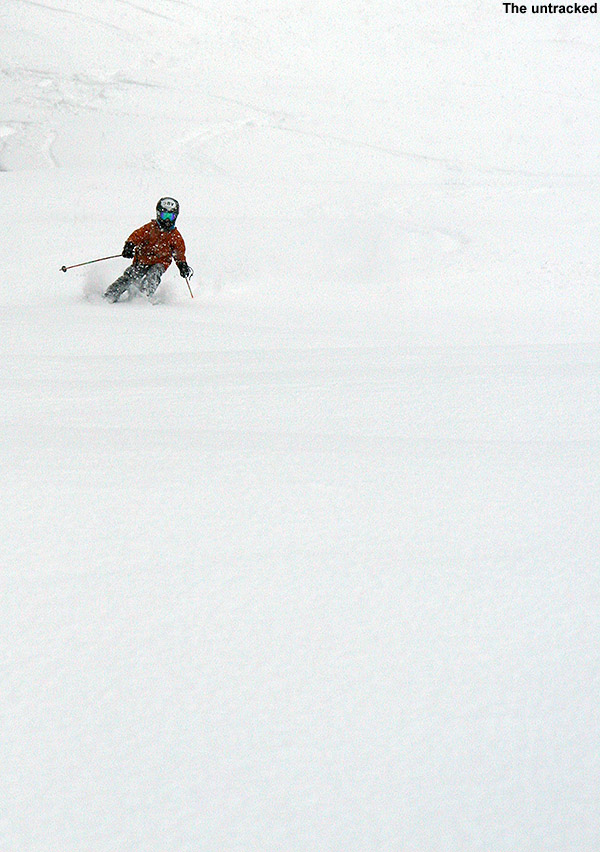
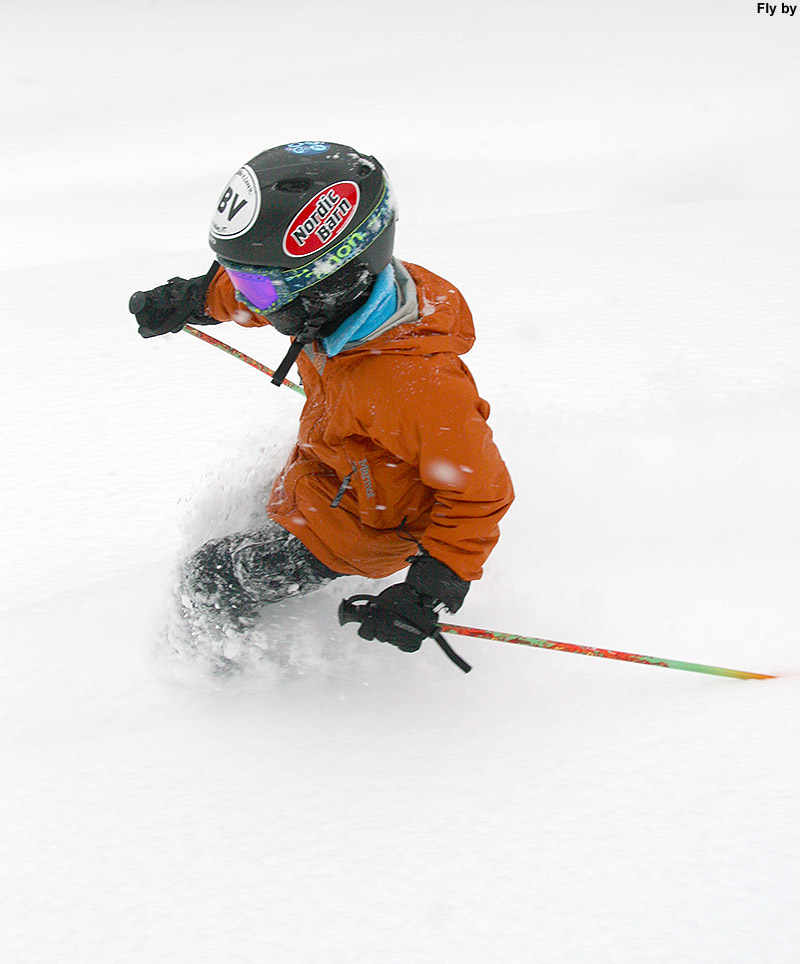
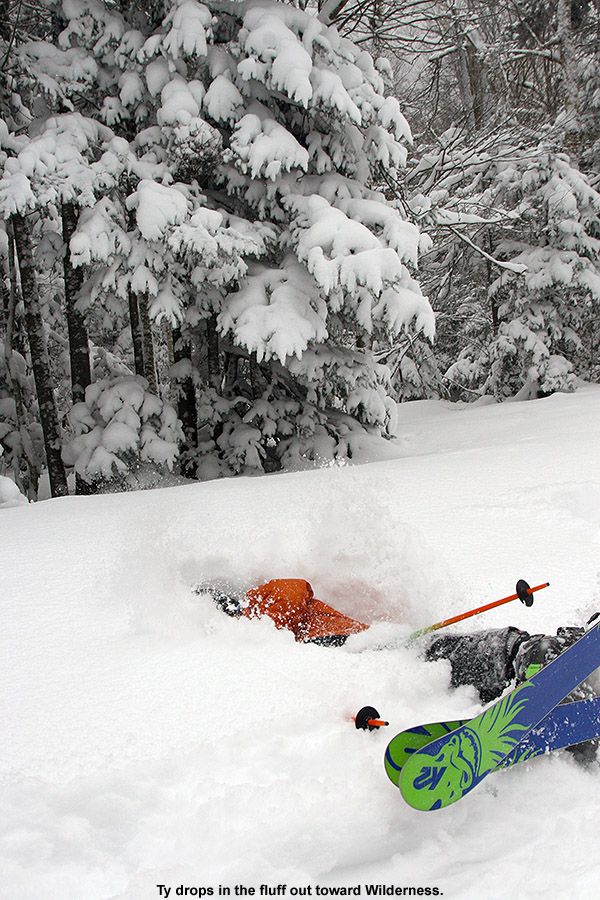
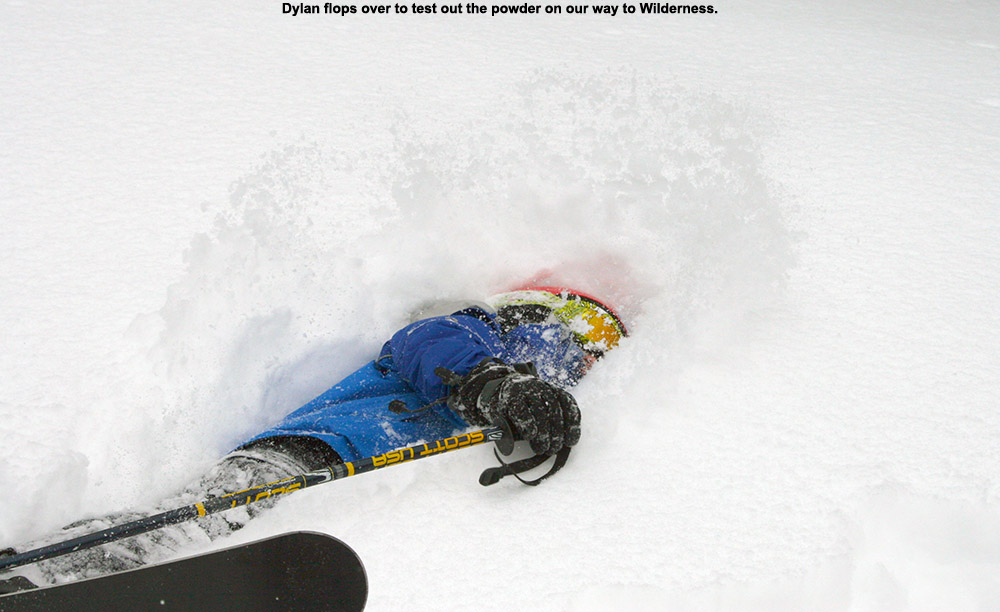
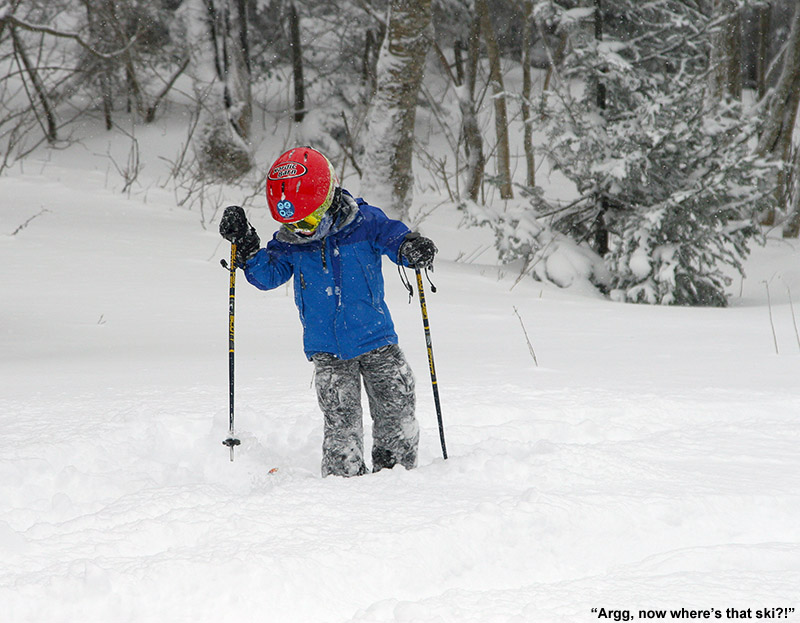
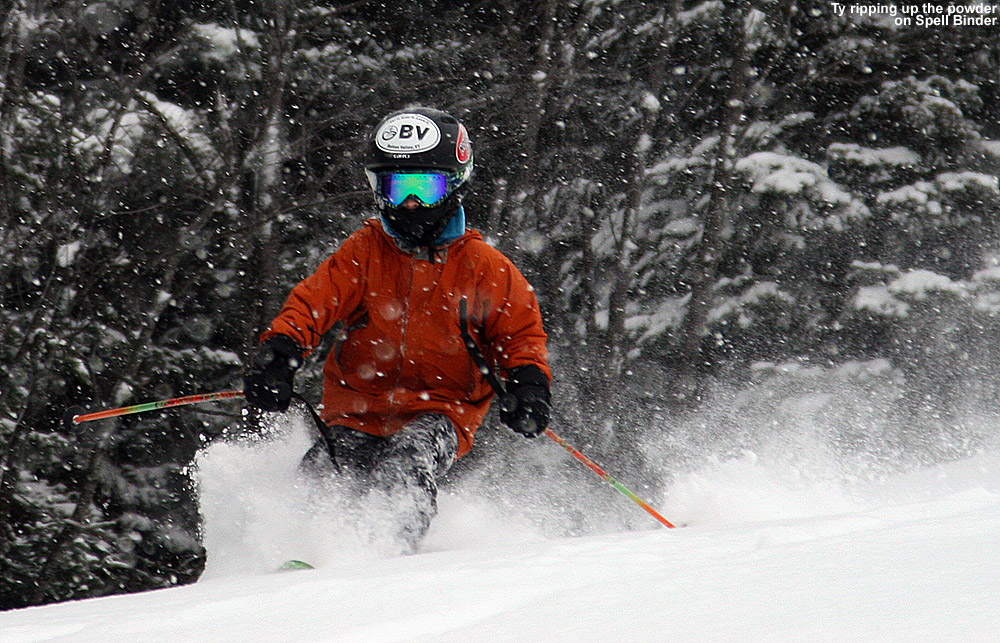
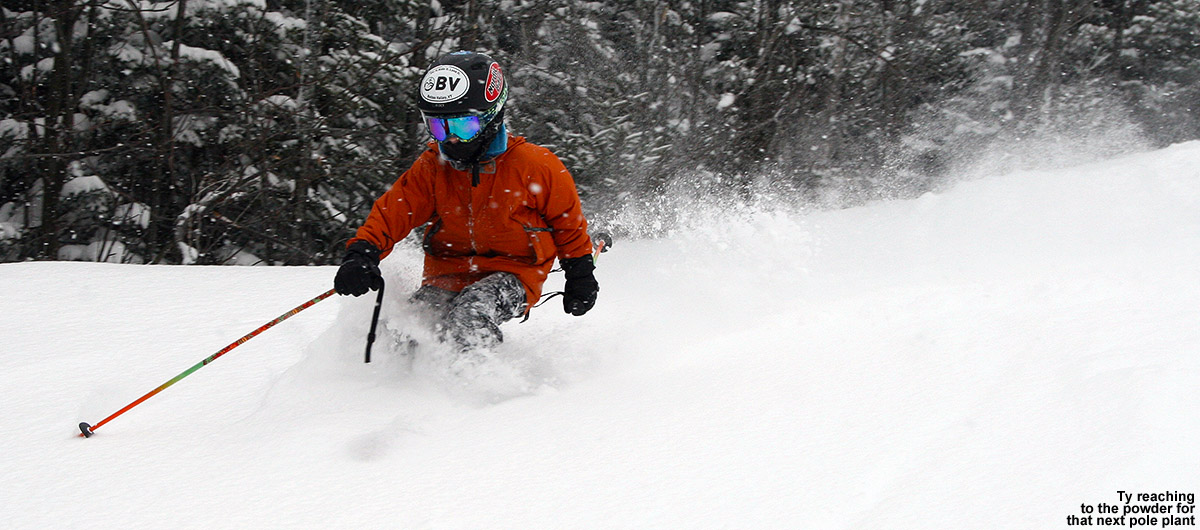
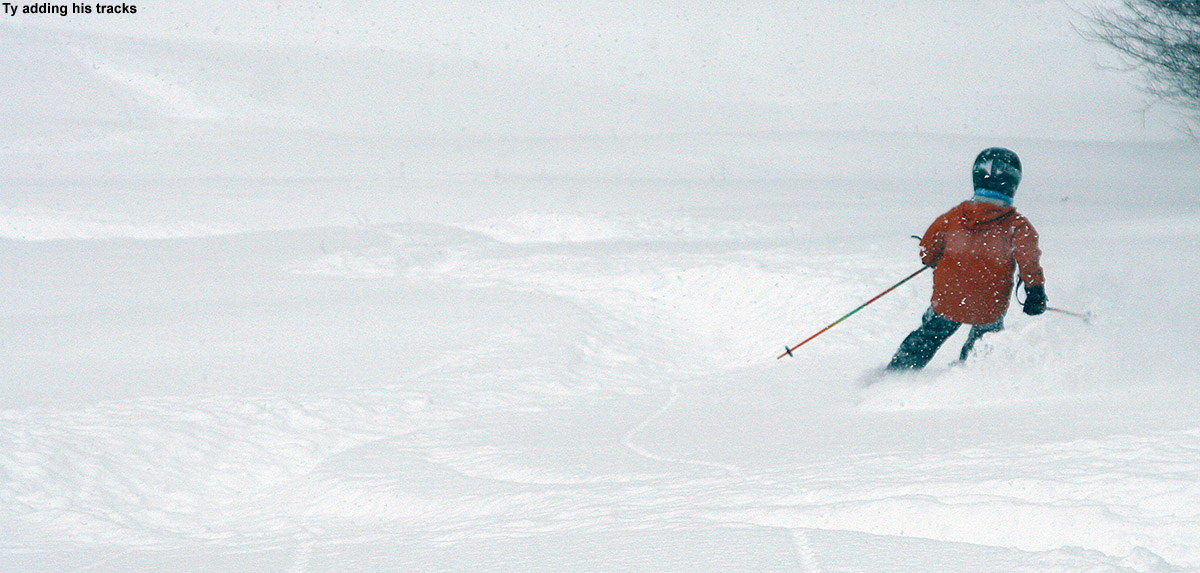
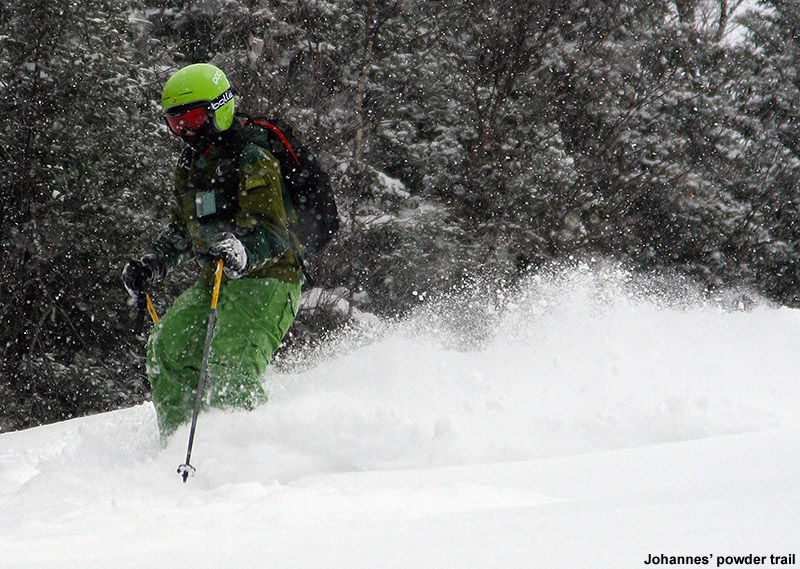
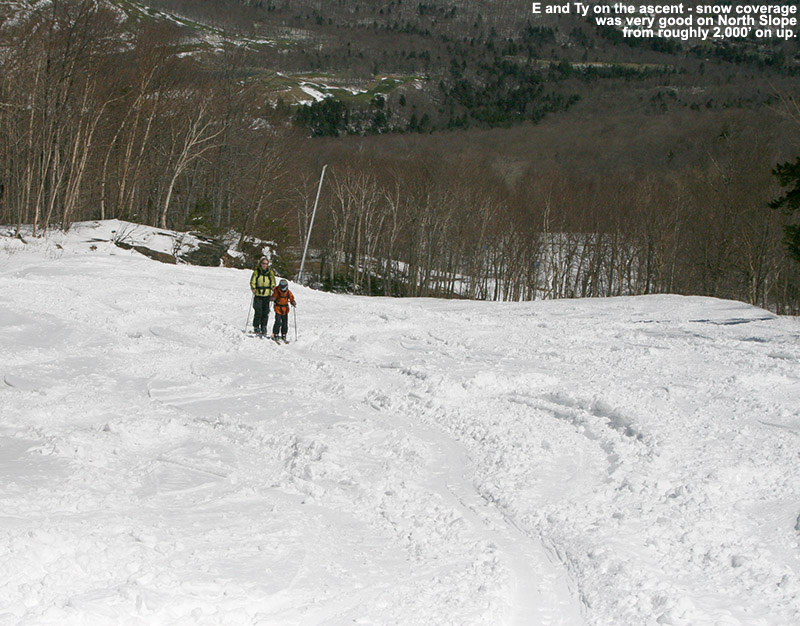
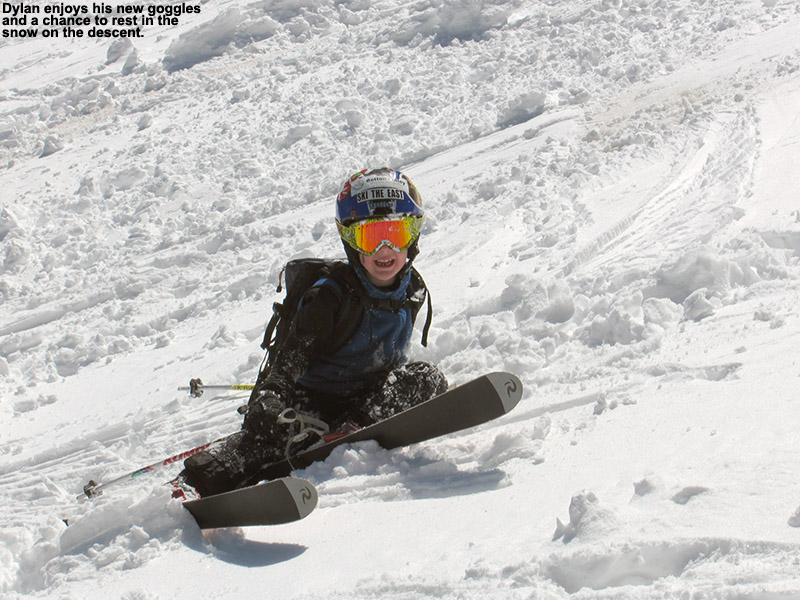
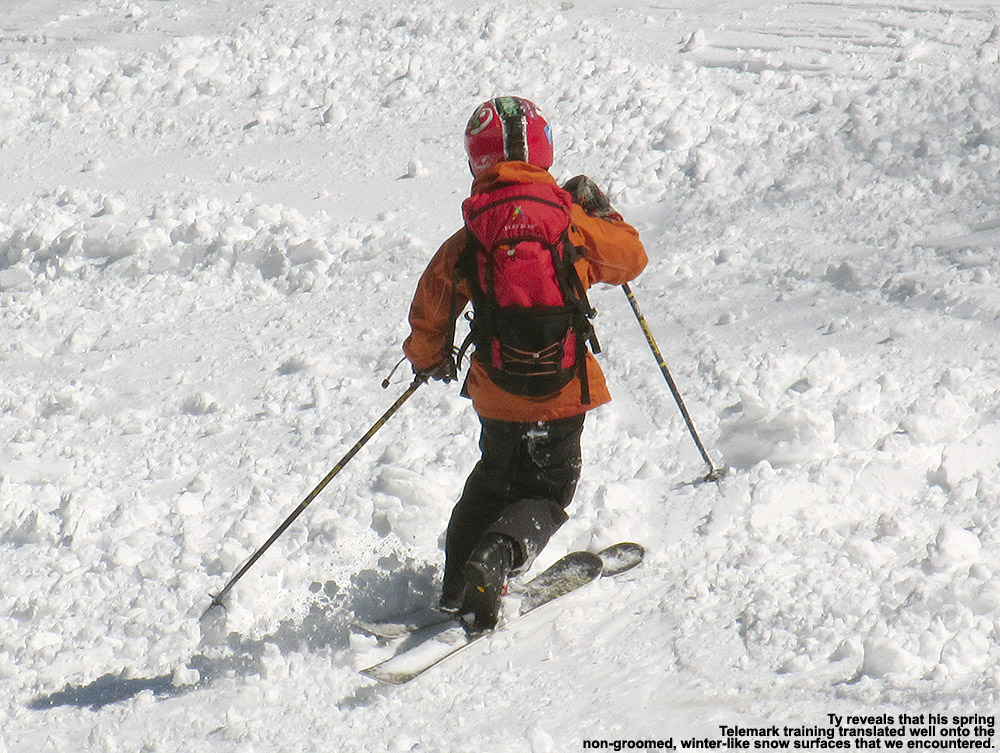
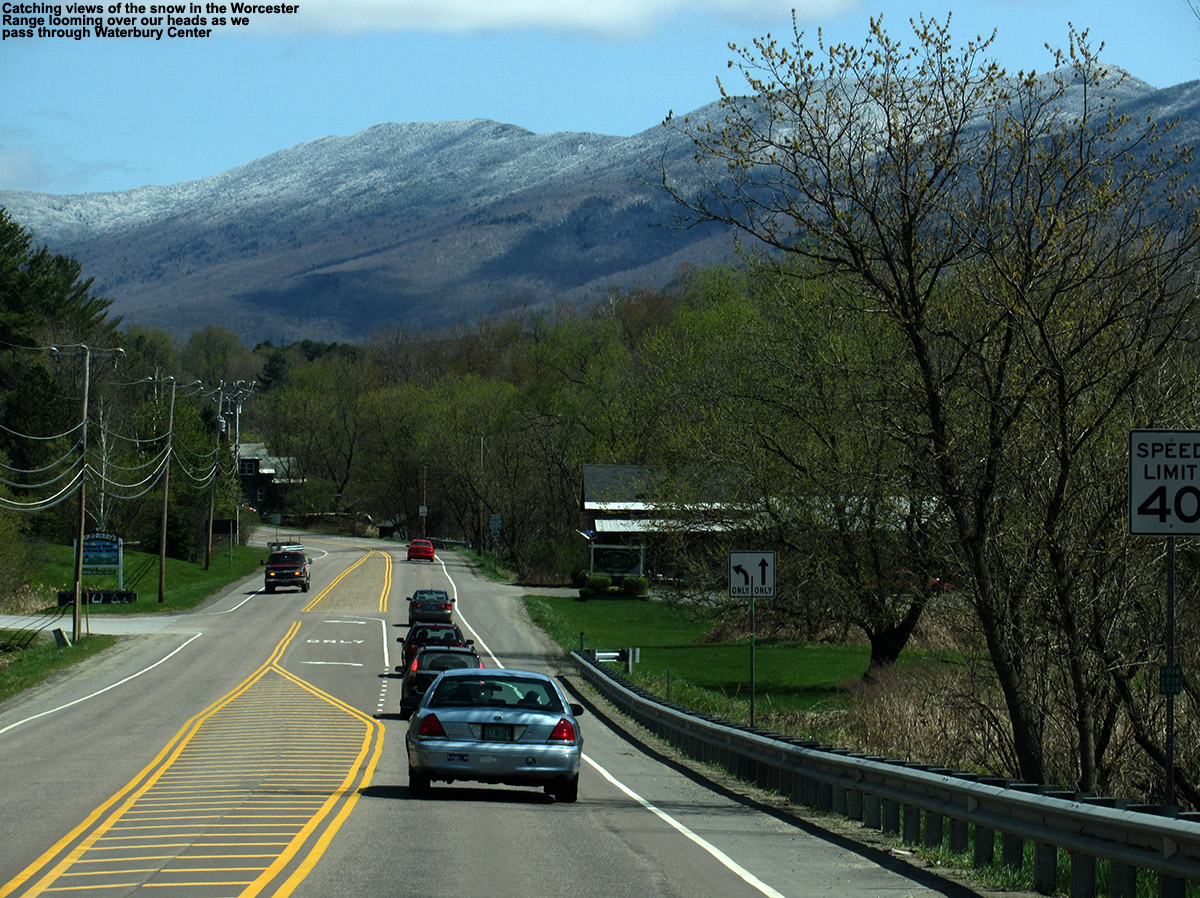
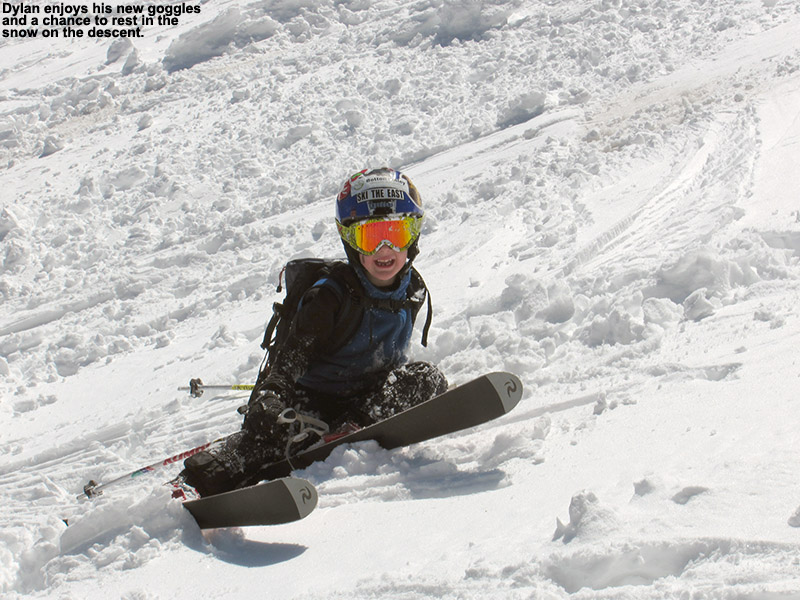
Dylan catching some sun and nor’easter powder today
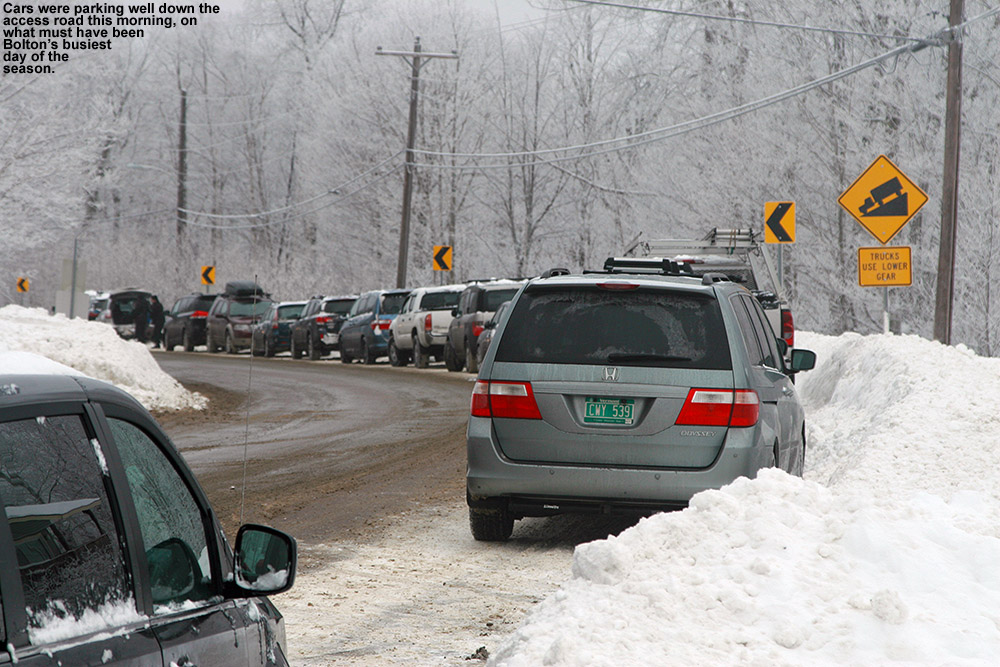
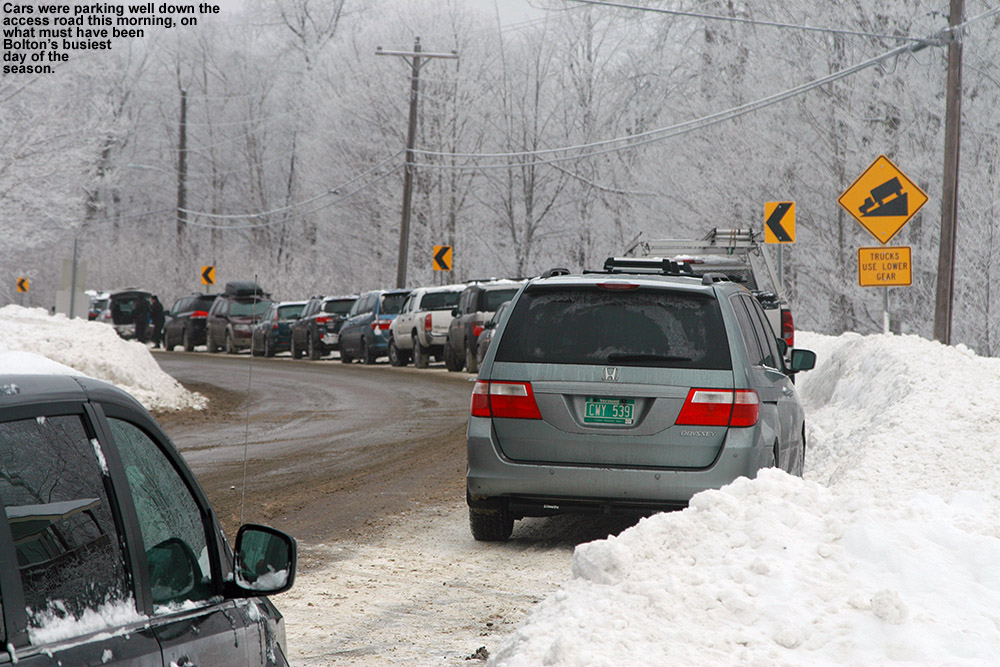
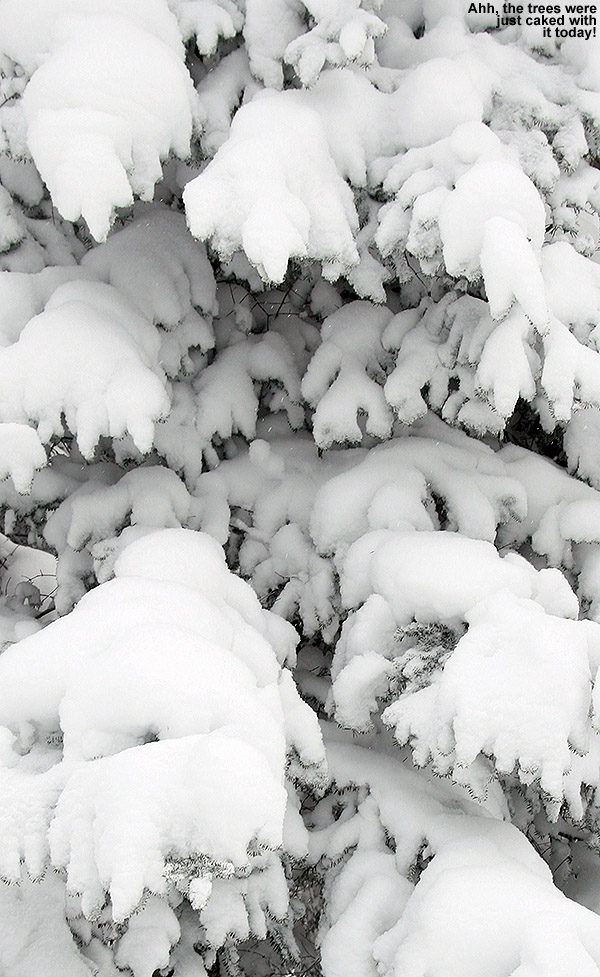
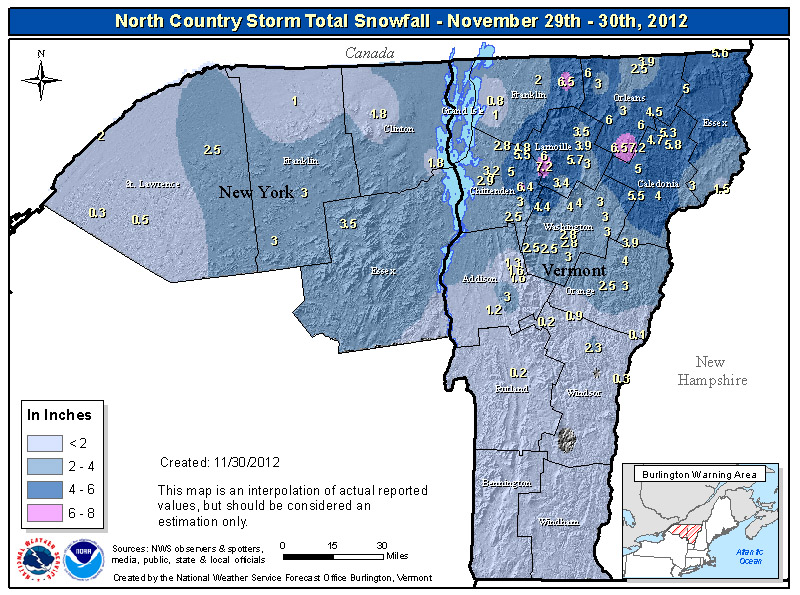
The snow from yesterday’s nor’easter had essentially shut down by late afternoon, and while there was a touch of upslope snow after that, there really wasn’t any refill to provide another huge round of fresh powder for today. With that in mind, we didn’t rush off to the mountain, but instead took care of things around the house such as finishing off the driveway with the snow thrower, etc. Eventually we headed out to Bolton Valley in the mid morning timeframe, and I’d contacted Stephen earlier and learned that he was probably 30 minutes or so ahead of us. We again spotted a car at Timberline as we’d done on Sunday, figuring we’d head over that way depending on how the day went. The resort appeared to be frantically plowing the parking lots there, although we didn’t quite know why at the time. As we approached the Village, we figured out why; we saw that traffic was backed up, and within a minute or two we knew that all the upper lots were full. It was actually pretty convenient being where we were (near the outlet of Wentworth Road), since we just spun around and parked on the access road following the advice of the parking attendants, but this was the first time in our seven seasons of visiting the resort that we’ve actually parked like that. I’ve seen it done before on busy days, but we’ve always been much earlier or later and found a spot in the main lot. In any event, I took it as a sign that the holiday visitors had arrived and business was looking good. I think the combination of the big storm yesterday (in which many people probably didn’t venture out to the slopes due to the difficult travel) and the holiday week really came together to get everyone out today.
A busy day at the resort today saw people parking on the Access road.
It was good that all four of the main mountain’s chairs were running, but queues were forming. We opted for a run on the Mid Mountain Chair, since the queue was just a couple of minutes. We came straight down on Beech Seal, which amazingly still held some nice untracked powder on the sides. It was still that medium weight powder, but it skied pretty well where it was untracked. The queue for the Vista Quad had disappeared when we got back to the base, so we got ourselves to the Vista Summit and headed down Cobrass. There’s definitely been a solid resurfacing on Cobrass (as well as the rest of the slopes), and although there were still a few slick spots, it was overall quite good. We popped into the Villager Trees, where coverage was definitely fine, but the higher density of the snow seemed to leave its impression in there. It was difficult to really get into a groove, because even one set of tracks in the snow made it much more challenging. It was difficult to explain, but we could feel how things were just off at that point.
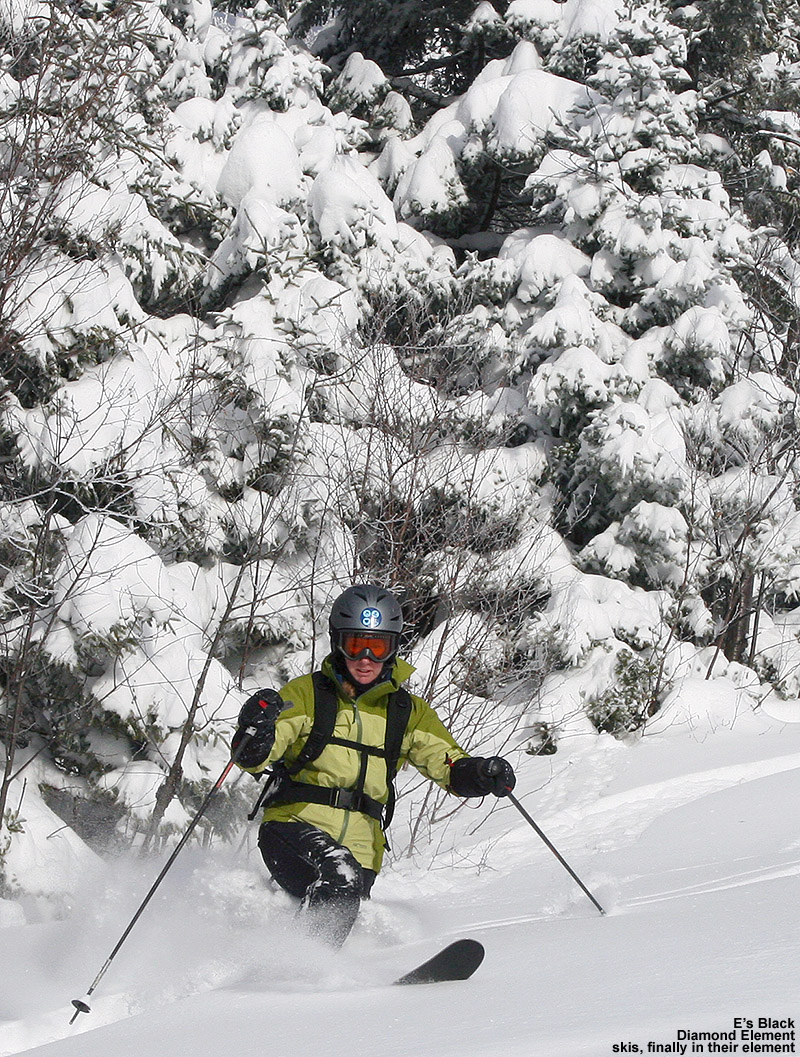
“As she floated her way down the Spell Binder headwall, E finally got to really feel her Black Diamond Element fat skis in their ‘element’ so to speak…”
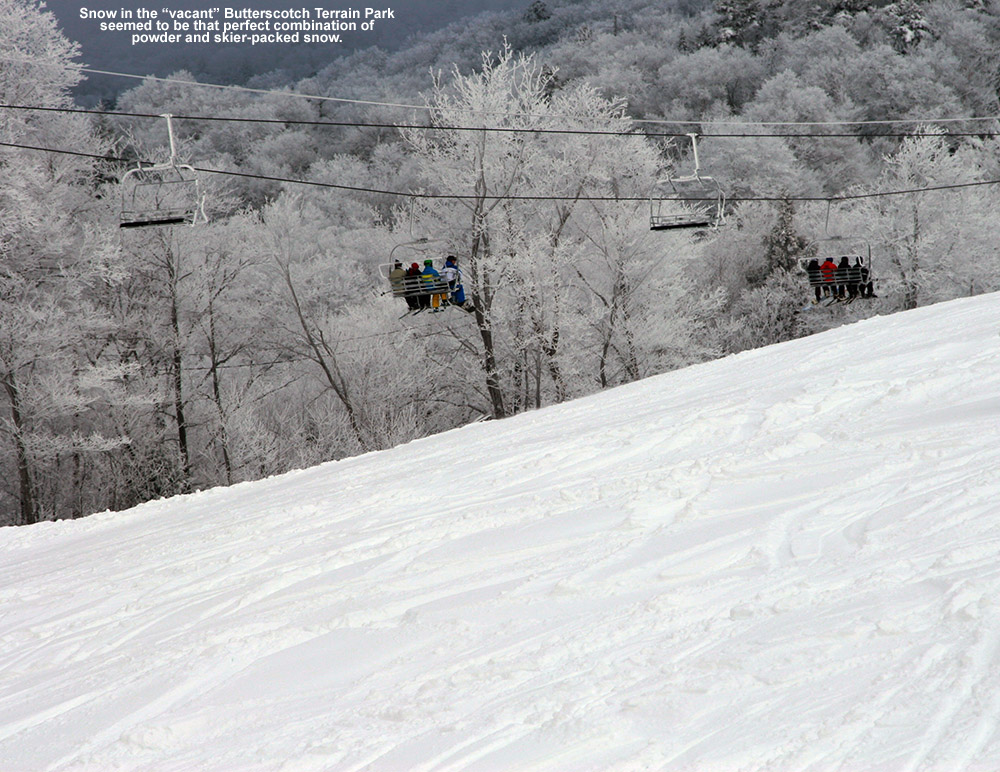
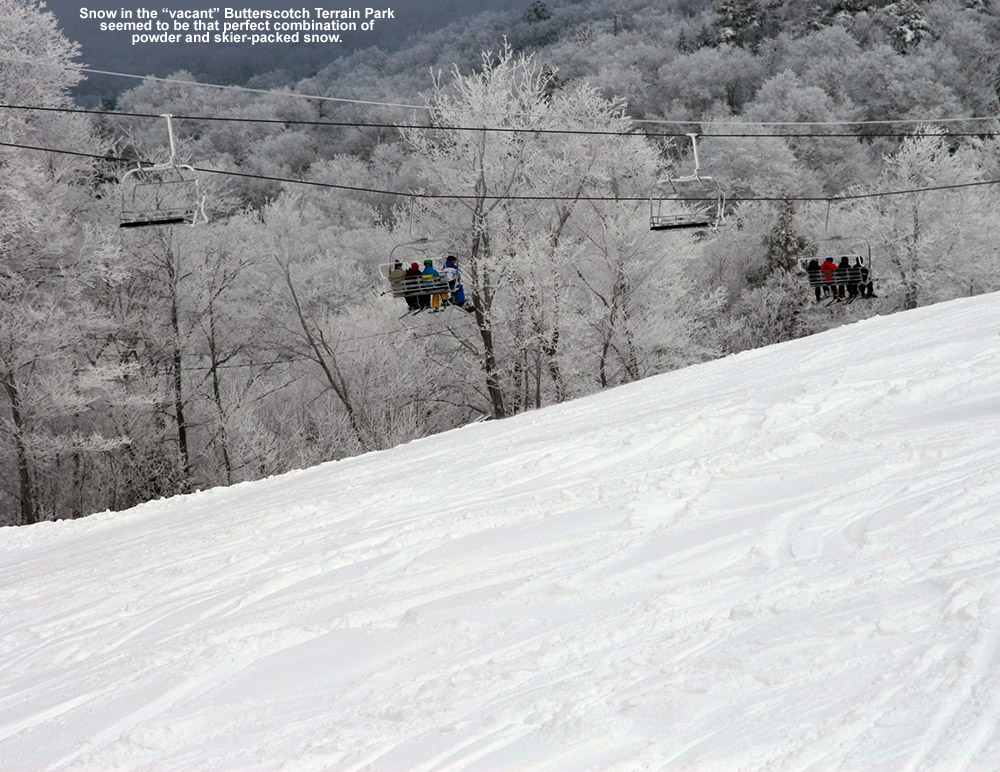
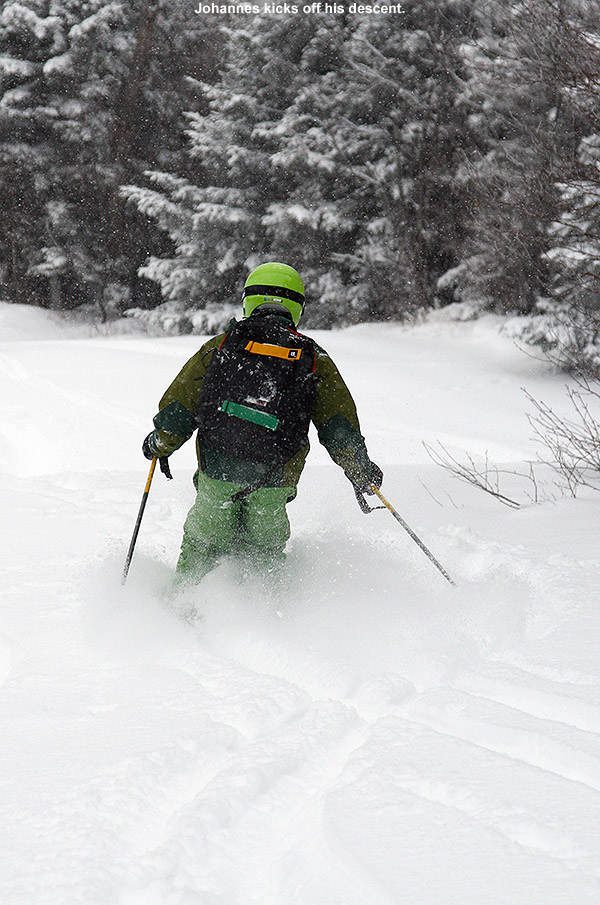
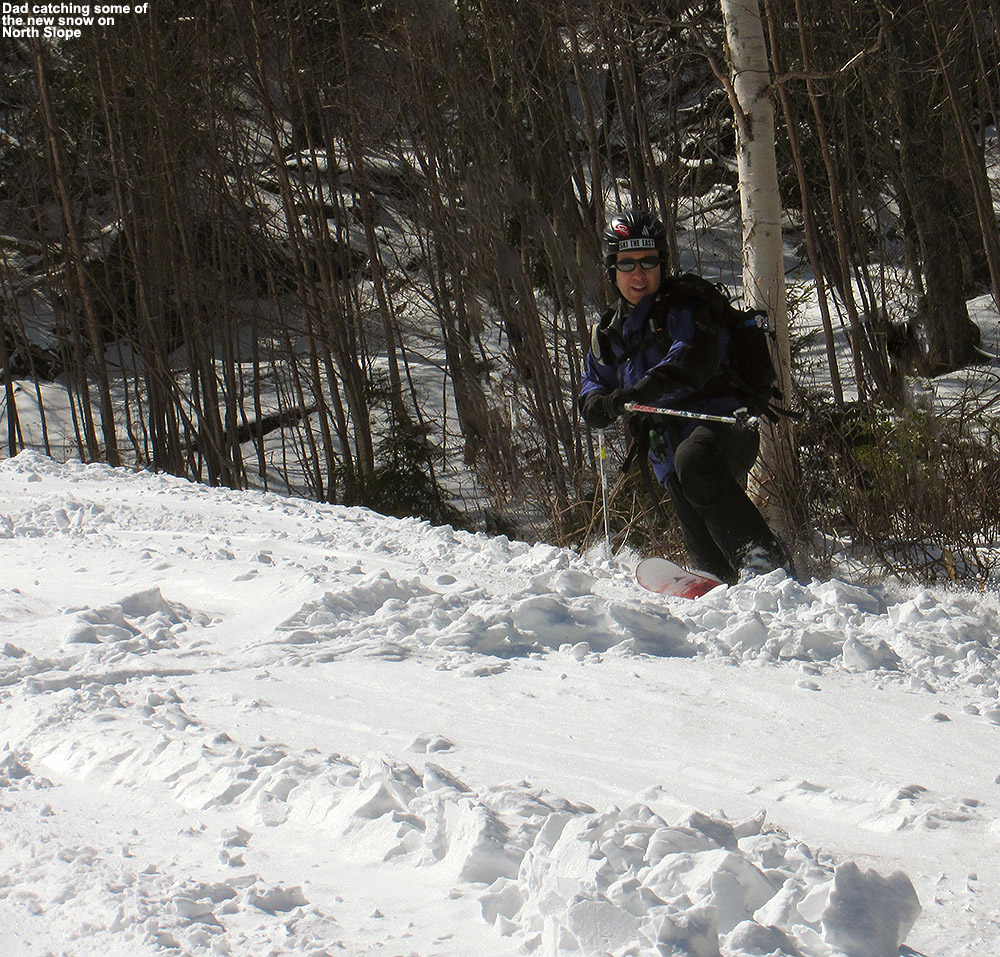
We finished off the run catching the bottom of the Butterscotch Terrain Park, which is still just being left for powder skiing without any features. Even just catching the bottom of that area was enough to get a sense that it might be what we needed to reinvigorate everyone’s skiing. The powder wasn’t so deep that you bogged down, and tracks were sparse enough that you could get some fresh turns, or plentiful enough that you were skiing on skier packed snow. There wasn’t any of that deep, semi-tracked snow that was feeling so difficult to ski. There was little if any queue for the Snowflake Chair, so we went through the park terrain three times before the boys decided that they needed to eat. For me, the snow in there was skiing just right and I would have been happy to ski it all day. We got to see Claire and Luke, and make a run with Stephen and Johannes as well. E was also very observant and noticed that a young boy had lost his mother at the Snowflake Summit, so a quick cell phone call remedied the situation.
The Butterscotch Terrain Park offered up the right combination of powder and skier-packed conditions for us today.
The base lodge was jam packed, so we took a look upstairs at Fireside Flatbread to get some pizza and grab a seat. Unlike yesterday when Dylan and I walked right in and sat down, it was filled to capacity. We hung out along the side for a while near the big stacks of wood for the fire, and eventually got a seat and some slices, but even as we approached 2:00 P.M. it was just a continuous flow of people picking up slices at the counter. Business was so steady that they even ran out of dough soon after that, and had to shut down for a while to prepare more. I couldn’t believe how people just kept streaming in well into mid afternoon, but I overheard that the wait for a table at the James Moore Tavern was an hour and fifteen minutes.
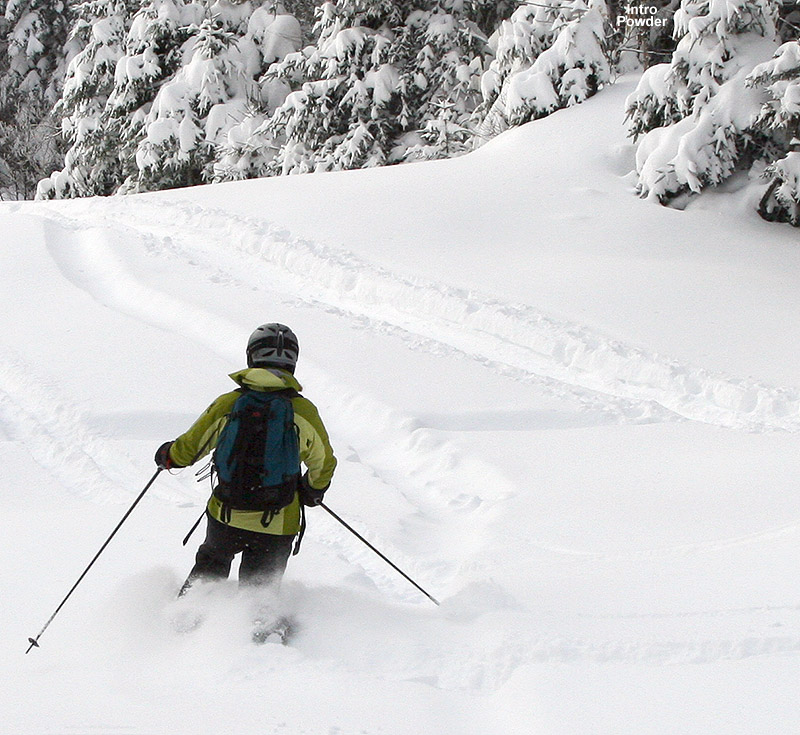
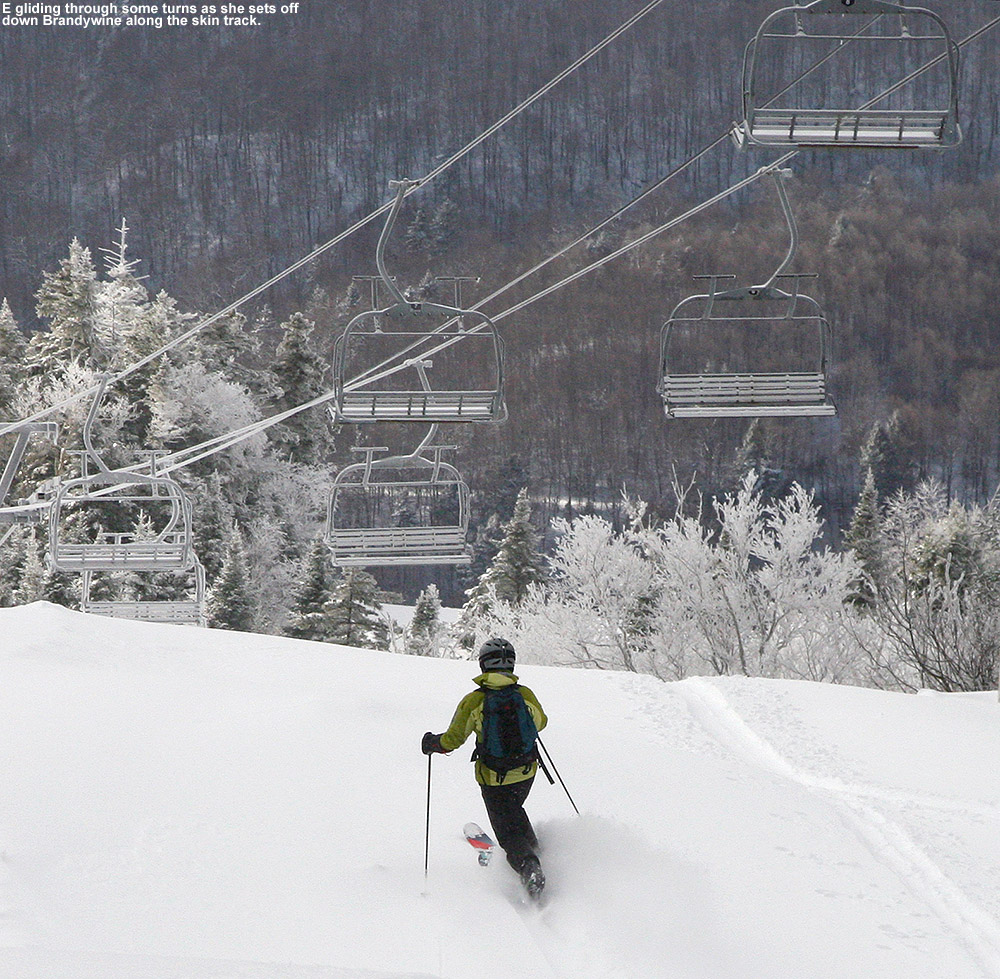
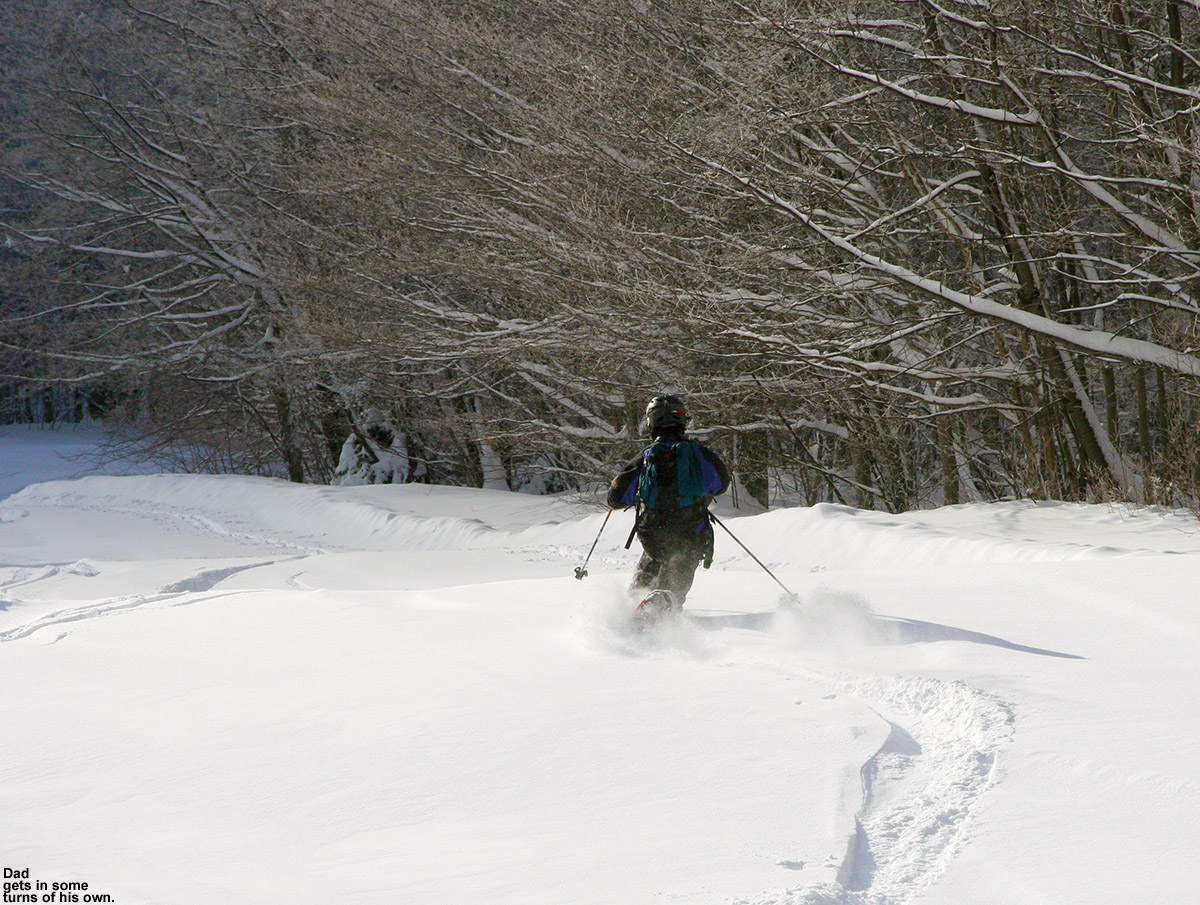
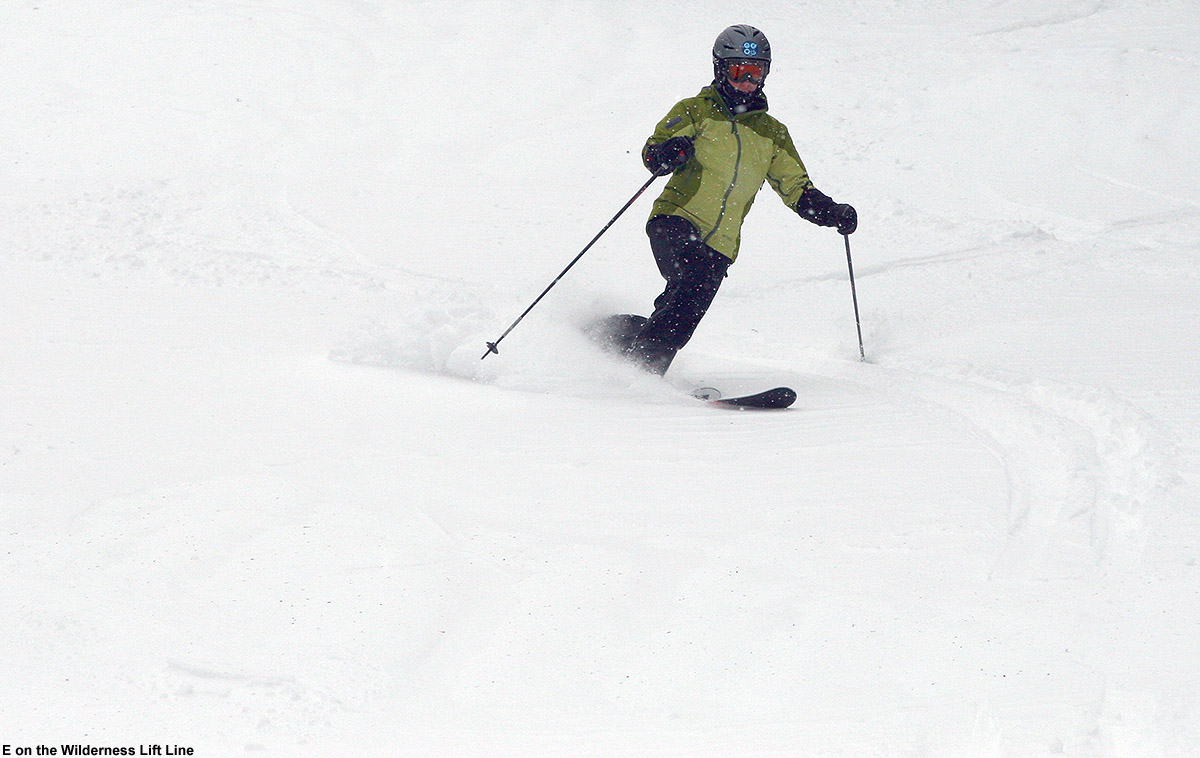
E sets off on a powder excursion.
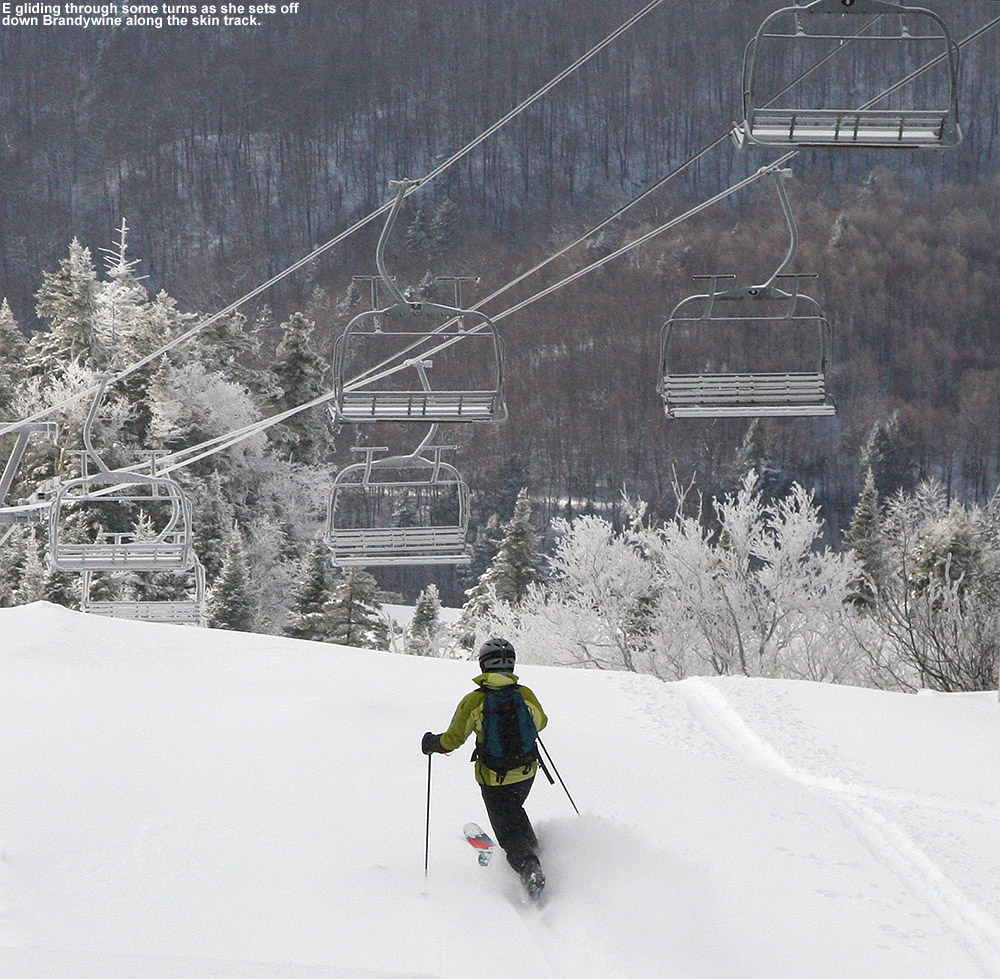
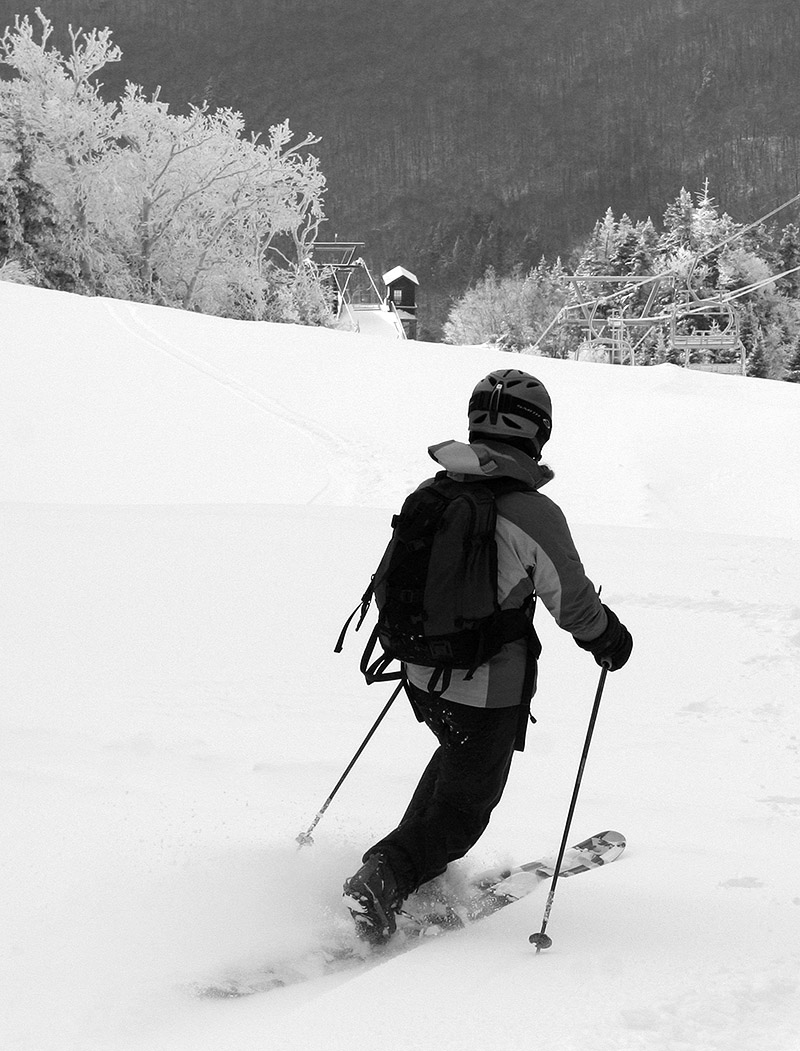
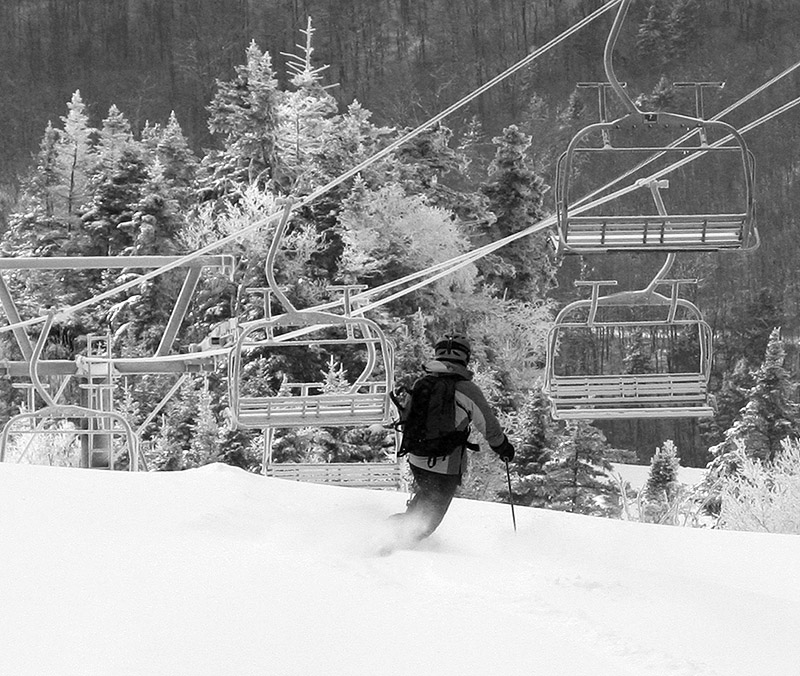
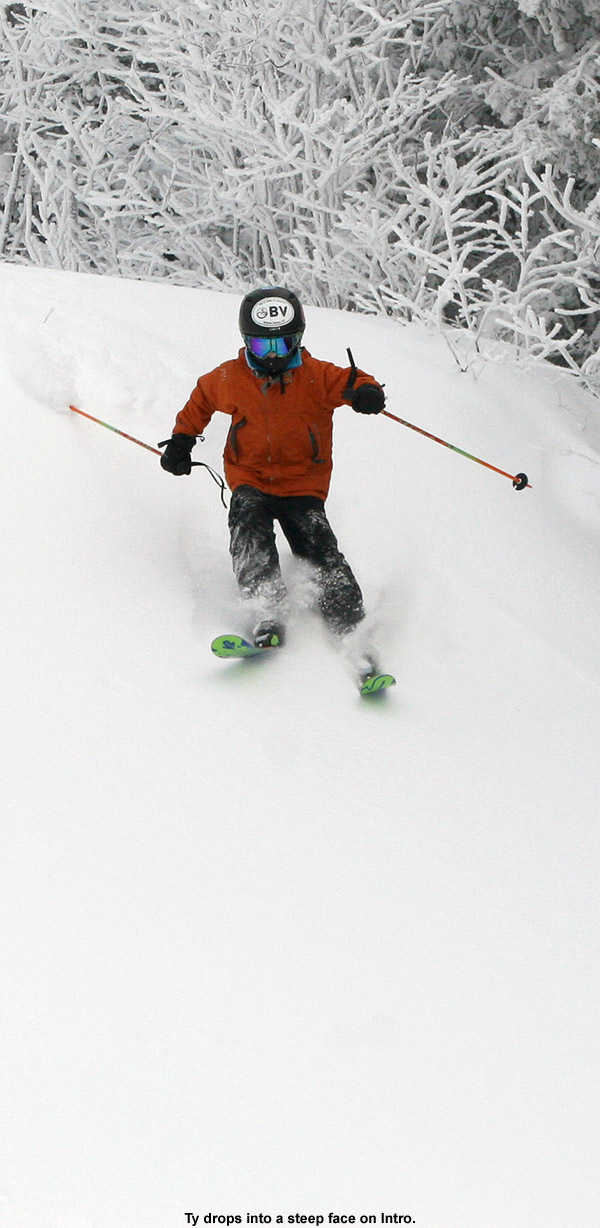
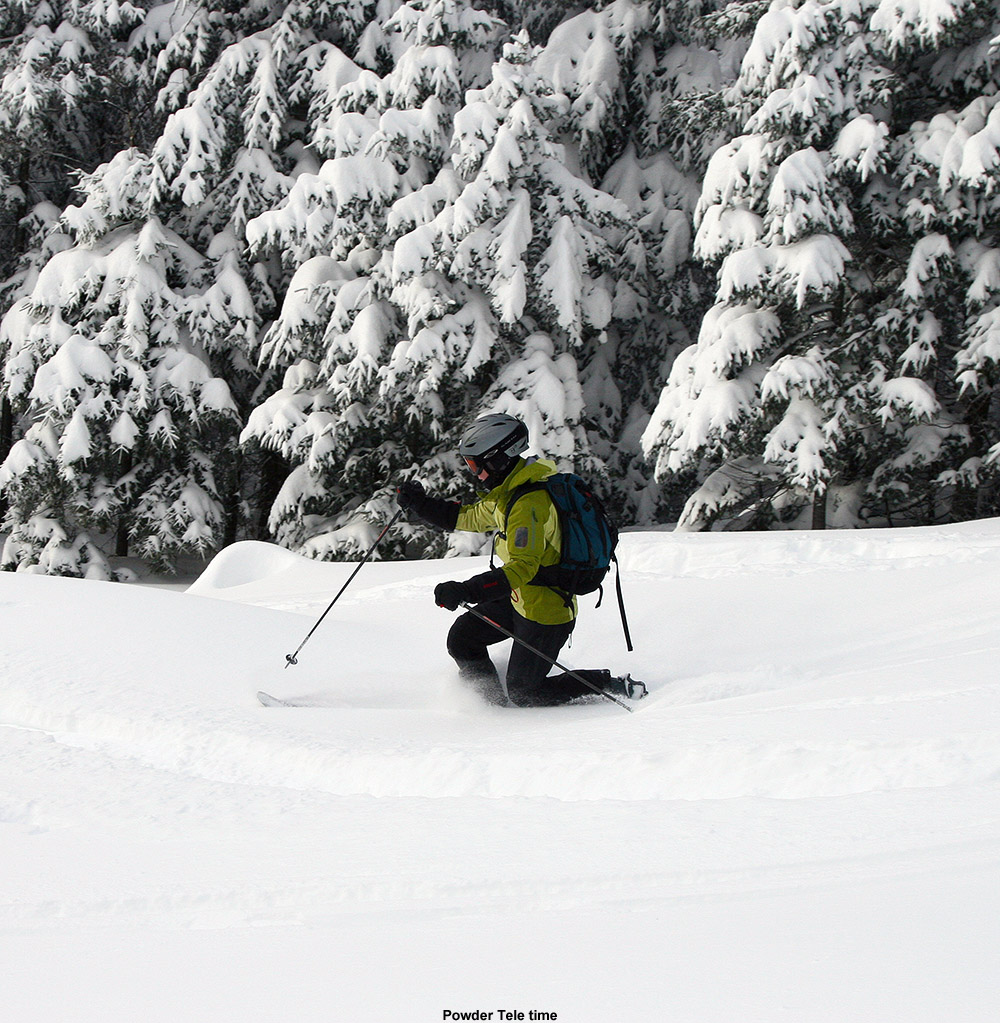
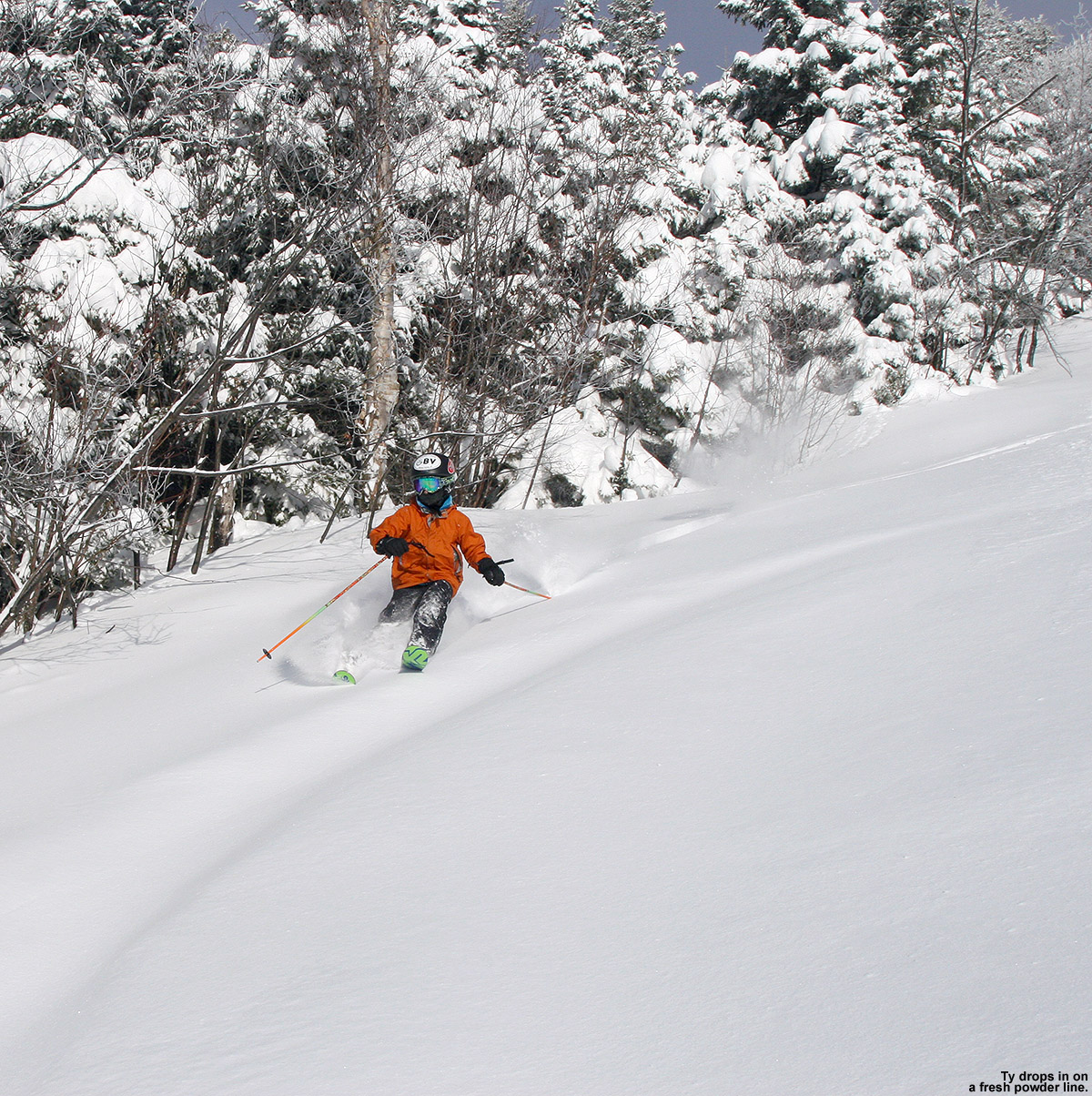
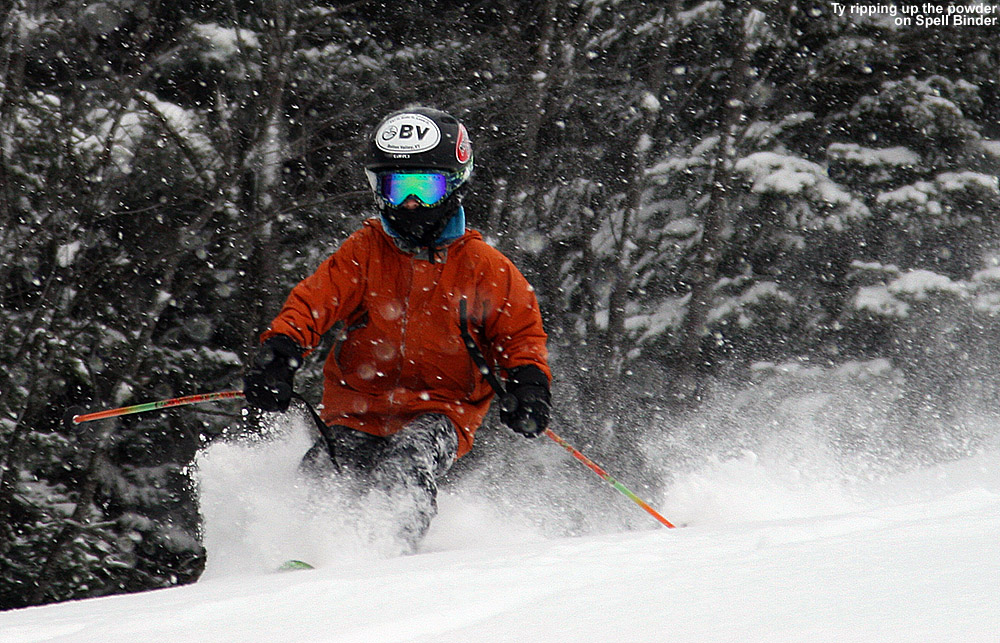
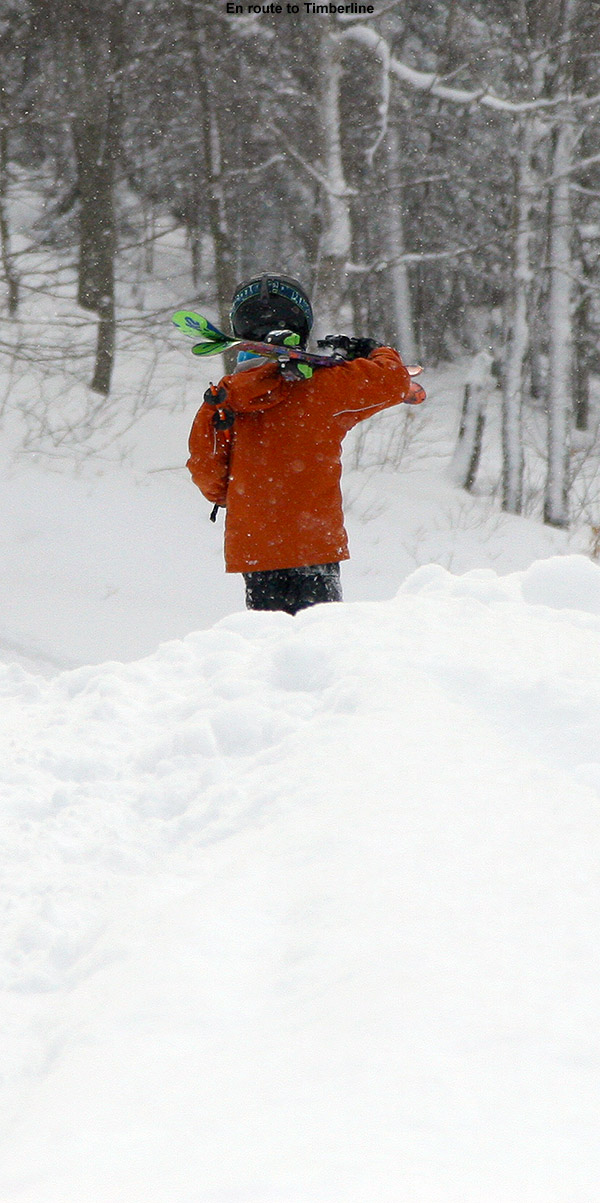
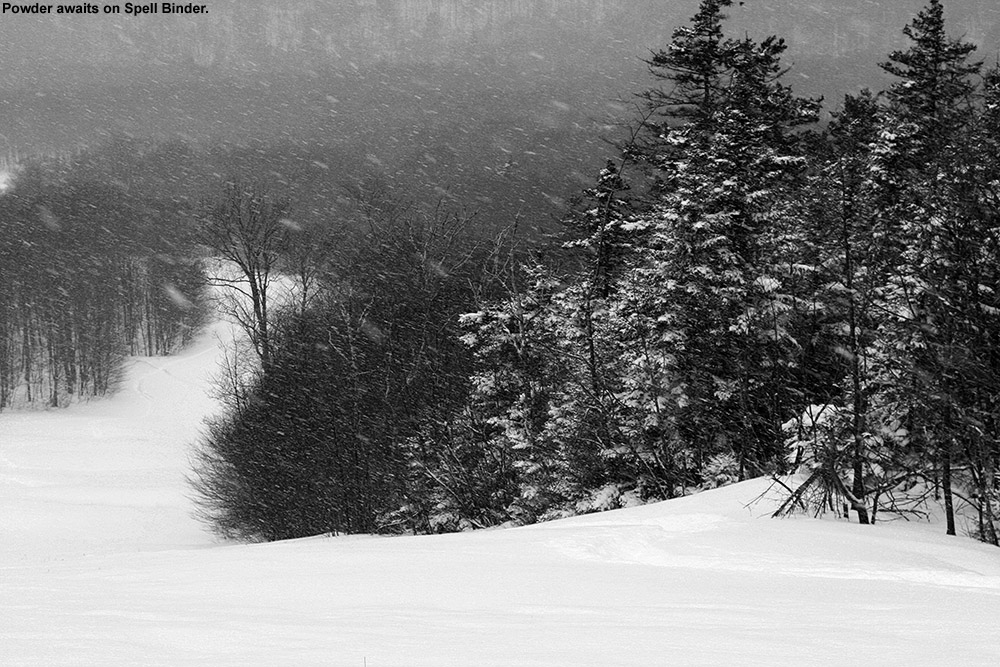
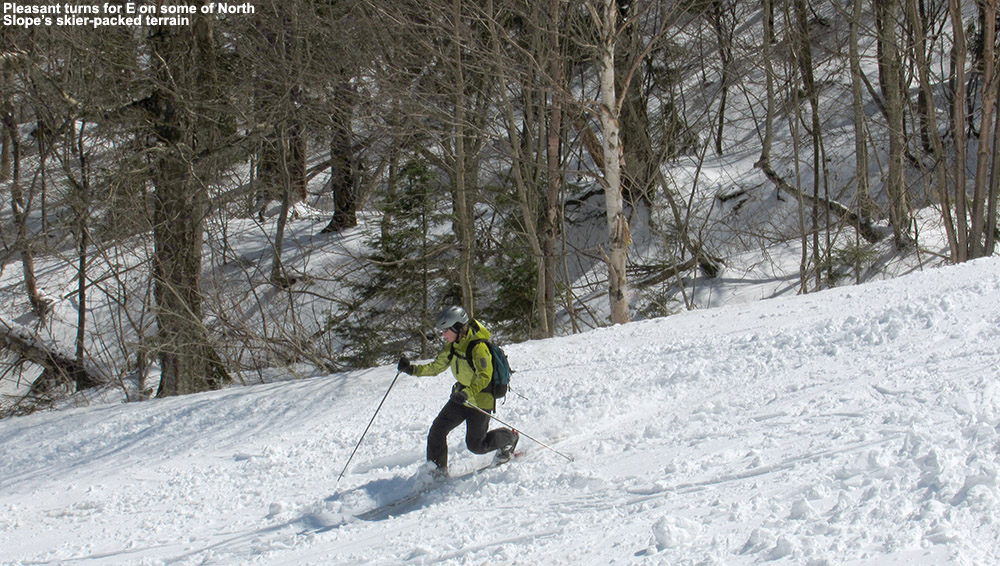
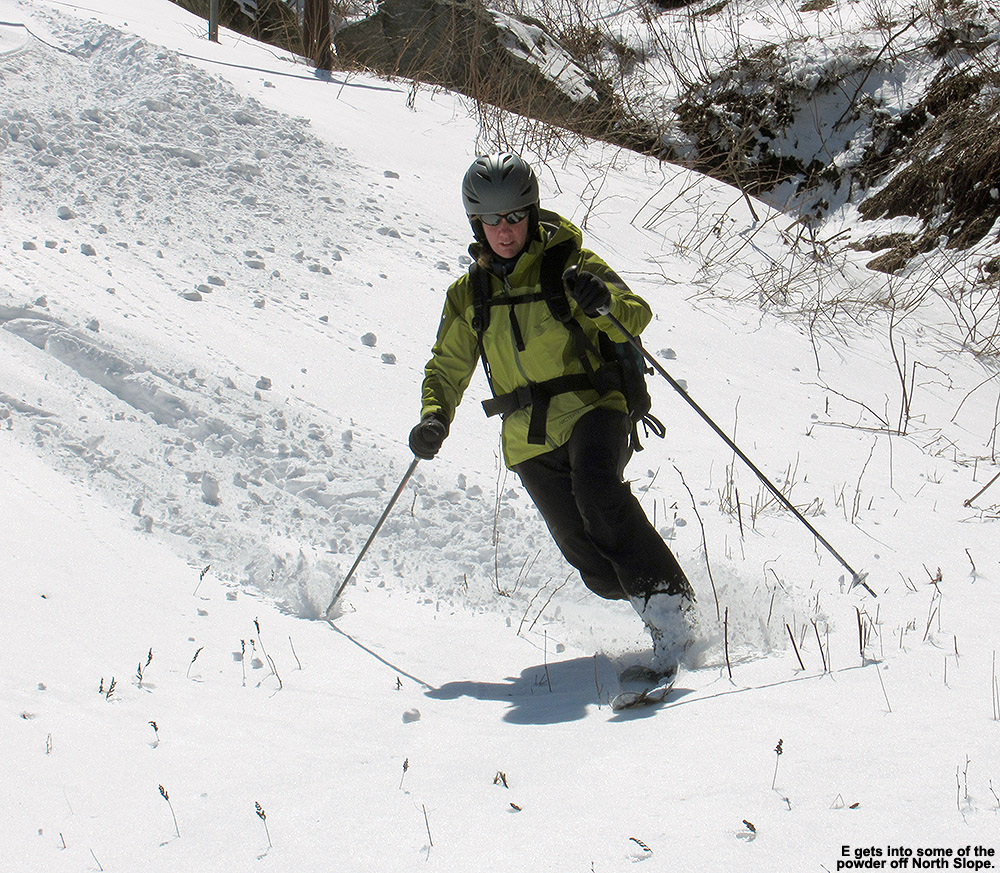
E and the boys were ready for one final run after that, so we decided to head over to Timberline. They were actually grooming terrain on Timberline, and I heard on one of the patroller’s radios that they were going to be opening the route back to the base to let people ski back to their cars. Although the snow was still that medium weight powder that had sort of proven itself susceptible to deteriorating the skiing with traffic, the skiing was actually better in some respects than with the Champlain Powder™ from Sunday. It was combination of a thorough resurfacing with the denser snow, but also the somewhat uncommon easterly wind that hit with the nor’easter. The combination had snow sticking to the steep pitches on Intro and Spell Binder, leaving a gorgeous covering of white in those spots that are typically scoured by the wind. With lightly tracked snow, the skiing was superb, even if one wasn’t sinking in as deep as they would in the fluff. As she floated her way down the Spell Binder headwall, E finally got to really feel her Black Diamond Element fat skis in their “element” so to speak, and she mentioned how she was recalling the comments I’d made about the front rocker allowing you to be more aggressive and still put that weight forward in the powder. I think she looked really good in steep powder, which has definitely been challenging for her on Telemark skis. The afternoon sun came out as we were making our descent, which really set up some great end of the day photos to cap off another holiday session on the slopes. It sounds like another round of snow is on the way for tomorrow and tomorrow night, so that should help to keep the snow surfaces in great shape.
The roads were snow covered, and snow was falling at a good clip, but the drive went smoothly, even on the Bolton Valley Access Road. Of course having put some new Nokian WRG2 tires on the Subaru a couple weeks back probably helped out the cause. We’ve had previous iterations of the WRG2 on other Subarus, and they have been fantastic. They’re essentially a winter tire made to run all year round (i.e. no dealing with the hassle of changing over tires each spring and fall) and since we started using them on our vehicles several years back, we’ve never gone back to winter/summer only tires. E has driven in the snow a number of times with the new tires, but today was my first chance to really test them out. Let’s just say that they devoured the Bolton Valley Access Road today without even a slip, and the road must have been at least a bit challenging because there were plenty of cars that had to remain parked at the bottom due to not making it up the road. I even saw a guy at the bottom of the road that appeared to be putting his chains on his tires
“…Dylan got a nice steep, untracked line. He really ripped that up, including the roll over at the end that dropped right out of sight.”
Snowfall was running in the inch per hour range up in the village, and there was some wind of probably 10-15 MPH, but it must have been well down from what was out there earlier – the Vista and Snowflake lifts had been down on wind hold in the early morning, but by mid morning the winds had let up enough to get them going. Since it was mid afternoon by the time of our visit, we grabbed a vacant spot in the top tier of the village parking lots, but it still only looked like three tiers had been filled anyway.
“My 6:00 A.M. and 12:00 P.M. analyses down in the valley indicated that this snow was coming in in the 7 to 8% H2O range, but it seemed to ski heavier than that…”
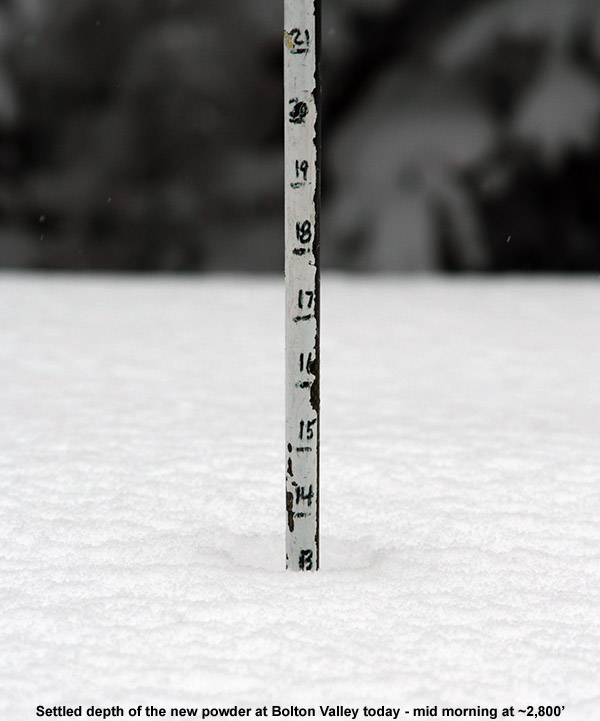
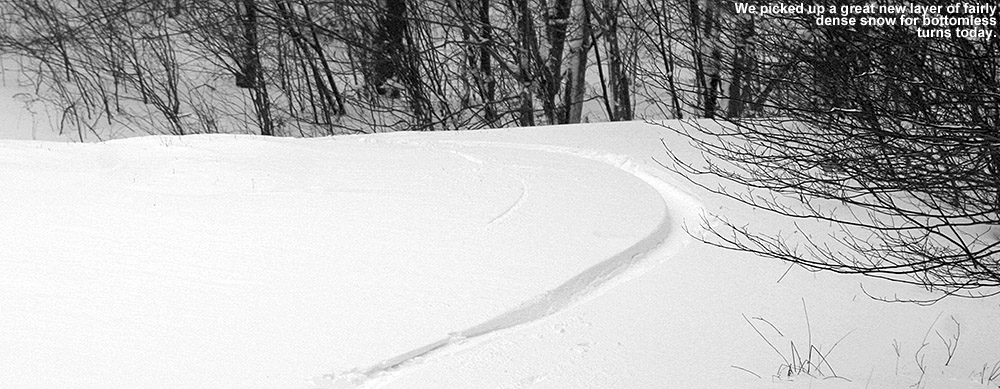
Since Dylan saw that the Snowflake Lift was finally open for the season, he immediately requested a run on that to start things off. We decided on a route through the Butterscotch Terrain Park, which isn’t actually a park yet, but it’s open for skiing. Today’s update on the Bolton Valley website was letting folks know that the park was open even without the features, and that it was offering up some nice powder skiing. Today featured a somewhat uncommon east wind, so it was at our backs on the descent. We still found a couple of wind scoured spots in the terrain park, but in general it was smoothly resurfaced by the dump of new snow, so I think the easterly wind was a plus in that regard. My 6:00 A.M. and 12:00 P.M. analyses down in the valley indicated that this snow was settling down in the 7 to 8% H2O range, but it seemed to ski heavier than that – possibly due to the wind. It also may have seemed a bit heavy due to the super dry Champlain Powder™ that we skied on Sunday. This snow is definitely substantiating the base though, so it’s a big win in that regard. Like he’d done on Sunday, Dylan decided to closely follow my tracks in the powder, and it really worked out well for him in areas where he might otherwise bog down and lose speed. He seems to be having a lot of fun with the technique, and I think he’s learning a lot about line choice and all that.
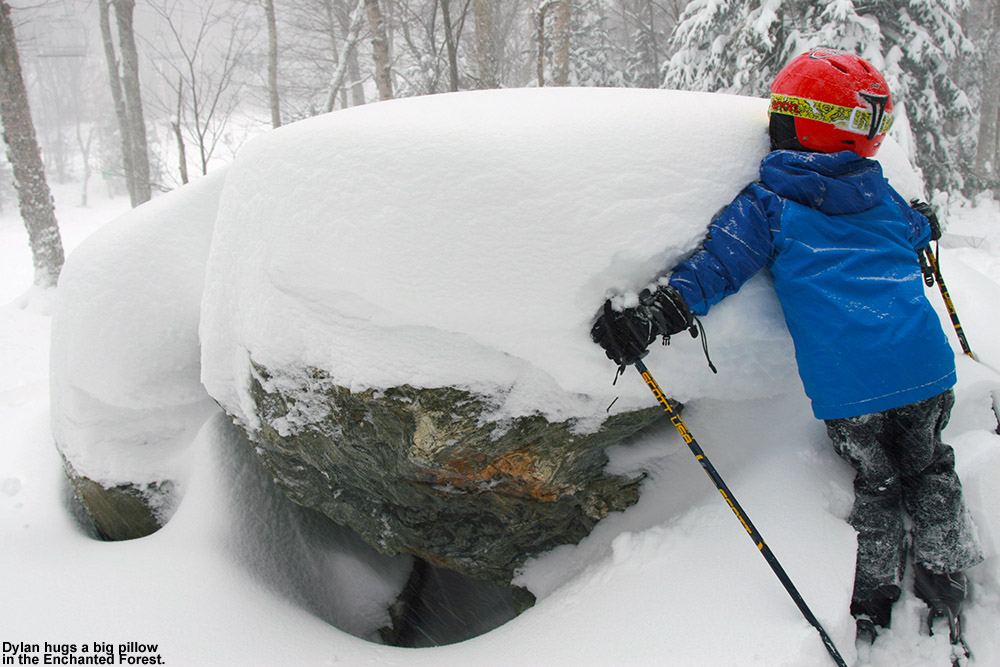
Dylan in the Enchanted Forest today
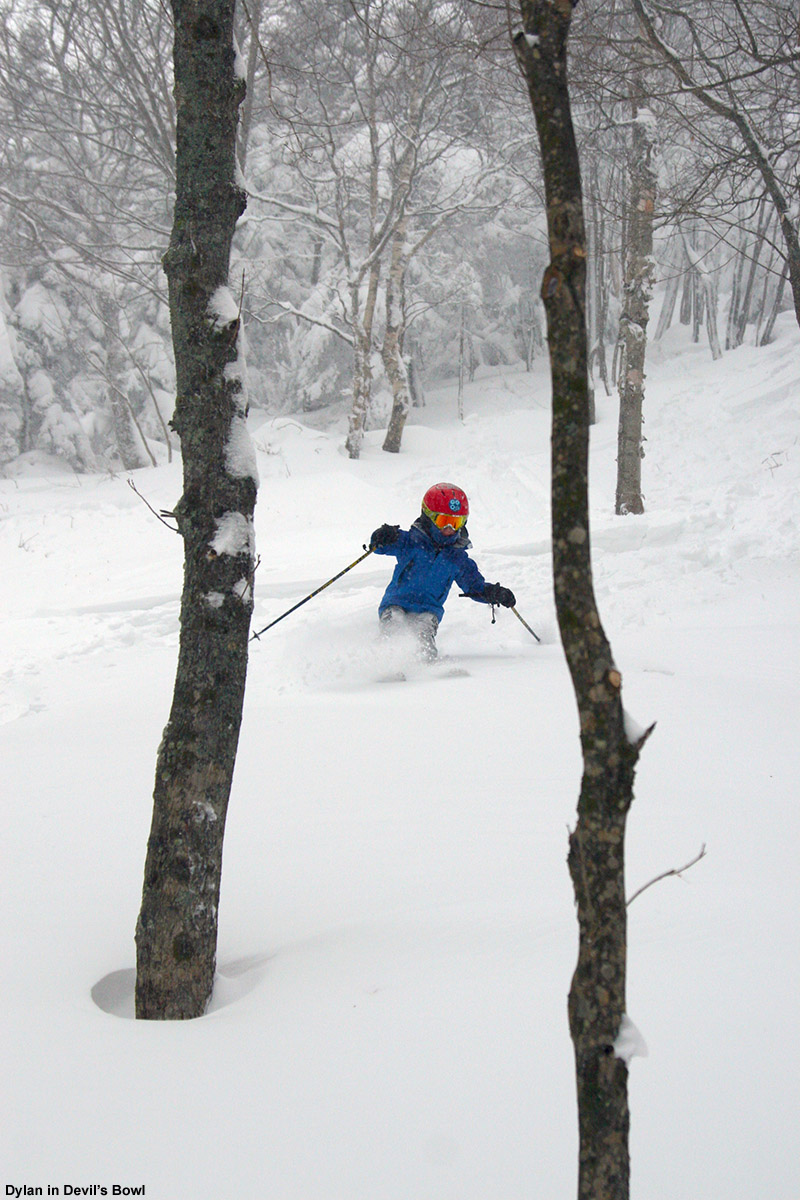
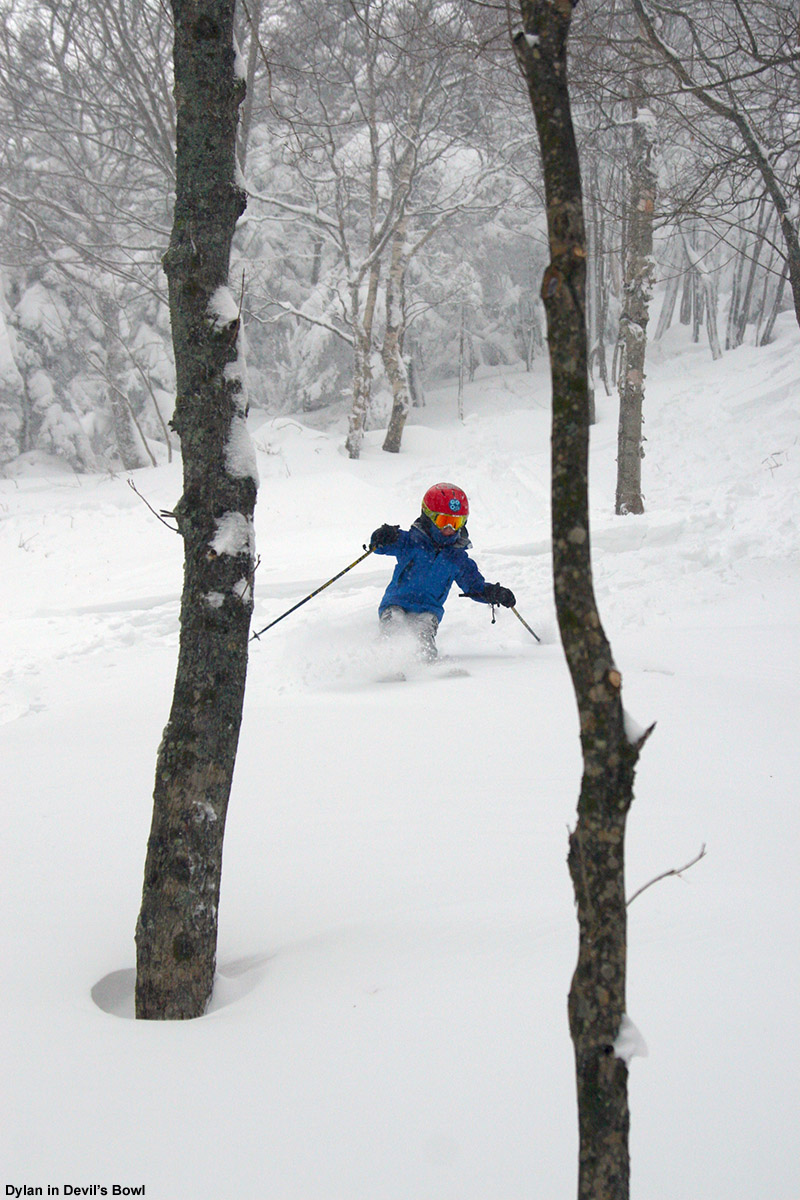
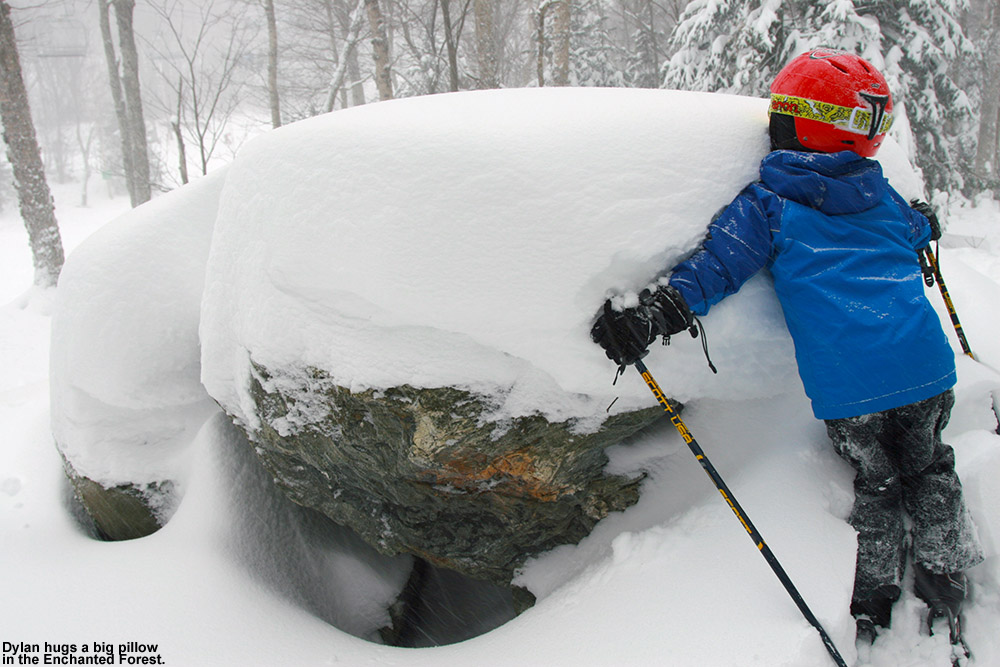
For the next run it was my choice of lift and trail, and I chose the Vista Quad. For my trail I wanted to check out Devil’s Bowl, one of the areas that we worked on this summer with the glade crew. It took a bit of re-orienting and thinking to get myself there, but I found it just as I’d remembered. The snow was wind protected, but still skiing more like medium weight powder than I’d expect. The turns were very nice though, and it’s going to be fun exploring that terrain this season. On the lower mountain we got into the Enchanted Forest – coverage is decent but they could still use a bit more to cover up brush and roots. The latest snow is stacking up with some loft though – as we pulled out of one line in the woods and hit an open area, we found ourselves behind a huge boulder with a cap of snow that made it look like a mushroom. Dylan thought it was pretty cool, so I snapped a photo of him with his arms stretched out around it.
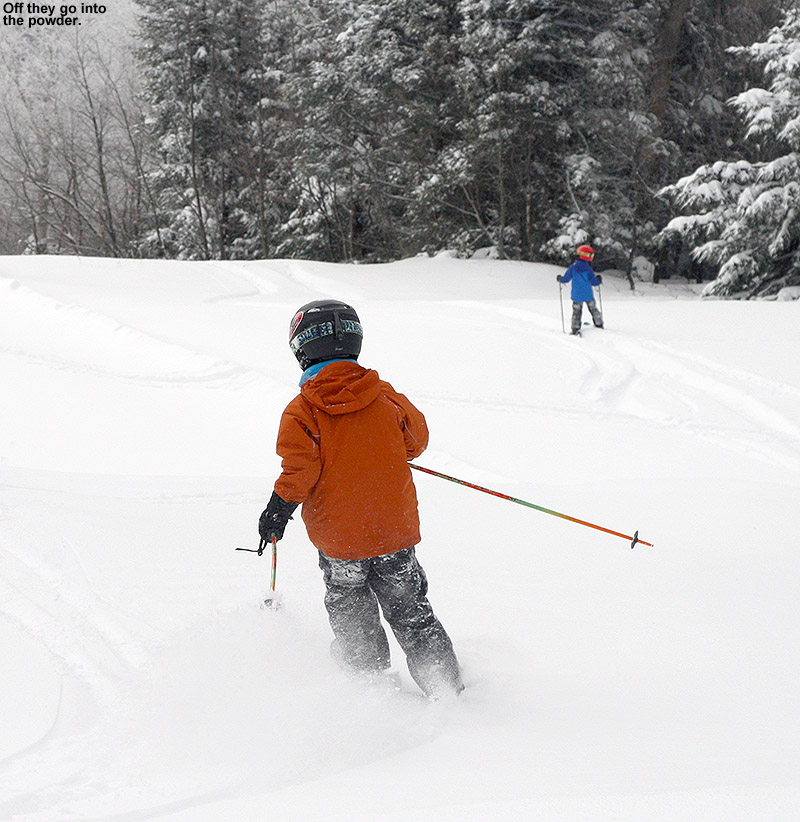
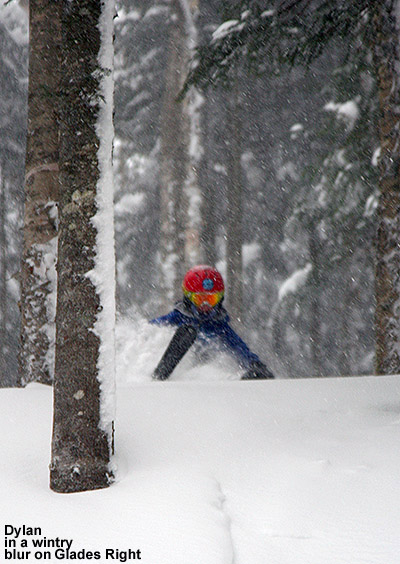
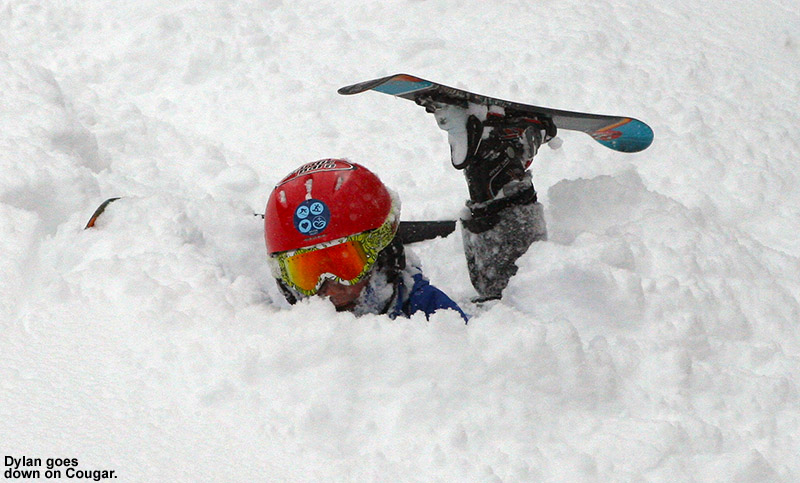
Dylan went with the Mid Mountain Lift for his next run, and I introduced him to Glades Right, which he approved of since he wanted to go that way anyway. Traffic had actually been pretty light in there, so Dylan got a nice steep, untracked line. He really ripped that up, including the roll over at the end that dropped right out of sight. We headed through Nixon’s and at the bottom of the mountain we took a powdery Lower Fanny Hill, dropping us right out at Wilderness.
We’d hit everything but the Wilderness Lift by that point, so it was the obvious choice for my run. On the lift ride, Dylan was definitely starting to get cold, so we made it a short run by getting off at the mid station. We checked out Andy’s, which has seen a similar level of traffic to Glades Right. The snow was good, the coverage was good, and it was fine way to end the afternoon on the slopes.
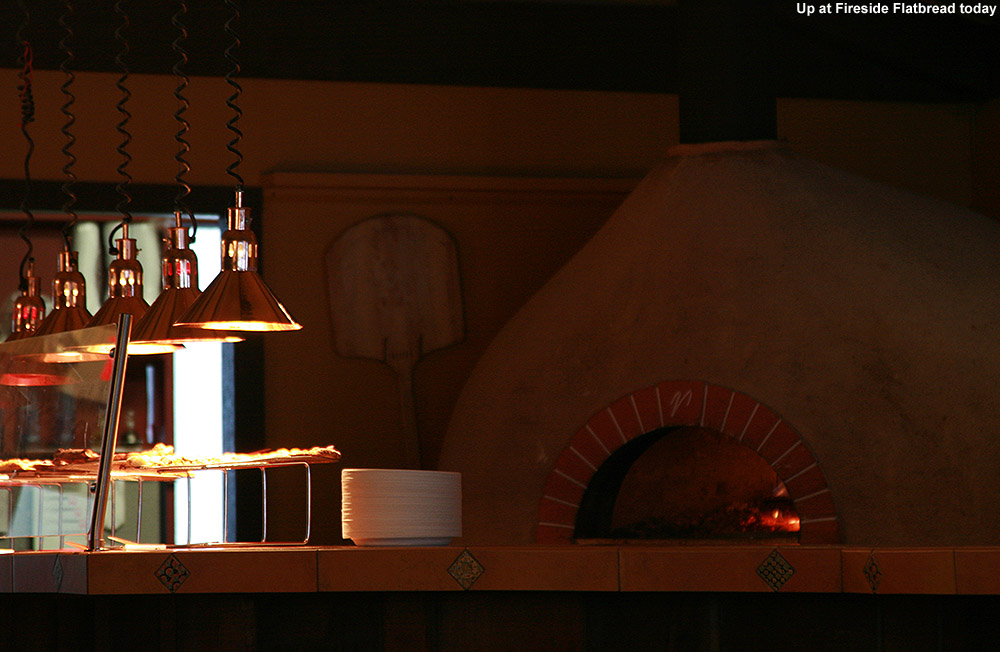
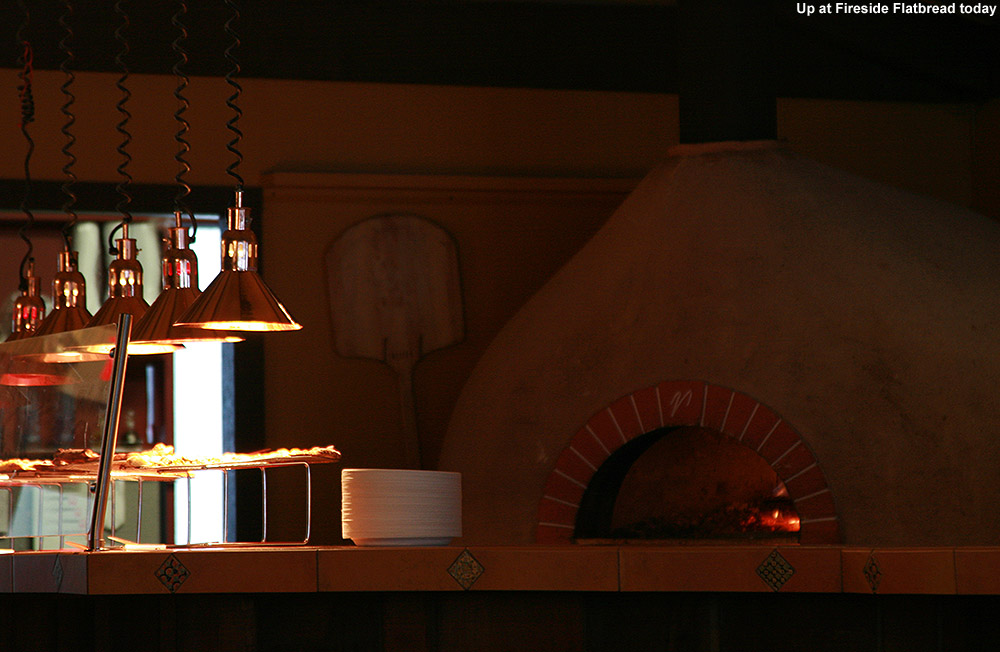
Dylan had been a trooper out there in the blowing snow, so we headed into the base lodge and I said that we could get something to eat. He was up for some pizza at Fireside Flatbread, and they’ve currently got it isolated from the rest of the upstairs lodge seating, so it made a great place to have a slice and relax as we talked about the afternoon. I’m not sure when the last time was that I’d had their pizza up there, but the crust was really good – definitely some quality flatbread crust, probably right up there with The Blue Stone, which is the new pizza place right in the center of Waterbury.
Fireside Flatbread
We had an interesting chance encounter at the end of the day when we gave a ride to a couple visiting from Minnesota. They had parked their car down at the Smilie Memorial School because they hadn’t been able to make it up the hill. It turns out that the woman, Ruby, had worked in one of our labs in the Biochemistry department at UVM a couple of summers back, so the rest of the ride I was able to catch her up on people she knew. She’s obviously got ties in the area, but it still made it feel like small world.
Overall it was a fun afternoon ripping up the powder with Dylan – all the lifts were walk on, probably due to the storm and the fact that the general message was to stay off the roads unless it was important. We didn’t quite adhere to that, but a few miles of driving isn’t too bad, even if the roads are a little snowy. It’s great to be back on the slopes after a few days off for the holiday, hopefully the snow gets freshened in the coming days and we can get some more good outings.
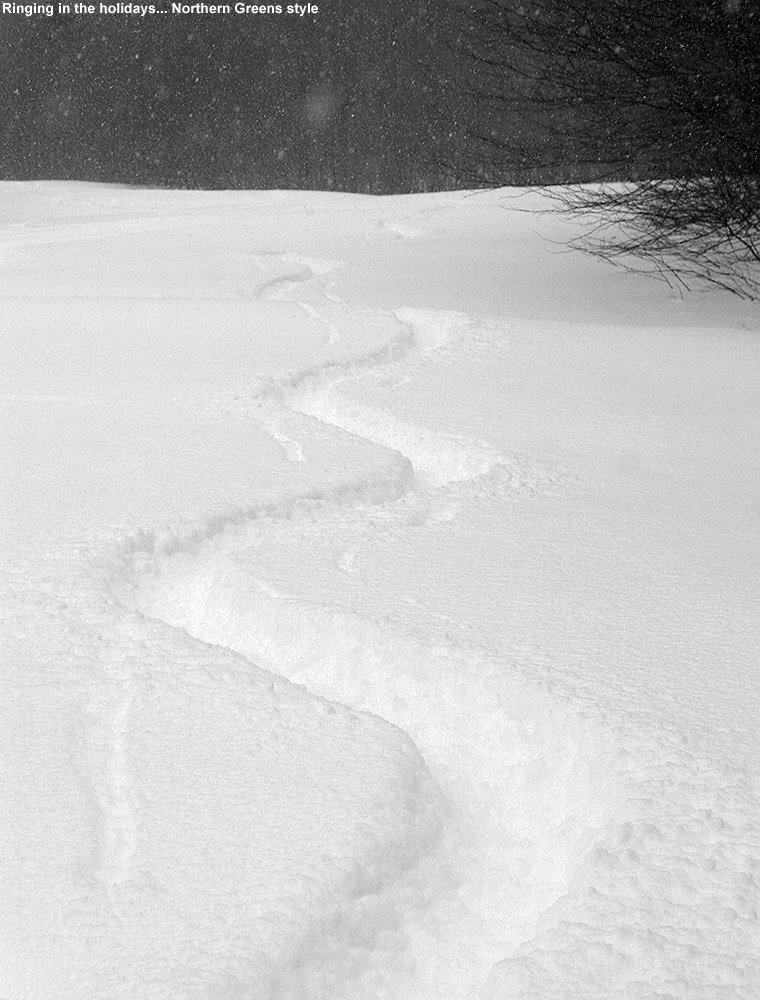
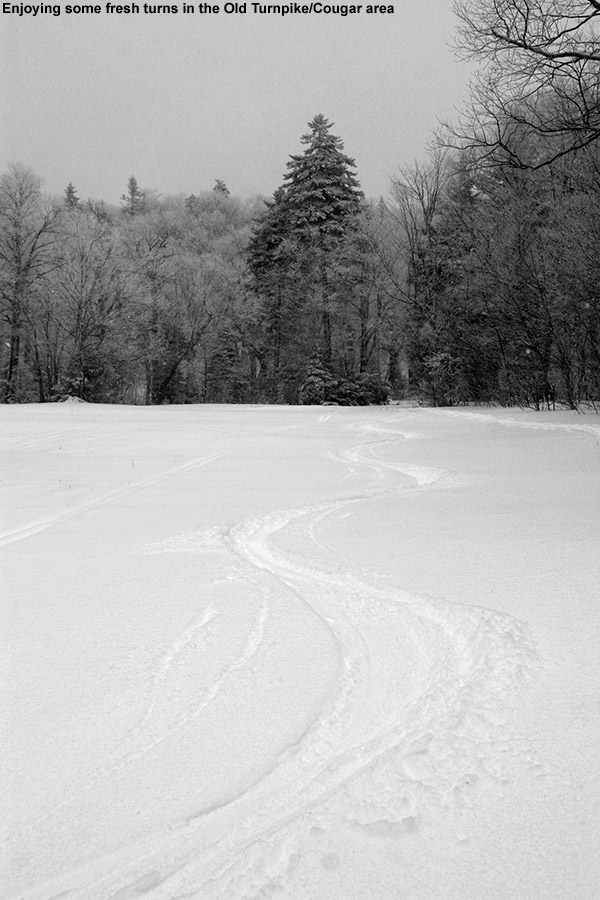
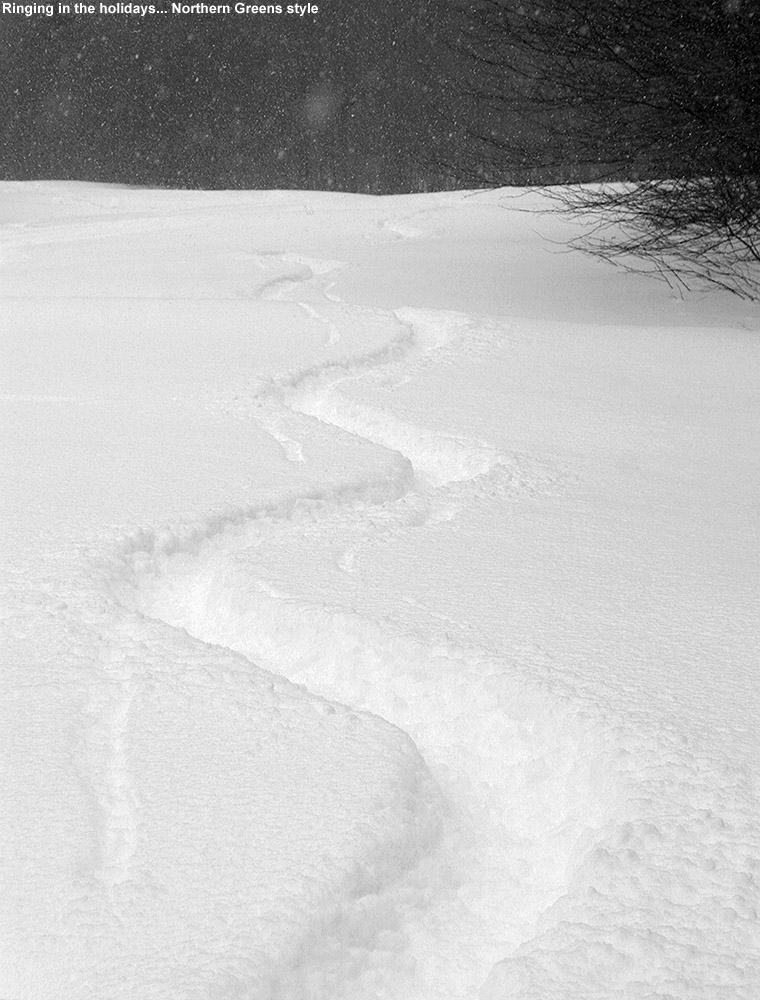
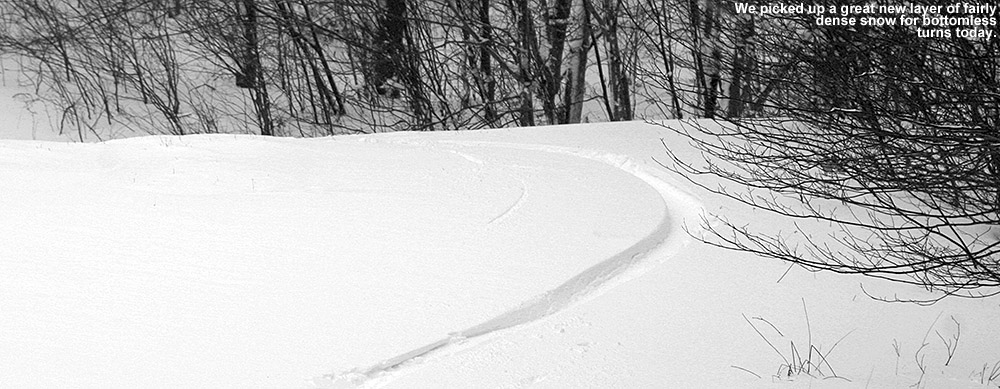
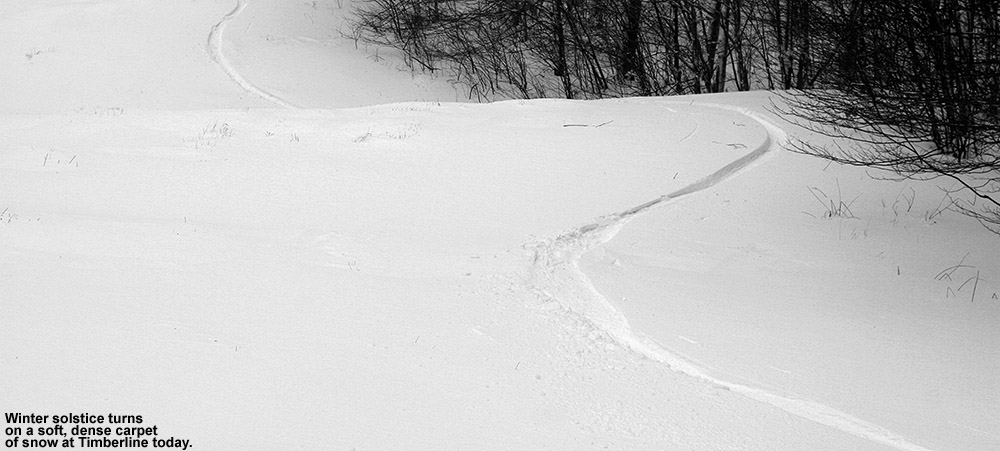
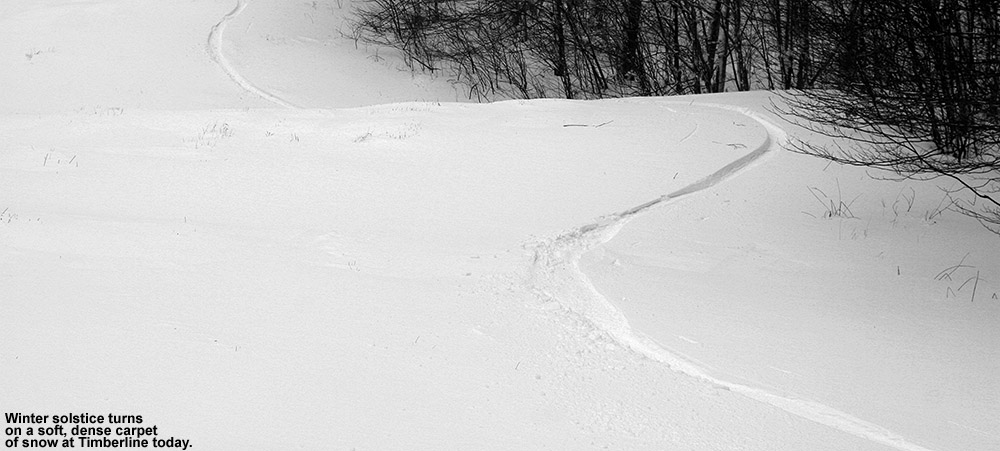
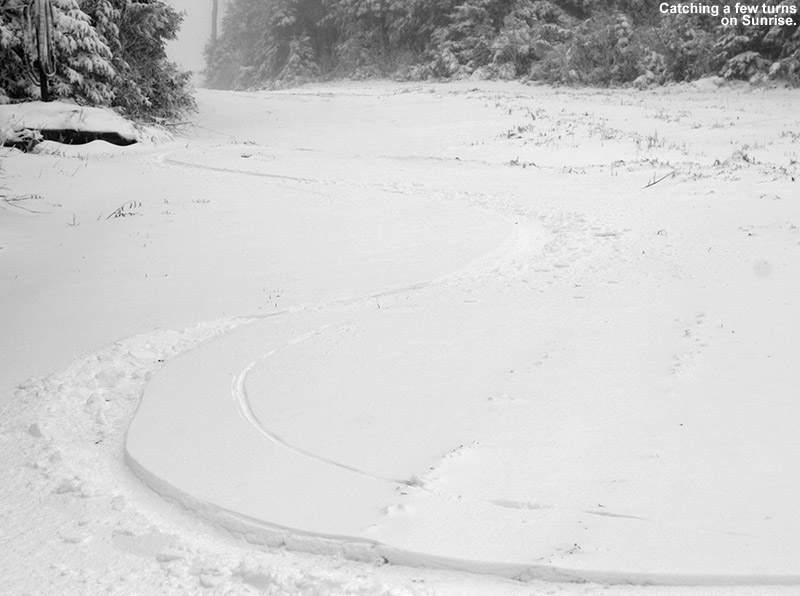
Tracks on Spell Binder – sometimes you can tell the quality of the snow just by the ski tracks.
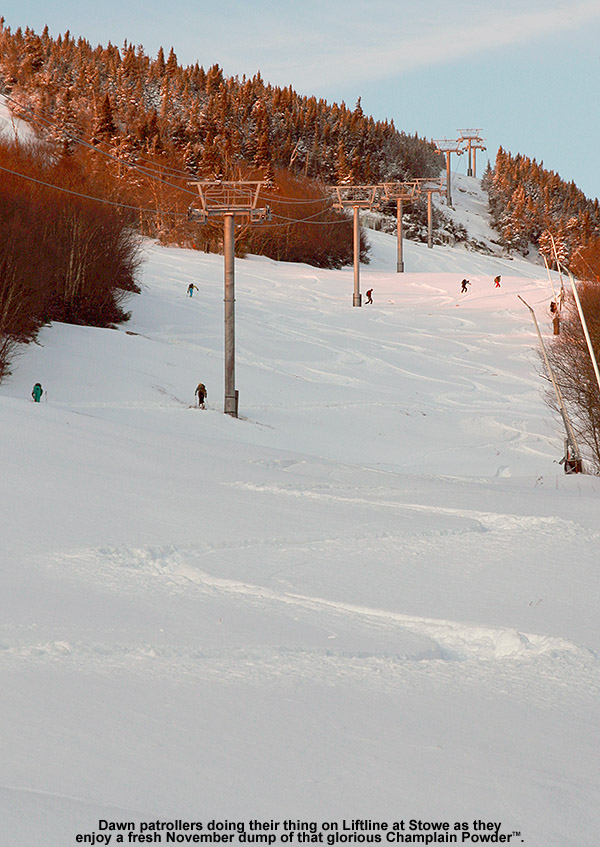
The upslope snow that started yesterday really delivered in the evening, and we got to witness it first hand as we drove off to a Christmas party in the Champlain Valley. We almost turned around right at the house as the snow was coming down at 2 inches an hour or more, and we could only see a few yards in front of the car. Fortunately that tapered off a couple miles to our west, but in the end we wound up with 9.5 inches of upslope fluff at the house, and Bolton Valley probably had over a foot, bringing them to 30 inches of snow in the past week. This snow was some incredibly high quality Champlain Powder™ to boot, with my snow density analyses coming in at 2 to 3% H2O.
This morning we got up to the resort around 9:00 A.M., and similar to yesterday the scene was fairly mellow – after dropping off E and the boys I was able to park in the third tier of the main lot. We started off with a run down Alta Vista, and it was E’s first chance to try out her Black Diamond Element skis, which are the women’s version of the AMPerage. I warned her that unlike my first experience with the AMPerages, which was entirely under powder conditions, she might not be that impressed with how they skied on the groomed areas before we made our way to the powder. Indeed she was very unimpressed, noting that there was so much ski width (115 mm at the waist) that she couldn’t even get them on edge. I hadn’t found that to be an issue for me with the AMPerages, so it could certainly be attributed to a difference in our ski styles, but I think it questions again the potential for these skis to serve as a one ski quiver for all surfaces. We got them as our backcountry/powder Telemark skis anyway, but it will be interesting to see how our usage patterns develop; being more comfortable on them so far, I might take them out on more marginal lift-served powder days, where E might stick with her narrower Telemark skis. E did point out that her Telemark ski boots are a bit loose, and she could feel the slip in them today due to the thinner socks she was wearing. Having that slip in there may make it challenging to get the pressure necessary to roll these fat skis on edge on groomed surfaces, so we’ll have to see if a better boot fit helps out, or if there’s going to be an adjustment period due to something else.
“We found a foot plus of Champlain Powder™ over a consolidated base – and it was more than enough to be bottomless…”
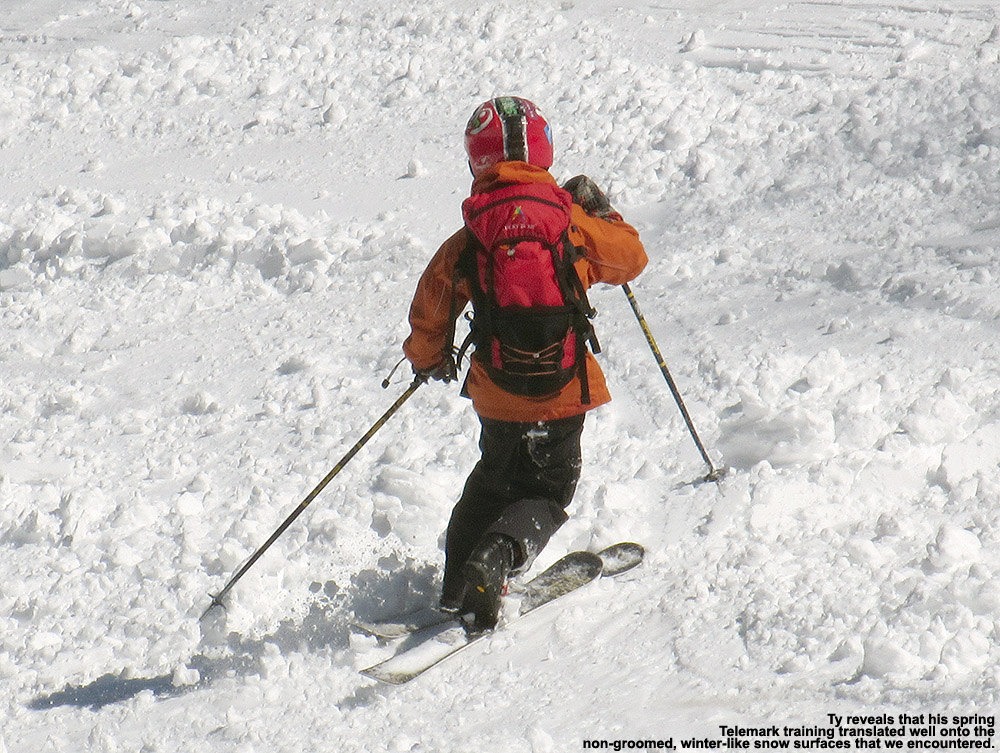
We made our way over to Wilderness and got into some powder, and not surprisingly, E didn’t have any issues with the skis there. But, neither did she find them to be as amazing in the powder as I had on my previous outings. Of course we were skiing in roughly a foot of amazingly dry snow over a well consolidated base, so almost any ski could handle it. We enjoyed lots of fresh turns on Lower Turnpike, and it was a bit slow with the modest pitch and all the powder, but the boys had a great time. Ty had an especially fun time straight lining sections of the powder. We also jumped into Wilderness Woods, which were being skied extensively – they’re certainly skiable, although you still needed to be somewhat cautious to avoid underlying objects. On that note, the Mt. Mansfield Stake hit 28” inches yesterday, passing the magic 24” mark that I’ve used as a measure of when those initial forays into the trees begin. Bolton even opened steep tree areas like Devil’s Playground today, so many trees are definitely ready for skiing if patrol deems areas like that acceptable.
We headed for the same route again on the next run at Ty’s request, but wound up taking the Wilderness Lift Line when Dylan led us that way. Conditions along the edges still offered up plenty of nice turns though. The boys were calling for an early lunch after those two runs, so we headed into the lodge, and eventually got a call from Stephen that he and the kids had finally made it to the mountain. We finished up our lunch and met up with Helena and Johannes to take a run while Stephen picked up his skis from the ski shop. We opted for the standard Sherman’s Pass route to let Helena and Johannes warm up. Surfaces were decent packed powder aside from wind-exposed areas, which were blasted down to whatever nasty hard surface lay below.
When we all got back together we hit Lower Turnpike again, and it felt much faster that second time. There were a few more tracks around to let you gain your speed, but somehow it was more than that. Whatever the case, the turns were smooth and silky in the powder. Johannes and Helena needed their lunch break by that point, so while they went in the lodge, E and the boys and I went back for another round. Dylan and I came in at a higher entrance and got some bonus fresh turns.
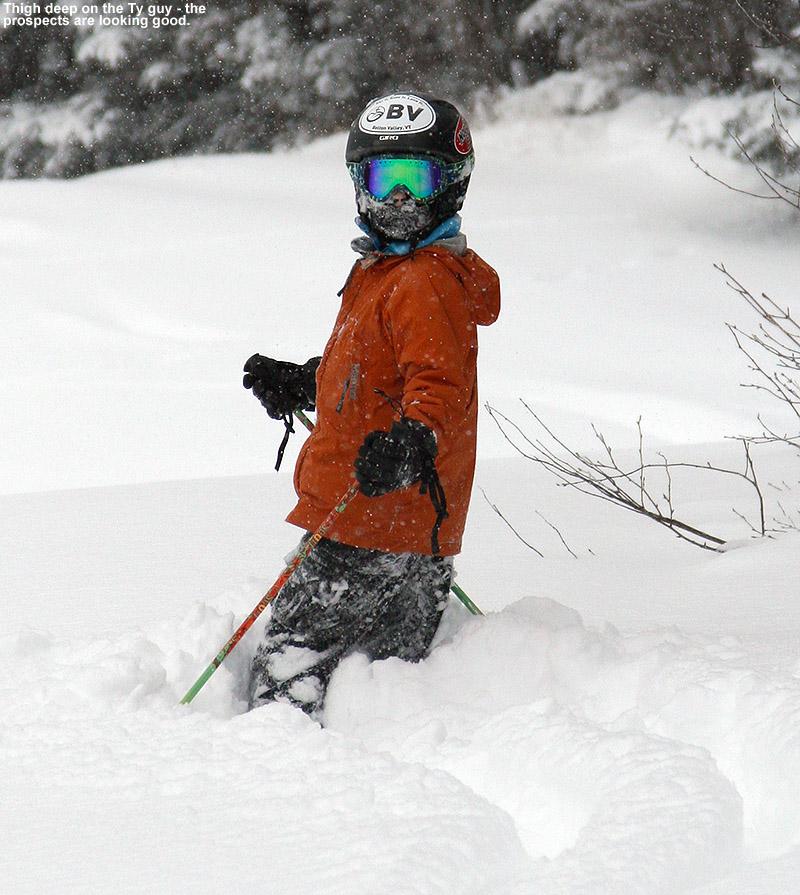
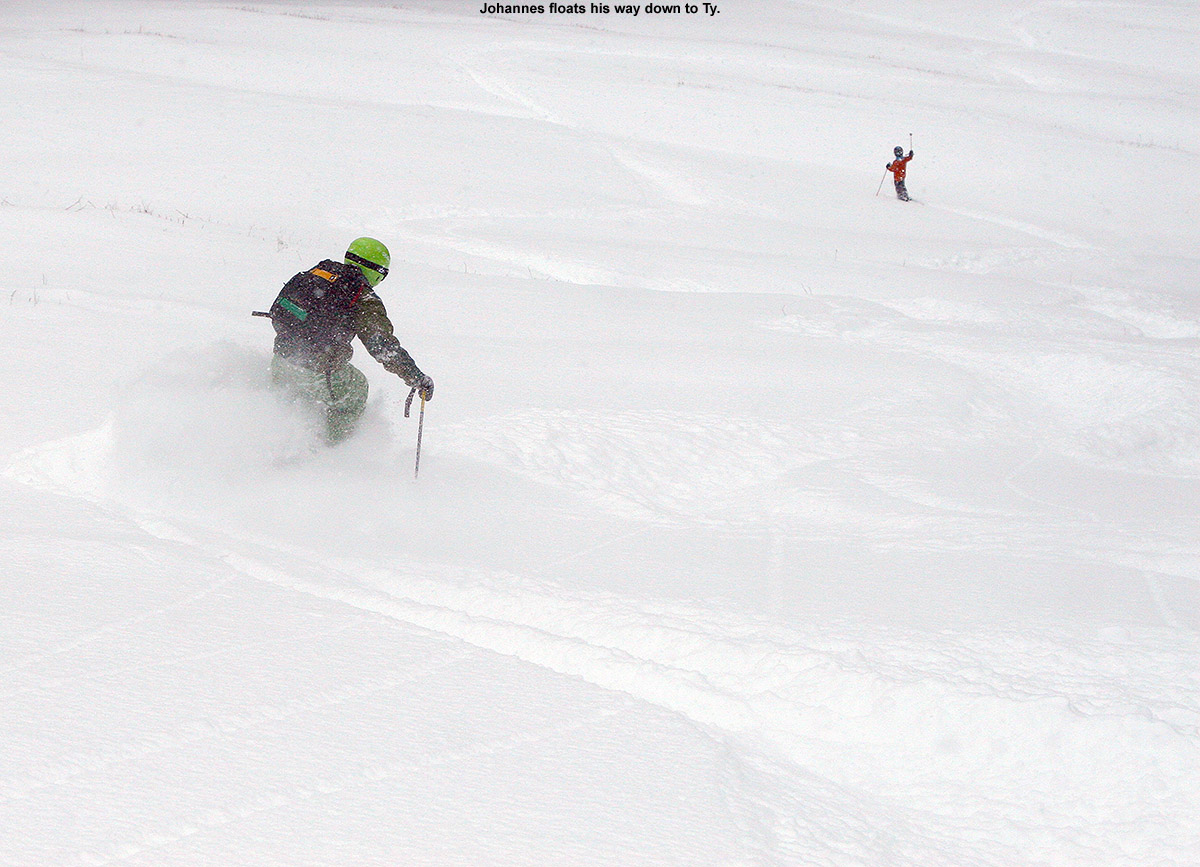
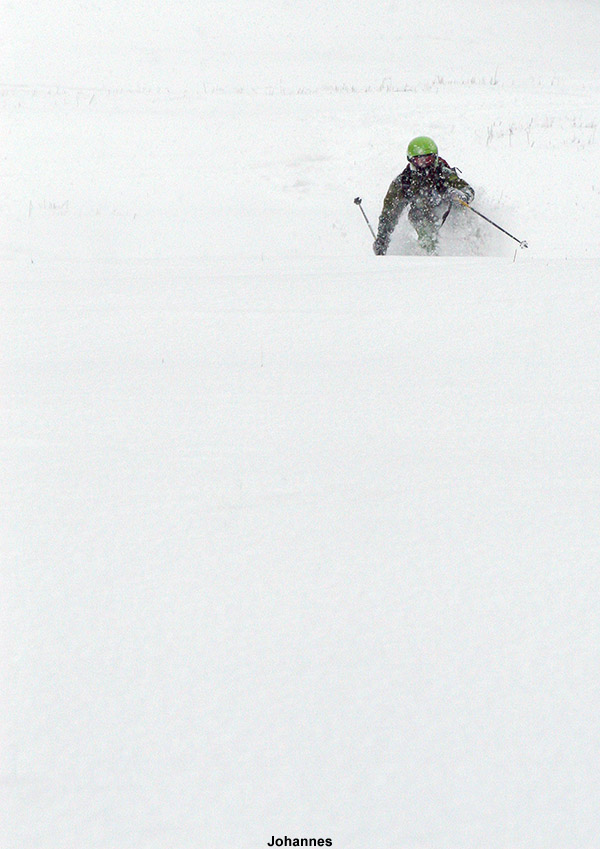
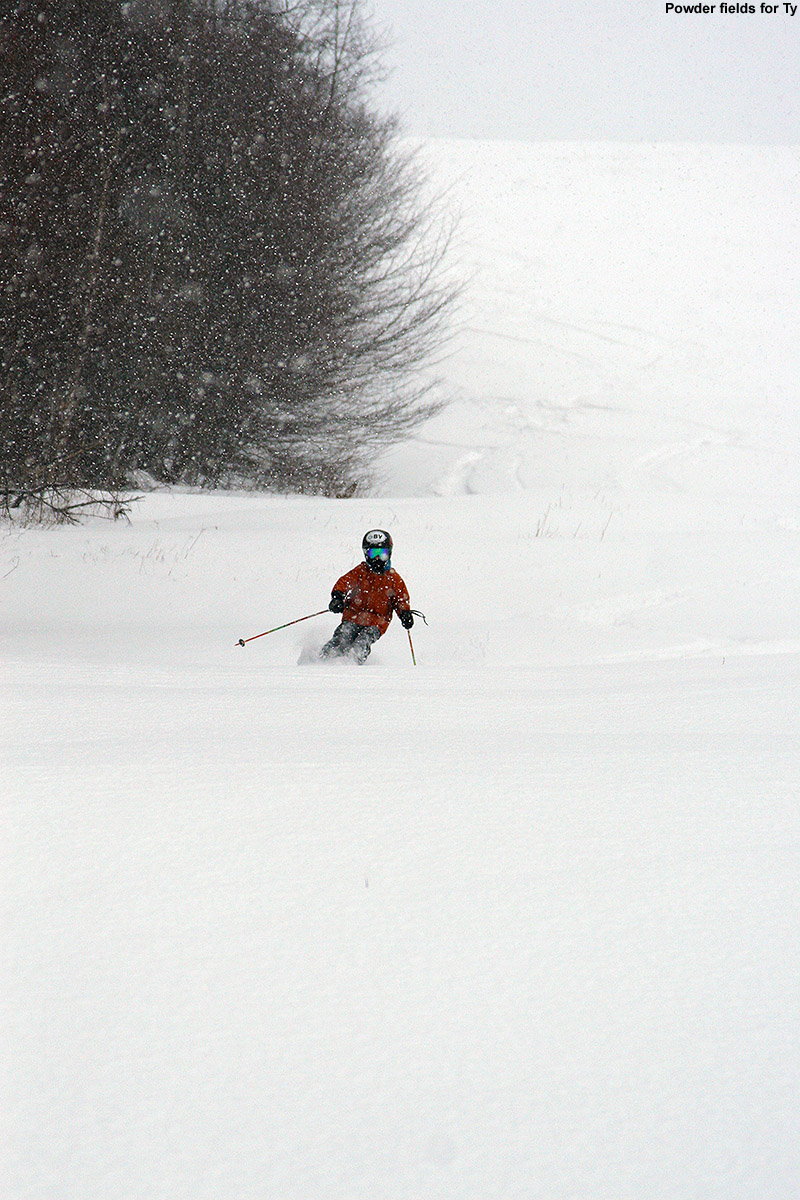
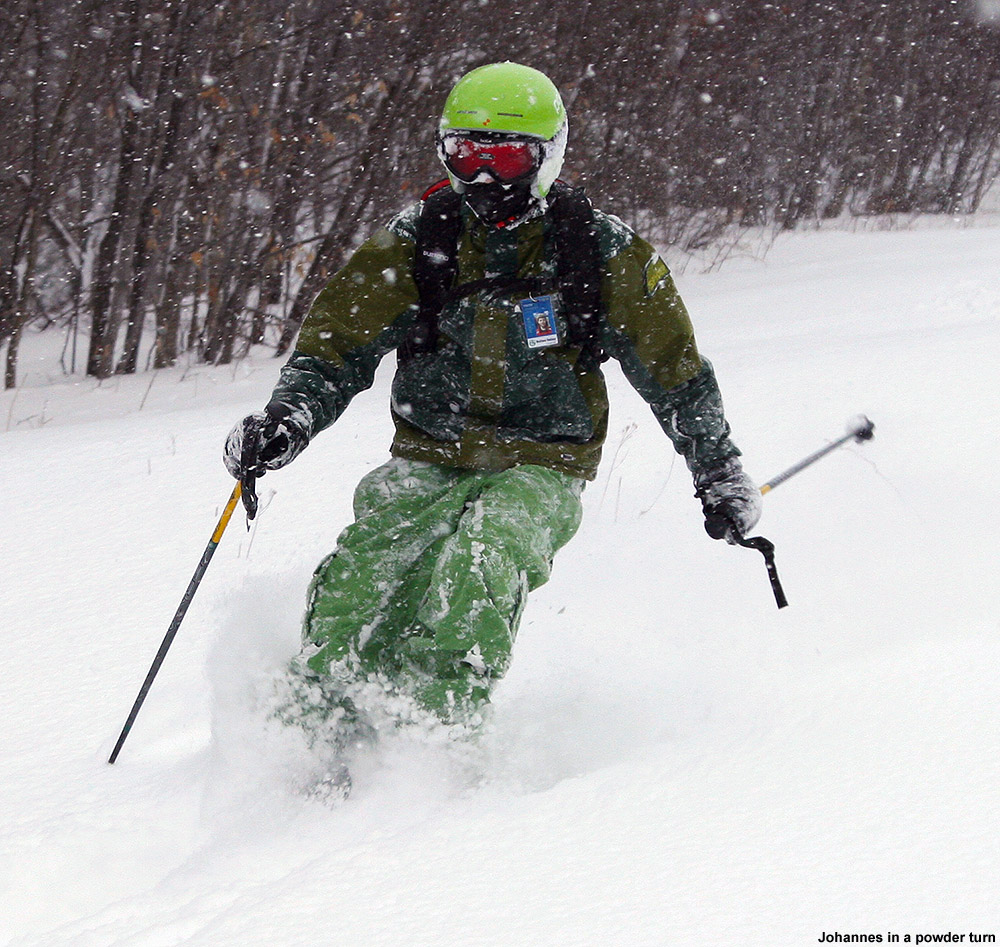
We had spotted a car over at Timberline on our way up to the resort, with the intent of finishing off the day there, but Dylan was pretty beat, so E decided that they would drive down and meet Ty and me there. Johannes had enough energy, so he joined Ty and me for the trip. Aside from windblown areas, which were reduced thanks to the lower elevation, the snow was simply amazing at Timberline as is typical for these types of events. We found a foot plus of Champlain Powder™ over a consolidated base – and it was more than enough to be bottomless, even on the Spell Binder headwall as long as you stuck to the skier’s right. That’s some pretty primo skiing. The only part to avoid was the bulk of the headwall section with sastrugi (or “fake powder” as it often looked today) from the winds. Both boys did well, and we made reasonable time down to the car, with the requisite photo sessions as well. Dylan missed some great turns, but he was certainly tired – while E was out getting a couple of final things for the holiday in the evening, I found that Dylan had gone and tucked himself into our bed and gone to sleep.
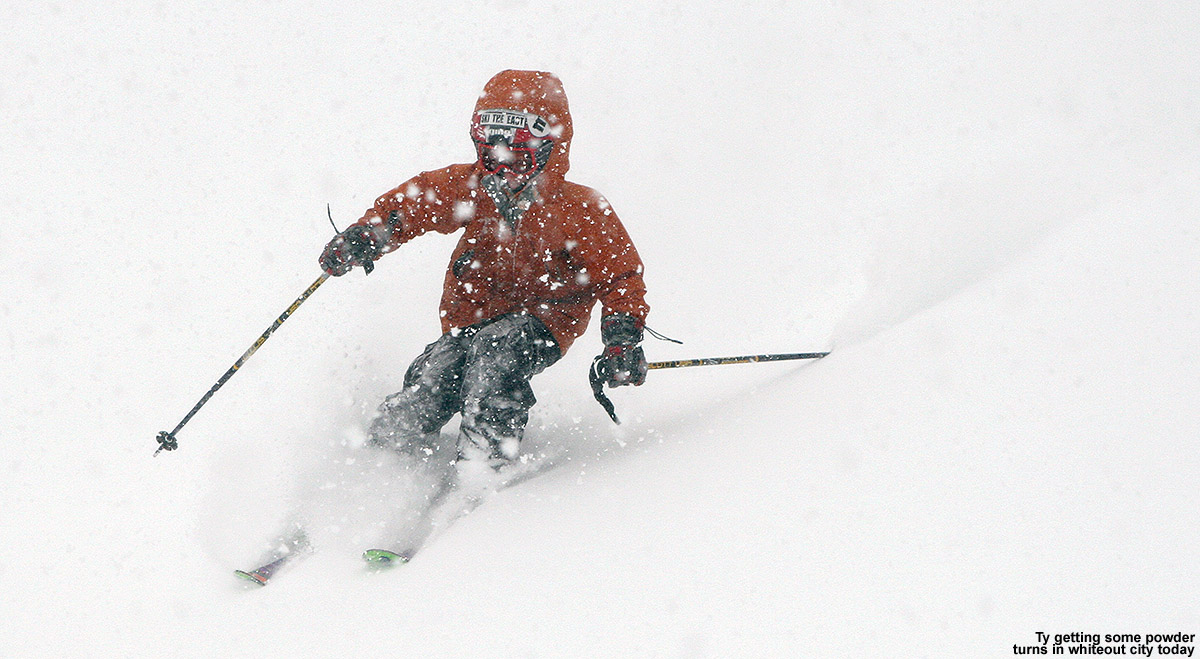
Ty taking on Spell Binder today
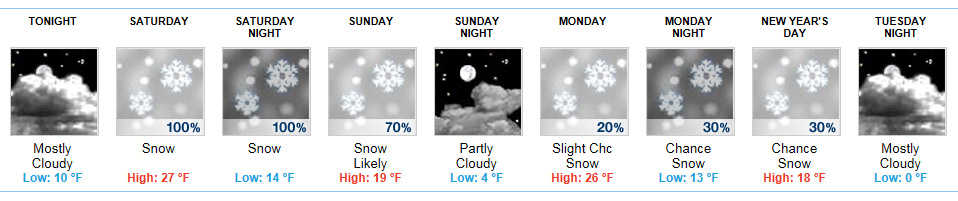
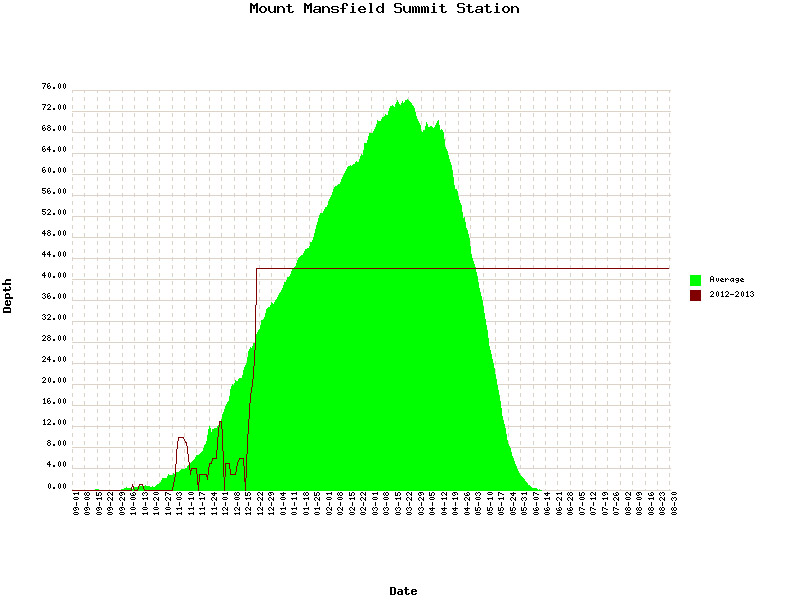
I was worried about the cold today due to the potential wind chill, but it turned out to be a fine day with temperatures in the 20s F and only minor breezes. We’ve got more snow falling tonight with the potential for four more storms to pass through the area this week. It could be an excellent holiday period for skiing if the potential storms hit our area as snow. The mountain is already opening up lots of natural snow terrain, so the snowpack is building with the weather pattern we’re in. The Mt. Mansfield Stake just hit 42” today, and that is a sign that off piste skiing should be well under way.
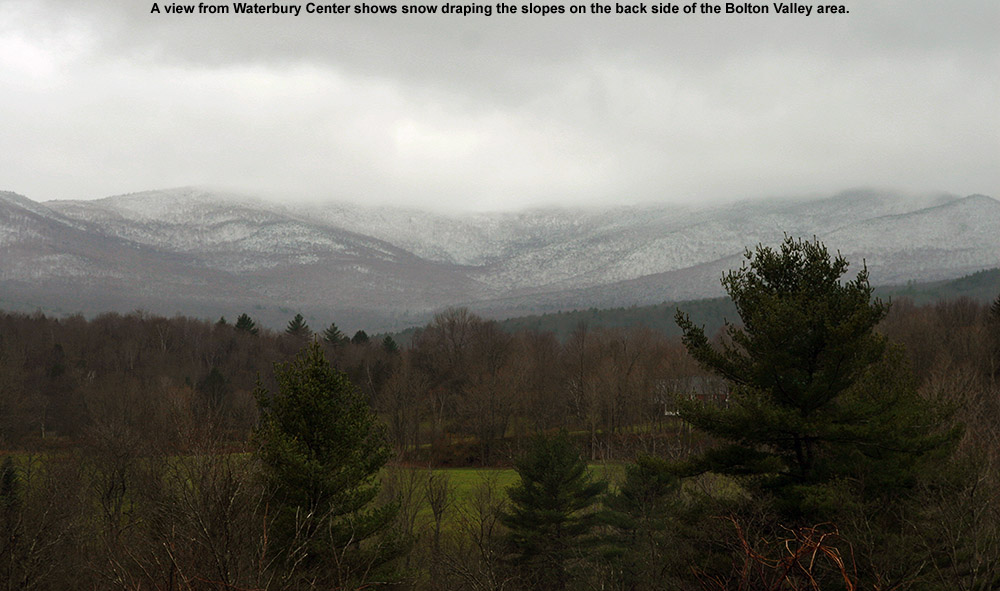
The back side snow of our current storm cycle was starting up right around 6:00 A.M. this morning when I was making my CoCoRaHS observations, and it continued at a steady, albeit light pace through the morning. Knowing that yesterday’s mixed precipitation left some variable surfaces on the slopes, I waited until around mid morning to let the accumulations get going, and then headed up for some turns. On my way up the Bolton Valley Access Road, I stopped in at the Timberline Base (1,500’) to check the depth of the new snow; I found 2” there, then roughly 3” up in the Village (2,100’). It actually wasn’t too busy at the mountain, with about three rows of the main lot filled.
“The skier’s left of Alta Vista yielded some excellent turns – it wasn’t untracked powder, but it was a good combination of new snow along with what skiers had pushed over there.”
It was basically walk-on at the Vista Quad so I headed up with the intention of checking out Alta Vista and going in the direction of Wilderness. The skier’s left of Alta Vista yielded some excellent turns – it wasn’t untracked powder, but it was a good combination of new snow along with what skiers had pushed over there. I did touch down to a firmer surface below, but you could tell that it was one of those thick, spongy sort of crust layers as opposed to an ice sheet. Checking in protected areas, it seemed like the upper mountain had picked up about 4” of new snow by that point. I boogied over to Wilderness to check out the snow conditions there, and as I dropped in elevation I could tell that the snowpack had taken more of a hit due to more warming. Underlying surfaces were a bit firmer, and of course the new powder a bit less, so the turns on chopped up powder weren’t quite as good. In addition, the westerly wind was whipping its way right up the trail, so that was taking away a lot of the snow. The sides of the trail were well protected and yielded at least some decent powder turns, even if I was typically touching down on my RT-86s. There was certainly a part of me that wanted to see how the AMPerages would float, but I figured it was good to get the RT-86s out and give the AMPerages a go in what’s expected to be a bigger powder day tomorrow.
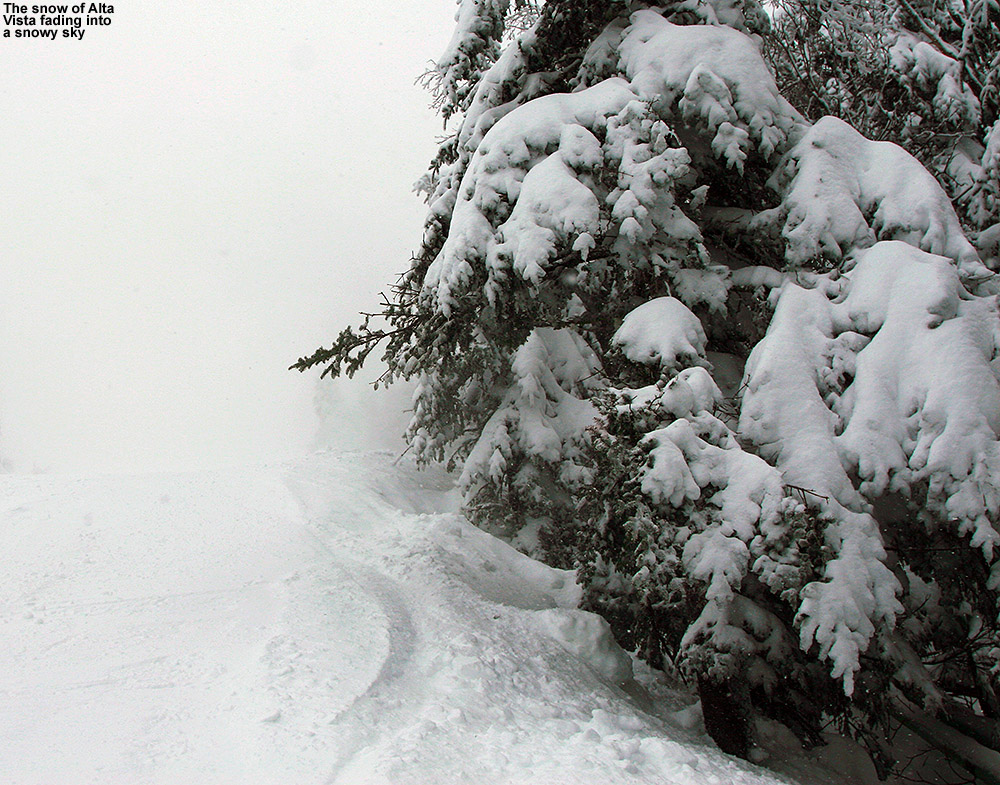
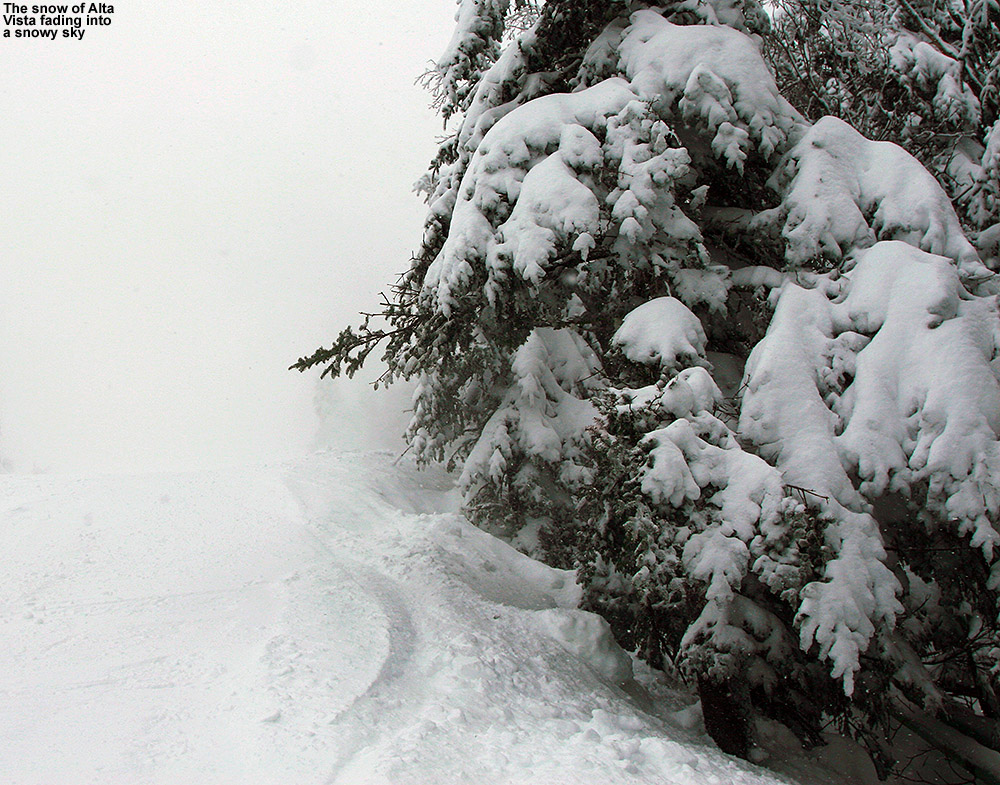
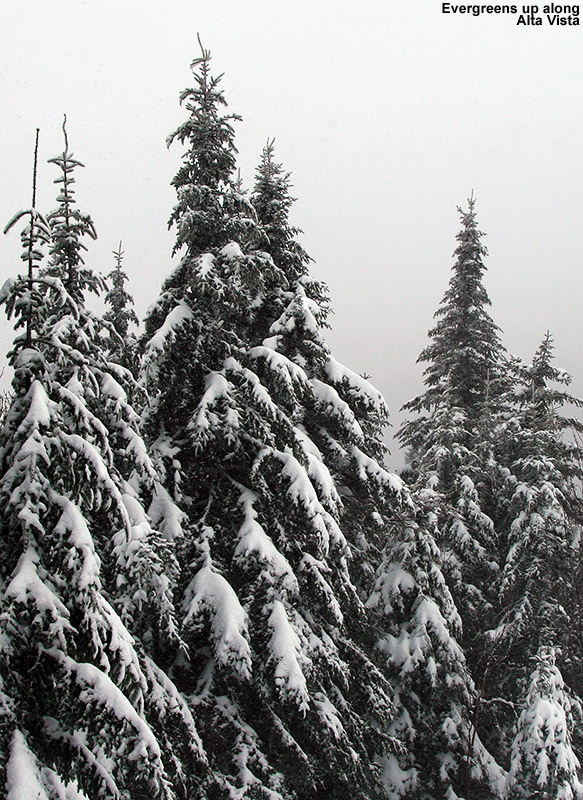
Wintry views off Alta Vista today
I next explored Cobrass on the other end of the main mountain, which was open on 100% natural snow with an “Experts Only” sign. Coverage was easily sufficient, and the only detraction was encounters with that firm layer. In the higher elevations it was sufficient to support skiing in the powder on top of it, but below mid mountain you could punch through so you had to be on your guard. In many spots you could tell that the conditions were the sort where turns were great in some of the fresh powder, or in areas that had seen plenty of skier traffic that had pulverized the thick layer back to packed powder, but those in-between areas created a challenge. That run led me down onto Cobrass Run, where there were more good powder turns as long as you didn’t get on terrain that was so steep that you’d punch through the thick layer.
I decided on one more run to explore the central part of the main mountain, hitting Alta Vista again but finding it not quite as impressive as my first run because other skiers had apparently discovered that left side. Sherman’s Pass was fine, with some excellent powder turns available along the skiers left down near Hard Luck and Lower Show Off. I checked out the Enchanted Forest, and coverage was good, but that low on the mountain the new powder was only a few inches, so I was spending a lot of time on the old surface.
“We almost didn’t go to a Christmas party tonight because it was snowing so hard when we were leaving that we could only see a couple of yards in front of us.”
Before leaving I stopped in at ski patrol and picked up my powder pass from Quinn from our summer glade work. Quinn said that he was very happy that they were able to have Show Off open, because the skier traffic was just what it needed to help keep that snow in place and fend off the effects of the wind. It looked really good from above when I was riding the lift, but I was thinking I’d hit it tomorrow with a bit more snow. I stopped in at the retail shop for a bit of last minute shopping with my pass holder discount, and the place was hopping. I ran into people buying all sorts of gear like goggles, gloves, etc., so hopefully business was good.
I’d say that another inch or so had fallen by the time I left the mountain around lunchtime, but we’ve been getting blitzed with snow tonight here at the house. We almost didn’t go to a Christmas party tonight because it was snowing so hard when we were leaving that we could only see a couple of yards in front of us. Fortunately the intense snow tapered off as we headed west out of the mountains, but there was a half a foot of snow on the snowboard by the time I measured after the party, and then after the snowboard was cleared, another couple of inches fell in just that next hour. That’s another 8 inches of snow here at the house tonight, so it will be interesting to see how much the mountain reports in the morning.
The mountain snowpack has been building up all week due to storms running through the area, and with the snowpack at the Mt. Mansfield Stake approaching the two foot mark today, it was finally time to venture up to Bolton Valley and see how the western slopes of the Greens were skiing. I awoke this morning to find 2.2” of new snow at our house in the Winooski Valley, and Bolton Valley reporting 4” overnight to bring their seven-day total to 19”. Although 19” of isn’t an outrageous accumulation over the course of a week, these recent storms have put down plenty of dense snow, so there’s been ample liquid equivalent in that snow to build the base for skiing.
“The turns were naturally really fun, with all sorts of new ski terms like smeary, slarvy, and drifty dancing through my head as the rocker in the skis did its thing.”
When I left the house (495’) it was a couple degrees above freezing and we were in a precipitation lull, but by the time I hit Bolton Flats a couple miles to the west, the next wave of moisture was coming in, and I was hit with a barrage of wet snow and rain. There was no snow on the ground right at the bottom of the Bolton Valley Access Road (340’), but snowpack appeared very quickly as I began the climb – just a couple hundred feet up there was a solid inch or two of snow down on the ground. The lowest part of the road is fairly protected, but as I got higher I could see that the winds were howling. With the strong winds I was keen to stay somewhat low in elevation, so my goal was to start a ski tour at the Timberline Base (1,500’) if the snow looked sufficient. The temperature at that elevation was right around the freezing mark, but snow was falling with plenty of intensity – when I had my skis out on the ground while I was getting ready, they were covered with a few tenths of an inch of snow in just a few minutes. The wind gusts were strong, certainly 20-30 MPH, and I actually had to head off into the trees a few dozen yards away when I realized that one of my glove liners had been stolen and carted off by the wind.
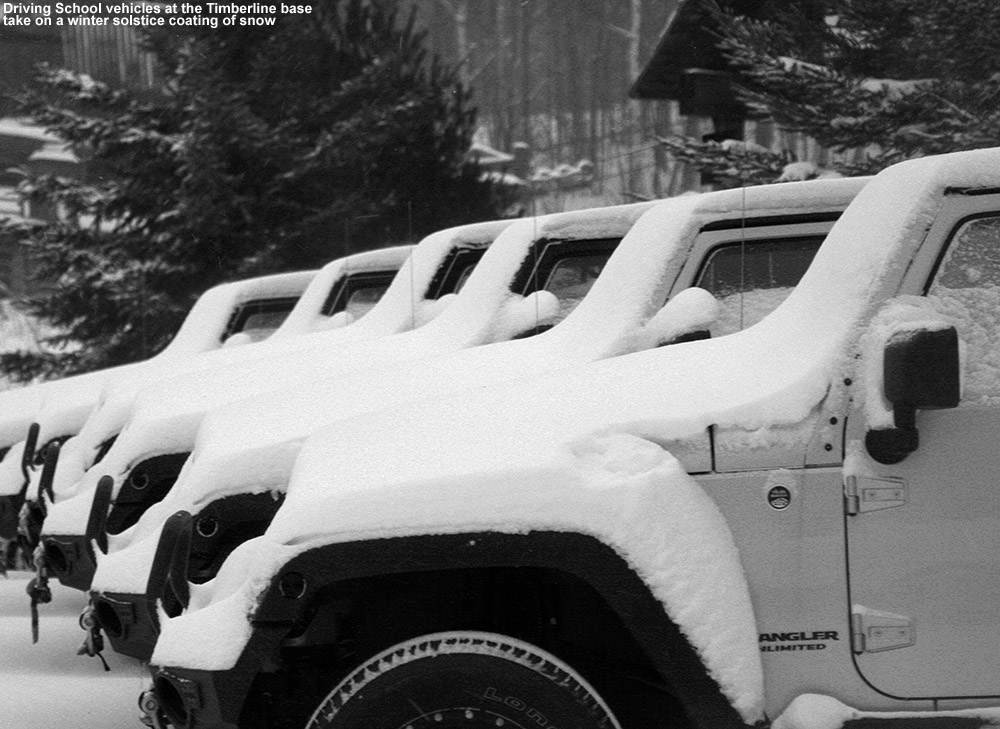
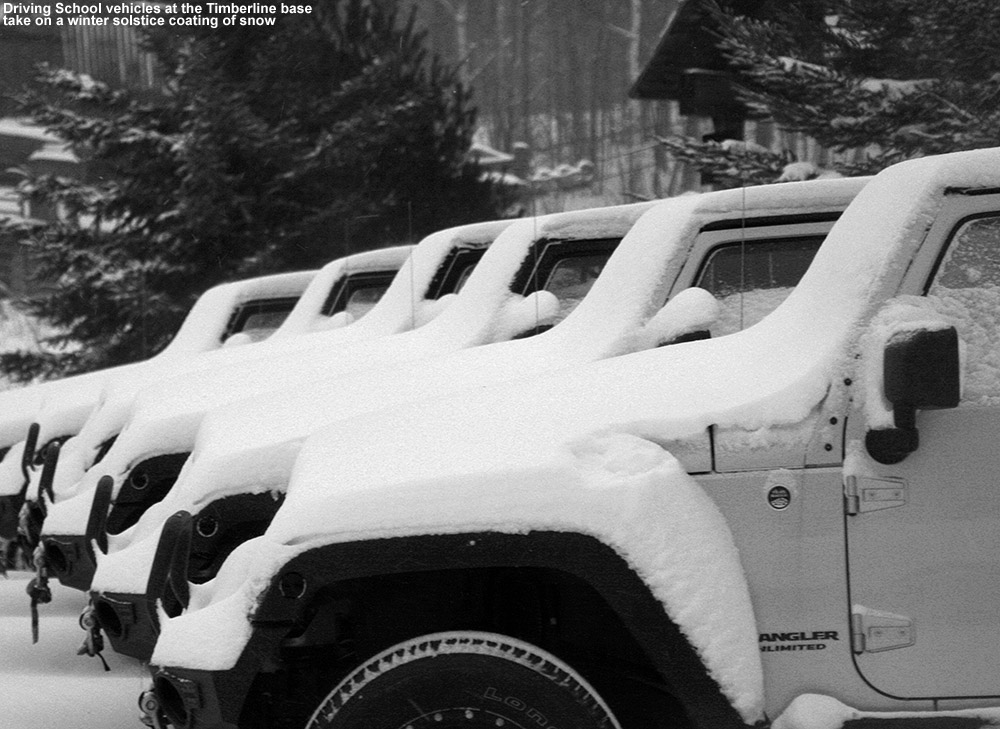
Aside from the driving school’s vehicles that were lined up in front of the base lodge, I only saw one other vehicle that seemed like it might belong to a skier (not surprisingly it was a Subaru). As I began my ascent, I didn’t initially find a skin track, although I followed some fairly fresh snowshoe tracks before breaking off to set my own track up the climber’s left of Twice as Nice. Snow depths at the base ranged from as little as 5 inches, to as much as 18 inches, with the average snow depth falling somewhere in the middle of that range. Breaking trail was at times a bit tough through the snow on the deeper end of the spectrum, but I enjoyed very good traction despite sporting the combination of AMPerages with RT-86 skins. This combination struggled to provide traction in established skin tracks back on November 30th and December 1st outings at Stowe, but it was very solid today. I’ve discovered that the width of the AMPerages combined with narrow skins proves to be a difficult combination in skin tracks that may have been made by narrower skis – it leaves one resting on just the outer edges of the wide ski base, where there is no skin. Today’s snow was dense with good grip, and I was able to head straight up the edge of the trail with minimal switchbacks. Snow depth increased somewhat as I ascended, and that increase seemed to be on the bottom end of the range; the deepest areas weren’t get deeper, but coverage was definitely getting better in areas that needed it. More notable than even the increase in snow depths was that after the first couple hundred feet of elevation, the snow got drier. There’s definitely not enough base yet to open terrain to lift-served traffic down at that elevation, but it’s getting close. One good dump with an inch or two of liquid equivalent would have it there. The wind actually subsided quite a bit by the time I was descending, so it was very comfortable with the temperature near freezing.
“Today’s snow
was dense…”
I didn’t have time for a really long run, so I headed right back down Twice as Nice, sticking to the skier’s left where the snow looked deepest. Indeed there were no issues touching down, and areas where depths were blown low by the wind were easily avoided. This was my first chance to try the AMPerages in a denser, powder (morning analysis of the snow at the house came in at a Sierra-like 11.4% H2O) and they again showed that they were in their element. After one cautious turn to see if I was going to find myself being tossed around in a Telemark stance… it was all downhill. The turns were naturally really fun, with all sorts of new ski terms like smeary, slarvy, and drifty dancing through my head as the rocker in the skis did its thing. I wouldn’t say that I ever tire of skiing powder, but these types of skis can definitely inject a new level of fun if you’re looking for something to invigorate your skiing. Boy did I want to stick around for some more turns!
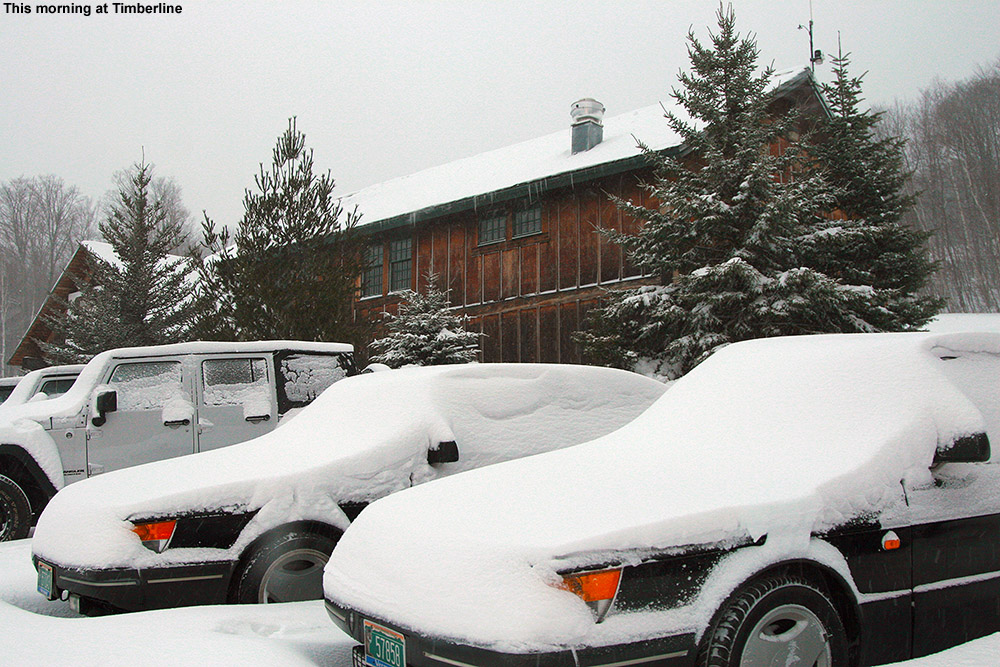
Timberline is sporting a good coating of dense snow
I’m not sure when the mountain started opening natural snow terrain, but as of today they’ve got numerous natural snow trails in the mix, including several black diamond runs on the upper mountain. That is a very good sign that snow depths are substantial up there above 2,000’. I see from one of Powderfreak’s recent posts on the American Weather forum, that Stowe has also been opening up a bunch of natural snow terrain, and the skiing looks excellent. It appears that some upslope snow could be coming in to the area tomorrow with the back end of this system, and that might deliver another foot of powder in some areas. The skiing should be quite good with that addition, and with potentially more of these storms in the pipe, we could be looking at a very good holiday week for the local resorts.
The powder at Stowe yesterday was so good, that I had to head out today for some more. E and the boys had some things to do at school in the morning, but for me it was a very casual Saturday today; with light snow falling to the tune of about an inch at the house, and powder in the mountains, it was just the sort of way you’d want to usher in the month of December. I took care of some things around the house this morning, and then headed off to Stowe in the early afternoon.
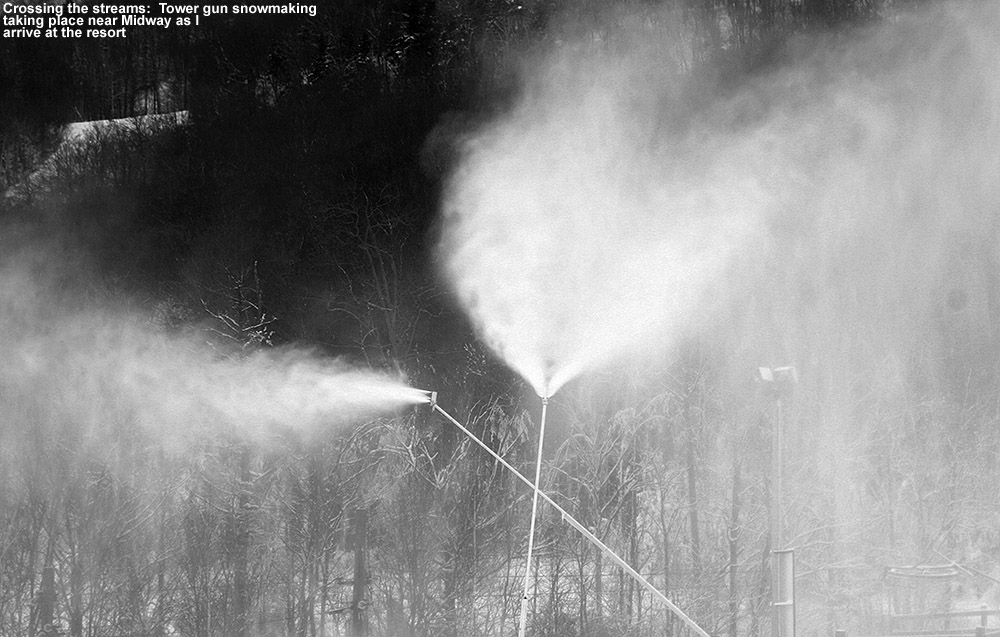
Temperatures have warmed considerably today relative to yesterday, and the temperature at the house was around 28 F when I left. That was pleasant though – much more comfortable than the teens, but not so warm that one would worry about melting the snow or affecting the powder. The temperature dropped to 24 F as I approached the resort base, and as has been the case for the past couple of weeks, numerous snow guns were cranking away on the slopes. On the American Weather Forum, Powderfreak sent in some impressive pictures of what Stowe has been doing in terms of snowmaking – those modern guns can really crank out the white stuff.
With the Fourrunner Quad area open with lift service, I decided to head over to the Gondola side of the resort to earn some turns. It was my first visit to that area of the resort this season, but if the snow depths were anything like what I’d experience on Nationalyesterday, I knew that there would be plenty of natural snow for turns. There were just a couple of cars in the Midway lot, and as I began my ascent on Chin Clip Runout I saw that there had been a surprising amount of skier traffic on the trails. Several people skied down past me as I climbed, and it had me wondering where they were all coming from. I was still plagued with the lack of uphill traction that I had to deal with yesterday because of the narrow skins on my skis, so I stuck to a moderately pitched route that took me up Switchback.
“Even though it was only a couple hours past midday, the clouds were thick and low, and the world had that close, dark, quiet feeling of December with deep snow.”
It was an incredible afternoon to be out on an ascent though. Even though it was only a couple hours past midday, the clouds were thick and low, and the world had that close, dark, quiet feeling of December with deep snow. Sounds were so muffled with all the powder around, that as I was ascending Switchback, two guys making their descent along the edge of Gondolier almost went unnoticed even though they were probably only 20 feet away from me. The only reason I knew they were there was because I saw a flash of movement out of the corner of my eye. Within another second they were gone, gliding downward in the fluffy silence.
When I hit eventually hit Gondolier, I had to make my own switchbacks because the pitch was just too steep for my skins, but things got a bit better when I reached Perry Merrill. Soon after that, I realized where all the people were coming from – they were coming out of the exit of Lower Rimrock, so people were making their way over from the quad to hit the lower terrain of the Gondola area. Above that point I found that the amount of fresh powder on the trail increased dramatically, because traffic really was down to people who were hiking for turns. I continued on up and wrapped around to finish my ascent on Upper Gondolier. In the 3,000’ elevation range it became a bit difficult to estimate the natural snow depth because of the effects of wind, but my depth checks along the ascent had revealed the following numbers:
1,600’: 9”
2,000’: 12”
2,500’: 14”
3,000’+: 14”+
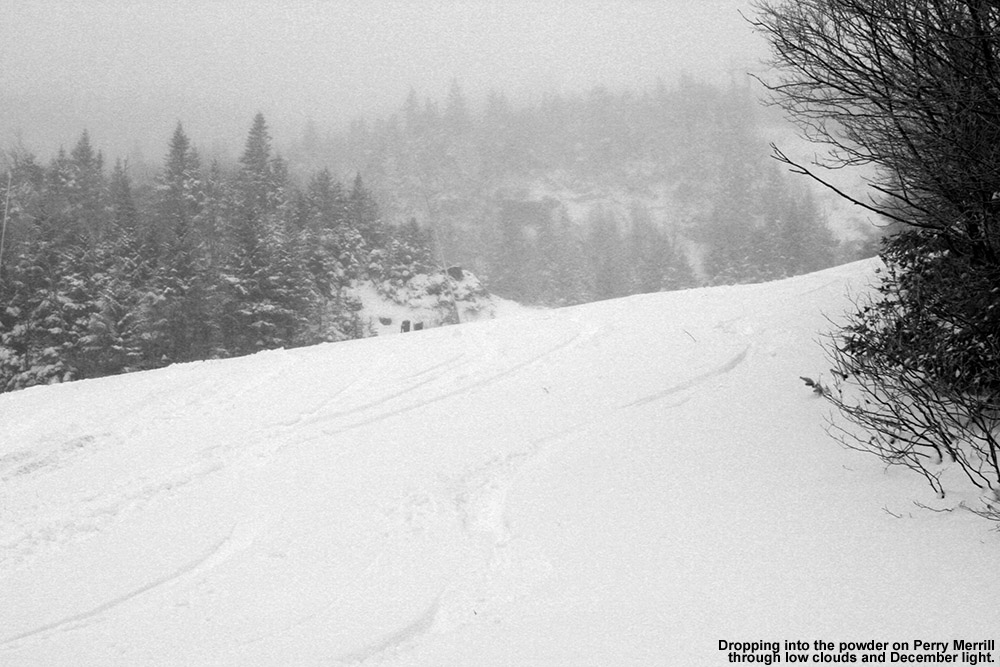
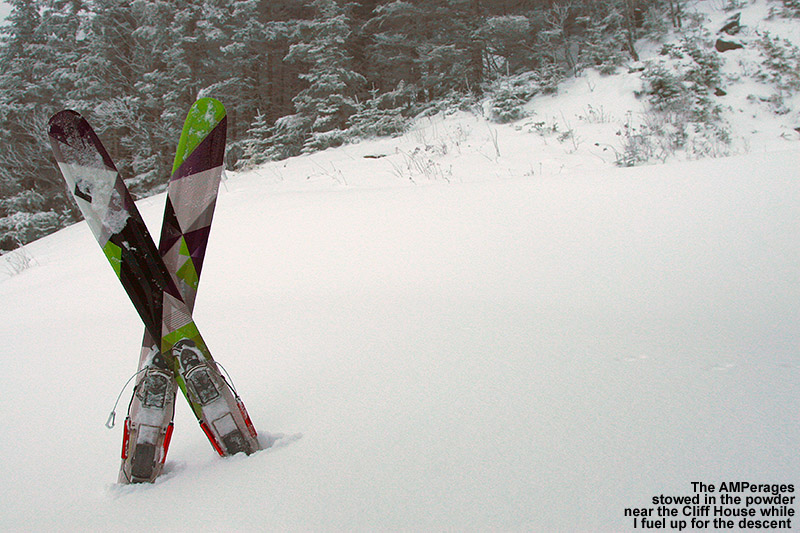
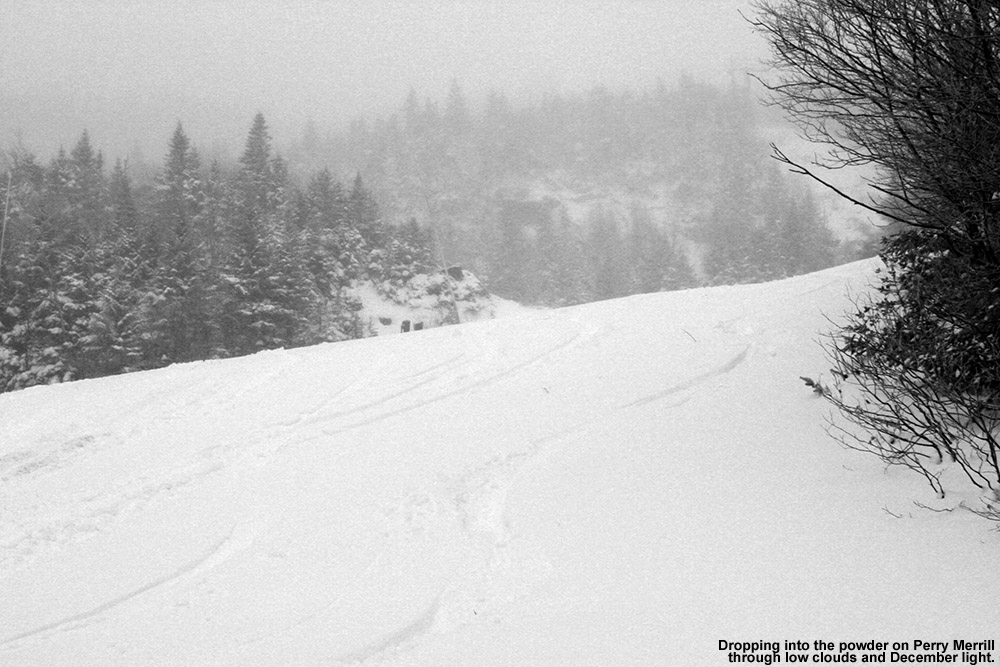
I had a snack and a drink at the Cliff House picnic tables, and it was definitely colder up there than at the base elevations; I put away my wet hat and got on my balaclava and helmet pretty quickly. The south side of the lodge had a nice area of drifted snow in excess of two feet, so I stowed my skis there while I recharged and enjoyed the quiet scene. Based on what I’d seen of Upper Gondolier (very windswept), and the terrain leading toward Chin Clip (pretty tracked up), I decided to descend on Perry Merrill. The best parts there were that very first steep pitch that drops toward Cliff Trail, and then the section near the big Gondola waterfall on down to where the traffic entered from Lower Rimrock. Between those stretches, the terrain was pretty windswept like I’d seen in other areas. Those Perry Merrill turns were awesome in general, with plenty of untracked powder, but I think that first steep pitch was the very best. There were only a few tracks, and the pitch, snow depth, and fat skis combined for quite a ride.
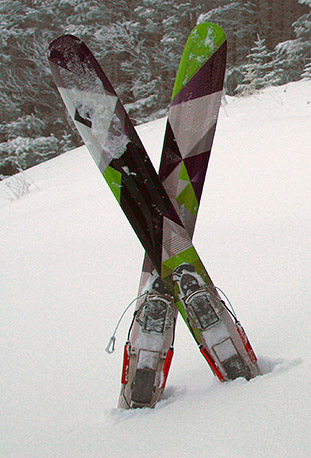
The AMPerages ready for action
The snow became more tracked with plenty of chowder below Lower Rimrock where all the skier traffic was entering, and it was my first chance to see how the AMPerages handled those conditions. I was able to tell pretty quickly that powder was really where they were the most at home. They were fine in the chowder or partially packed areas, they just didn’t have that feeling of amazing superiority that they do in the powder. Their slower edge to edge speed due to the width, which doesn’t really become apparent in untracked powder, was more evident in packed areas. It’s interesting to hear Black Diamond speak to the potential of the AMPerage as “the closest thing you’ll find to the mythical one-ski quiver”, because while it does have camber underfoot to go with the tip and tail rocker and make it more versatile on packed snow, it’s still a ski with a 115 mm waist. Based on impressions so far, I suspect one could pull it off as an all around ski here in the Northern Greens and various places in the mountains of Western North America, depending on their penchant for powder, but it still seems wide for everyday use. It’s definitely not something I’d consider an all-around ski for many locales. I got the AMPerages (and E the women’s Element version) as our powder Telemark skis, and although I don’t think we’ll refer to them as our all-around skis, they will probably see fairly heavy use. There’s almost always some powder out there to ski, even if it’s not a deep day, but the beauty of fat skis is that they can help float you even on those smaller days. I’m sure we’ll both have more to say about these new fatties as we work our way through the season, but up to this point I can only reiterate that I’m extremely impressed with how they ski in powder – if you haven’t yet tried a pair of fat, rockered skis for powder – do it.
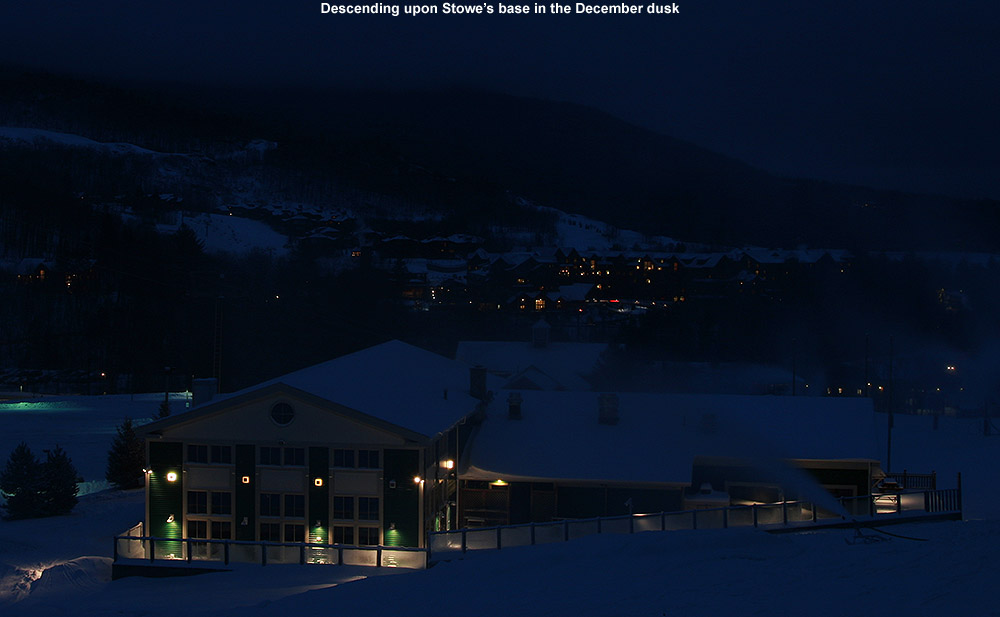
It was well on to dusk as I was finishing my run, and when I saw the lights of the base area laid out below me, I stopped alongside the bottom race shack on Gondolier and took some pictures of the scene. The darkness really reinforced that December feeling. I actually think the powder may have settled a bit more in the higher elevations (probably due to wind) relative to some of the lower elevations, but the skiing was still excellent. It was absolutely a good start to the month.
I awoke this morning to our coldest temperatures of the season – we bottomed out at 7.2 F and there was no doubt that the snow was going to be light and dry. Since the snow had shut off by roughly midnight, there had been plenty of time to clean up the roads, and the trip over to Stowe was quick. There were a good 20+ vehicles present as I parked in the Mansfield lot, and although it was still fairly dark, I could see a few skiers making their way up the slope leading to the trails. They seemed to be heading off in the direction of Nosedive, so I opted to head that way and hopefully make use of an established skin track.
“I’ve often wondered if it was worth going the slightly narrower route on skins to reduce weight and enhance glide. After today’s experience, I can tell you to forget about it for typical alpine ascents.”
The track headed up Lower National through a few lower elevation snow guns, and the areas of firm, manmade snow quickly made me aware that my ascension setup wasn’t going to be perfect. I was using my AMPerages (139-115-123) to see how they fared in the powder, but since I don’t have skins for them yet, I was using my RT-86 skins (127-86-113). That width differential left a good deal of base exposed, and on occasion I had to use a heaping helping of arm strength with my poles to avoid slipping. Although I’ve always cut my skins to the full width of my skis, I’ve often wondered if it was worth going the slightly narrower route on skins to reduce weight and enhance glide. After today’s experience, I can tell you to forget about it for typical alpine ascents. Unless you’re going to be touring on very low angle terrain, it’s just not worth it based on what I experienced today – any benefit from the weight/glide could easily be lost by the constant slipping. Thank goodness the skin track didn’t have any post holes in it this morning or it would have been a huge pain to hold traction. Up through Lower National I was getting by reasonably well with the occasional small slip of my skins, but the challenge wasn’t quite over. After reaching the top of Lower National, the skin track shot up Midway, which has quite a steep pitch, and maintaining skin traction became a lot harder. The pitch eased a bit as the track made its way onto Nosedive, but by the time I’d reached the Liftline/National junction, time was getting short and I was more than happy avoid any more slipping. It was time for a descent.
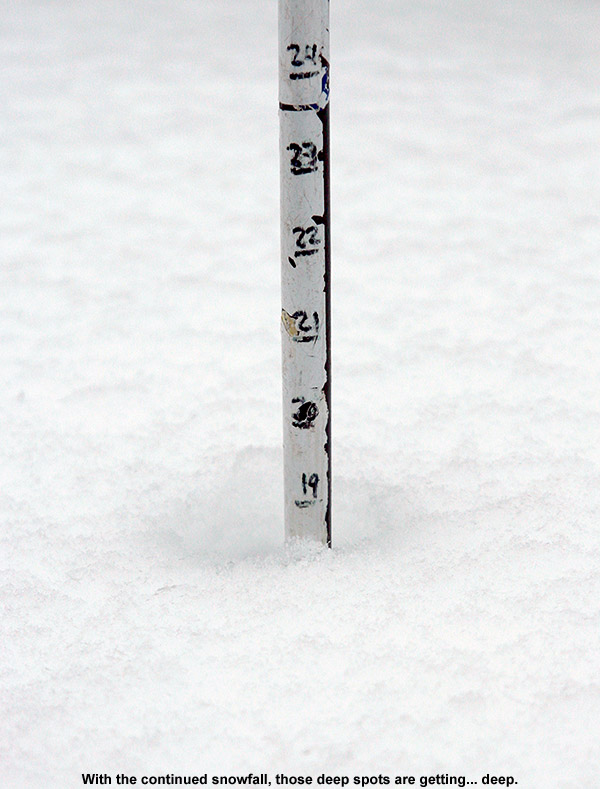
I’d been checking on snow depth during my ascent, but due to all the snow this week, there was a lot of unconsolidated stuff under the current storm’s bounty and it was difficult to assess just what came down overnight. I’d been getting measurements of roughly a foot or more since I’d started at the base area (~1,500’), but when I stuck my measurement pole into the snow at that ~2,800’ mark, I got an overall depth of 18 inches. Combined with what I was seeing around me from other skiers (check out the pictures from adk and from Powderfreak at the American Weather Forum), who were having little if any issues touching down on obstacles below the snow, the potential turns were looking really good. National is quite steep and while it wouldn’t typically be my first choice for early season skiing, Mother Nature has really been dishing out the snow on Stowe this week. It looked ready and I was about to test it out.
“These new fat, rockered skis are absolutely the real deal. I continued to bound my way down the steep slope, just amazed at how easy the turns were.”
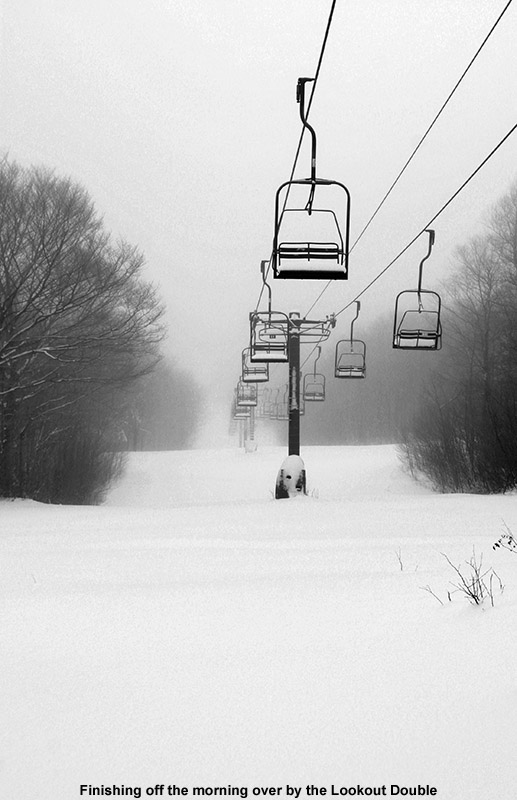
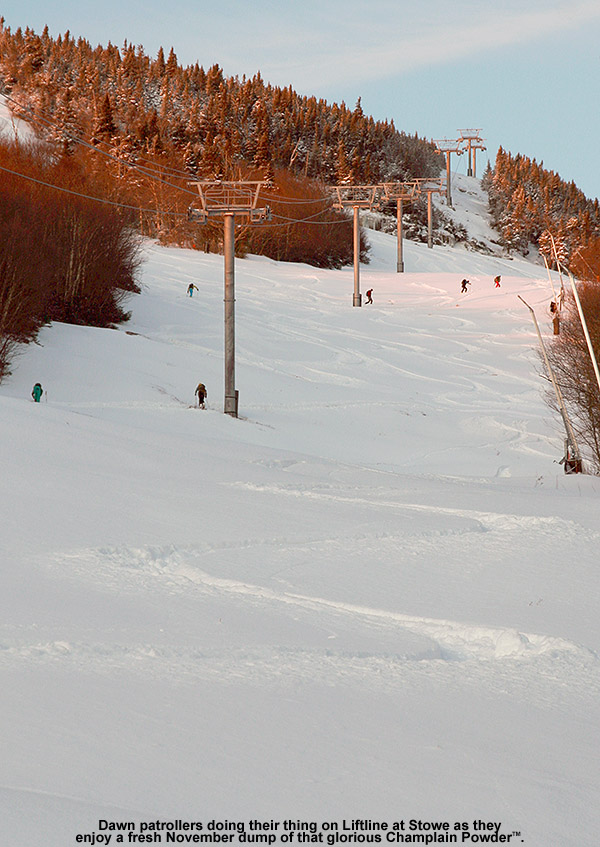
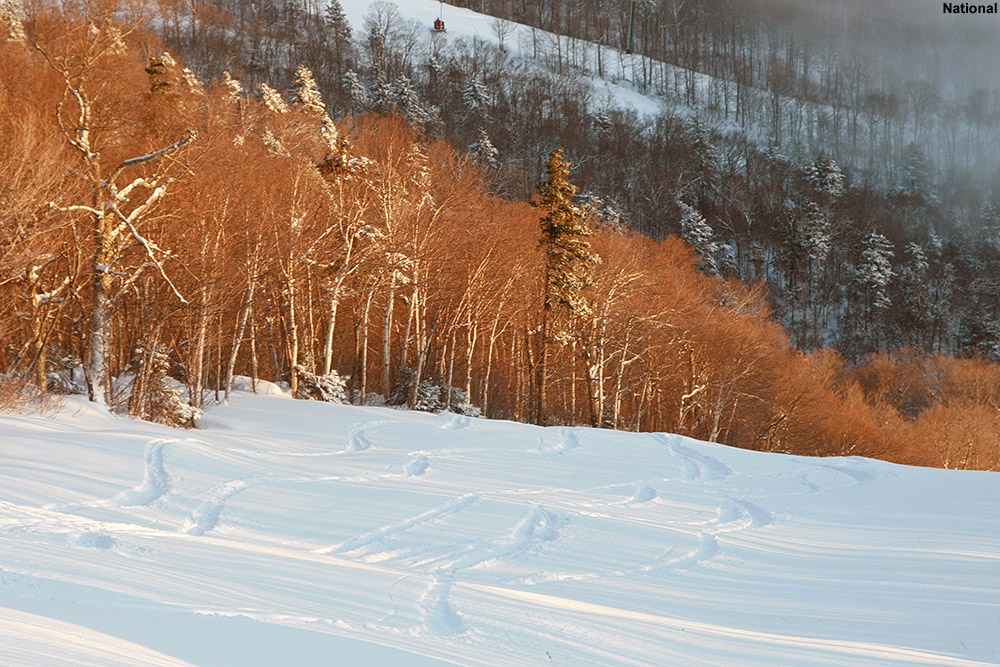
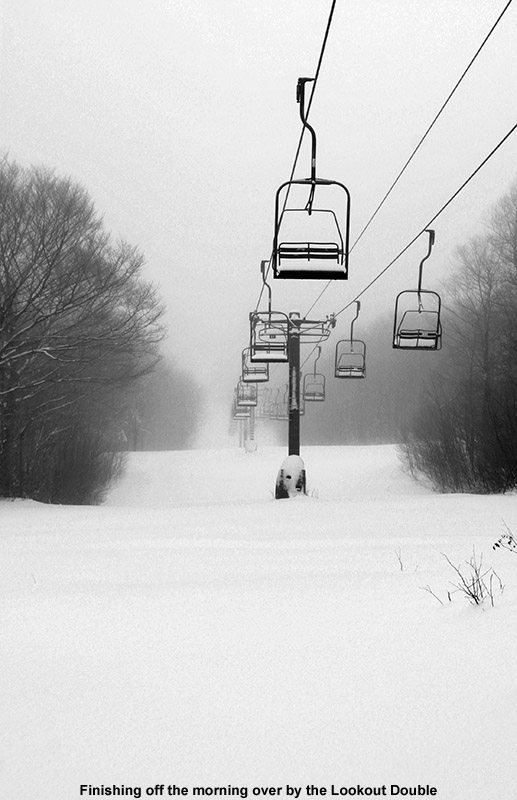
I switched to descent mode and decided to see what the AMPerages could do. I dropped in for the first few turns, tentatively, still wondering in the back of my mind if I was going to hit something below, but it was immediately obvious that there was plenty of snow. The powder was light and dry, and I quickly found myself just giddy with how well the AMPerages performed. This was my first time on such fat, rockered skis, and although I figured that there might be some modest, incremental increase in ease of powder skiing over my regular Telemark setup, it was far more than that. These new fat, rockered skis are absolutely the real deal. I continued to bound my way down the steep slope, just amazed at how easy the turns were. At the bottom of National I decided to avoid heading back down toward the snow guns where I’d ascended, and instead took Houghton’s over toward the Lookout Double. It was very quiet over there, since it was well away from any snow guns, and I finished off my run turning my way through fluffy silence. It’s not even December 1st and there’s not just passable, but really good natural snow skiing from top to bottom on Mt. Mansfield, so indeed that’s a great end to November on the slopes.
A peaceful Lookout this morning
Sure today featured the best snow I’ve encountered this season, but I can already tell that the powder skiing is going to be just that much more fun this season with the new boards in the quiver. I’ve now tested the AMPerages in some legitimate Champlain Powder™ – they handled the fluff with aplomb and they are clearly NVT worthy in that regard. Presumably the whole season won’t be just a fluff fest, so I’m also eager to see how they handle thicker snow and crud, but we’ll have time for that.
I left the house near midday under cloudy skies and a temperature of 39 F, but a few minutes into the drive, the temperature dropped to 37 F in the Waterbury Center area, and snow began to fall. It snowed lightly all the way to the mountain, and accumulations began to appear just as I hit the resort base at ~1,500’ in elevation. The temperature had really dropped as I ascended the last stretch to the resort, and as I parked in the Midway lot, the temperature was right around the freezing mark.
Accumulations in the Midway area were generally a trace to an inch, so I stowed my skis on my pack and headed over toward Nosedive to use that standard route of ascent. As I approached the 2,000’ mark, the snow depth became a bit more consistent, generally in the 1”-2” range, and I switched to skins. I was probably a touch early on putting on my skins since I encountered a few more spots of mud, but that’s what rock skins are for, and it made for a lot less slipping than hiking in my boots. The precipitation that had been snow at the start of my ascent turned into more of a freezing mist as I headed into the clouds around 3,000’. Up around 3,600’ at the Stone Hut it was windy, well below freezing, and quite chaotic with Stowe’s snow gun firing off what seemed like a 21 gun salute. I sheltered behind the hut to keep out of the wind and the roar of the snow guns as I switched to descent mode and had a much needed snack. The wind made for plenty of drifting during my ascent, but I’d sum up the snow depths with respect to elevation as follows:
I’d only encountered a couple of groups descending on Nosedive while on my ascent, but there were plenty of tracks from previous visitors and the snow was quite packed out, so I decided to descend some other terrain off to the south. The combination of wind, freezing mist, low visibility, and manmade snow made for a really challenging descent, especially on my skinny Telemark skis, so I generally just took it easy and stuck to mellow terrain. In general I didn’t find much in the way of decent turns until I got down onto Sunrise below the snowmaking, and pretty quickly after that the snow depth was getting a bit meager. I did manage some nice turns here and there, but eventually it was more gorilla-style survival turns until I finally decided to call it at the elevation of Crossover. I strapped the skis back on my pack and had a nice stroll back to the car. I’d say at this point the skiing isn’t worth putting in a ton of effort, but it’s definitely fun to get out for a few turns if you’re close by. We’ll have to see if anything comes from the Nor’easter that’s expected this week though, because the current snow could serve as a decent base for another round of accumulations.
With everyone having their own unique perspective on skiing, some of which you can discover at supreme ski morzine skiing school. They tend to love skiing since they teach people how to do it! But combined with the multitude of weather-related factors involved in winter recreation in general, there’s usually ample room for debate about where a ski season sits relative to average. However, when it comes to the 2011-2012 ski season in Northern Vermont (and perhaps to an even greater extent in other parts of the Northeastern U.S.) most any metric would set it firmly in the lower half of seasons. Some key contributing factors to the outcome of the season were temperatures, which were above average for every month from October through May (specific monthly temperature departures are available in the monthly detail section), overall precipitation, which was well below average during that period, and as expected with that combination, snowfall that was well below average. However, the numbers don’t always tell the whole story, and indeed that was the case in Northern Vermont this past season. If numbers aren’t everything, perhaps timing is everything, and the snow machine of the Northern Greens exhibited some impeccable timing for some of the busiest ski periods when it came down to it. There was also a consistency and intensity in backside snows that seemed to heal just about every mixed precipitation event. So while I don’t think that the winter of 2011-2012 can be considered anything but below average around here, the bigger story might just be how “surprisingly good” it was. That story unfolds in the details below, and may inspire people to look at other skiing options. Some may consider the vail village ski rentals in such a situation, especially after reading about this different location.
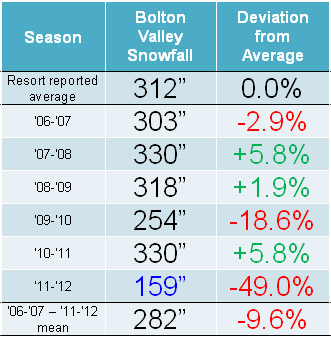
Snowfall: A very reliable and trustworthy indicator of just how poor the winter’s snowfall was for the general Northern Vermont area, is the data from the area’s first-order weather station at the National Weather Service Office in Burlington. Out of 127 years worth of data going back to the winter of 1884-1885, the 37.7″ of total snowfall in Burlington during 2011-2012 was the third lowest in their records (only 1912-1913 with 31.3″ and 1904-1905 with 32.0″ were lower). Interestingly this third lowest recorded snowfall obtained in 2011-2012 came right on the heels of Burlington’s third highest recorded snowfall of 128.4″ in 2010-2011. Relative to average snowfall, which for the 1884-2011 period of record in Burlington is 73.3″, 2011-2012 came in at just 51.4%. Burlington is the local first-order weather station for the area, but despite its proximity to the spine of the Northern Greens, the Champlain Valley’s snowfall doesn’t necessarily correlate with what goes on in the mountains. Looking next at Winooski Valley snowfall data obtained from our house, which sits right along the spine and is a decent representation of what happens in the mountain valleys of the Greens, we find that snowfall was well below average during all the key winter months, and our season total was 115.3″. Not surprisingly, this is the lowest snowfall total obtained in the six years that we have collected rigorous data at our location, and it’s almost two standard deviations below the mean (172.1 ± 31.5″) obtained from 2006-2011. However, at 67.0% of the average snowfall, it’s not quite as low as what Burlington experienced. Like the local mountains themselves, some spots in the mountain valleys have what Powderfreak refers to as a snowfall “insurance policy”, which comes in the form of upslope snow. Burlington and the Champlain Valley can get in on a bit of mesoscale weather action in the form of lake-effect snow from Lake Champlain, but it’s not a major contributor to snowfall due to the size and orientation of the lake. To the east of the Champlain Valley however, the upslope snow, sometimes referred to as Champlain Powder™, is what sets the snowfall in the Greens apart from areas that rely solely on synoptic precipitation. Interestingly, as we head up in elevation above our house in the valley, we find Bolton Valley reporting a very similar deviation from average snowfall compared to Burlington this season. Bolton recorded 159″ of snow this past season, which based on Bolton’s reported seasonal snowfall mean of 312″, comes in at just 51.0% of average. That amount of snow is extremely low for this area, and is more akin to what one might find in a typical season at Lake Louise Ski Area in Alberta vs. the spine of Vermont’sNorthern Greens. The updated table with Bolton Valley’s snowfall from the past several seasons is added below, which illustrates the strong snowfall deviation from average seen in 2011-2012:
Snowfall at Bolton Valley Resort during the 2011-2012 ski season (shown in blue) was extremely low, just half the average amount.
Although still well below average all around, there certainly was a trend toward slightly better snowfall as one continued to head north in the state, with the northward trend of 63.4% at Stowe, 66.6% at Smuggler’s Notch, and 71.5% at Jay Peak relative to average. A contributor to the low snowfall at the resorts was the fact that there was really only one big, multi-foot storm cycle during the heart of the season. That storm came at the end of February and dropped 40″ at Jay Peak, just on the heels of a couple smaller systems for a total in excess of 50″ of snow in just a few days. The resulting skiing was fantastic due the density gradient that was set up by the way it fell – 1 to 2 feet of dense snow came first, and it was topped off with another couple feet of champagne that finished at around 2% H2O. The snowpack at the Mt. Mansfield Stake jumped from 49″ to 81″ during that period, and the icing on the cake was that the storm cleared right out to produce bluebird skies on Feb 26th. Unfortunately, one great storm doesn’t make a season. Based on estimations from my weather data, on average we should only expect one or two of those 40″+ storms per season, but they would typically be backed up by several 20″+ storms, and the deficiency of those is part of what left the overall snowfall lacking.
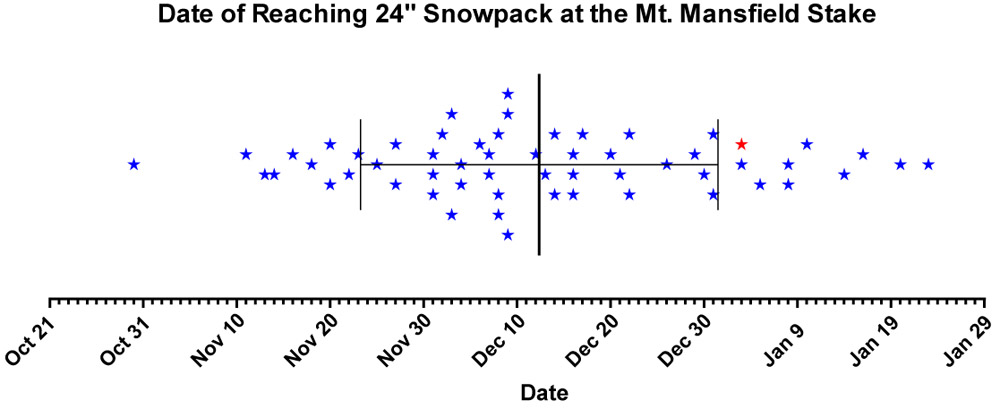
Tree Skiing:In the past I’ve used empirical data from trip reports to establish a mean date for the start of tree skiing in Northern/North-Central Vermont, and as I outlined in last year’s ski season summary, that analysis revealed a date of December 10th ± 13 days, with an average depth at the stake of 28.1 ± 6.5 inches. However, after a comment from Powderfreak back on December 12th, in which he indicated that he’d observed tree skiing on appropriate terrain at Stowe to start roughly when the snow depth at the Mt. Mansfield Stake hit 24 inches, I decided to run an analysis using snowpack data from the stake. Instead of just the 15 to 20 seasons worth of ski trip reports that are available since the arrival of the internet era, there are almost 60 seasons worth of data available from the Mt. Mansfield Stake. Analysis of the stake data using the first date of attaining 24″ of snow depth or higher as the start of tree skiing, actually produced a very similar result (December 12th ± 19 days, with an average depth at the stake of 25.8 ± 2.7 inches) to what was obtained from the empirical data. With the date being so close to what I determined from the empirical data, I’m pretty confident that the date of attaining 24″ in the stake data will serve just as well in determining the average start of tree skiing, and the relative start date for individual seasons. With the median and mode for that analysis coming in quite close to the mean, the distribution seems normal, so the standard deviation in the data should have some predictive value. This “24-inch rule” isn’t meant to replace the traditional “40-inch rule“, but it’s there to compliment it as a more practical measure of when people actually start venturing into the trees in this area (the fact that it is corroborated by many years of empirical data can testify to that). The point at which the stake hits 24 inches is a decent mark for when appropriately maintained trees are going to start offering up good turns for those with the right skills and knowledge, whereas once the stake hits 40 inches, skiers can pretty much venture into most off-piste areas with a good degree of confidence. Between those two points is going to be a continuum of increasing access to off piste terrain. Moving from the 24″ depth to the 40” depth will typically take place during the month of December, with the snowpack at the Mt. Mansfield Stake reaching the 40″ mark at the beginning of January on average.
So where did the 2011-2012 season stack up in terms of the start of tree skiing in Northern Vermont? Not surprisingly, when assessed by the new method of reaching 24″ at the Mt. Mansfield Stake, it’s down near the bottom of the pack. Below, I’ve added a scatter plot that I generated using the Mt. Mansfield snowpack data; the X-axis is a timeline spanning from October to January, and the blue stars represent the dates when 24 inches of snow depth was attained at the stake for the various years from 1954-2012. The red data point is for the 2011-2012 season (date of attaining 24″ = January 3rd, 2012), so the season is indeed more than one standard deviation on the late side (the large vertical line in the plot is the mean, and the small vertical lines are ± 1 standard deviation), although it actually isn’t as late a start as some seasons:
A scatter plot showing the date of attaining a 24-inch snowpack at the Mt. Mansfield Stake. Each star represents a year from 1954-2012, and this year’s date of attaining a 24-inch snowpack at the Mt. Mansfield Stake (January 3rd; indicated by the red star) is on the later side.
How did the 24-inch snowpack depth analysis compare to what we actually found on the ground this season? Since skiing natural snow terrain on piste began first, I’ll mention that momentarily before discussing the trees. I saw the first signs of people skiing natural snow trails this season on December 27th at Bolton, and coverage certainly looked sufficient on at least moderate terrain. The tracks I saw at that point already looked old, and I suspect that on piste natural snow coverage was actually sufficient the day before (December 26th), thanks to the Christmas Day storm. Bolton picked up close to a foot of snow from that storm, and at the end of the day on the 26th, the snow depth at the Mt. Mansfield Stake came in at 14″. The first day that we actually ventured into the trees at Bolton Valley was December 29th, and as I stated in my report from that day, we only ventured in for one run because the base was just a little too thin to really ski with confidence in there and enjoy it. And, when the snowpack was measured at the Mt. Mansfield Stake later that afternoon, the depth was 21 inches, just a bit shy of that 24-inch mark. By the next day, we were skiing natural snow trails with more than enough coverage, but it wasn’t until January 7th at Bolton that I commented about some of the trees finally being ready after the boys and I skied Wilderness Woods. The measurement from the stake came in at 24 inches that afternoon, and we were clearly reaching another threshold of sorts, so attaining that 24-inch depth at the stake was indeed a decent measure for the start of tree skiing this season in our experience. Powderfreak and I have discussed how that 24-inch number is going to be quite rough, since a 24-inch depth attained mostly with fluff will represent something substantially different that a 24-inch depth attained with cement, but it looks like it’s going to be a reasonable approximation of when people start to take their initial forays into the trees and find the conditions good enough to stay there.
Looking at tree/off piste skiing for the season as a whole, there’s no question that it was curtailed relative to normal. The very late date of reaching 24 inches at the stake in the beginning of January (January 3rd) is 1.13 standard deviations beyond the mean according to the Mt. Mansfield snowpack analysis, putting it close to the bottom 10% of seasons. When this is coupled with the large amount of melting in Mid March due to record heat, which closed a lot of terrain, it equates to a tree skiing season that is roughly 2 ½ months long, compared to the more typical length of 4 to 5 months. The off piste season was certainly condensed, and while coverage was there to enable plenty of access in January (Stowe reached 100% open status by January 14th), tree skiing really seemed to take forever to hit its stride; to wit, the snowpack at the stake didn’t hit the 40-inch mark until the end of January.
Snow Quality: In last season’s summary, I checked my trip reports and found those days in which we were skiing powder, typically suggesting a fairly high level of snow quality, and those days in which powder skiing wasn’t available, often indicating some sort of thaw (or in one case this season, insufficient base depths). For the list of outings below, I’ve again placed a P whenever we were skiing powder, and put a red X if we weren’t, to reveal the temporal pattern associated with that categorization. Outings with an X may still be providing decent skiing such as wet snow, corn, etc. (or else we’d probably be doing something other than skiing) but aside from the spring period, there’s going to be a price to pay in terms of snow quality after these episodes when temperatures eventually cool back down. Chronologically, the first X appears for the outing on December 10th at Bolton Valley. The lack of powder skiing on that date wasn’t actually due to temperature fluctuations, but instead due to the fact that there just wasn’t enough natural snow; substantial snowfall was very slow in coming in early December. The natural snow depth up above 2,000′ in the Bolton Valley Village was still only 2-3″ at that point, so short of junkboarding, skiing was really restricted to just the limited terrain that had manmade snow. The next X appears on our Bolton Valley outing on December 31st, and it represented a notable bump in the winter weather. The holiday week wasn’t too cold, but it was certainly snowy like one would expect at Christmas time in Vermont, with three decent snowstorms totaling more than two feet of snow at the northern resorts (refer to the December entry in the detailed monthly section for more information). So there was indeed some great powder skiing during that stretch. The main factor that kept the overall quality of the skiing from being really outstanding was the lack of base. The natural snow terrain that was open was excellent, but there still hadn’t been enough snow to open the steepest terrain without snowmaking. The X in this case comes in at the tail end of the holiday period where there was a thaw. I described the skiing on New Year’s Eve as reminding me of the Pacific Northwest, with low hanging clouds on the mountains, and dense snow underfoot. I’m not sure how long the resulted firm snow conditions lasted, because three small to moderate storms came through the area that week, with the first one dropping a half foot of snow in the mountains. By the following Saturday there was powder skiing again for the weekend. From that point on there were no interruptions in powder skiing though to mid March – at least from our perspective; we don’t ski every day of course, but we did ski every weekend through that period. However, Powderfreak does ski just about every day of the season at Stowe, and he noted that there were only a few select days without powder. I’ll speak more about that at the end of this section. By far the section of the outings list that stands out the most is the second half of March – the dramatic change in conditions is quite obvious, with seven outings in a row marked with an X. Record warm weather came in with a vengeance in mid March, and it was all spring skiing until the weather cooled back down to normal levels and produced snowstorms for the final two thirds of April. We finally finished off our season with a couple of corn snow days in May, a point in the season where that type of snow is the norm.
The 2010-2011 ski season was the first one to which I applied this type of powder skiing analysis, and relative to what I thought it would look like, I was certainly surprised by the consistent availability of powder conditions once I saw the data lined up. But as surprised as I was with that result, the 2011-2012 analysis is even more astounding. Somehow there was good to great skiing every weekend/holiday period throughout most of the core ski season, despite the overwhelmingly warm temperatures and low snowfall. As I mentioned above in the snowfall section, Bolton Valley reported just 159″ of snow for their entire season. That’s ridiculously low – it’s half their usual snowfall, and we typically average more snow than that at our house, almost 3,000′ below the upper elevations of the resort where the snowfall measurements are taken. That amount of snow might suffice for some decent skiing in an environment like the high elevations of the Rockies with very consistent winter temperatures, but this season in Vermont was anything but that. There were temperature issues throughout the season, and January was a perfect example – at the end of the month, local meteorologist Roger Hill pointed out that we’d had seven January thaws. I had many ski weather-related conversations with Powderfreak in the 2011-2012 ski thread at American Weather’s New England Subforum about the surprisingly high quality of the skiing, and there was certainly consistency in conditions, but we also determined that it was an issue of timing. Snowfall was low, and spells of warm temperatures abundant, but storms were just timed well to ensure that most snow quality issues were remedied by the weekend. Although the season was warm on average, we didn’t have many big rain events, and any that we did have seemed to be quickly covered by backside snow. There was indeed something special about the timing though, because somehow we had weekend after weekend of nice skiing with powder on Bolton’s 159″ of snow. The detailed reports below and the monthly ski summaries that follow, provide the specifics of how it all went down, and the frequency and distribution of P in the outings list really speaks to that theme of “surprisingly good”:
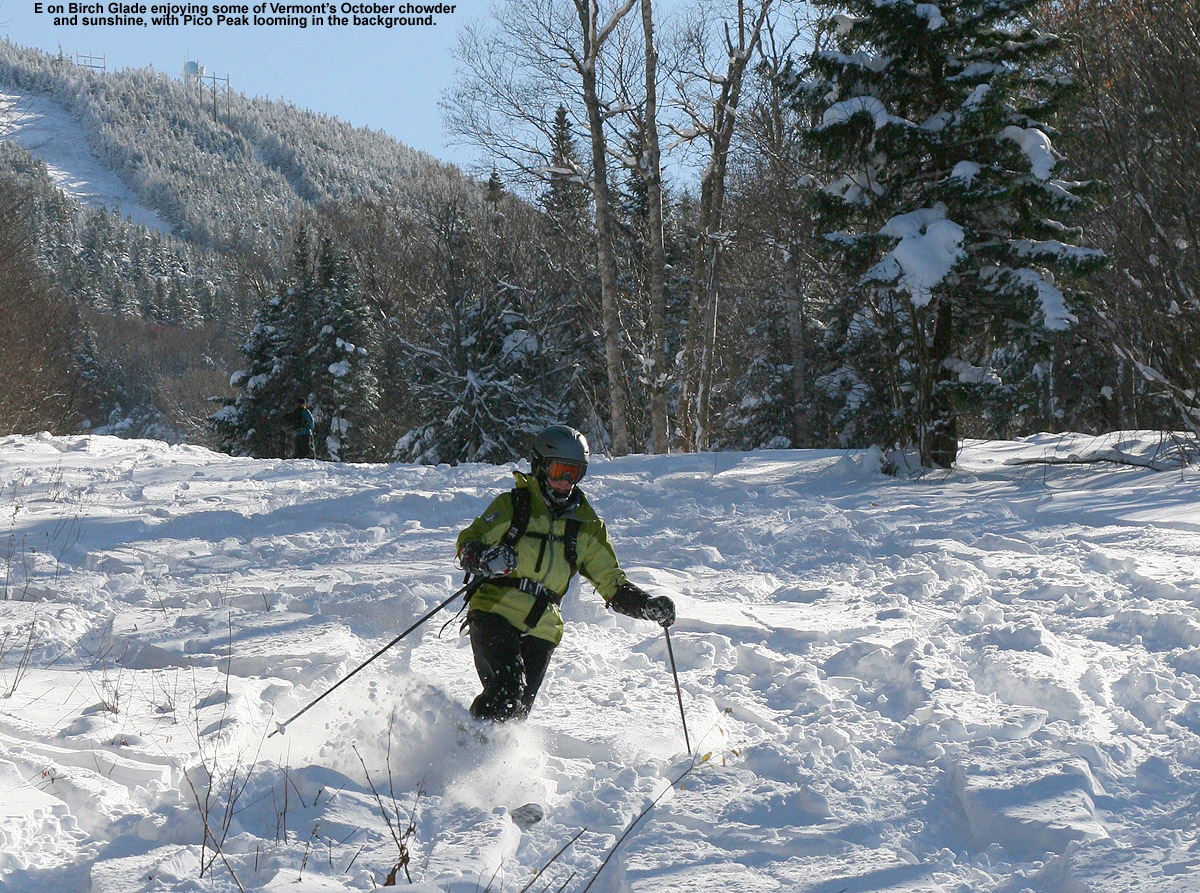
E enjoys some of the October powder at Pico after back to back storms set up some great ski conditions.
October: Snowfall in the month of October is generally scant down at the elevation of our house (495′), and because we’re on the fringe of the cold season at that point, it’s not a great indicator of snowfall in the local mountains. The six year average I have in the valley is 0.9″ of snow for October, so by that measure, the 1.2″ of snow that we received in October 2011 was very typical. However, for the New England region as a whole, October 2011 would wind up being anything but typical. Back to back snowstorms hit New England at the end of the month, with the first one on October 27th dropping over a foot of snow at Killington to kick things off with gusto. That type of storm is pretty standard for the mountains of Vermont in October, but just a couple days later on the 29th, it was followed up by a second, larger storm – a record-breaking monster of an October snowstorm for Southern New England. Over 30 inches of snow fell in some locations, and those weren’t necessarily high elevation locales. Massive power outages ensued because leaves were still on the trees in those areas, and people were without power for up to two weeks. Ironically, despite the back-to-back snowstorms in New England, including an historic, 100-year event, Northern Vermont ended up with little if any snow from either of them. The lack of snowfall is seen easily in my 2011-2012 Waterbury/Mt. Mansfield snowpack plot – the only snow depth recorded on Mt. Mansfield for the entire month was 0.5″ on October 30th, and that is essentially invisible with the scale used. I don’t know what Mt. Mansfield averages for snow in October, but I’m sure what they got was well below average. As for the skiing though, what we couldn’t get in the Northern Greens was easily obtained about an hour south in the Central Greens. With the mountains of Central Vermont getting hit by both storms, we headed down to Pico with the boys for an outstanding day of turns in the powder. The back-to-back storms had essentially set up snow on snow, or powder atop a base. That’s a bit of a treat compared to the way October skiing on natural snow often plays out, so it was enjoyed by many. It almost seemed like half the ski population of Stowe had temporarily migrated south to access the great turns at Pico. So while in general, October was pleasant, mild, and nearly snowless in Northern Vermont (Burlington came in 2.0 degrees F above normal at the National Weather Service Office) some great skiing snuck in there a bit to the south.
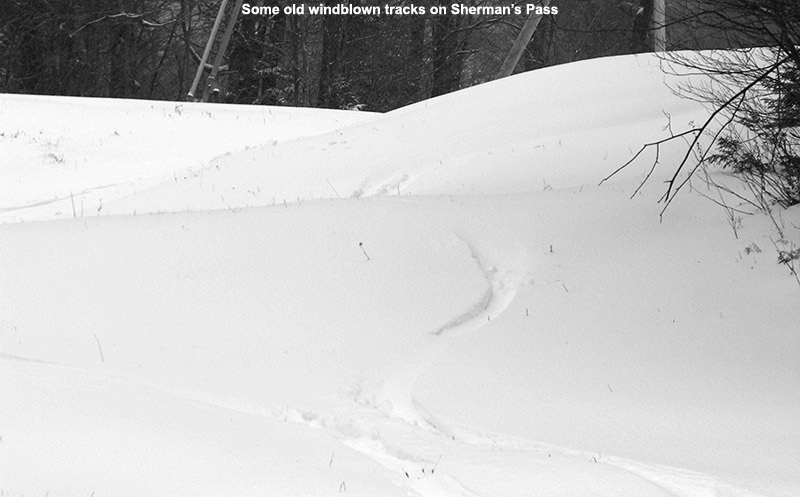
Some November turns on Sherman’s thanks to our recent snowstorm
November: I’ll put November 2011 into perspective by looking at November 2010, in which the ski conditions were apparently poor enough that we didn’t ski once. Fortunately, that didn’t happen this season – even if just by a day. The near lack of snow in November 2010 could be considered demonstrative of typical November snowfall in the valley though, because up to that point it had truly been feast or famine since we moved to our current Waterbury location in 2006. However, this past November finally bucked that trend by coming in with 11.4″ of snow (128% of average) which is as close to “normal” snowfall as I’ve ever seen for the month based on my data. We had a couple of minor accumulating snowstorms early in the month, and then another mid month, but it was a storm near the end of the month that really produced 95% of our November valley snowfall. That storm dropped almost a foot of snow at the house, and got me to head up to Bolton Valley for some turns. In terms of skiing, options for catching the new snow atop a manmade base were rather limited because most of the local resorts were of course using their manmade snow to serve customers, but I headed up to Bolton Valley to see if the natural snow alone was enough for some turns. Since they don’t open until December, Bolton hadn’t yet made any snow by that point, but it turned out that the storm had dropped over a foot of snow up there, and it was dense enough that one didn’t need much of it to keep them off of whatever lay beneath. I enjoyed some decent turns, even if that outing wound up being the only one for the month. This past November was a decent step up from the previous couple of seasons with little to no snow, but we’ve still yet to have a very snowy November since the 2007-2008 and 2008-2009 seasons; both those seasons delivered roughly 20″ of snow in the valley, and plenty more in the mountains. The general seasonal trend of warm weather continued right through the month as well; although much colder than October on an absolute basis, November was even warmer relative to its long range average, coming in 5.1 degrees above normal at the National Weather Service Office in Burlington.
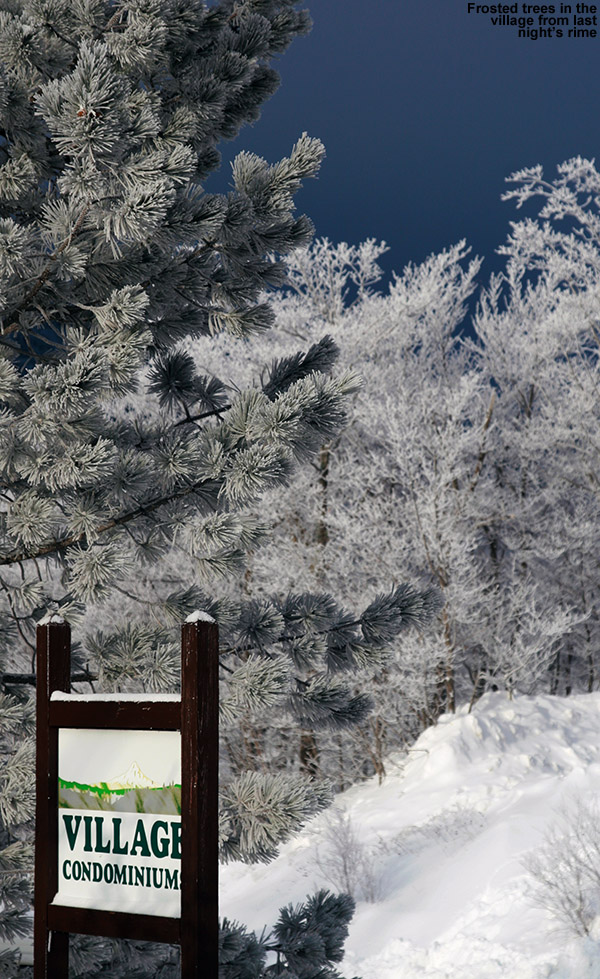
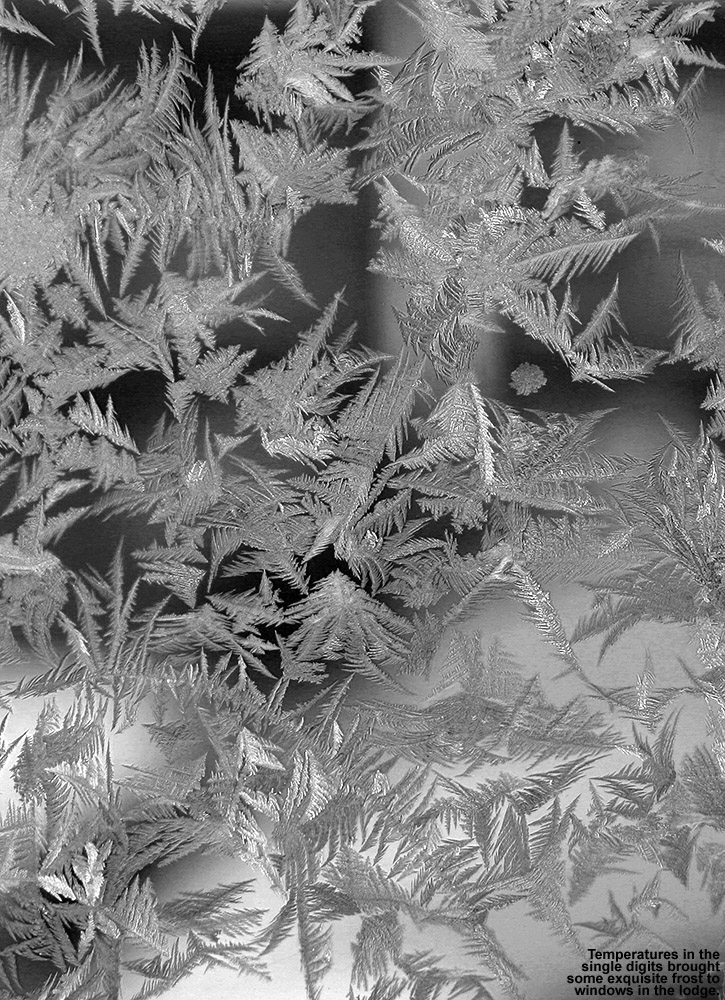
Holiday week frost delicately adorns one of the windows in the Bolton Valley base lodge.
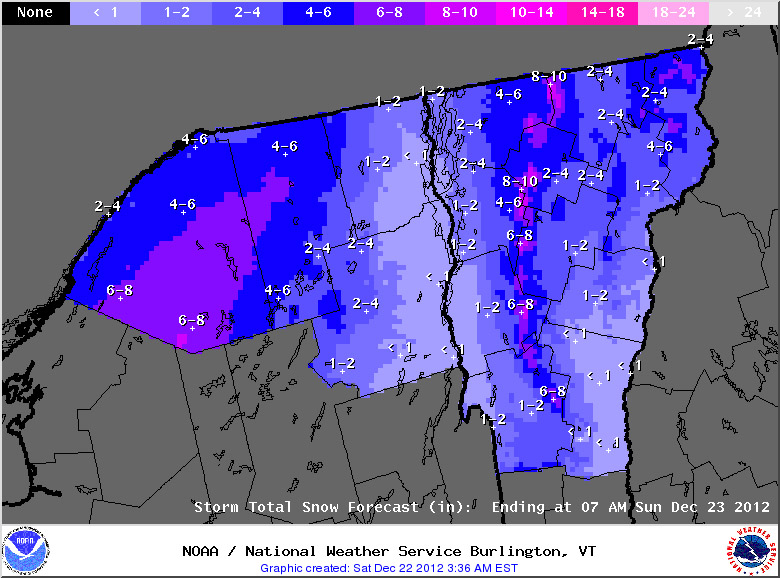
December: The first two thirds of December simply felt like a continuation of November; the pre-holiday period was hampered by above average temperatures, but the more notable issue was the absence of significant storms. The Northern Greens were holding their own thanks to numerous small snowfalls, and these events were definitely enough to get us into some powder skiing, but they weren’t enough to really build a deep base of natural snow. The last third of the month was really the highlight in terms of snowfall. As the all-important holiday week approached, Central Vermont northward finally got into some moderate storms. The localized nature of these storms was good for highway travelers from down south, and one could hardly ask for better timing of fresh snow for the holiday week. Storm 1 hit on Friday the 23rd, dropping roughly half a foot from Killington northward, storm 2 was on the 25th, centered on Stowe where they received over a foot, and storm 3 began on the 27th, with totals again topping out around a foot. The skiing was quite good, indeed excellent by the end of the week as the snow from the storms continued to pile up, but the lack of snowfall earlier in the month meant that the natural base depths weren’t there like they would normally be. Fortunately, some natural snow terrain was open, but certainly not the steepest stuff, and the natural snowpack was still just a bit too lean to spend much time in the trees. In any event, we skied eight times during that holiday stretch, a sign that there was definitely some good skiing. With all the new snow, our local area certainly had it a lot better than many places in the country did during the holiday week, so in that regard we were lucky. I’m sure business was still down at the Vermont ski areas in general, but people may have been hearing about the holiday snow that Northern Vermont was getting, because Powderfreak posted on Christmas Eve how lodging space was still very tight in Stowe. Despite the snow in the northern half of Vermont though, the general talk around the region was how poor and snowless it was in general, so I’m sure many places lost some potential visitors due to that. Even with those moderate storms at the end of the month, when all was said and done, we still ended up quite low on snowfall down at the house; the 24.7″ we received was just 59% of our average for the past six seasons. Temperature consistency/snow surface quality: With the slow start to snowfall, we didn’t even ski during the first weekend of the month, but we did get out for the other four. The second weekend was the one where there was no powder simply because there wasn’t enough snow. Temperatures were certainly above average as a whole (NWS in Burlington was +4.8 F on the month), but December mean temperatures start getting cold enough that even above average departures can still be sub-freezing and produce snow in the mountains . The third weekend of the month had some decent conditions at Stowe, and then the final two weekends sort of lose their definition with the big holiday week, and that period gets lumped together. Conditions for the holiday week were mostly wintry; strictly speaking though, the last weekend of the month did see a thaw, but in the context of the whole holiday week it was rather insignificant.
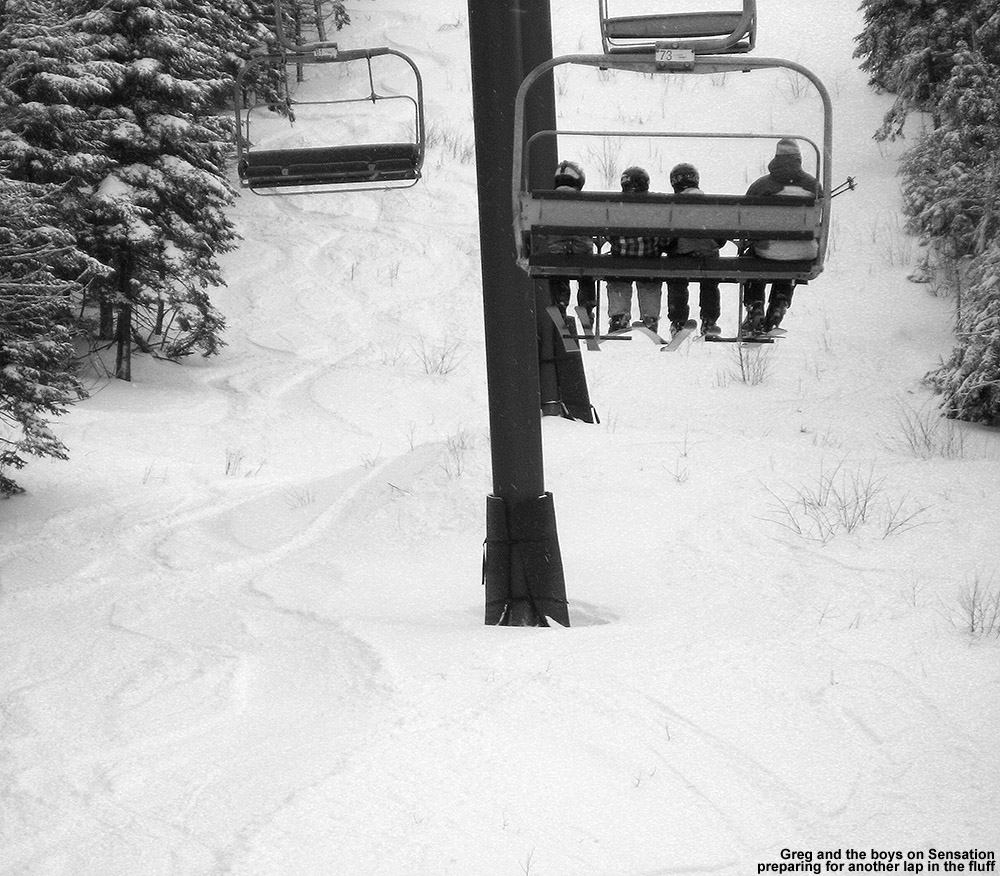
Greg and some of the boys riding Sensation today between laps in the powder below
January: We had 13 accumulating snowstorms at the house in January, which is quite decent and actually a bit above average in number, but as mentioned in the Snow Quality section of this season summary, we also had seven January thaws. These thaws didn’t mean torrential rains, but what we saw were many storms with mixed precipitation in the middle, cutting down on snow totals. The Northern Greens continuously made fantastic recoveries in snow conditions due to grabbing that upslope snow on the backside, so snow surfaces were quite nice in general, but in those first couple of weeks after the holiday storms, we got back into what Powderfreak calls “nickel and dime” snows. They kept surfaces fresh, but base depths built very slowly. Finally on the 12th, we got a more significant storm, which dropped two feet at Jay Peak, and roughly a foot and a half down through Sugarbush. That storm was an undeniably propitious event, and Stowe’s terrain was 100% open by January 14th. Again we saw Mother Nature pulling off some of her nice timing with that storm cycle, since it was just in time for the MLK weekend. I remember skiing great packed powder snow on Waterfall at Stowe on the 16th, and commenting to Powderfreak how astonished I was – it seems like that trail is hardly ever open even in a good season, and there we were skiing it with such premium snow in a very low snow season. We were fortunate to get that storm though, because after that it was back to nickel and dime storms with some of those similar mixed precipitation sandwich events with backside snows for the remainder of the month. Overall snowfall at the house was 32.6″, not quite as low as December, but still just 83% of average, so we weren’t making any gains on the low season snowfall. At +5.8 F, the deviation from normal temperatures at the Burlington NWS for January was even a degree higher than it had been for December. Like December though, normal January temperatures are cold enough that substantial snow can fall with positive departures like that. Temperature consistency/snow surface quality: With eight days under our belts from the holiday week, and nothing returning the conditions to midwinter after our Pacific Northwest-style outing on December 31st, we didn’t ski on January 1st, but we did ski on all four of the full weekends during the month. As seen in the outings list above, powder was present throughout our trips to the mountain, which was pretty amazing considering all those thaws/mixed precipitation storms.
It was storm skiing today at Bolton Valley.
February: There’s no question that February will go down as having the best skiing of the season in Northern Vermont, but the month certainly didn’t start out in a spectacular way. An initial half foot storm at the beginning of the month did a fantastic job of resurfacing the slopes after one of those January “sandwich” storms with mixed precipitation in the middle, and Mt. Mansfield continued to impress. Although still well below average in terms of both snowfall and snowpack, Northern Vermont was clearly doing extremely well in comparison to even Central Vermont by that point. After that initial modest snowfall event, our wishes for a weather pattern change that would get us away from all those mixed events were indeed answered, but perhaps not exactly in the manner we would have liked. Instead of switching over to more typical snowstorms, the precipitation basically shut off. Down at the house, we’d had just over half a foot of snow through the first three weeks of the month. For a month in which we average over 40″ of snow in the valley with a very low standard deviation of about 8 inches, we were staring at the potential for an amazingly low monthly snowfall total. Happily, the last week of the month ensured that February 2012 didn’t live on in infamy. We quickly picked up a couple of appetizer storms on the 21st and the 22nd, which didn’t produce much snow at the house, but delivered close to a foot in the mountains. It was on the 24th though that the big kahuna came through; that storm dropped up to 40″ in the northern mountains, with a total of over 50″ at Jay Peak for the three storms combined. It wasn’t just a fluff storm either; snow from that storm definitely fell “right side up”, and ski conditions were off the charts. So much snow fell so quickly though that the avalanche conditions got a bit tenuous in the backcountry. I saw mention that Jay Peak broke their 24-hour snowfall record during the storm, but since I see that listed as 42″, I don’t think that was actually topped with this storm. In any event, the natural snow depths made huge gains, and as mentioned above; that storm even brought the snowpack at the Mt. Mansfield stake to an above average level. With a final storm total of 22.7″ at the house, it was our largest valley snowfall of the season. That one storm pretty much made the month in terms of our valley snowfall, but we still ended up with just 30.7″, which is 73% of average. The general presence of heat didn’t let up either, and the departure from normal at the NWS in Burlington again went up an entire degree from the previous month to reach +6.8 F. Temperature consistency/snow surface quality: The great timing of storms continued, and even the reduced snowfall in the first ¾ of the month was enough to keep powder around; conditions certainly remained good as we moved through that first part of February.The big storm was wall to wall snow and timing hardly mattered, but it was a weekend event anyway, with storm day skiing on Saturday, and fresh powder and blue skies on Sunday. That weekend took the cake of course, but all four weekends of the month offered some great skiing.
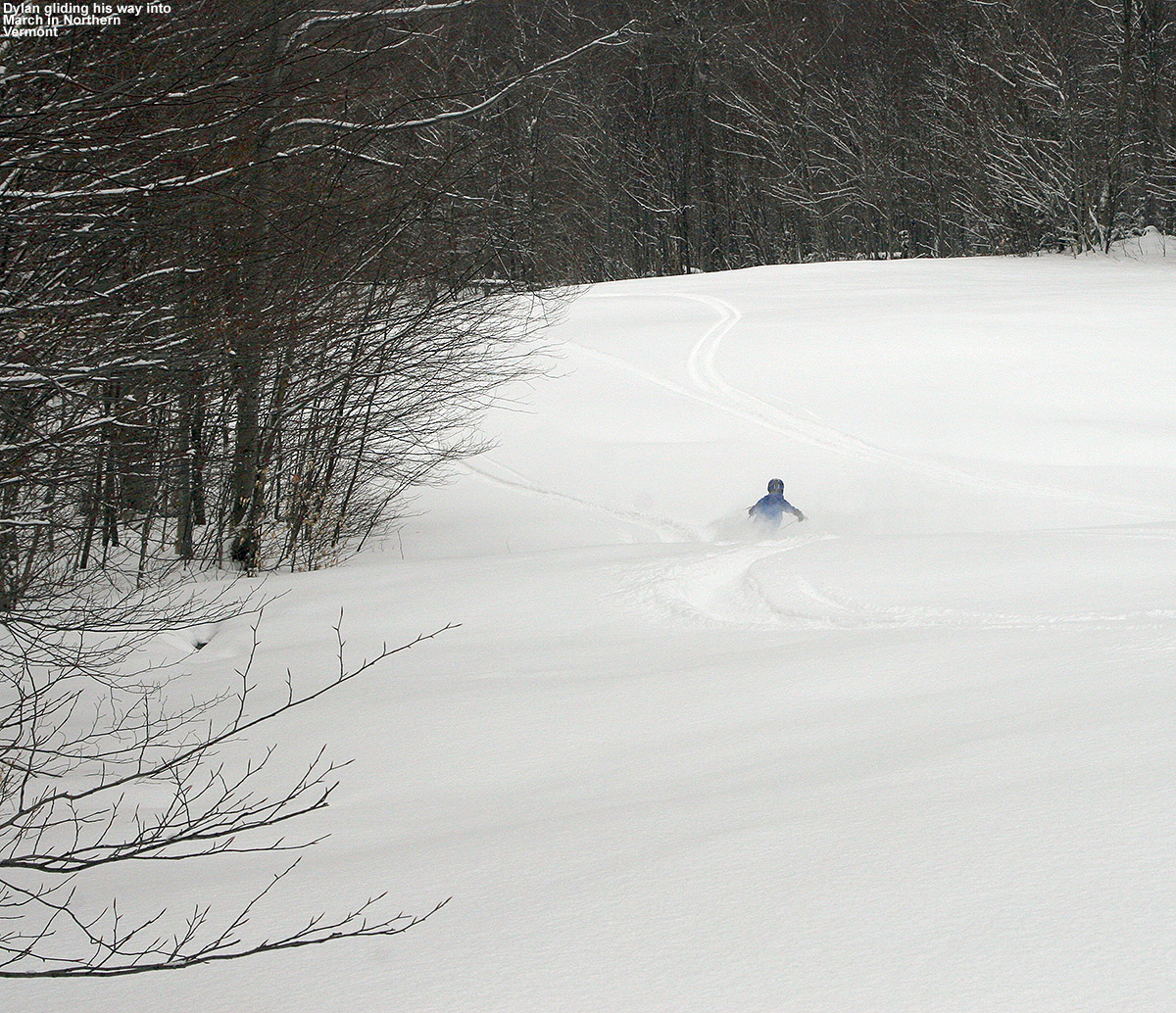
Dylan roaming the expanse of Spell Binder
March: The first half of March felt like a continuation of that decent stretch at the end of February, even if we didn’t get any additional three to four foot storm cycles. Just a few days after the big February storm ended, another decent cycle came through heading into the 1st of the month, with close to a foot of additional snow at the northern resorts, and a foot and a half at the southern resorts. Amidst other freshening events, a storm on the 4th dropped about a half foot of snow, and then over a foot fell from a storm on the 9th that targeted the north-central resorts. The boost from the big February storm was felt in base depths and surface conditions, and you could feel that the season had really turned into what one would expect for March. Even as unseasonable warmth started to intrude and occasionally turn the powder wet through the first half of the month, there was usually enough time to get in turns for a good part of each day while the powder was still dry, and then more snow would come along to freshen things back up. The weather through that period was certainly on the warm side, but it was during the second half of the month when all hell broke loose with regard to temperatures. That expression is somewhat apt, because for March, it felt like that when five consecutive days of record temperatures with departures of +40 F hit the state from the 18th-22nd. Combined with the more moderate warmth during the rest of the month, the result was an incredible +12.2 F departure from the average March temperature at the NWS in Burlington. With almost no new snow in the valley during that warm second half of the month, March snowfall was a paltry 14.2″ at the house, just 60% of average. Temperature consistency/snow surface quality: The list of ski outings from above shows the trend here quite well, the first two weekends offered powder conditions, and from then on it was spring skiing. However, powder had been available for every weekend or holiday period since the middle of December by the point at which the snow conditions flipped, and that’s a commendable three-month stretch for such a season. Beyond the middle of the month, X was the only way to describe the powder conditions until we finally got to April. There was decent corn snow and great weather during that second half of March, but it was so warm that trail counts dropped rapidly at many resorts; even the huge snowpack gains made by the northern resorts at the end of February were lost as the snow depth at the Mt. Mansfield stake fell well below where it had been before the big climb. Despite the good spring skiing, it seemed like many resorts closed down simply because people had given up on winter by that point. The slow start and rapid end to winter seemed to take the wind out of everyone’s sails and, it had them looking to quickly put the season in the rearview mirror.
A pair of skiers ascending Nosedive this morning amidst the continued snowfall.
April: Temperatures for the month of April still came in above average (+1.2 F) at the National Weather Service in Burlington, but after the unprecedented warmth of March, that felt downright cool by comparison. Indeed April was more typical though, and some good skiing returned, even if the slightly warm temperatures kept the snow especially elevation dependent. With that trend, snowfall down at the house was almost insignificant, just 0.5 inches or 8% of average. That’s the least snowy April we’ve encountered in the six years that I’ve been monitoring snowfall at our location. Storms nailed the mountains with snow though, in the form of a minor event on the 4th of the month, then a big cutoff low dropping 2 to 2 ½ feet on the 9th. That snow was fairly dense and represented an unmitigated resurfacing of the slopes as one headed up in elevation. The skiing was great, at least in a Sierra Cement/Cascade Concrete sort of way where it doesn’t take much to cover whatever is below, but it would have been even better if the March warmth hadn’t deteriorated the snowpack as much as it did. With most ski areas closed after March sapped people’s interest in the season, plenty of great earned turns were made, but at the resorts that had stayed open, there was also some excellent lift-served skiing. April finished off with one final storm at the end of the month, which was nothing like the big one earlier, but it dropped about a half foot in the upper elevations and that was enough for some final powder skiing before we moved on to May. Temperature consistency/snow surface quality: While certainly not up to the level of April 2007, we did get to ski powder on all of our April days except April 1st. Most of what fell during the month for snow was rather dense, but it was still a nice reprieve to have fresh snow after the way March had gone. We only skied three of the five weekends that month, as half of our outings ended up being midweek.
Heading over to another snowfield to our north for some smooth turns on the untouched snow
May: After some tempering of the heat for April, Mother Nature was back at the stove for May, with a +5.3 F departure for the month at the NWS in Burlington. We didn’t have any accumulating snow in the valley, although that’s typically the case down at our elevation. There were actually no significant winter storms to speak of, but we did have one Vermont ski day on the 12th, enjoying the last of the corn snow up at Jay Peak. We took advantage of a Mother’s Day package that offered a chance to sample a lot of the new facilities up at the resort (water park, arcade, restaurants, etc.), and indeed taking in that smorgasbord of activities is an especially nice way to go when skiing is only going to be a minor part of a trip. Our other day in the month was actually out of state in New Hampshire on Memorial Day weekend, taking our traditional camping trip Auto Road ascent with the boys to ski the snowfields. The snowfields were somewhat on the lean side this year, but not bad considering what the region went through meteorologically during the winter season.
At the monthly level, the 2011-2012 ski season was a simply amazing stretch of positive temperature departures followed by even more positive temperature departures, and that trend has continued right into the summer, with June and July coming in at +1.9 F and +2.4 F respectively. August is currently coming in with a positive departure as well, and if it ends up staying that way, it will be the 17th month in a row in the positive departure streak for Burlington. Those departures are going to flip at some point, and it’s going to feel quite chilly by comparison. Despite that trend though, even when combined with below normal precipitation, the quality of the ski surfaces encountered this past season in Northern Vermont was quite good. I’m not sure if I’m willing to say better than average, since I don’t think surfaces were better than average at Bolton Valley, but I am willing to say that in our visits to Stowe this season, the typical on piste surfaces we encountered were actually better than the previous season. One thought is that the lack big storms in general also played out as a lack of notable rainstorms, which while generally infrequent in the heart of winter anyway, are likely more detrimental to the snow surfaces than more modest events with simply some mixed precipitation in the middle. The Northern Greens certainly showed throughout this past season that they have the ability to cover the back side of mixed precipitation events with additional snow quite effectively when there’s at least some moisture in the atmosphere to be wrung out. The fact that business was down somewhat at the resorts, may also have contributed to less skier traffic and slightly elevated on piste snow quality. Whatever the case, for a ski season that felt like an abysmal “perfect storm” of sorts with regard to temperatures and precipitation, 2011-2012 in Northern Vermont can certainly be described as “surprisingly good”.
The skiing yesterday was so good, that it was definitely worth going back for some more today. Snow continued to fall last night, and even down at the house it was still snowing under partly cloudy skies during the first part of the morning. It was only accumulating minimally in our yard, but the radar showed the moisture continuing to crash into the Northern Greens, so the mountains were getting at least of bit of additional accumulation. Down at the house, the mix of clouds, sun, and snowfall eventually gave way to full sunshine. Ideally, it would have been nice to head out really early to catch the powder before it was potentially affected by the late April sun, but the boys were enjoying a leisurely start to a day off from school, and we didn’t head to Stowe until late morning.
With the clear skies, it was a chance to finally see how the snowfall had played out in the mountains on our drive to the resort. The first thing I could see was that accumulations of white were just painting the tops of the ~2,000’ peaks across the Winooski Valley from our house. Our next view was of the Worcester Range, which was white for about the top 1,000’. The real dramatic views came when we finally saw Mt. Mansfield though, where the alpine regions were just blazing white above the touches of green foliage in the valley. Everyone in the car was stunned by how white the mountain looked, and E pulled over so I could get a few pictures from a good viewpoint.
Our first views of Mt. Mansfield revealed some stunning bright snow above the developing foliage in the valley.
Unlike yesterday, we found the gate to the Mansfield parking lot fully locked, so we parked right near it along with the cars of a few other people who were doing the same thing. We geared up, and walked over to the area above the Mansfield Base Lodge. The morning sun was already warming the snow in the lowest elevations, and I could see that there was less snow down near the lodge than when I’d been there yesterday. The temperature was still 34 F at the base though, so the freezing line wasn’t going to be too far above us.
E and Ty skinning up North Slope today for some April powder
We put on our skins right on the flats above the lodge. We were able to piece together a skin route up to Crossover fairly easily, but some gaps in the snow cover were starting to form. The strong April sun was also starting to make the snow sticky, but there was a nice stiff, cold breeze that seemed to be fighting against that. E and the boys weren’t too psyched by the look of the snow coverage, but I assured them it was going to get much better above 2,000’, and indeed it did. Not only did the coverage get better, but the snow was much drier above the 1,800’ Crossover level, and it looked like turns were going to be quite good. We encountered a few groups making ascents and descents, and a lot of dogs, but they were all quite well behaved. Actually, one of the coolest dog encounters of the day, or perhaps lack of encounter, was with what we’re guessing was a Samoyed. He appeared way above us, and came bounding down toward us with fur so incredibly thick that the look was that of an abominable snowman. We’d seen a few people around, but there was no obvious owner in sight, and when the dog came by he didn’t hassle us at all, he just passed along with a friendly look and went on his merry way. He definitely had the bearing of a dog that was built for snow and was having fun in his environment. We were able to continue our ascent up to around the 2,800’ elevation just above the top of the Mountain Triple before the boys really decided that they’d had enough. E was also unsure about the quality of the snow, and didn’t want to continue on a long ascent just to get more snow of marginal quality. Based on my impressions of the snow, which had continued to dry out more and more as we ascended, along with the body language of the skier’s we’d seen descending, I felt that the conditions were going to be great. But, you never really know how it’s going to ski until you try it, so I offered to skin up a little farther and ski down to check the snow before we made our final decision about the descent. Dylan was full of energy and made the ascent with me. After removing our skins, Dylan made the first descent, and once I saw him rip off a beautiful Telemark turn, I knew we were going to be in great shape. Indeed the snow was fairly nice packed powder up at that elevation; the cool temperatures and breeze were doing their job well.
The birthday boy with his new shiny goggles takes a break in the snow during our descent.
We still descended at that point, and went by the same route we climbed, knowing that the coverage was decent and there would be a lot of good turns. The boys had several days of fairly intense Telemark training toward the end of the lift-served ski season at Stowe, but it’s been a few weeks since they did all that work, and E was wondering if they would retain all the progress they’d made. It was also the first time since those sessions that they’d been in powder, chowder, or any type of winter snow. We were happy to see that those first turns that Dylan made weren’t a fluke, and the boys really made a lot of excellent Telemark turns, even some in steep terrain in the chopped up powder. Various groups of skiers and riders had used the North Slope route by this afternoon, so most of the terrain was tracked up, but we still found some nice areas of untracked snow, and those were some of the best turns of the day. The last pitch of North Slope had a few tricky spots because it’s steep and has some areas of rock instead of grass, and then below Crossover in the terrain park area it was a game of connecting the dots among sticky snow, but it was a pretty minor part of the run compared to the bulk that had good snow. The fun part about that last section was the team route finding, and playing in the pockets of powder that had settled in among the vestiges of the some of the terrain park features.
Like Dylan, Ty showed some great recall on all the Telemark practice he put in this spring
Overall I think E was pleasantly surprised by just how good the snow turned out to be; it certainly wasn’t up to the quality of yesterday by time we got out, but there was definitely some midwinter snow above that 1,800-2,000’ level. I was intrigued by the interesting interplay between the strong sun and the cold and wind; I’m still amazed at how well the snow avoided getting sticky in the higher elevations. It was definitely a really good outing for Dylan. First off, it was his birthday, but he also go to use his new Anon goggles for the first time and he was very excited about that. On top of that though, he really had good energy on the ascent and made some really nice Telemark turns on parts of the descent. I’d say he kicked off his seventh birthday with some style.