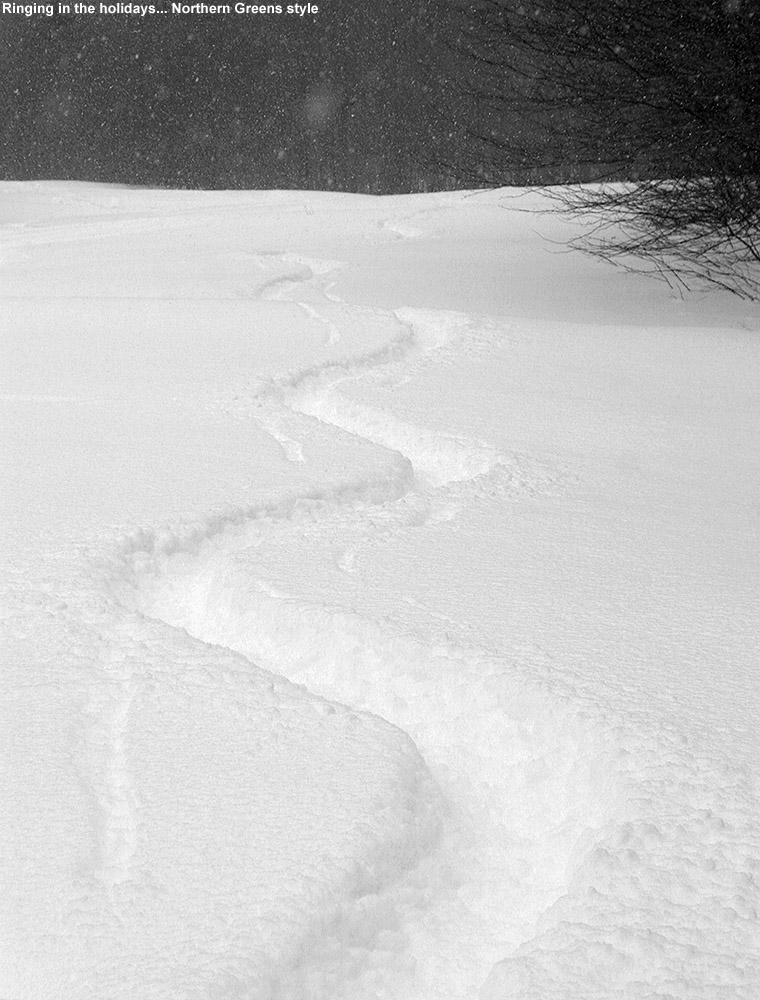
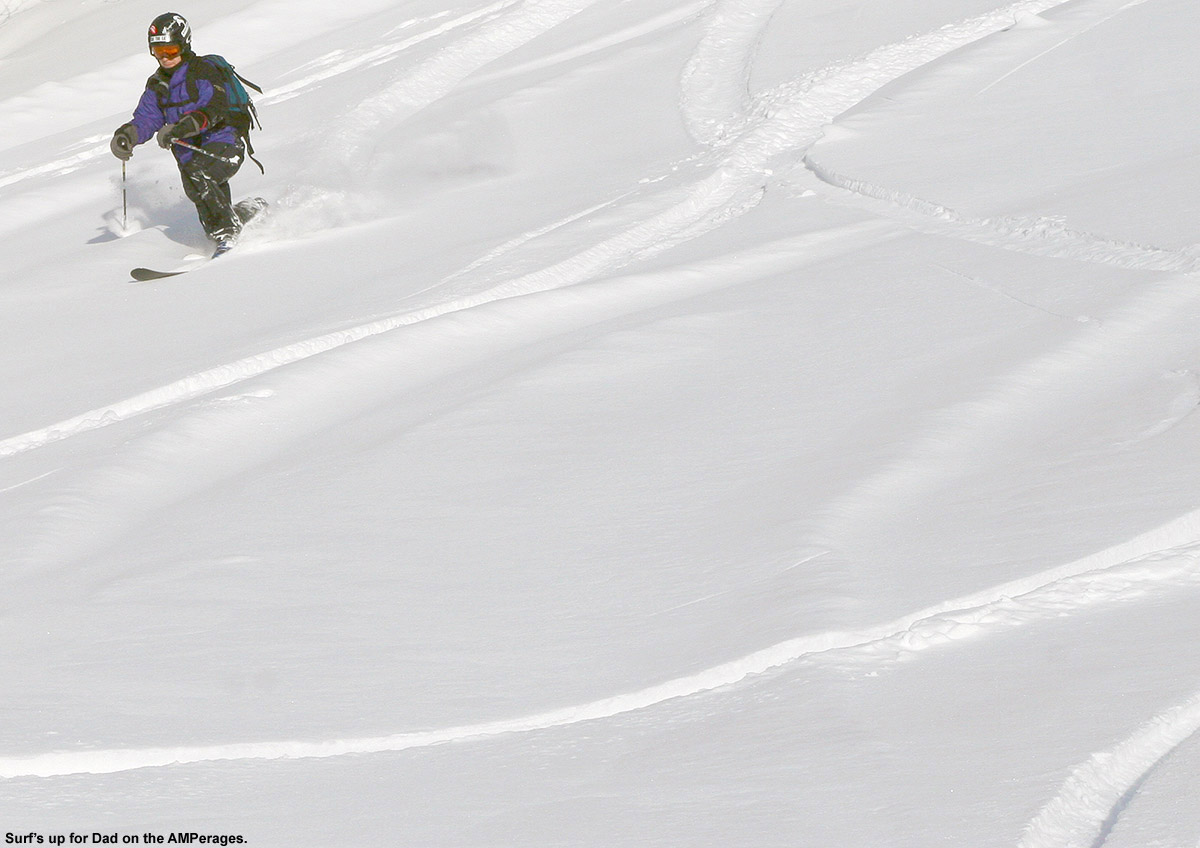
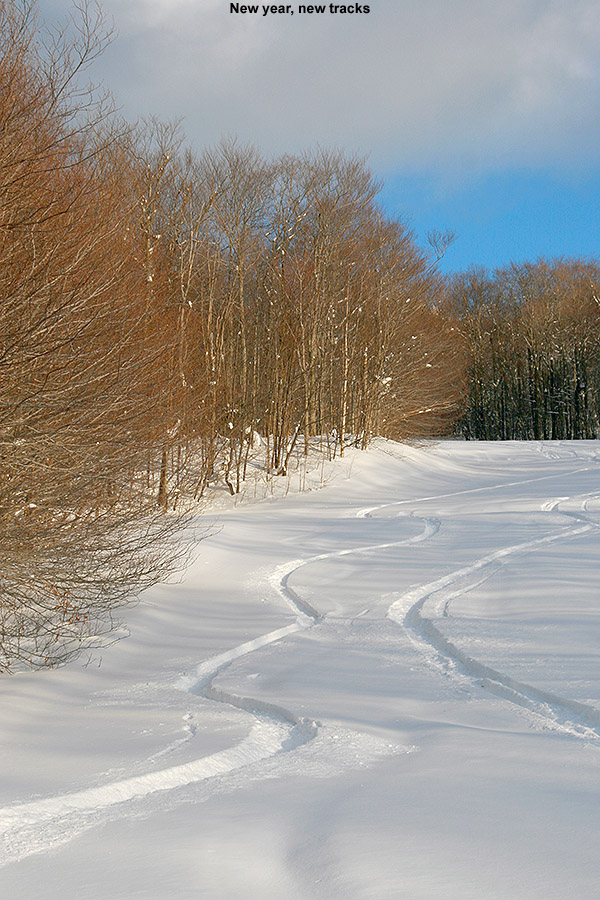
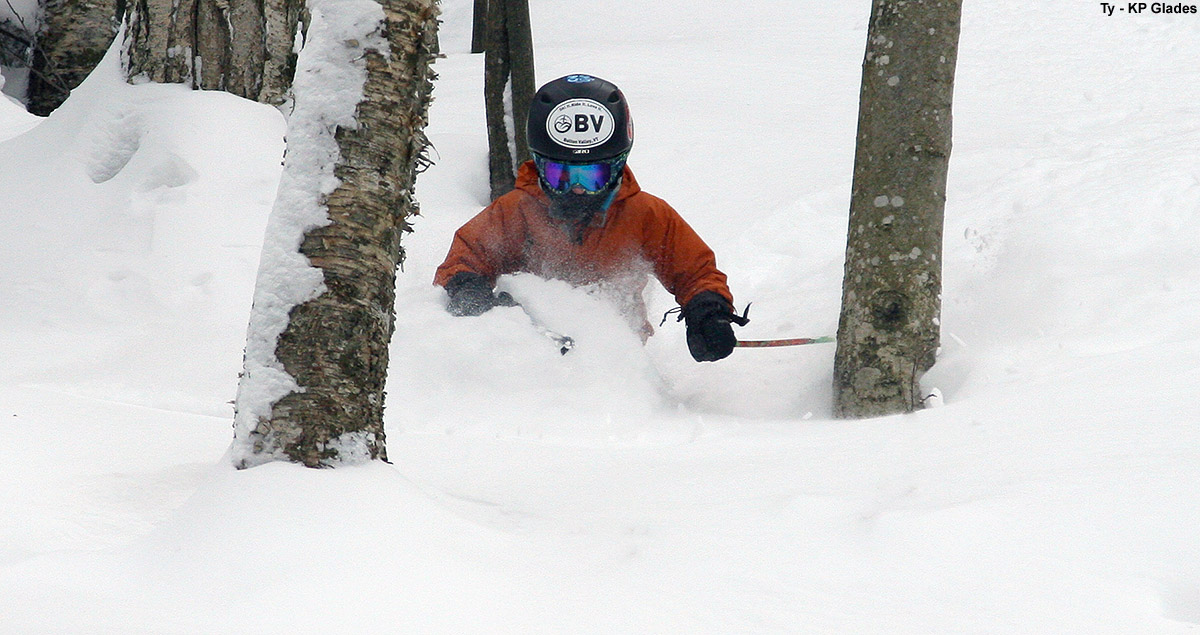
A couple of modest storms have helped replenish the powder at Bolton Valley over the past few days, and there could be more on the way tonight.
It’s been two weeks since I was last out on the slopes, because there hasn’t been much to draw me out in the interim. We finally got a small snowstorm on Wednesday though, and with another few inches of snow at the mountain overnight into this morning, it seemed like it was time to check out how the powder was building up. Actually, the potential exists for a few more inches of snow tonight with the passage of an arctic frontal boundary, so my real goal was to make a reconnaissance run to see how the snow might be set up for tomorrow. If things come together to offer up some quality turns, it could be time to entice E and the boys up to the hill.
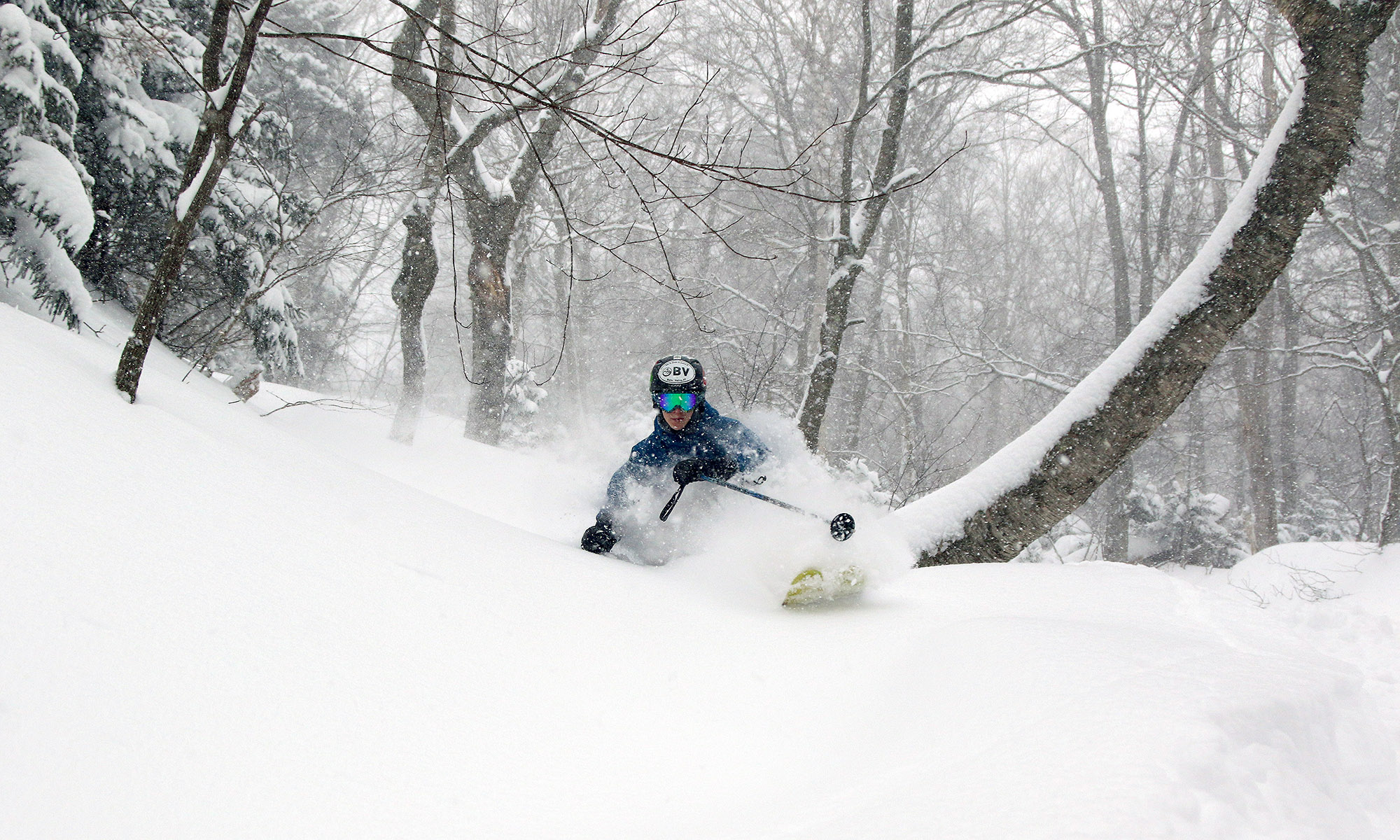
“The snow wasn’t overly deep with just 4 to 5 inches, but the pitches fit that depth quite well, the turns were mostly bottomless on the fat skis, and it was some damn fine powder skiing.”
After hanging out at home and watching some of the AFC Championship game featuring the Patriots, it was almost 4:00 P.M. before I got headed up to Bolton Valley. I knew that it was going to be getting toward dusk by the time I got on the snow, but I also knew that it would be quite peaceful, and I’ve really been enjoying these tours that I get to finish off while descending to the lights of the Village. Comfortable temperatures in the upper 20s F down at the house in Waterbury, gave way to somewhat chillier temperatures and snowfall as I ascended the Bolton Valley Access Road. Our little system from earlier today had dropped a couple inches at the house, and 2 to 3 up at Bolton, but there had been a snowfall lull during the middle of the day. As evening approached however, snow associated with the upcoming frontal passage was making its presence felt, and as usual, it was starting in the higher elevations. The intensity of the snow increased as I ascended, and the road began to take on a light accumulation of snow at ~1,200’. With no night skiing going on tonight, numerous cars inched their way down the road as they finished off their ski day. I made a brief stop at the Timberline Base to check on the snow situation at 1,500’, and indeed as expected, I found that the snowpack is still a bit too lean down at that elevation to be supporting comfortable skiing without rock skis or junkboards. There was only 1 to 2 inches of powder down at the base lodge, and that was on top of a fairly thin base. The snowpack was much improved up in the Village at 2,100’ though, where there was a decent base of several inches, and a consistent 4 inches of powder.
Other late-day turn-earners
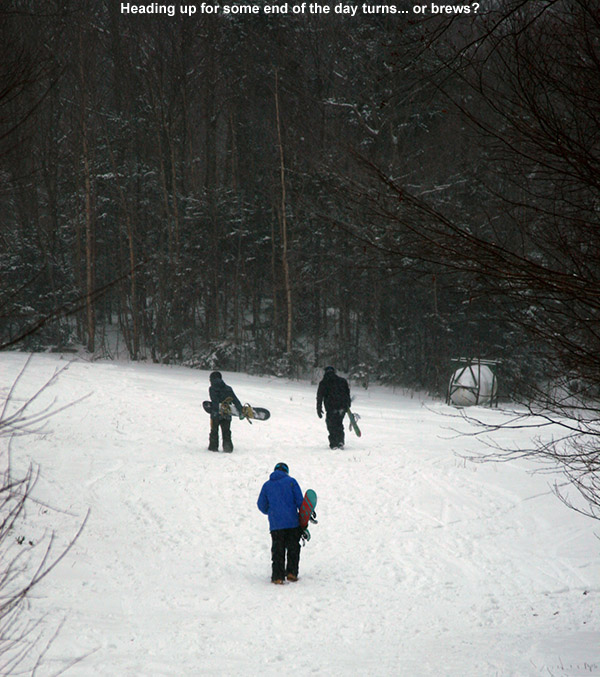
I geared up and began my ascent of Turnpike, watching three snowboarders ahead of me that appeared to have similar thoughts. In a couple of minutes however, they stopped along the trail just after the junction of Turnpike and Wilderness Lift Line, cracked open some beers, and kicked back in the snow. Good times. We exchanged greetings as I passed, tossing around comments on the joys of the new snow, and I continued upward. There was a nice skin track at times, although it did get disrupted as ski tracks merged and diverged from it, or the end of the occasional deeper water bar forced it away from the trail’s edge. Steady light snowfall continued, and an occasional gust of wind worked its way into the protected confines of the trial.
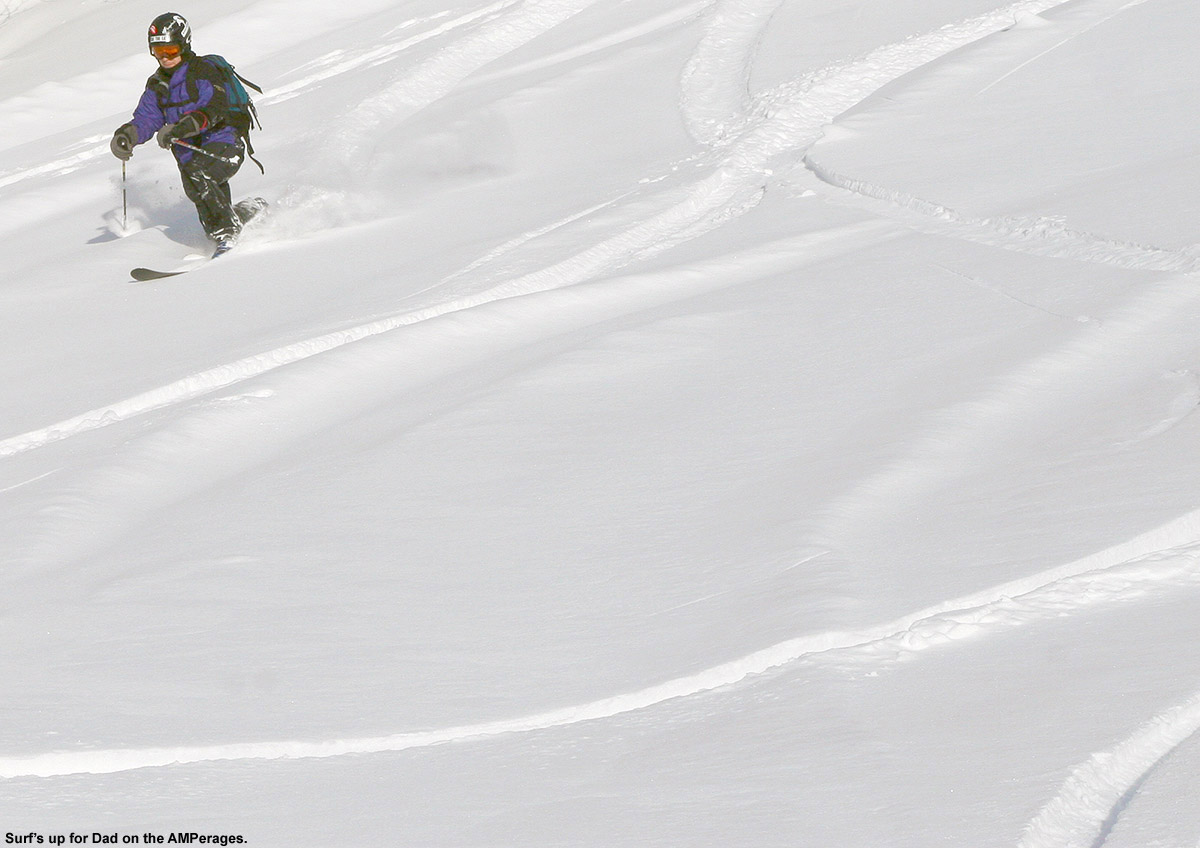
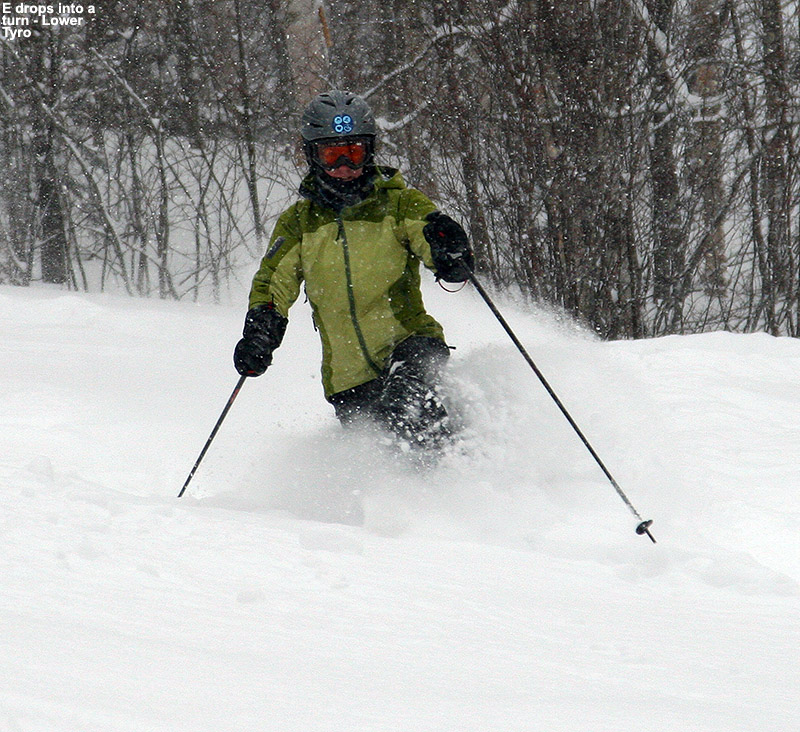
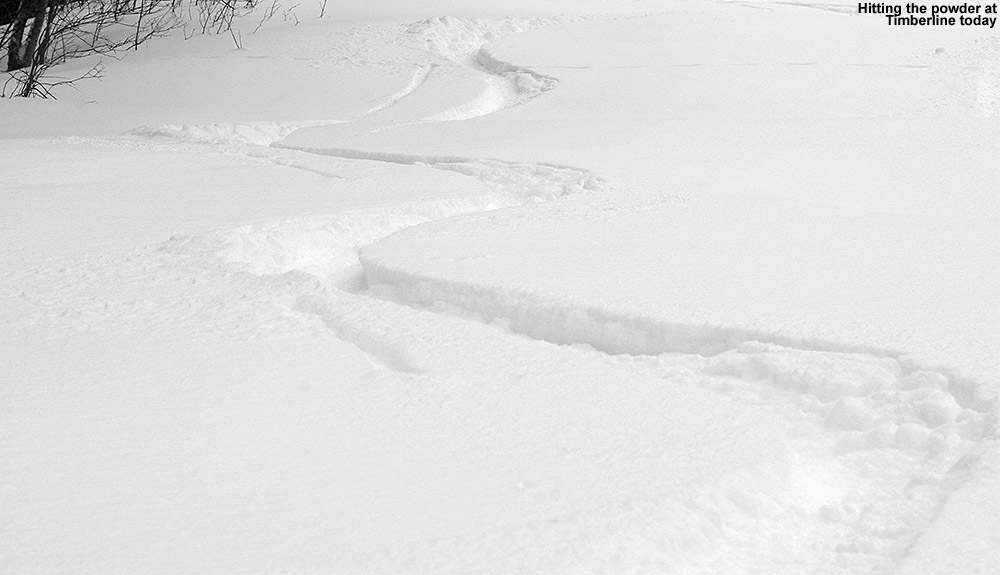
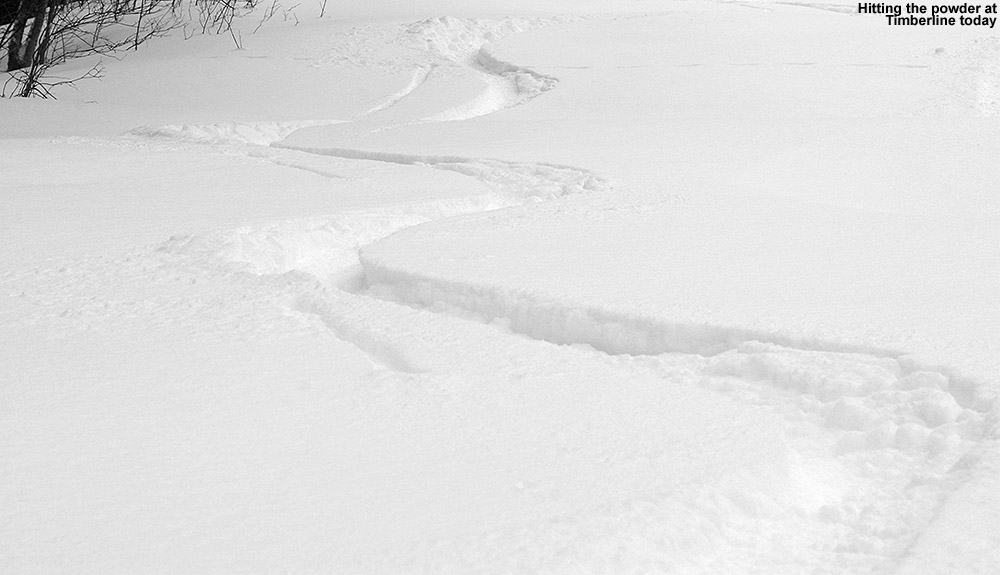
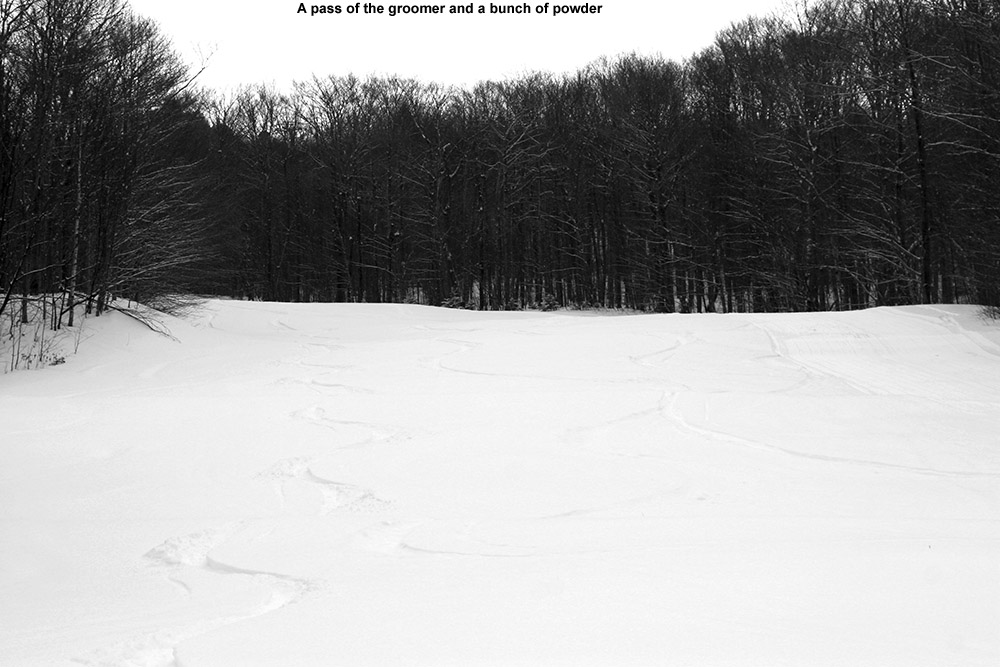
Being a trial run, and paying some respect to the growing darkness, a decided to stop at the connector between Turnpike and the Wilderness Lift Line around 2,500’. The depth of the powder had increased just a bit by that point, and measurements were in the 4 to 5-inch range. There was some untracked snow still remaining on Turnpike, but despite being a bit more exposed to winds, the Wilderness Lift Line had seen a lot less traffic and seemed like the way to go for fresh tracks. There were some tracked areas off to the left and right, but excellent lanes of powder showed themselves near the middle of the trail, even in the darkened view allowed by my goggles. The turns, as I’d later describe them to E, were what I’d call “par for the course” for that area over the past few weeks. The snow wasn’t overly deep with just 4 to 5 inches, but the pitches fit that depth quite well, the turns were mostly bottomless on the fat skis, and it was some damn fine powder skiing. The only complaint would be that the snow was a little cold and slow in spots, so maybe an extra coat of wax would be in order if we try something similar tomorrow.
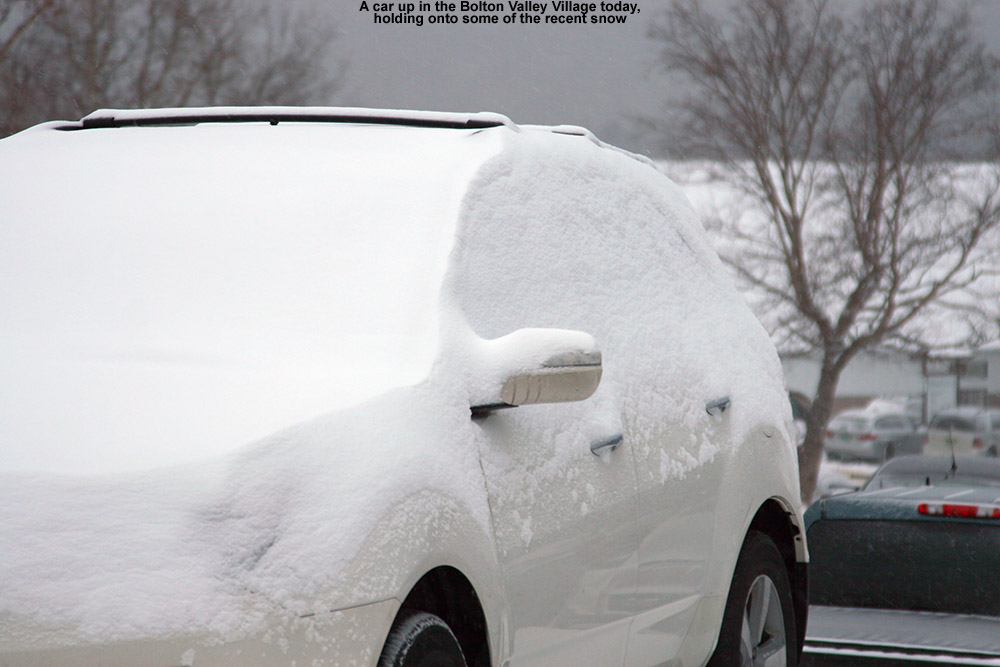
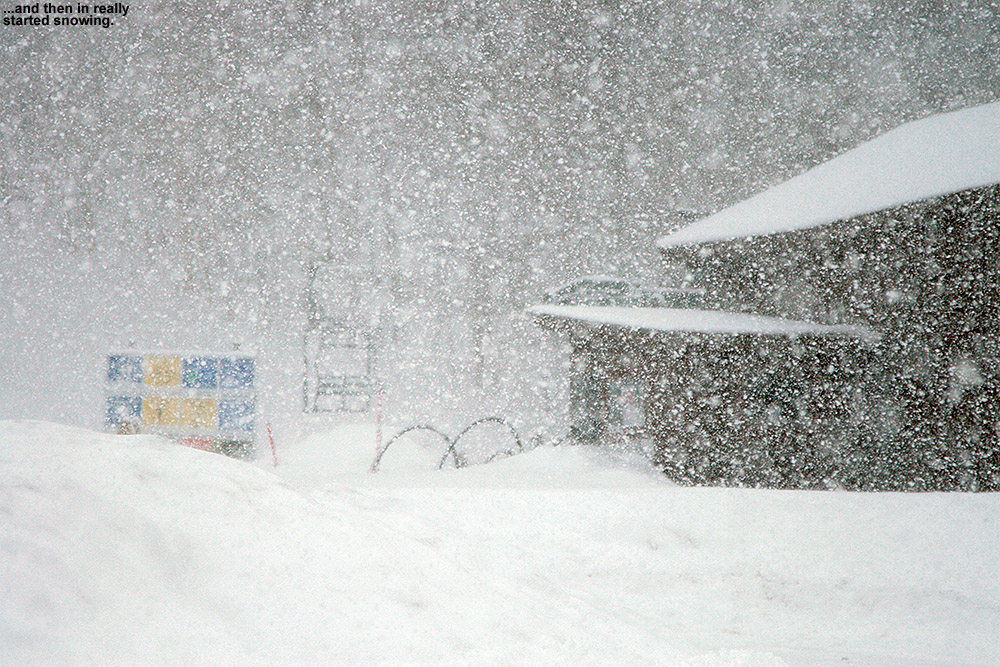
There were no signs of the snowboarders by the time I reached the bottom of my run, but the Village was abuzz with lights, and televisions that were probably set to the Patriots game. I stopped in for a few minutes at the big screen set up next to Fireside Flatbread in the lodge, and it wasn’t looking good for the Patriots – the Broncos were up 20 to 3. Outside, the snow had redoubled its efforts, and was coming down at a moderate pace. I had to take some time to wipe the snow off the car, as there was a good coating on the leeward sides. Snowfall that was initially more minimal down here at the house has picked up as the evening has progressed, so we’ll have to see where things stand tomorrow with the new snow. Winter, and fortunately powder skiing, is certainly back after its earlier hiatus.
Although I never made it up to the main mountain yesterday, the skiing I found at Timberline was quite good, and suggested that the snow would be even better at higher elevations. That snow, combined with the continued moderating temperatures expected to rise through the 20s F into the 30s was a recipe for some very nice skiing. The forecast has been predicting these conditions for a while, and E and the boys were on board for getting up to the mountain today as well. I’d told E about yesterday’s turns, so we had to decide if we wanted to go for some of that powder at Timberline, or ride the lifts and ski at the main mountain. We decided that it would be good for the boys to get in some lift-served skiing at Bolton Valley, since they’ve yet to do that at all this season. We also realized that we could still work in some Timberline powder if we spotted a car at the Timberline Base, and that would get the boys a little of everything.
“I have to admit, I could really tell the difference between being on my mid-fats today, and being on my fat skis yesterday.”
When I was checking out the Bolton Valley website yesterday evening, I noticed that they were having a special promotion today – it was the first of four Subaru/Hyundai days in which owners of those vehicle brands could get a free lift ticket for the afternoon. Also, additional guests could get tickets at 50% off. I wouldn’t have been more than a passing thought, except that E was thinking of getting out with Gabe, one of our BJAMS students, to let him practice snowboarding before our regular season program begins at Stowe next week. I told E about the promotion this morning, and although it turned out that she didn’t get together with Gabe, we had another potential student that could use a ticket. E was planning to get together with Claire to work out the ski groups for the ski program, and during their planning, they realized that Luc could come and ski with us using a free ticket.
Claire dropped of Luc with plans to meet with E again later, and we headed up to the mountain. Heading up the access road, it was right as we approached the Timberline area that we realized our day was going to be a bit different than we’d expected. The sign was already up indicating that the upper parking lots were full, and that meant that there were a lot of visitors at the mountain today. Although we could probably have found a spot up in the Village lots from people that were leaving, we decided to park the cars at the Timberline Base, since we’d already been planning to end up down there anyway. It was about three runs of the shuttle before we were able to get on, but once we did, the boys loved it since it was their first opportunity to ride the Bolton Valley shuttle bus.
“I guess when half the state owns Subarus, you’re going to get a response to such a promotion.”
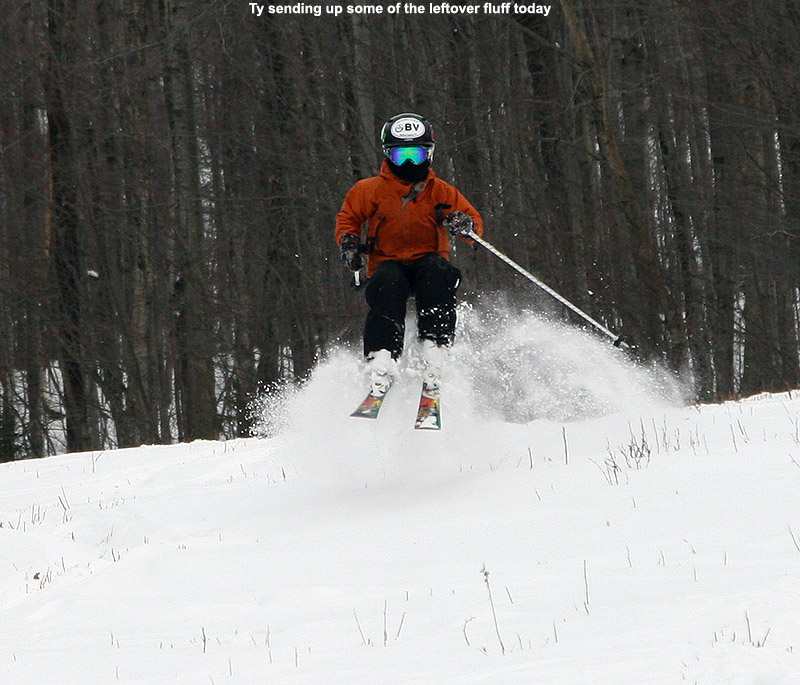
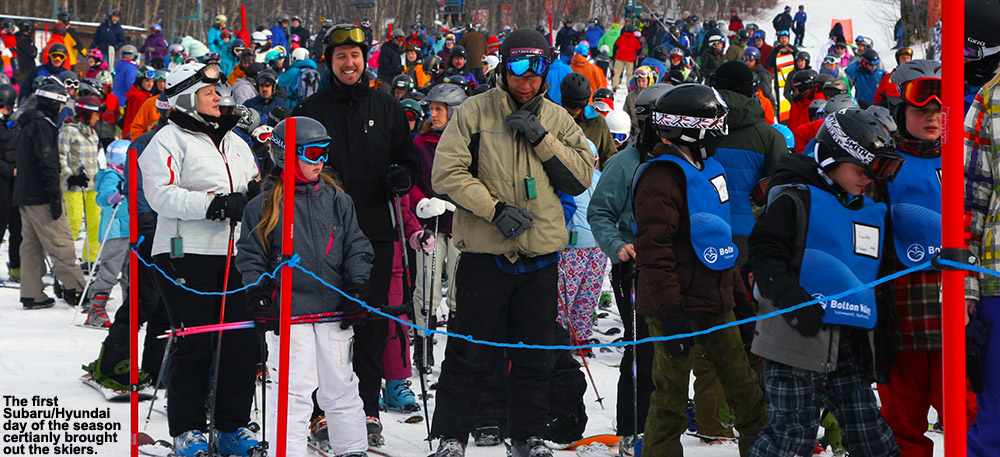
As if the need to initiate parking down at Timberline hadn’t been enough of a signal, at the base area, it was immediately obvious that the Subaru/Hyundai promotion was a hit. I guess when half the state owns Subarus, you’re going to get a response to such a promotion. The lift queue at the Vista Quad was quite long, and had to be at least 10 minutes. We decided to take a run on Snowflake, since the queue wasn’t too long, and the snow on the Butterscotch slope looked quite good. Indeed the snow was quite good, with some powder off to the edges, but it was just too short a run to be waiting 5 to 10 minutes to ski it, so we decided to make the next run down to Timberline.
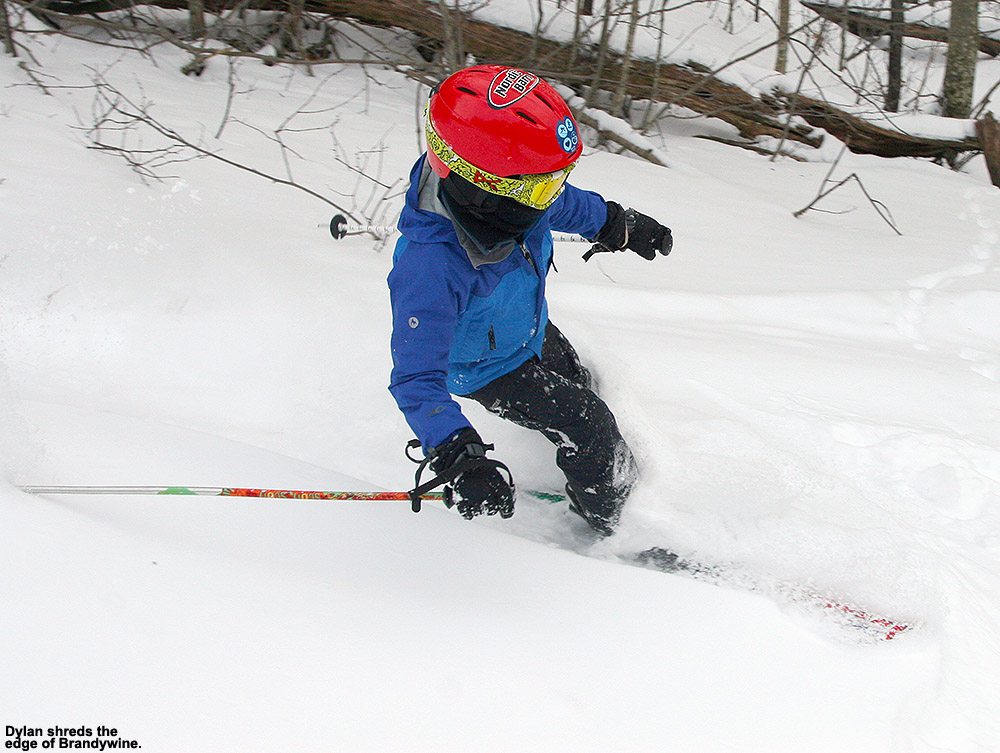
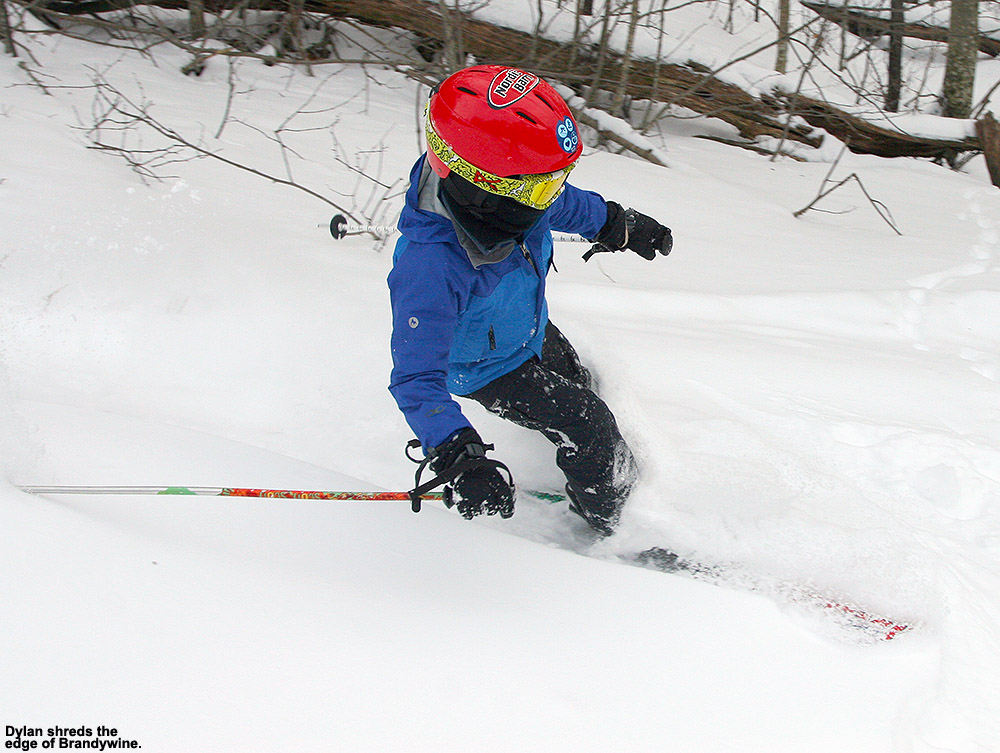
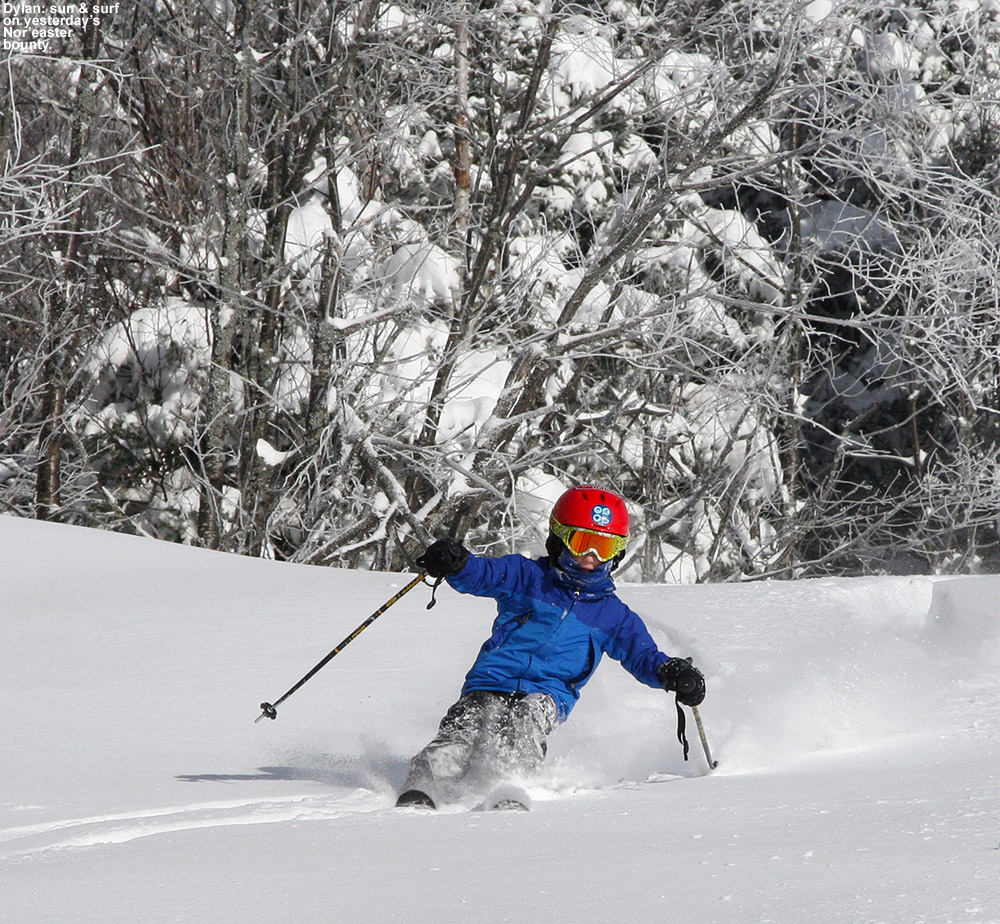
Dylan making quick work of the powder out there on Brandywine
From my Timberline explorations yesterday, I knew that there would be plenty of decent skiing even if we just followed out the Timberline Lane traverse to Brandywine, so that’s what we did. When we got there it was immediately obvious that there were more tracks than yesterday, so it was more challenging to find fresh snow. Also, folks were finding the skiing a bit tricky, due to the snow composition and coverage. I have to admit, I could really tell the difference between being on my mid-fats today, and being on my fat skis yesterday. Typically that difference in powder performance is more subtle, but not today – the fat skis had kept me that little bit higher in the snow yesterday, and that meant minimal interaction with the base or any crust that was sandwiched in between the layers of powder. Also, with the areas of untracked snow not as vast as yesterday, it limited line choice. Although the conditions were a bit challenging for E and the boys at times, there were still a lot of great sections of powder, so great turns were made.
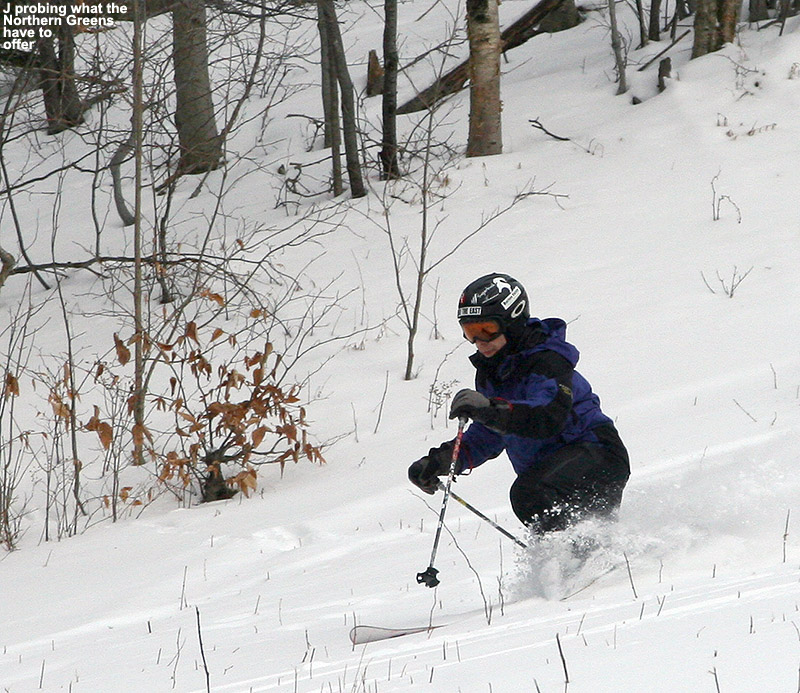
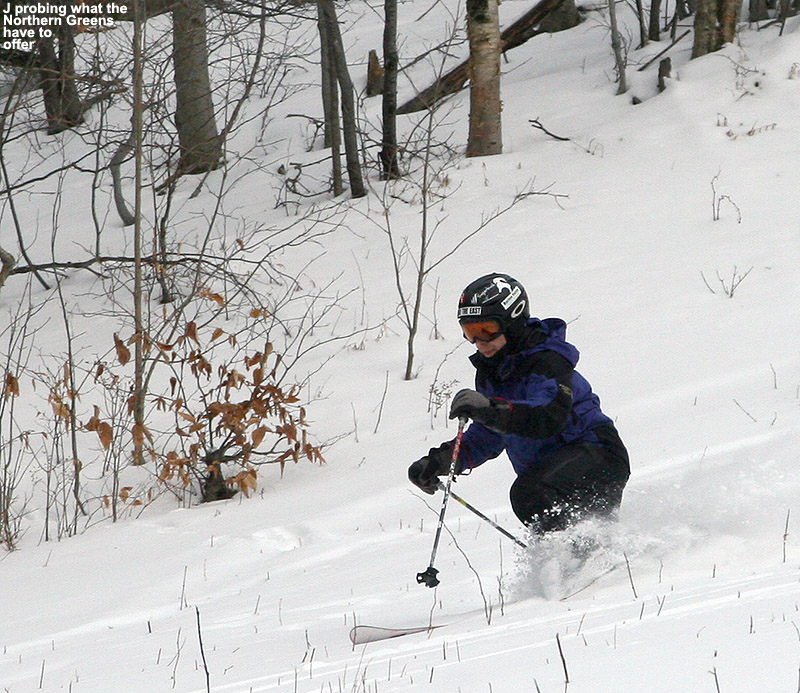
Even without getting in on the biggest accumulations, the Northern Greens have been doing their thing to the best of their ability.
Back down at the cars, it was mid afternoon, and the combination of lift queues and conditions on Timberline that while OK, certainly didn’t have E and the boys raring to go for more, and that made it an easy decision to just call it a day. We headed back to the house where E and Claire spent some time working out all the groups for the ski program. I’m not sure how many extra tickets were sold today for the promotion, but it certainly brought people out. The fact that it was a nice mild day after the recent cold weather probably played into it as well. Hopefully they can have some of the other main lifts open for the next one of these promotional days, because that wouldn’t put so much pressure on the Vista Quad. With the base snow that is out there, all that’s needed is one good synoptic snowstorm to hit the area without going too far south or north and most terrain would be able to open.
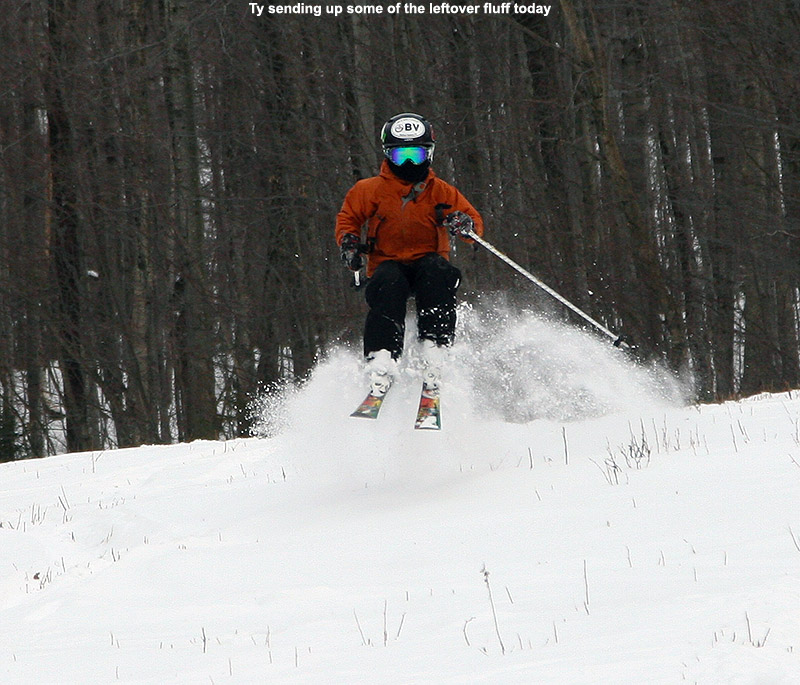
Despite only modest storms over the past week, the snow has definitely built up for some nice powder skiing.
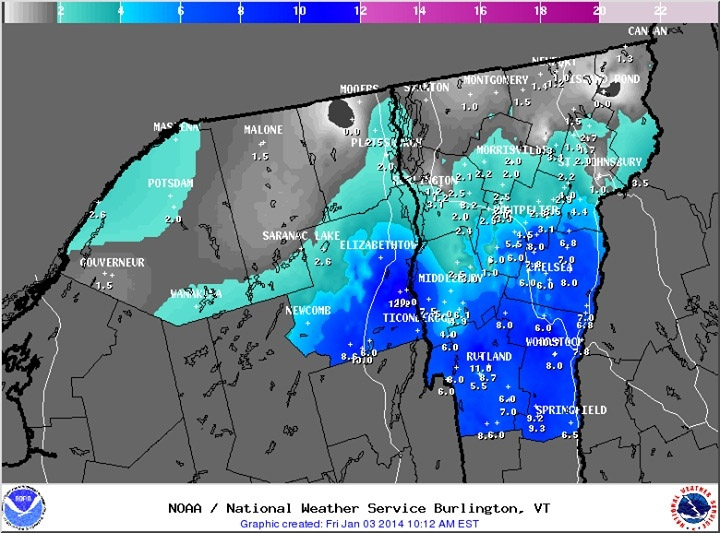
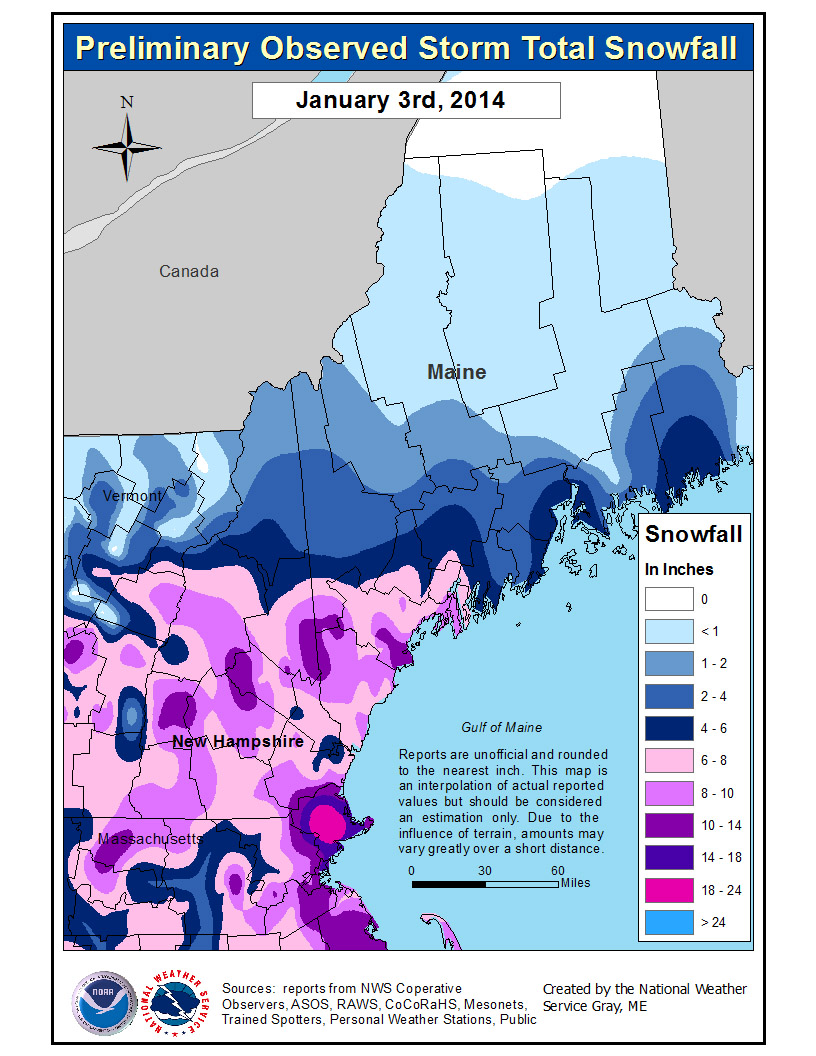
Our weather pattern in the Northeast has been fairly active over the past week, with four storms affecting our area since December 28th when I was last out on the slopes of Bolton Valley. For Northern Vermont, these storms really haven’t been big hits though. The first storm on the 29th was one that really hit Central Vermont and New Hampshire, and areas off to the east in Maine, while areas to the north and south of that saw little if any snow. In general, the ski resorts in the southern 2/3 of Vermont picked up the snow, with Okemo topping the list at 10 inches. The second event was just a little cold temperature diamond dust that fell from a weak short wave system through the midday hours on New Year’s Eve. Third in line was a weak Alberta Clipper system that brought a couple of inches to the northern valleys and mountains, and the fourth was the big kahuna… at least for some areas. It was a coastal storm that was pretty far off shore, so again it was southern areas that picked up the largest snow totals. For the Vermont ski resorts, Stratton topped the list with 18 inches, although there were places to the north of Boston that picked up two feet. In terms of Northern Vermont it was again a fairly minimal storm, but the few inches that fell were quite dense. Here at the house we picked up 3 inches of snow, but it contained almost a third of an inch of liquid. One notable aspect of that storm was how cold it was – it was snowing significantly with temperatures in the single digits and even below zero Fahrenheit. That was part of what made the snow up here so dense – it was actually too cold for optimal dendritic snowflake production.
“One of my favorite parts of the descent was playing in the dips and rolls along the skier’s left of the trail – there was some incredible flow, and the fats had that “no width” feeling much of the time.”
Despite the recent additions of snow, there hasn’t been too much incentive to ski over the past couple of days, basically because of the continuation of those cold temperatures. When the high temperatures are below zero Fahrenheit, as they have been in some locations this week, I’d much rather get other work done and save skiing for when the temperatures become more respectable. Fortunately, today was that day. Temperatures climbed into the low 20s F this afternoon, and since I was curious about how those rounds of snow over the past week had settled in up at the mountain, it was time to check it out. I really didn’t know what to expect up on the hill. New trails have been opening up on natural snow, including some black diamond runs like Schuss and Vermont 200, so that seemed like a good sign. I was also curious about the lower-elevations on Timberline though. If the recent snows had put down enough coverage there, I was excited to skin up for some powder turns. To cover my options, I put both the fats and mid fats on the ski rack, and threw their skins in the back of the car. I was ready for whatever was out there.
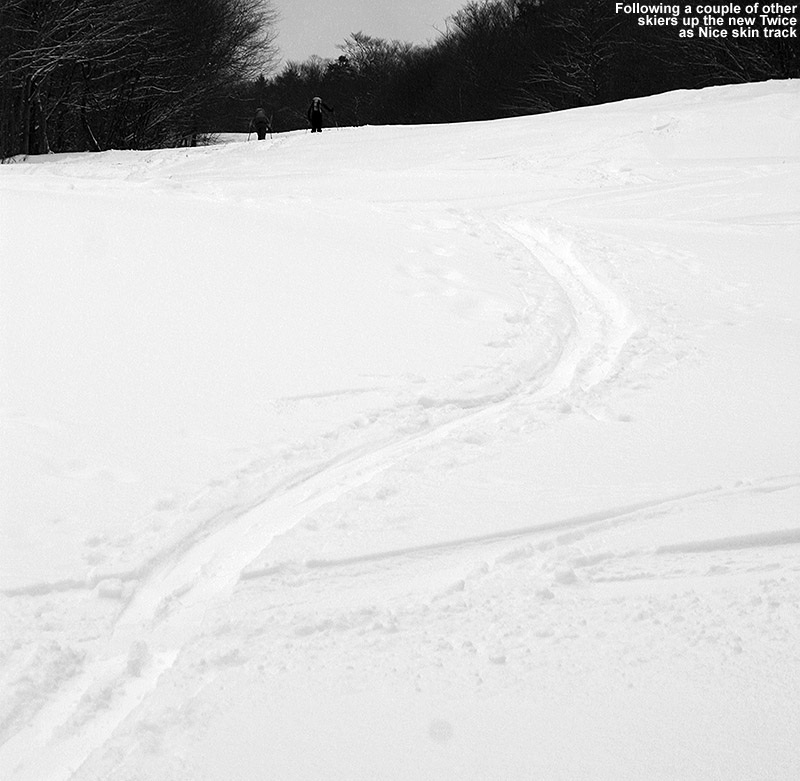
First on my list was to check out Timberline on my way up to the main base, but that’s as far as I got. There was still some tall grass sticking out of the snow on the slopes, but I could see a lot of ski tracks scattered about, and it was clearly game on for Timberline turns. I grabbed the fats, put on the skins, and headed up. There was a well-established skin track heading up the usual Twice as Nice route, so clearly a lot of people have been earning turns since the most recent storm. At the base elevations down at ~1,500’, the snowpack had a few different layers. Going from the top down there were 3 to 4 inches of powder, with what appeared to be a thin crust below it, then another inch of powder, and then some denser snow. All told it was only about 5 to 6 inches in deep, but there was enough substance to it that it seemed like it would provide some decent skiing. Up above 2,000’ it was notably deeper, with more base and a snowpack hitting the 7-10” range.
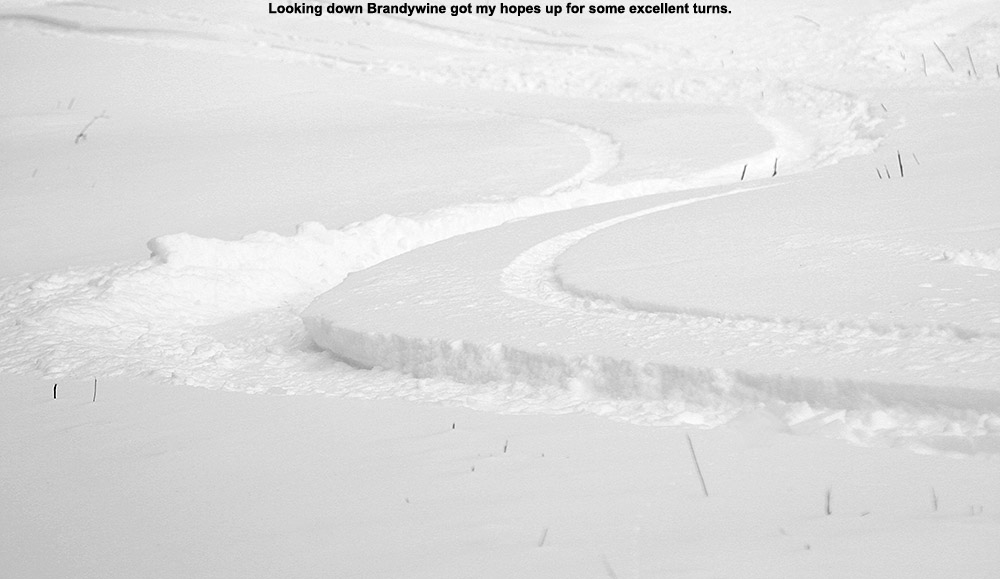
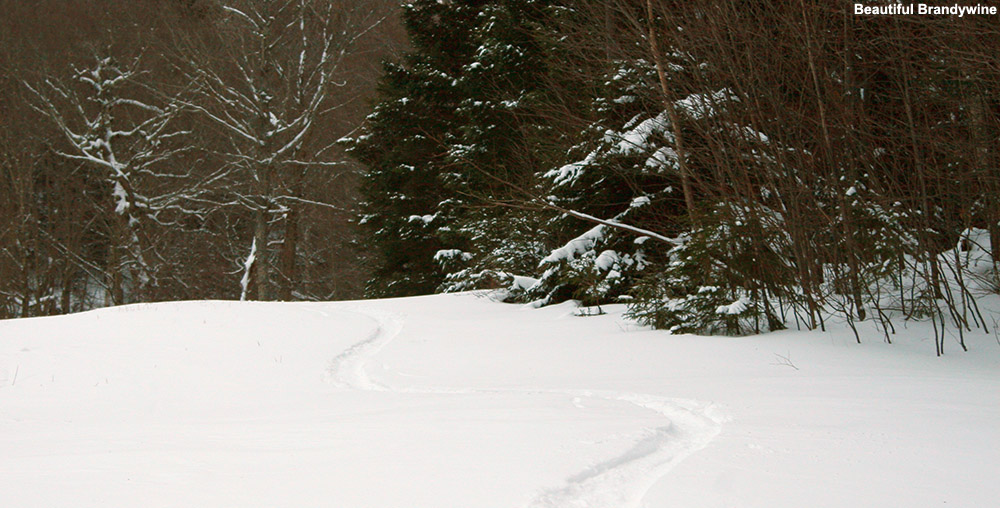
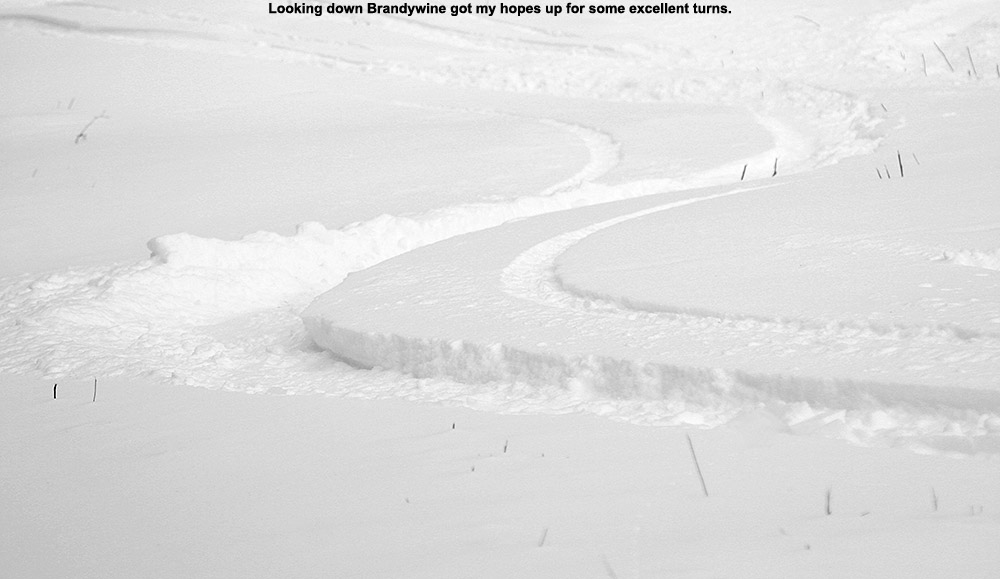
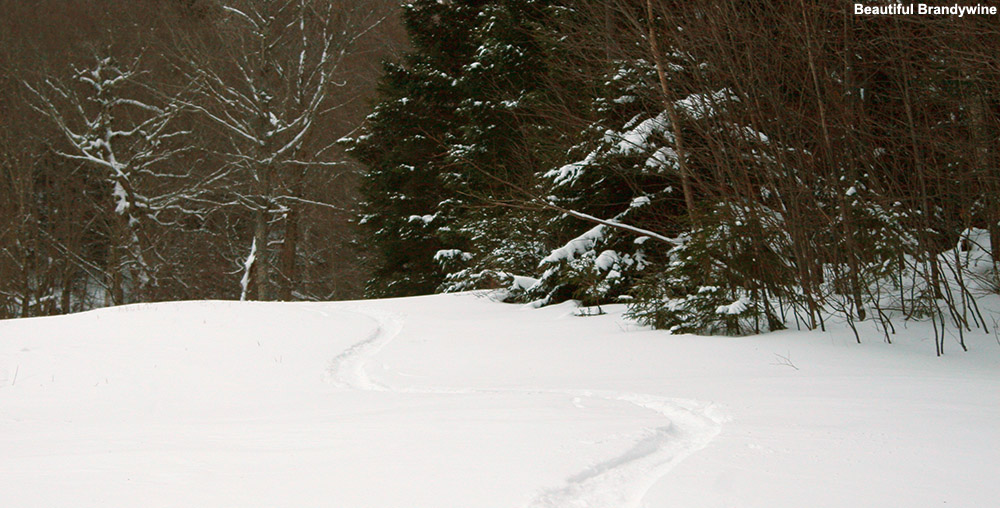
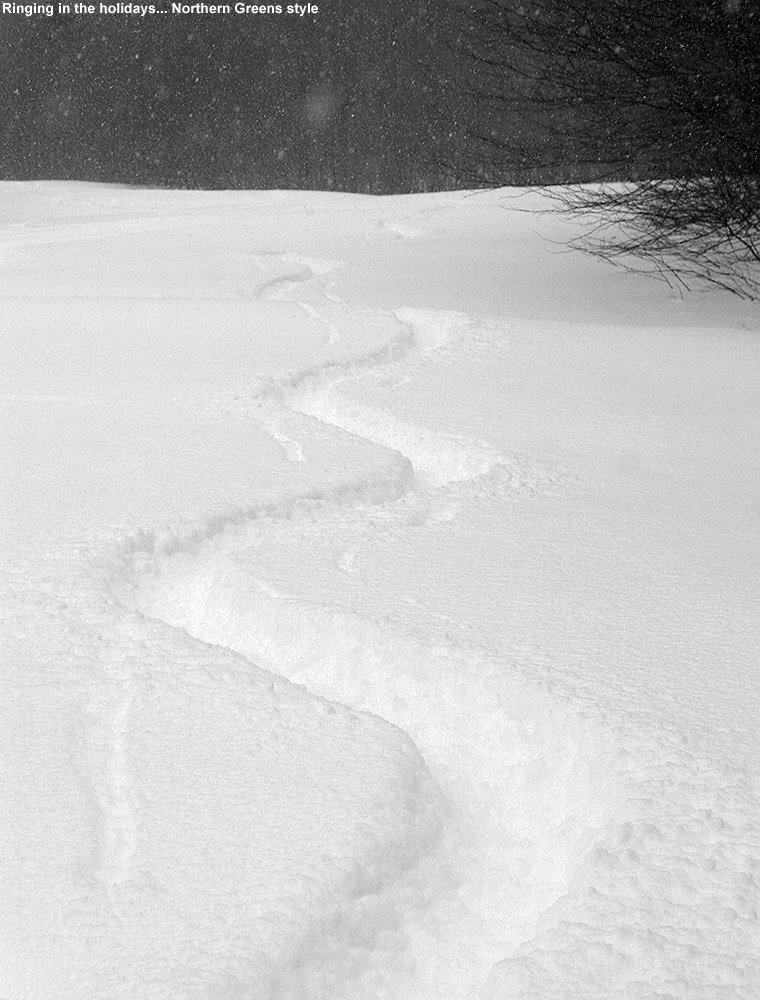
Based on what I’d seen in the lower elevations, I thought that Brandywine might be a nice option, so I headed to the top of Intro and switched over for the descent there. Looking down Brandywine, the signs were definitely positive. The trail had seen a few skiers, but there was plenty of untracked snow on the skier’s left, and based on the tracks it looked like there would be plenty of cover. The turns were even better than I’d expected, with 6 to 8 inches of powder over a hardened base up top. There was that thin layer of crust sandwiched in there somewhere, but it only occasionally made its presence felt, and the fat skis made quick work of it. One of my favorite parts of the descent was playing in the dips and rolls along the skier’s left of the trail – there was some incredible flow and the fats had that “no width” feeling much of the time. There has definitely been some good snow building up on the mountain while I wasn’t looking – it’s certainly not enough to support lift-served traffic yet, but we’re just one good synoptic storm away from that with the base that’s down there now.
Enjoying a run through the untracked snow on Brandywine today
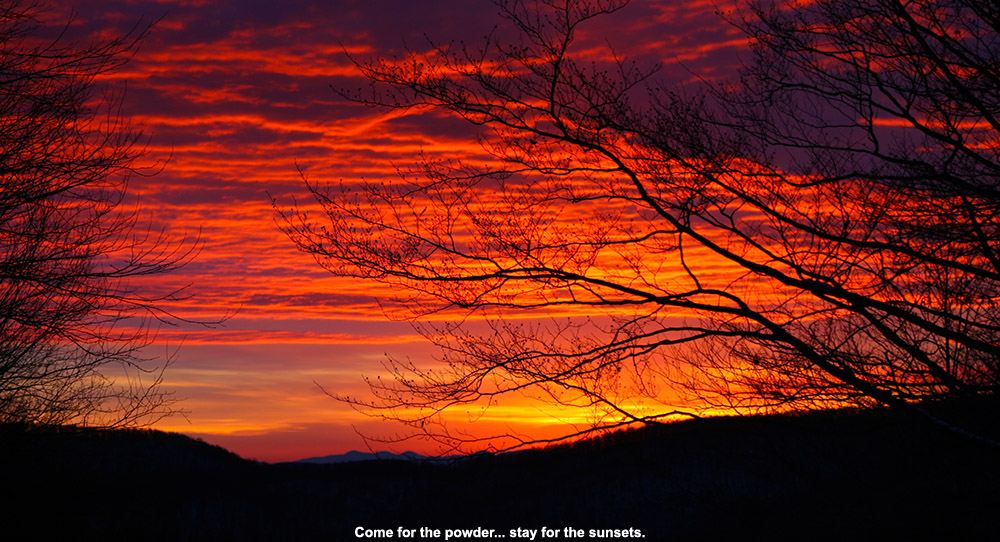
When I reached the junction with Timberline Run I saw that it was rutted from snowcat traffic, so I took Spur, which was totally untracked. The powder wasn’t so deep that I couldn’t move on the modest pitches, but it was enough to keep you floating for turns. As I passed by Spell Binder I saw that there had been a lot of skier traffic there, so indeed people have been hitting it hard. It seems like there was a mini army out there skiing laps over the past couple of days. Just as I was reaching the end of Spur, I saw that the sky was exploding with color off to the west, and it quickly became dramatic enough that I had to stop and take it in. I was probably there for 10 minutes watching the color change as the sun sank lower, and I happily got some good photos of the light show. Even the lowest elevations about which I was most concerned offered up good turns, so it may be worth another visit tomorrow. Temperatures are staying mild ahead of the next storm heading this way, so I’d say it’s time get out in the snow in the northern mountains.
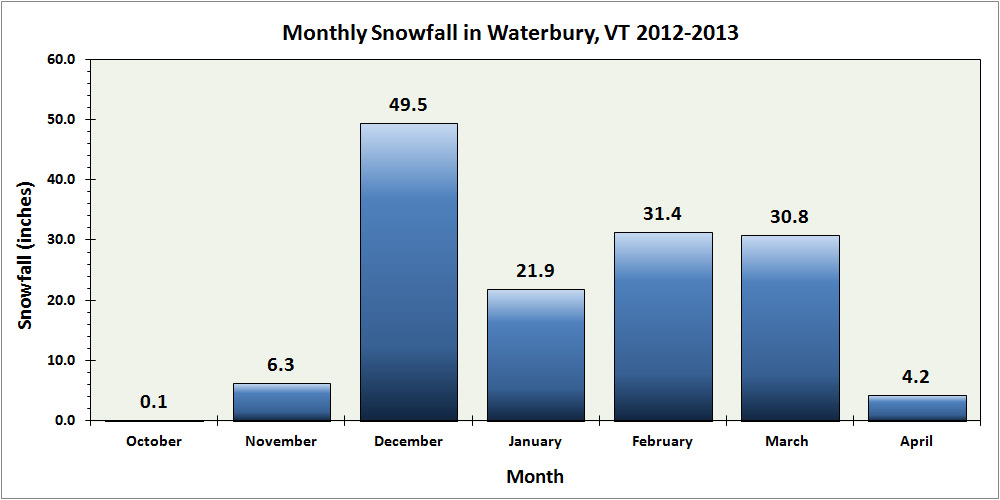
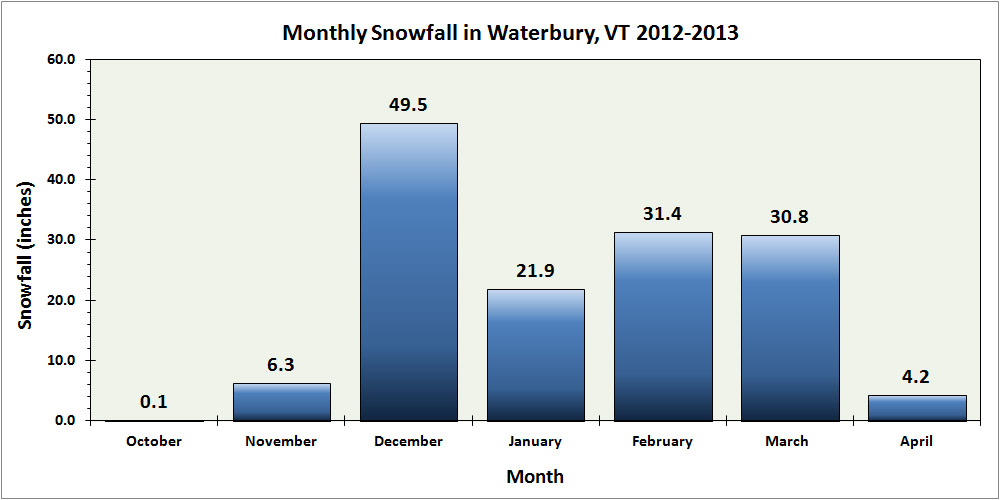
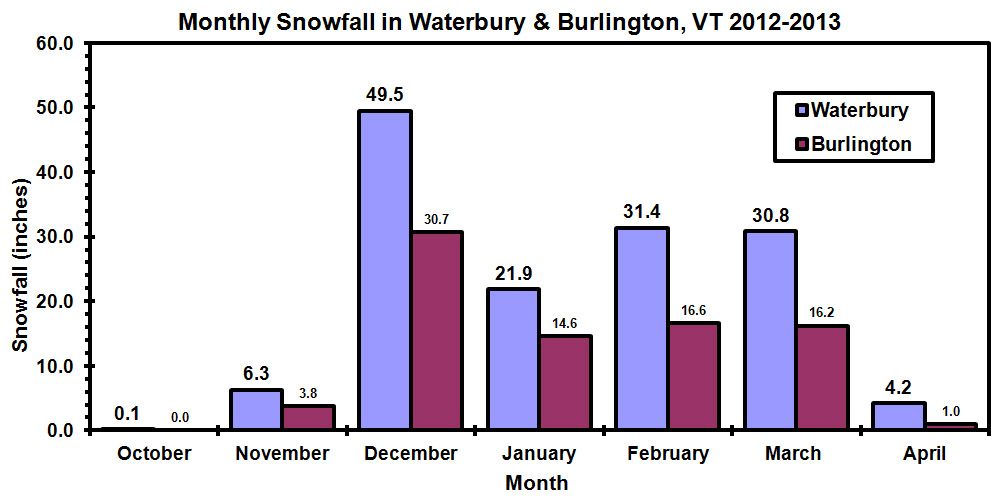
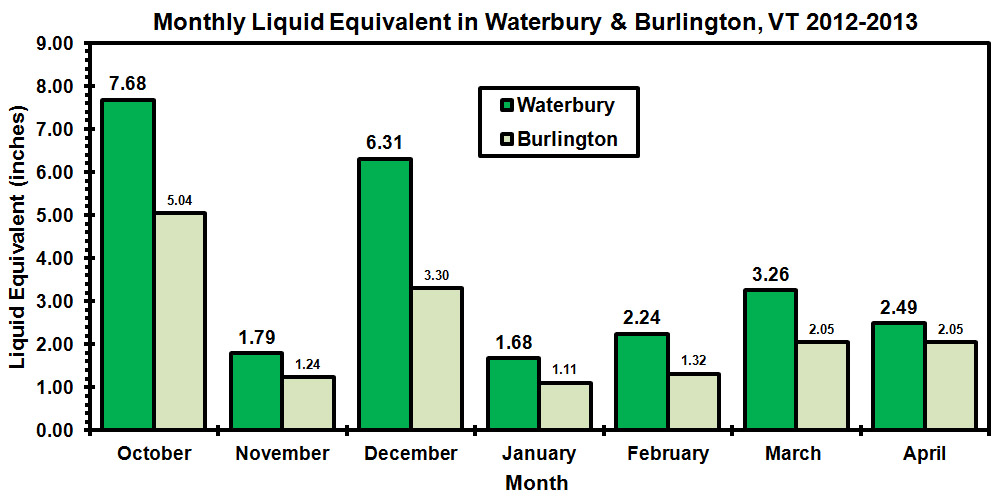
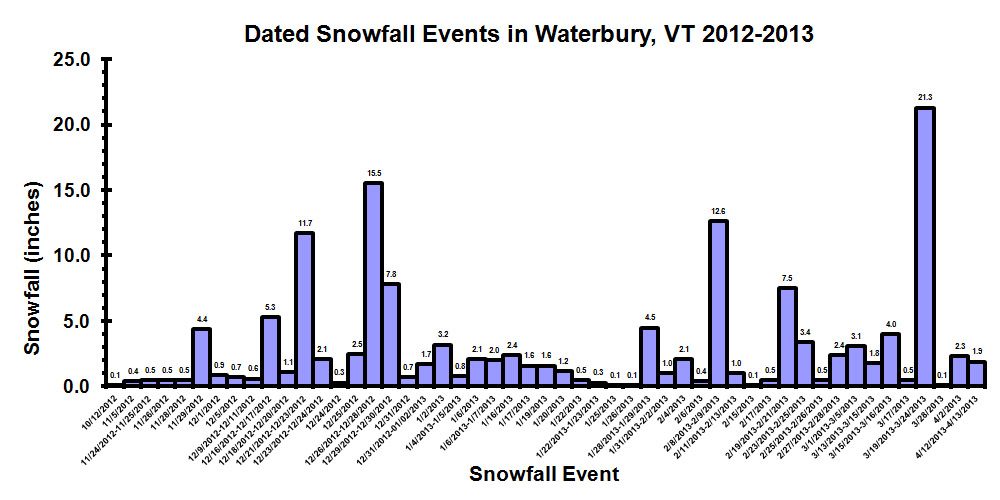
Waterbury snowfall for the 2012-2013 season – broken down by month
The last snowstorm of the 2012-2013 winter season extended all the way out to Memorial Day weekend to produce some great late season skiing, but now that we’re well into summer and all the snow has melted, we can look back at how the winter went down at our location in Vermont’s Winooski Valley. The main focus in the seasonal analysis below is on snowfall, but snowpack and temperatures will be discussed as well. In this post I’ve hit on some of the highlights that came out of the data, and attached our various plots and graphs, but to get to the full data set, you can use the following link:
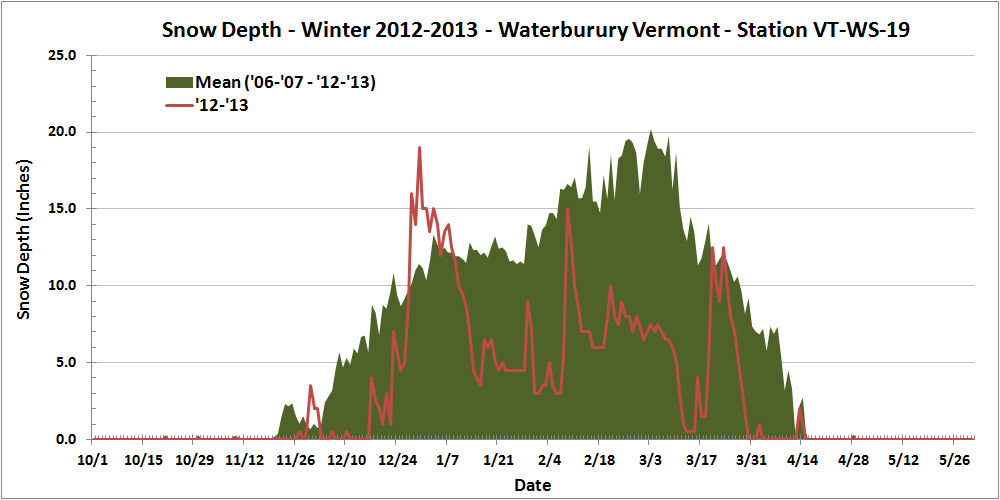
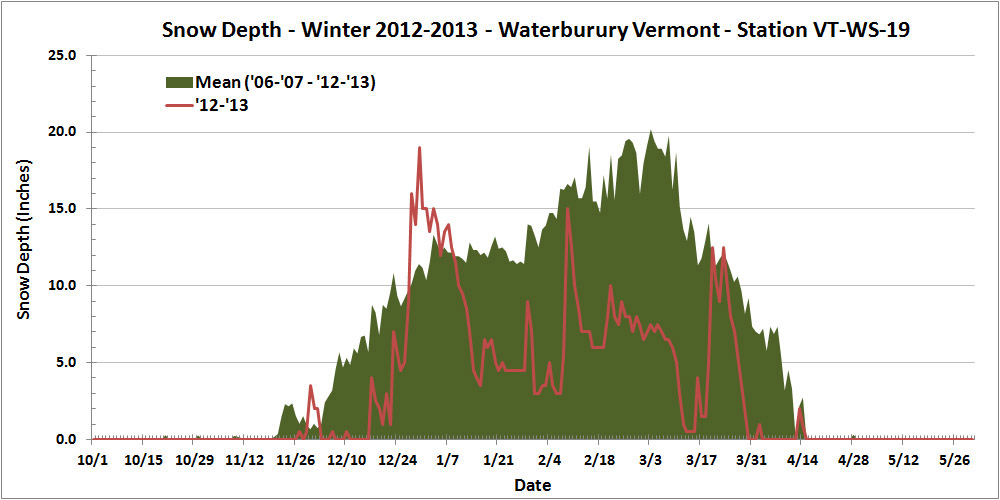
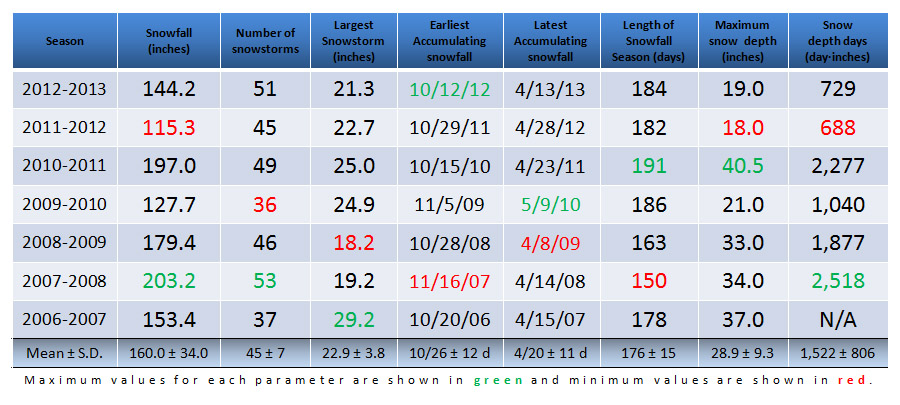
Thankfully, this past season’s snowfall (144.2″) marked a notable increase over the previous season (115.3″), but the total snowfall for 2012-2013 was still less than 90% of average, so that’s not likely to lift the season into the category of “great” winters. In addition, the amount of snow on the ground at the house last season didn’t help to improve the winter’s standing. Using the value of snow depth days as an integrative way of representing the season’s snowpack, one finds the 2012-2013 winter season producing a value of 729 inch-days, less than half the average value, and right down there in the basement with the well below average 2011-2012 season (688 inch-days). And, if the overall snowpack depth hadn’t already undermined any chances of redemption to an average level, the 2012-2013 snowpack secured the season’s ignominy by reaching the lowest value we’ve seen in January and February (3.0″), and coming within a hair’s breadth of melting out in the area around our measurement stake at a record early date in mid March:
This past season’s rather meager snowpack at our location in Waterbury (red line) relative to average (green shading)
Often, each month of the winter/snowfall season has its own unique flavor with respect to the weather, so one method I like to use to get a feel for the winter is to look at it on a month-by-month basis. Again, the focus below is on snowfall at our location, but snowpack is also considered, as well as mountain snowfall/snowpack and the associated effect on the local skiing. I’ll have a separate 2012-2013 ski season summary coming up, so I’ve kept the ski discussion minimal here in anticipation of a more thorough discussion in that report. The month’s total snowfall is listed at the start of each section below for reference:
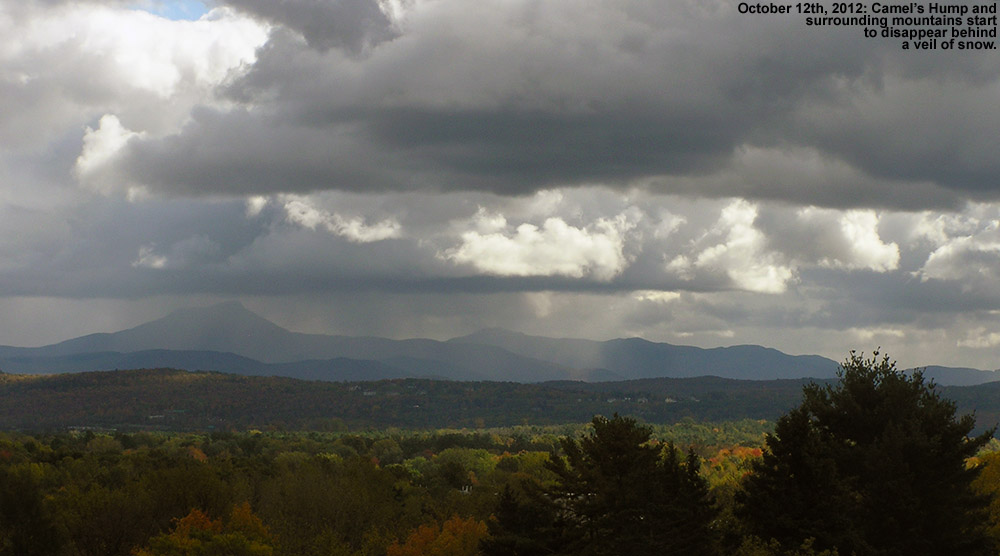
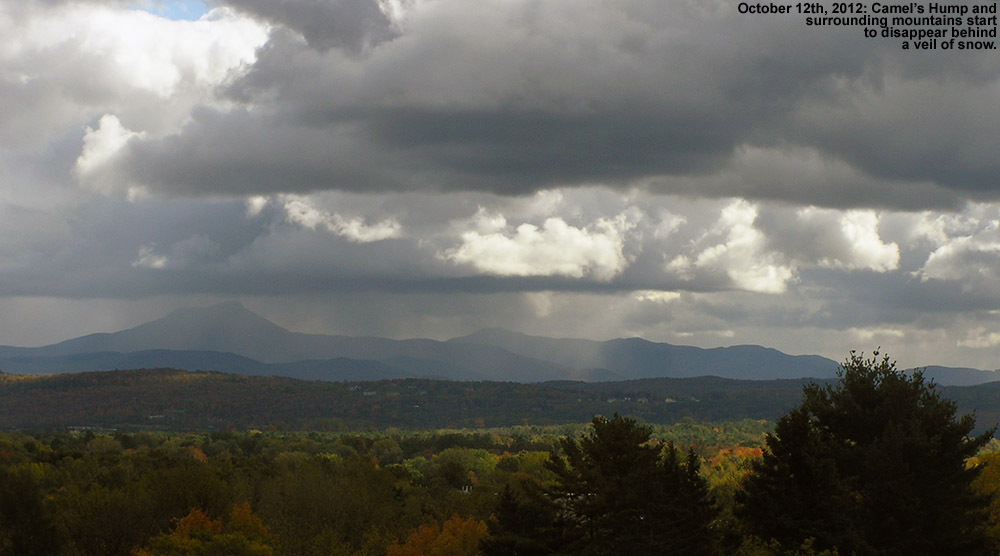
Snowfall: 0.1″ – October snowfall isn’t reliable enough down at our elevation to be factored much into the seasonal assessment, but this October was on the weak side, with just a tenth of an inch of snow, vs. the mean of roughly an inch. Regardless of this, there was still enough for the needs of companies like https://divisionkangaroof.com/areas-served/gainesville/ with the weight of the snow causing damage to some roofs. One small feather in the cap of 2012-2013 is the fact that the first accumulating snow fell on October 12th, which beats out 2010-2011’s October 15th snowfall by three days, and now represents the earliest measurable snowfall I’ve recorded here at the house since I started monitoring the weather in 2006.
Snowfall: 6.3″ – November snowfall came in just a bit below average this past season, so certainly not remarkable, but notable in that it was probably about as average a November as we’ve seen. November has typically been feast or famine when it comes to snow. We actually had a total of five snowstorms in November, but a small to moderate storm of 4.4″ at the end of the month contributed the bulk of the monthly total as well as some of the first great skiing of the season in the mountains.
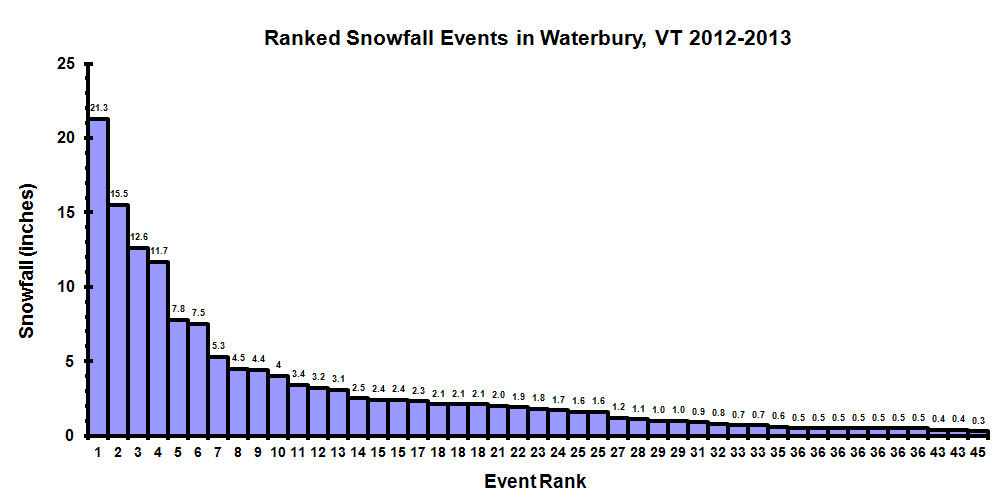
Snowfall: 49.5″ – December held the first lengthy, redeeming snowfall period of 2012-2013. Although the first half of the month was extremely poor on snowfall (just 2.2″ of snow at the house), from the 16th of December onward, temperatures got cold and snow came in for a dramatic change; close to 50″ of snow fell on us in the second half of the month, and as a whole the month actually wound up several inches above average. Those in homes with faulty or no heating in place are likely to struggle with the crushing cold at this time of year which is why it’s so important to conduct regular maintenance on heaters so you’re not left to suffer over winter. Reaching out to the likes of these professionals could help with this – siriuspac.com/heating-repair-service/. A problem left unaddressed could snowball into substantial damage and become more costly to repair over time so it’s well worth acting on it as early as possible. We received our second (15.5″) and fourth (11.7″) largest storms of the season during that stretch, right near Christmas and just a few days apart, so needless to say, the snow was there to set quite the holiday mood in the valleys and up above on the slopes.
Snowfall: 21.9″ – January continued that good, snowy weather pattern in its first week, albeit to a lesser degree than December, but unfortunately that modest first week ultimately wound up representing roughly half of the month’s snowfall. The second week featured a couple of substantial thaws with no measurable snow, and in fact we received no accumulating snow at all for the period between January 7th and 16th, a very long stretch for the mountainous areas of Northern Vermont during the winter. The third week of January offered just a few small systems, and the fourth week was arctic cold with minimal snow. The final week attempted to recoup the losses with a modest half foot storm, but it was too little too late – the month ended with just 21.9″ of snow, by far the lowest January in my records. The combination of very low snowfall and two January thaws was very deleterious to the valley snowpack – after coming down from the depths achieved in December, the snowpack depth at our location never even reached 10 inches again during the month, and got as low as 3.0 inches. That is ridiculously close to losing the winter snowpack in January, definitely the closest we’ve come based on my records since 2006.
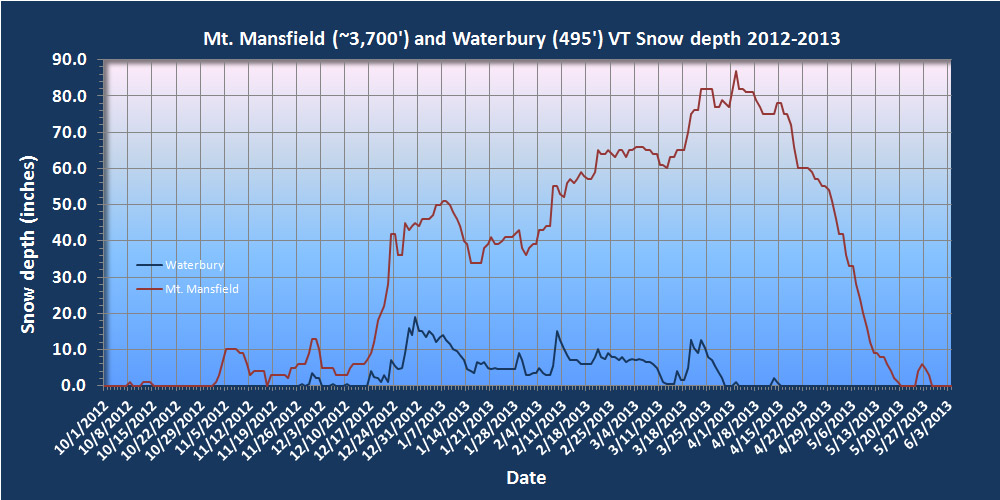
Snowfall: 31.4″ – February was again below average in snowfall, partly due to the continuation of the dry arctic pattern in the first week, and it wound up missing the mark for the lowest February in my data set by less than an inch. Although that persistent dry pattern didn’t make for a very snowy first half of the month, our third largest storm of the season (12.6″) hit in the second week. It was still a rather modest storm, but at least it did break that one foot mark for accumulation at the house. By the end of the third week of February, the snow depth at the Mt. Mansfield stake actually poked above average for the first time in about a month and a half – but it was only by a couple of inches, and it quickly went back below average as the snowpack sat there essentially stagnant for an entire month. On February 21st, the snowpack was at 65″, and roughly a month later on March 18th, it was still at 65″, without any major consolidation of more than a few inches. That’s stagnant. Our snowpack at the house languished similarly, never even getting above 10 inches of depth during that stretch – and that’s a time of year when it is usually building to its peak of the season. The carryover of the low snowpack from January also set the lowest mark (3.0″) for snowpack that we’ve ever seen in February.
Snowfall: 4.2″ – April was even a couple inches below average for snowfall, but temperatures stayed cool enough to keep the winter season rolling along, and that’s what really helped make the period wintrier. We didn’t have any notable April snow accumulations down at our elevation, just a couple of small ones on the 2nd, and again on the 12th – 13th, but the mountains continued to get fresh snow right into mid month to keep surfaces in great form and the Mt. Mansfield snowpack robust.
Snowfall: 0.0″ – There was no accumulating May snowfall down at the house this season, but that’s not too much of knock on the Month, because not getting snow in May is more the norm than actually getting snow. The mountains did get that beautiful Memorial Day weekend storm though, and the late season powder skiing was mighty fine. Although I can’t factor that directly into the analysis for the valley, it was quite cold in the valleys at the end of the month, and close to even snowing there.
There were a couple of other interesting notes with respect to snowfall this season:
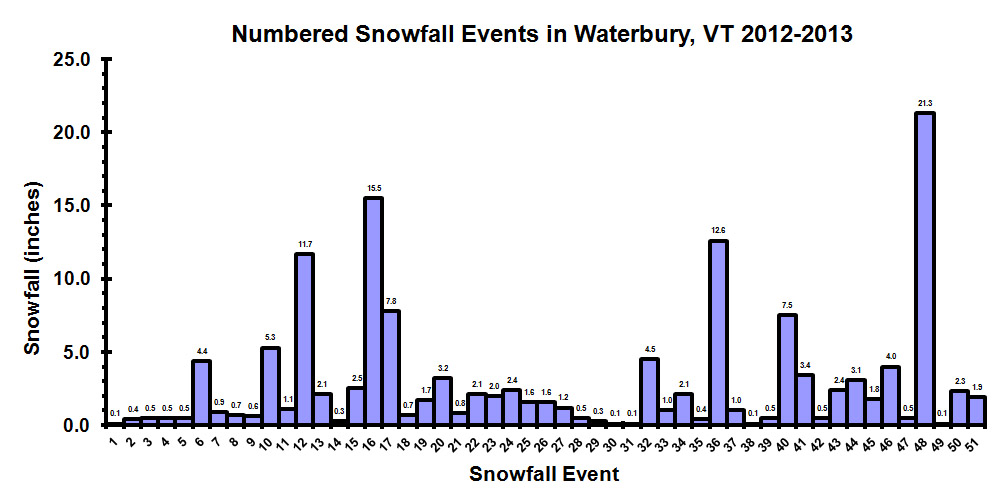
1) Storm frequency and average storm size: Despite coming in below average for snowfall, the 2012-2013 season offered up a healthy 51 accumulating snowstorms, almost up there with the 53 storms we received in 2007-2008. Of course, to come in below average for snowfall with that many storms indicates that the average snowfall per storm was down, and indeed it was. At 2.8″/storm, 2012-2013 ranks down there with 2011-2012 (2.6″/storm), the only odd seasons out compared to the more typical seasons up near 4″/storm. For whatever reason, this season’s average came in on the low side. This is presumably due in part to many of the everyday events being on the small side, but also due to the lack of bigger storms, which is covered in point #2 below.
2) Storms with double-digit snowfall: It’s certainly an arbitrary and subtle distinction, but after looking through my data, I noticed an interesting trend with respect to each season’s largest storms for our location. In my season summaries, I always make a list of the top five storms of the season, and when the season seems to have gone well, all of those top five storms have been in the double digits for snowfall. In fact, the “best” seasons thus far have been able to surpass that five-storm threshold. For reference, here’s the top five list for this season, with the links to the detailed web pages for each storm:
Indeed, if we look at the number of storms with double-digit snowfall by the seasons, we see an obvious trend. With the number of double-digit snowfall storms listed in parentheses after the season, one notes those “good” seasons – 2007-2008 (6), 2008-2009 (7), 2010-2011 (7) seemed to find a way to exceed five double-digit storms, whereas the poorer snowfall seasons – 2006-2007 (4), 2009-2010 (2), 2011-2012 (3), 2012-2013 (4) just didn’t. Surely the law of averages comes into play here to some degree – seasons with patterns producing lots of snow likely have a greater chance of getting a big storm in here, but that’s not a given. It’s also very suspicious that those seasons that come in sort of in that middling ground like 2006-2007 and our season of interest for this summary, 2012-2013, fall just short of making the cut. I suspect this trend may be more intact in a location like ours because of the relatively high number of storms and snowfall, and upslope snow (which was on the low side this season) as an extra protection against huge snowfall variance, but this is going to be an interesting trend to follow into the future as a gauge of snowfall seasons.
In sum, while snowfall was certainly a bit below average, and snowpack was well below average, I’d still give the season a reasonable grade. If C is average, I’d go with a C- for 2012-2013, just a bit off from making the average. Were snowpack a more significant factor in my winter preferences, one could argue for going a bit lower, but at least minimal snowpack was maintained throughout the entirety of the winter to keep everything white. Overall it could have been a lot worse, and with the amount of snowfall we did get, it’s hard to drop the season into the D range, which, based solely on snowfall and snowpack at the house, is where I’d put a season like 2011-2012.
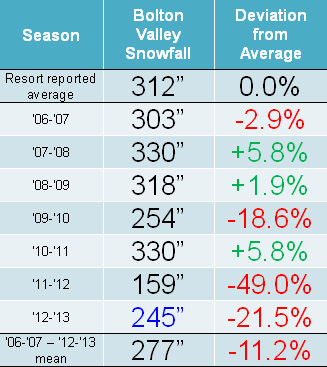
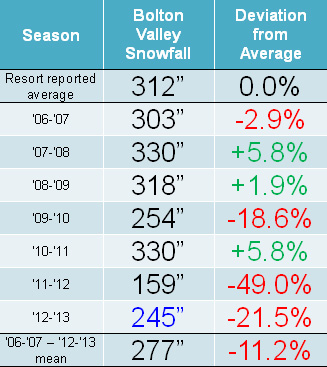
Snowfall: Compared to the snowfall-deficient 2011-2012 Ski Season, the 2012-2013 Ski Season was certainly a step up, but it was still generally below average for snowfall in the mountains of Northern Vermont. It was Bolton Valley that seemed to fare the worst of the northern resorts along the spine of the Green Mountains, perhaps due to their west slope location and this season’s dearth of upslope snow; they reported just 78.5% of their average snowfall. Heading northward, Stowe and Smugg’s fared a bit better at around 85% of average, and Jay Peak reported roughly average snowfall. Down at our house in the Winooski Valley, snowfall was 88.6% of average, so not too shabby by most accounts, but a bit below the mean like some of the local mountains. These past two seasons have actually been the first pair delivering back-to-back below average snowfall in our area since we started keeping track in 2006. Those numbers can be seen in both our Waterbury Winter Weather Summary Table, and the table of Bolton Valley annual snowfall below; this past season’s snowfall is highlighted in blue:
Low snowfall last winter meant back to back seasons with below average snowfall at Bolton Valley.
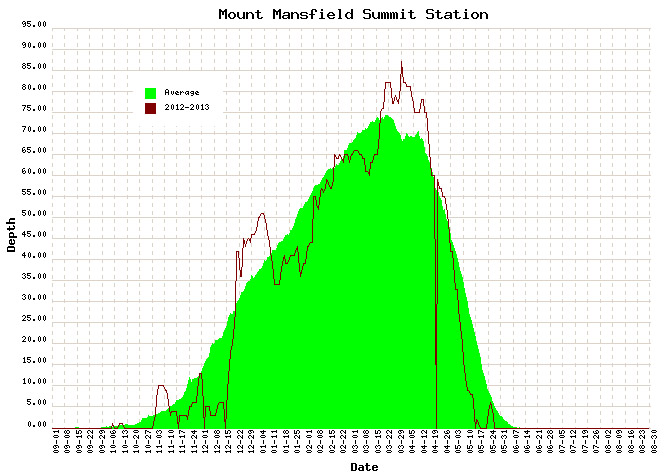
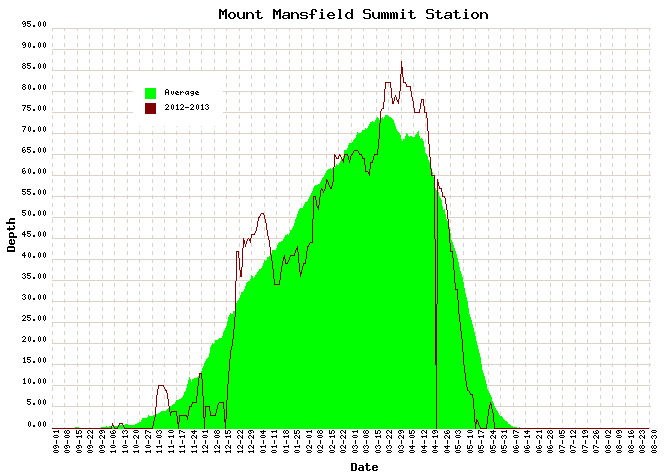
Snowpack: Aside from the spikes associated with a couple of early season storms, the mountain snowpack was below average going into mid December. That changed quickly though, with the onset of all that new snow during the second half of the month. The above average snowpack achieved during the holidays didn’t actually stay that way during January’s warmth and lack of storms. After consolidation, the snowpack generally trundled along at or below average through February’s continuation of relatively low snowfall. From mid February to mid March, the snowpack sat there essentially stagnant for an entire month; to wit, on February 21st, the snowpack was at 65”, and roughly a month later on March 18th, it was still at 65”, without any notable consolidation of more than a few inches. The late season stretch from mid March to mid April represented a nice rebound for the mountains however, with some quick gains from the big Northern New England March storm getting it above average, and the snow depth staying at least modestly above during the period.
Two periods stood out this past season for above average snowfall: The holiday period and mid-March through the end of April.
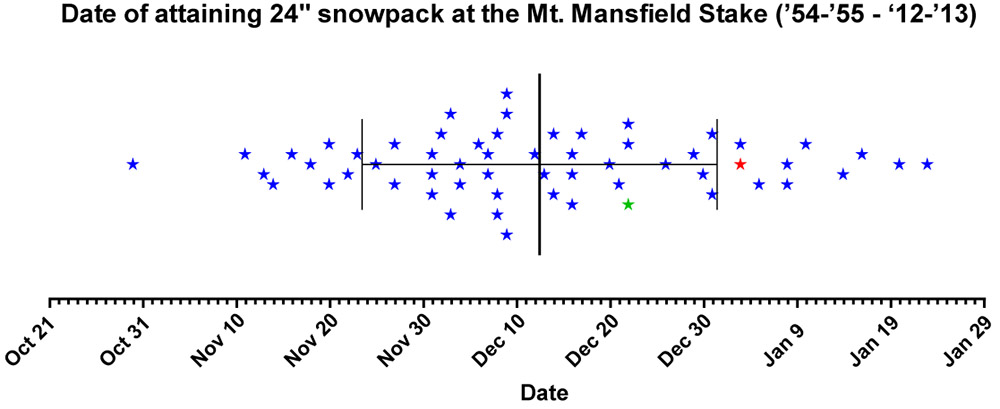
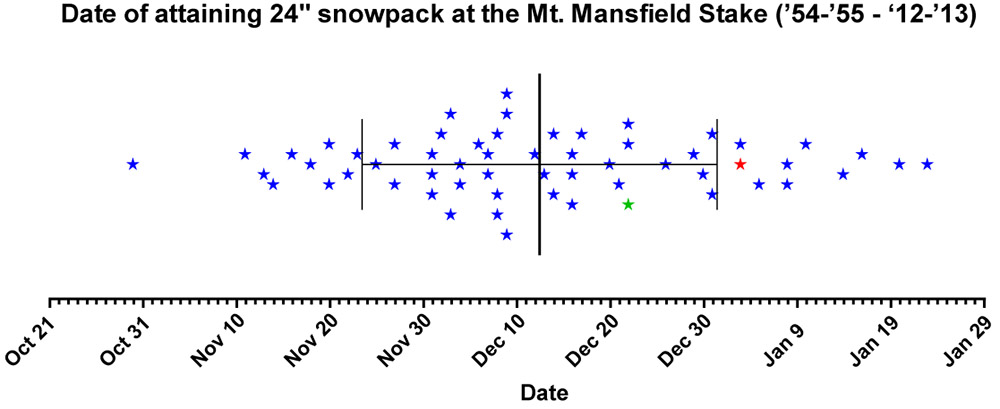
Tree Skiing: One metric used as a rough guide for the start of off piste skiing in the Northern Green Mountains is the point at which the snow depth reaches 24” at the Mt. Mansfield stake. For those unfamiliar with how this metric was established, it’s described in some detail in the 2011-2012 ski season summary. With the incorporation of this season’s data, the mean date remains at December 12th ± 19 days, with an average depth at the stake of 25.9 ± 2.7 inches. After the very slow start in 2011-2012, in which the 24” depth wasn’t attained until January 3rd (more than a standard deviation later than the mean), this past season was notably earlier. The plot below shows the date at which 24” was obtained for each season since 1954, with 2011-2012 shown in red, and 2012-2013 shown in green:
Each star marks the date of attaining a snow depth of 24 inches at the Mt. Mansfield stake, covering all years since 1954. Although still a bit later than average, reaching a depth of 24 inches at the stake this past season (green star – Dec 22) occurred much earlier than the previous season (red star – Jan 3). The mean date for attaining a depth of 24″ is marked by the large vertical bar in the center of the plot, and the smaller bars indicate the range of one standard deviation above and below that mean.
This past season, the date (December 22nd, Depth=28”, Green Star) was still later than average due in part to the slow first half of December, but unlike last season it was well within the 1 S.D. bars (thin vertical black lines). Note that the 24” mark is being used as an indicator of when the first forays into appropriate off piste/tree skiing terrain typically start in the Central and Northern Greens. In terms of empirical tree skiing observations, personal experience again lends some support to the use of 24” mark this season, as we began venturing into the trees the very next day on December 23rd at Bolton Valley. It should be noted though, that while the 24” mark was attained on December 22nd this season, the 40” mark was attained the very next day on December 23rd. The 40-inch rule (i.e. reaching a depth of 40” at the stake), is used as an indicator of when most off piste/tree skiing around here is ready to go. Although I haven’t looked into the data, this season has got to represent one of the quickest ascents from 24” to 40” – it’s interesting to note however that after rising to 42” of depth on December 23rd and 24th, the snowpack settled back to 36” for a couple of days before rebounding to 45” on the 27th.
Snow Quality: As an monitor of snow quality for the season, the chronological list of our ski outings has once again been compiled, with those days in which we were skiing powder indicated by a P, and those days in which powder skiing wasn’t available indicated by an X. The availability of powder suggests a fairly high level of snow quality, and the absence of powder generally indicates that temperatures rose above freezing at all elevations. Each listing below represents a link to the full report where images and more information from the outing can be obtained. Outings with an X may still be providing decent skiing such as wet snow, corn, etc. (or else skiing was typically avoided) but aside from the spring period, there’s going to be a price to pay in terms of snow quality associated with these episodes when temperatures eventually cool back down. The pattern of snow conditions in the Northern Green Mountains was fairly typical this past winter, with those days lacking powder skiing showing up in three distinct periods: 1) the early season with its usual temperature fluctuations, up through mid December before the weather pattern changed and the cold weather stabilized, 2) a thaw period in mid January, and 3) the period starting in mid March where spring weather began to make inroads. However, with the way the weather patterns this past spring continued to provide cool temperatures and snowfall, powder skiing generally dominated until mid April. Having analyzed the skiing in this way for the past three seasons, a surprising level of consistency is noted, with an overall average of close to four out of five days providing powder, despite notable differences in the demeanor of these recent ski seasons. The 2010-2011 season, which was above average in snowfall, provided powder on 78% of outings, the 2011-2012 season, which was well below average in many ways, revealed the same 78%, and most recently the 2012-2013 season, which was slightly below average in this area, produced a very similar 77% of outings with powder. The percentages don’t take into account differences in the number of outings each season, but with all three seasons falling into the range of 50 to 60 ski outings, differences in the sample sizes aren’t huge. The list of categorized ski outings with links to their full reports follows below:
The detailed month-by-month synopsis of the season is next:
October: It wasn’t an especially snowy October to kick off the season; we had five rounds of snow in the mountains, and the third one even dropped accumulations to the lowest mountain valleys, but none of the storms were huge dumps, and we had just a tenth of an inch of snowfall down at the house for the month. October’s first snowstorm started up on the 7th, with snowfall being reported at the top of the Mt. Mansfield Toll Road in the afternoon, and by the next morning Powderfreak sent along his picture of 4” of accumulation at the top of the Stowe Gondola. I also got a shot of Mt. Mansfield later in the day with its first accumulation of the season. It didn’t seem like quite enough snow to tempt me out to ski, but the FIS boys hit the snow and provided a thorough report of the turns. The second storm delivered some accumulation on the 11th, with a snow line up around the 3,000’ level and less than an inch of snow found up on Mt. Mansfield. The third storm was the one that finally touched the lower valleys with some minimal accumulations, but in terms of mountain accumulations, I don’t think it was anything more than junkboarding material. The 4th (on the 14th of the month) and 5th (on the 16th of the month) storms of October also appeared to be pretty minimal and generally flew under the radar in terms of discussion. So while it wasn’t a great October for natural snow skiing (with nothing like the back-to-back larger storms at the end of October during the previous season), some folks made some turns and there were several smaller rounds of snow to keep the peaks white.
April: Despite the somewhat slow increases in the snowpack during the heart of the winter, the gains made during the latter half of March meant that the snowpack was at least modestly above average heading into April, and it quickly reached a peak of 87 inches at the Mt. Mansfield Stake when the first storm of the month dropped a foot of snow at Stowe on April 2nd. I was up at Bolton Valley that day for a ski tour, and I got to witness some impressive snowfall rates as the storm crashed into the higher elevations. The alpine terrain above tree line on Mt. Mansfield was in good shape, consistently providing excellent outings during that first part of the month. Cool temperatures with additional snow meant that the snowpack stayed at an above average level right through the month, and another storm on the 12th saw Ty and I enjoying close to a foot of dense powder out in the Bypass Chutes at Stowe on the 13th. The skiing gradually transitioned to full on spring conditions after that weekend as the active pattern waned, and an impressively long stretch of clear weather moved in and stuck around well into May.
May: For most of May, there wasn’t much to talk about in terms of new powder, especially with the extended period of incredibly clear weather that carried over from the end of April and lasted a fortnight, finally ending on the 10th of the month. There was some mighty fine spring skiing right through that period with all the sun and warm weather, even if it did cause the snowpack to decrease a bit faster than it otherwise might have. The tranquil period of warm weather allowed the Mt. Washington Auto Road to open on the 10th of the month as well (definitely on the early side), but since unsettled weather had just returned at that point, we didn’t get to make our spring pilgrimage to the snowfields until the 18th. To really cap the month off well, Northern New England and the Adirondacks were rewarded with a Nor’easter over Memorial Day Weekend, which delivered roughly 3 feet of powder to Whiteface and nearly 2 feet to Mt. Mansfield. Excellent powder turns were made while the valleys were almost fully leafed out for the spring. We didn’t actually head out for any June turns beyond that, but the skiing over Memorial Day Weekend had been so good that it hardly mattered – it was just a few short months until the snows of fall would be returning.
So what about the overall feel for the quality of the ski season in Northern Vermont? Well, much like the snowfall numbers suggest, it feels like it came in a bit below average, even if not horribly so. The mountain snowpack (as gauged by what was seen at the stake on Mt. Mansfield) had its ups and downs, and on balance it probably gets rated in a similar manner to what the slightly subpar snowfall would suggest. Being frequent Bolton Valley skiers and living down below the mountain in the Winooski Valley, our perspective might be skewed a bit downward with the resort receiving just 78.5% of their average snowfall. Having the north miss out somewhat on a couple of big regional storms, while watching a horrid valley snowpack (see the 2012-2013 Winter Weather Summary for details) that kept ski routes to the lower valley bottoms essentially off the table, certainly didn’t win the season any extra points. It seems that 2012-2013 ultimately sits in the lower half of ski seasons and won’t be remembered as anything epic, but it also appeared to hold onto a decent level of powder availability (77%) based on our experiences, and that means there was still a pretty decent amount of good skiing. The fact that even the poor 2011-2012 Ski Season was able to hold onto a powder percentage in that range is also reassuring in that regard, suggesting that there is indeed a certainly level of reliability that can be expected in these seasons where snowfall/snowpack is below average.
We’re pleased to announce the completion of our Bolton Valley Photo Gallery for the 2012-2013 ski season. This year’s gallery is our largest to date, with over 270 images documenting this season’s ski adventures indoors and out, in the front, side, and backcountry, under blue skies and flake-dumping maelstroms at Vermont’sBolton Valley Ski Resort. Continue on to the thumbnail images below and browse away! Detailed reports are associated with every photograph in the gallery, so if you find a scene that sparks your interest, simply hover over the thumbnail image to get the date, and head to the archives on the right side of the page to read the full report. We’ve also got similarly extensive galleries from the past several ski seasons, representing nearly 1,600 photographs from around Bolton Valley, and these can all be found at our J&E Productions Photo Galleries Page. We’ll also have our full 2012-2013 Ski Season Summary coming out later this summer, so stay tuned for that update as well.
“Since there hasn’t been much traffic in a while, the combination of the most recent snow and lighter events from last week provided 8-10 inches of beautiful powder over a smooth base.”
With the conditions already quite good based on observations from my outing on Sunday, and Bolton Valley reporting 5” of new snow up top, it was definitely a morning to hit the slopes. I contemplated heading up to the main base to get the most snow, but as I drove past Timberline it looked pretty good so I decided to check it out. I went back and forth for a few moments about which base to visit, and eventually decided to stay where I was because it was generally quiet and I was hoping I could keep out of the way of any grooming equipment. There were a couple of other cars were parked below the center island below the lodge, which meant that there might be a skin track already in place. It was a nice morning – it was cloudy, but there was no wind and the temperature there at 1,500’ elevation was 22 F. That was very pleasant after the arctic temperatures we’ve recently seen.
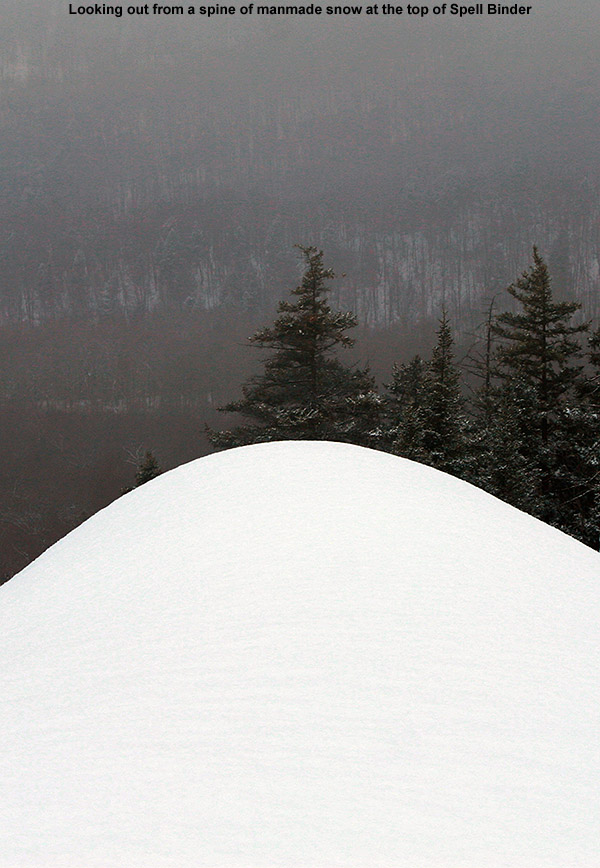
Snowmaking spine on Spell Binder
I began my ascent and followed the skin track that people had established on Twice as Nice. My depth checks on the powder consistently revealed 4” new, which is what Bolton reported for the base elevations. For the descent I headed over to Spell Binder, since a groomer was working on Showtime, and there were already a couple of tracks and a groomed strip on Twice as Nice. I’d forgotten that the mountain could make snow on Spell Binder, but they’d made some snow on the upper headwall area. There were some huge snow whales there, which they’ll have to spread around at some point. The approach to skiing the steep terrain on the headwall was a toss up. One option was to ski on some of the manmade snow, but there were some tricky snow formations made by the guns, and the 4-5 inches of snow wasn’t enough to keep you from touching down on that dense manmade surface. The other option was to ski the sides of the trial that had not seen snowmaking. The base snow was of higher quality, and there had been additional round of powder on top of it, but there were spots of poor coverage where snow had been swept away by winds. I ultimately made use of both options, going where my line took me.
I was a bit conservative in my skiing of the headwall since I didn’t want to hit any rocks that might be lurking under the snow, but once I was below that, the rest of the trail was in another league in terms of snow quality. Since there hasn’t been much traffic in a while, the combination of the most recent snow and lighter events from last week provided 8-10 inches of beautiful powder over a smooth base. Sunday’s turns were certainly good, but with the addition of this latest storm, these were the deepest turns I’d had in a couple of weeks. The top levels of the snow were in that 4-5% range of H2O content, and there was a nice gradient of more dense snow below. It was that combination that powder skiers seek for great turns.
The addition of this latest storm has certainly helped the meager snow totals that we’ve seen this January. We’ve now had almost 22” of snow at the house this month, however, that’s still only about half the average I have in my records. Tomorrow is supposed to be a warm day, so this latest round of powder is going to settle down, but the forecast says we’re back into the cold tomorrow night into Thursday, with some chances for snow. No large systems are expected, but some Clipper systems may come through in the next several days, and the Greens can usually do something nice with that moisture and often pull out totals just like we saw today.
Making tracks in the Bolton Valley backcountry today
We’ve had arctic air in the Northeast all week, which has made it one of the coldest and driest periods of the season. With the lack of moisture there’s been only an inch of snow at the house in the past seven days, and although Bolton Valley was reporting a similar accumulation, they had picked up a few inches since I was last there for my backcountry outing on the 19th. I also suspect they’ve picked up various small accumulations of dry arctic snow similar to what we’ve seen down here at the house, but they haven’t hit that one inch threshold for the snow report. Although still rather cold this weekend, temperatures have definitely moderated somewhat from the beginning of the week… when high temperatures actually remained below zero in many locations. Yesterday we topped out around 15 F down here at the house (495’), and the afternoon temperature was sitting around 4 F up in the Bolton Valley Village (2,100’). Today we actually got up around 20 F at the house, and when I arrived at the Village in the mid afternoon, the temperature was a reasonable 12 F. The arctic air is definitely waning. Although I wasn’t planning on doing too much skiing this weekend with the combination of air temperature and minimal new snow, I at least wanted to get out one day for a tour. I almost got one in yesterday, but ran out of time since we were having James and the kids over for the evening. However, E and Claire cancelled our BJAMS ski program at Stowe today due to the forecast temperatures, so it gave me the opportunity to get in an afternoon tour. I think today actually worked out to be the better ski day of the weekend, since it was almost 10 F warmer up on the mountain, and we had sunny skies in contrast to a bit of gray yesterday afternoon.
“It was surprising to think that the snow was holding pat after such a dry week, let alone improving.”
Last weekend’s outing on the backcountry network was fun, since the powder was decent, but also fruitful in that I discovered a nice new glade in an area I hadn’t previously visited. That discovery really wasn’t planned, but since it worked out well I figured I’d go with a similar theme today; my goal was to check out a descent off Heavenly Highway in the Moose Glen area. It’s an area that E and the boys and I have wanted to explore for a while. Since the boys were a bit under the weather and they weren’t going to head out in the cold temperatures, it was another solo outing for me. I find these solo outings work well for reconnaissance though, because I can move quickly and efficiently and explore a lot of terrain relative to when we’ve got the boys along.
“As I slid through that last run in the powder, my feet felt really quick. I guess that’s the best way to describe it; the pitch of the slope, the depth of the powder, and the length and width of my skis all just came together to make everything work for Telemark turns.”
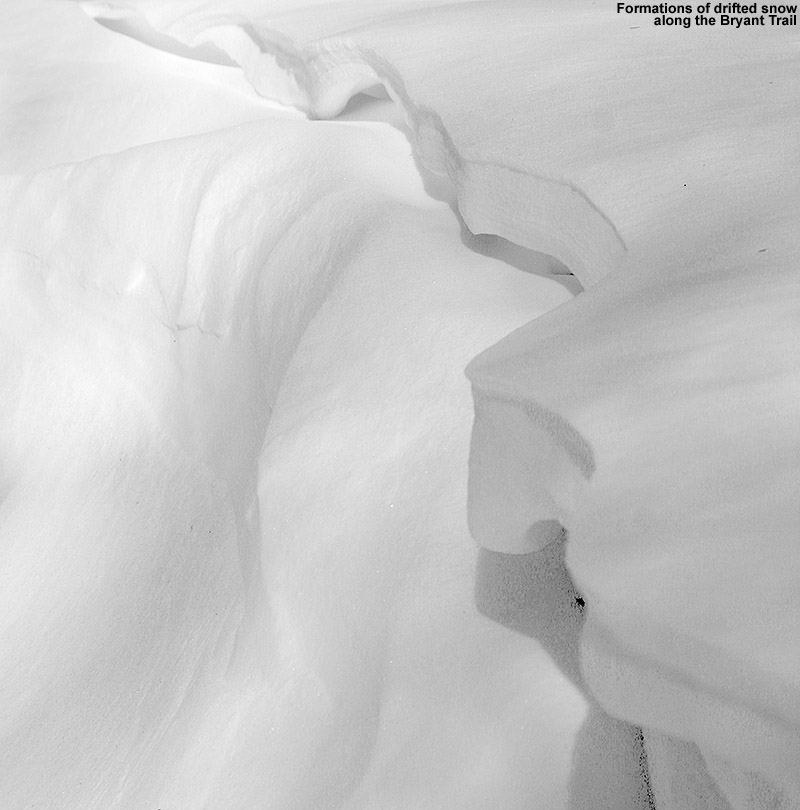
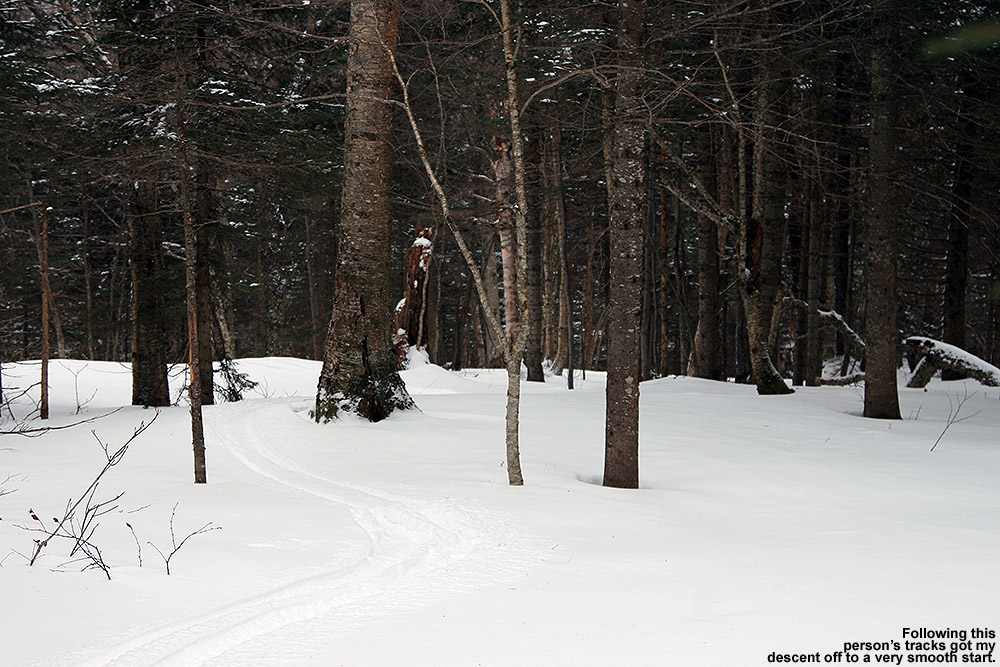
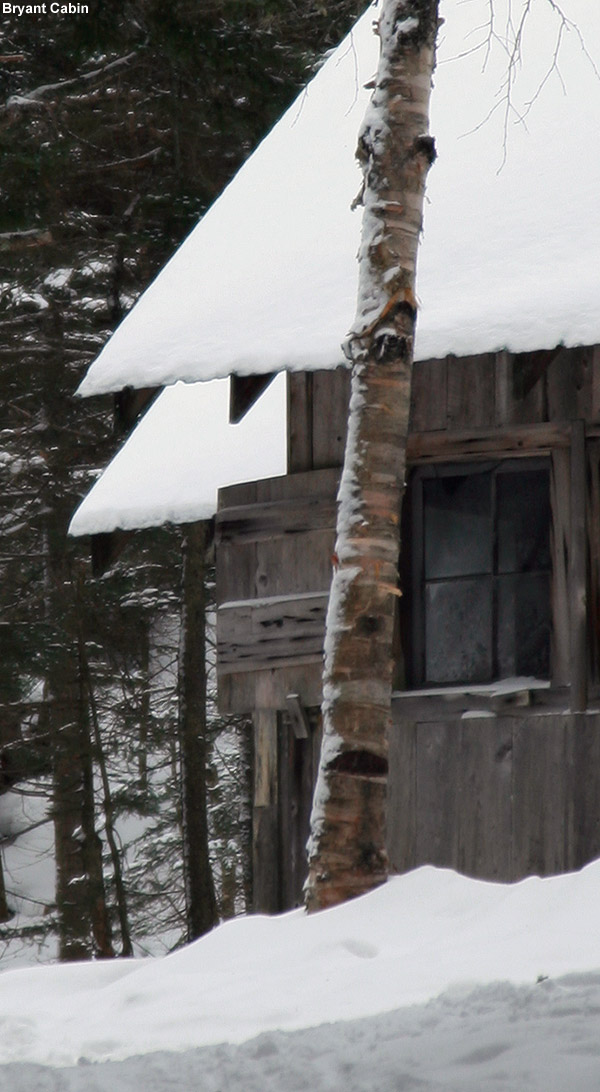
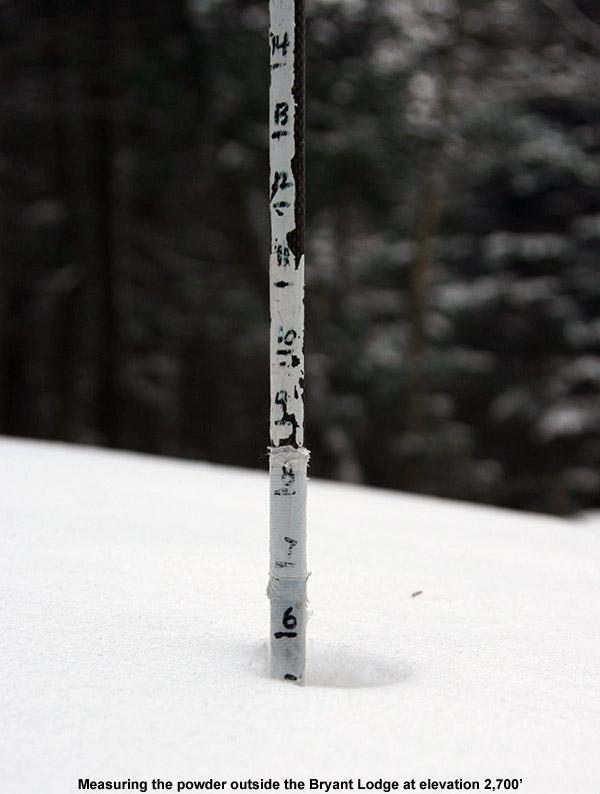
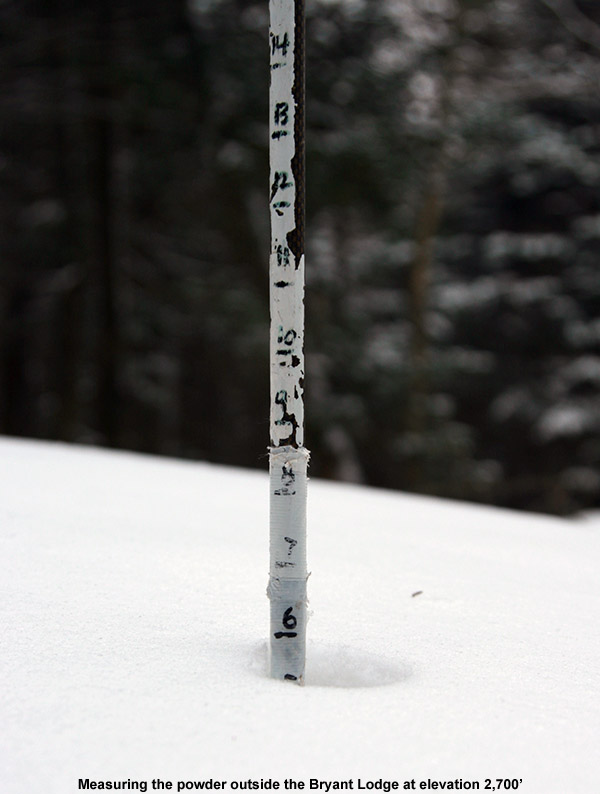
Once again, despite the chilly temperatures and dearth of fresh snow, the main parking lots up in the Village were pretty full, so the resort was getting a lot of visitors. On piste conditions are actually pretty good based on what I’ve seen though, as the arctic air appears to be preserving packed powder surfaces very nicely. I’ve been sort of down on the arctic air that’s been hanging around because it doesn’t bring fresh powder for skiing, but boy does it do a heck of a job on snow preservation. Even though new snow has been minimal in the past week, I could tell that the quality of the snow on the ground had improved as soon as I began my ascent today. I saw a bunch of Telemark skiers working on turns on the Telemark Practice Slope, and even though that was a tracked area and they were often on the subsurface below the powder, the turns were very quiet. As I probed around and checked depths during my trip up the Bryant Trail, I could tell first hand that the subsurface had improved since last weekend. Presumably that ultra dry arctic air has been working on it, because it was even more crumbly and Styrofoam-like than last weekend. The conditions also seemed to be bolstered by additional powder. Whereas last weekend I found 3 to 4 inches at the 2,100’ level and 6” up at 2,700 at the Bryant Cabin, today I found roughly 5 inches at the base elevations and 7 to 8 inches at the cabin. It was surprising to think that the snow was holding pat after such a dry week, let alone improving.
Along the Bryant Trail
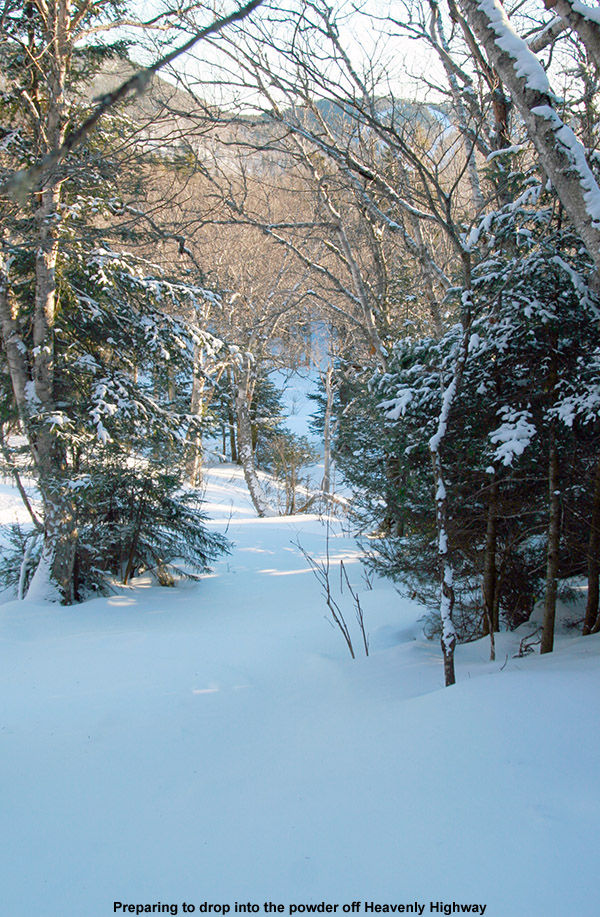
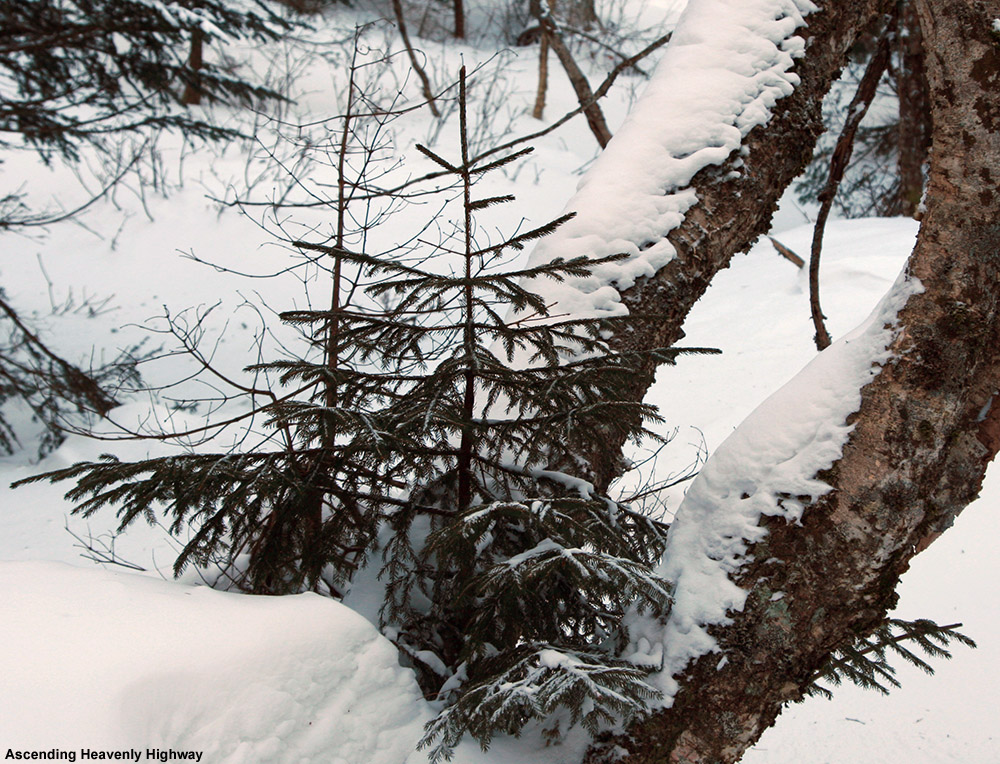
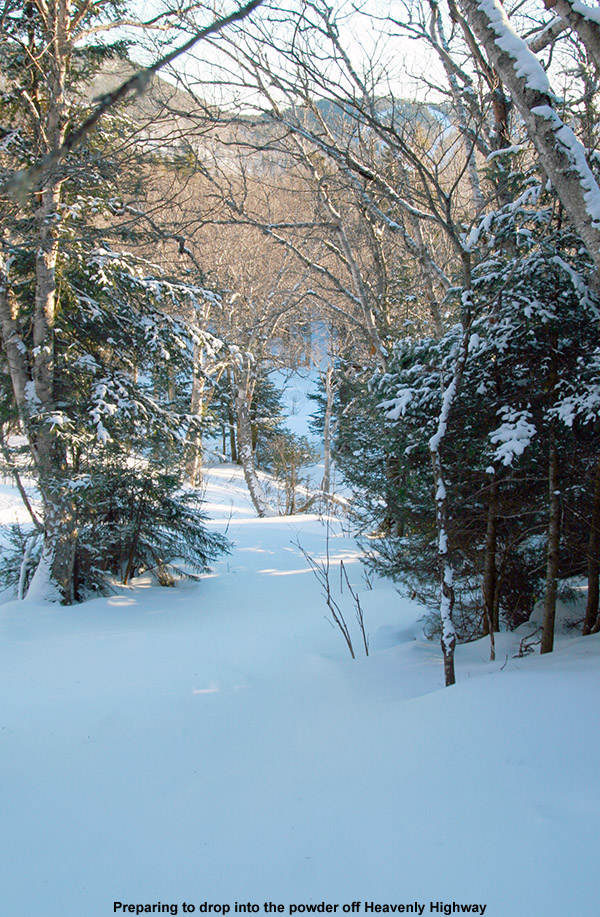
My ascent went smoothly, and I saw a few other groups of skiers here and there having fun in the good snow. After reaching the Bryant Cabin, I continued on up to Heavenly Highway, and once I got up to around the 3,000’ elevation I could really see just how well preserved things were at those elevations. In protected areas, the evergreens were still coated in white like snow had just fallen. I finally switched to descent mode in the Moose Glen area, where below me sat a nice open, untracked line powder line. The pitch looked perfect for the 6 to 8 inches of medium-weight arctic fluff that it held, and I could see the exact line I wanted to take. As I sat there contemplating those first turns, there was an almost tangible excitement in seeing if the snow was going to deliver. As good as the snow can seem on the ascent, making those turns is really where the rubber meets the road.
I dropped in and the turns were smooth and effortless; there was still the occasional touch on the subsurface, but indeed the conditions had taken quite a leap since last weekend. There were a couple old tracks from previous skiers to give me an idea of where to go on the descent, but I also let the lay of the land dictate the route. A number of clear areas offering nice turns, but I could tell that many more shots would be available if the snowpack was bumped up a foot or two. After some consolidation and this dry January spell, snowpack depth at the Mt. Mansfield Stake is about a foot below average, so typically some of those areas with brush would be covered by now. Hopefully we can do some catching up on snow depth in the next couple of months.
Getting ready to drop in
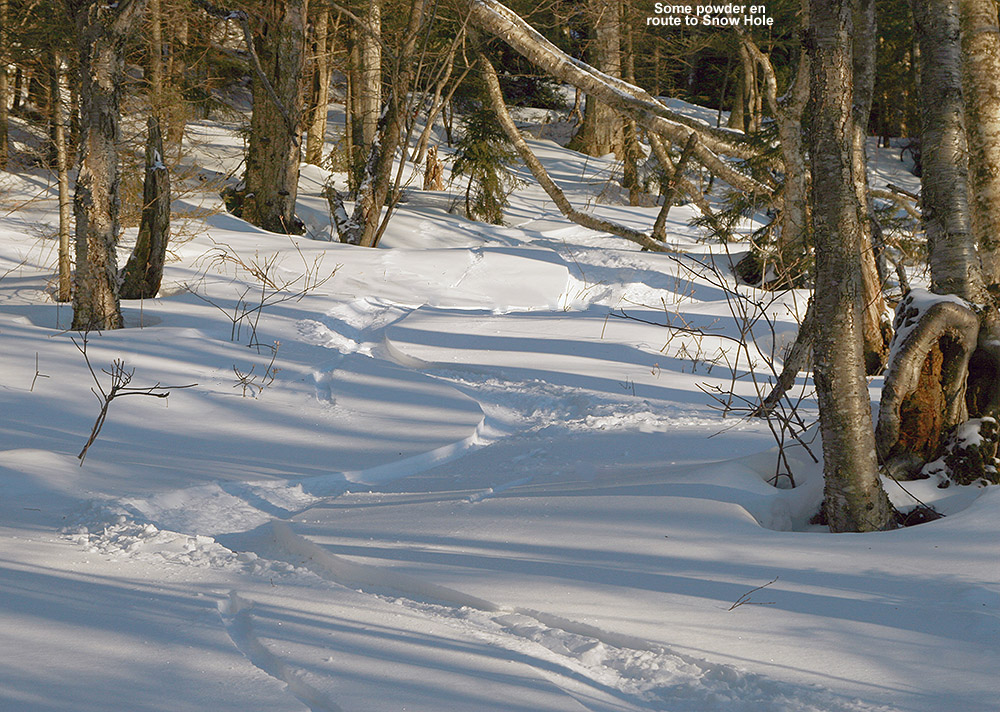
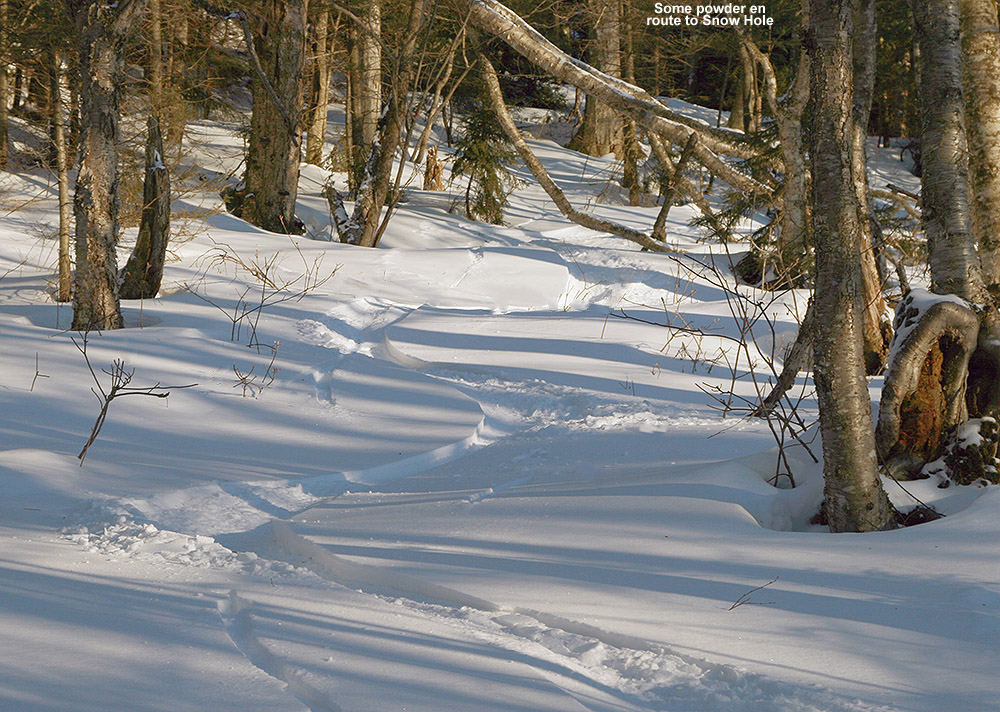
I continued downward in a general southerly direction and entered an area of flat terrain among evergreens. I could tell that it was a bit of a shelf with land sloping off to the south. There was a clearly cut route that entered the area, but the ski tracks that had led me there disappeared. After a few minutes of poking around, I was happy to find that my instincts had led me in the right direction. There was a nicely made glade dropping down the initial steep slope, and then in mellowed out into a large, sparsely treed area with lines everywhere. I enjoyed a lot of good turns in there, and I eventually found that it had led me right down in Snow Hole, which without the Wilderness Lift running, didn’t have many ski tracks. I was really appreciating the consistency of the snow in Snow Hole – the powder was just perfect for the pitch; it was dry, but somewhere just on the dry side of medium in density, and the floatation was great.
When I came to the fork indicating the route over to the Wilderness Lift, I opted to check out the right option instead, and quickly found myself on Gardiner’s Lane. I was really liking the overall setup of this descent, gaining that extra elevation above the Bryant Cabin had already given it that extra boost of vertical, and I knew I still had some good turns to go. On World Cup I headed past the glades adjacent to the Telemark Practice Slope, since I could see that they had seen a number of skiers, and continued on until I got to some additional untracked lines. The woods are pretty open there, so there was no need for a specific glade to get some really nice turns.
As I slid through that last run in the powder, my feet felt really quick. I guess that’s the best way to describe it; the pitch of the slope, the depth of the powder, and the length and width of my skis all just came together to make everything work for Telemark turns. I’d say that was really just the pinnacle in terms of that feeling, but all day today I felt good on the AMPerages. After the way they’d felt slow at times last weekend when I hit the Bruce Trail, I was tempted to switch to my narrower-waisted RT-86s today for a faster feel with a potentially firmer base. In the end I decided that I wanted the float of the AMPerages, and I’m glad I went that route. Whether it was that improvement in the powder, the subsurface, the snow density, or just the lines I hit today, they were the tool of choice.
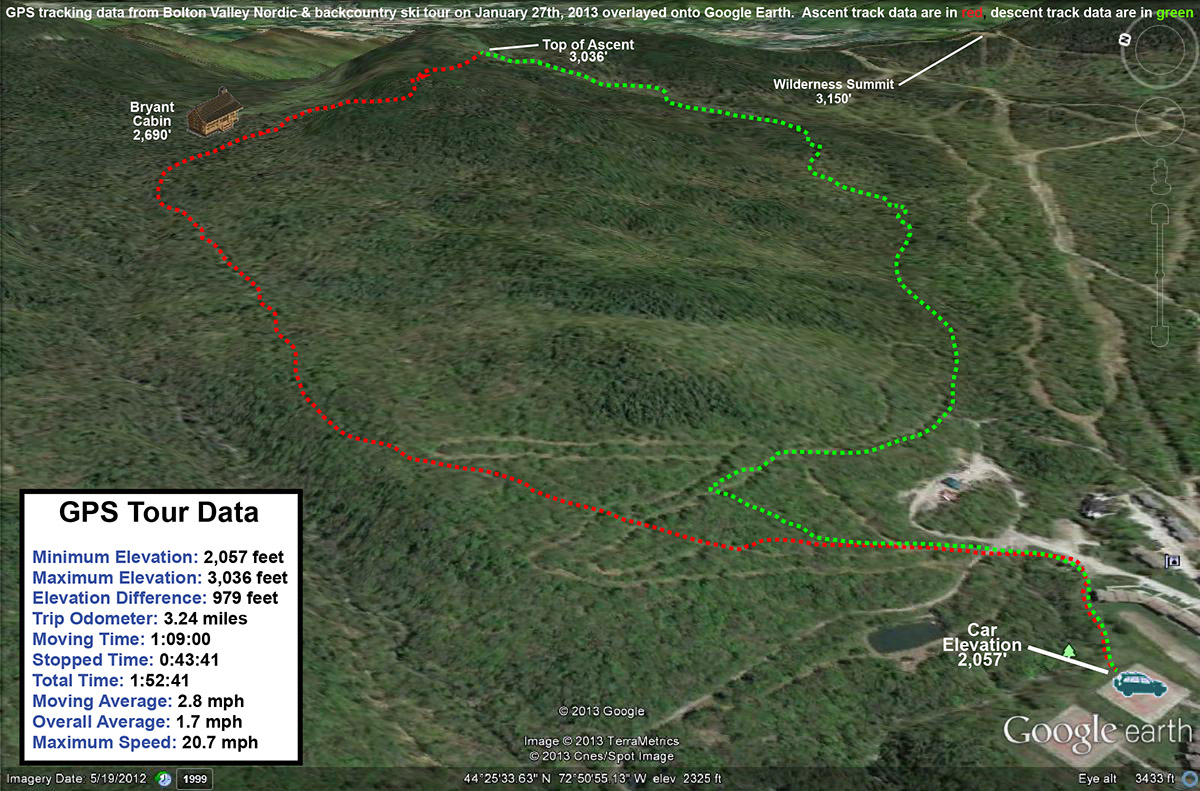
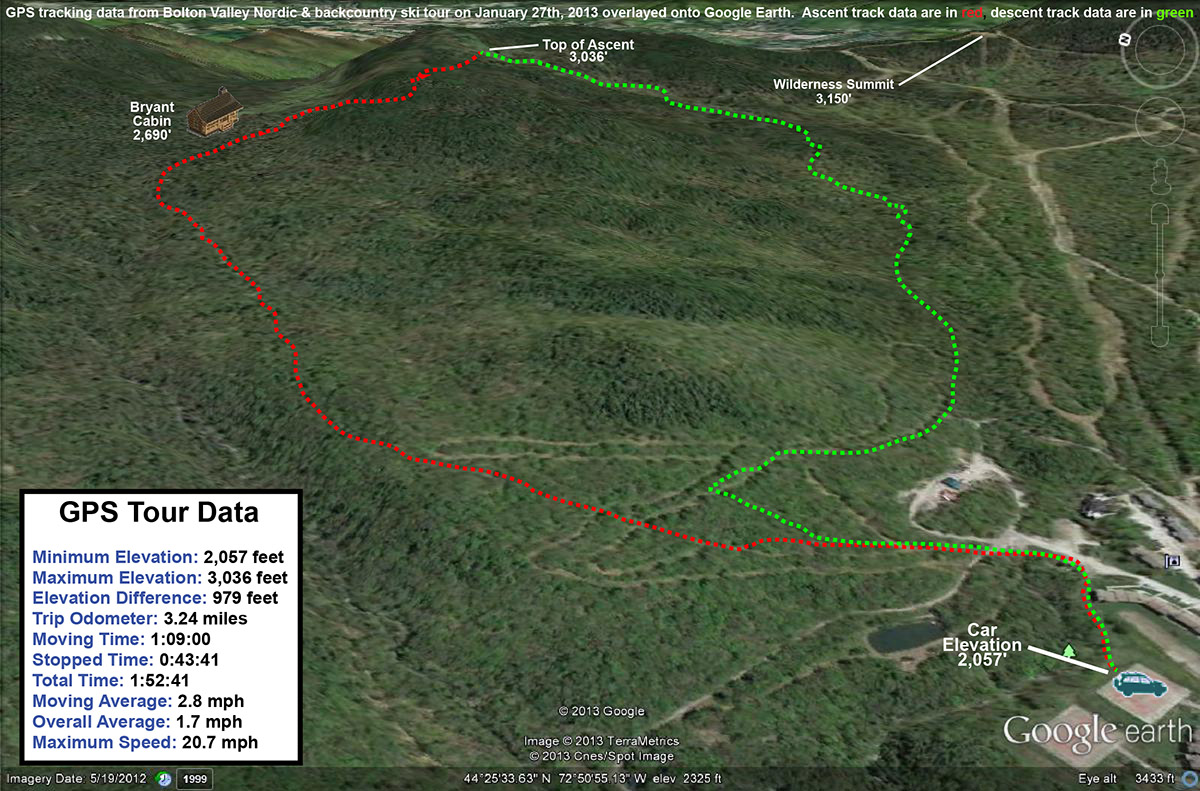
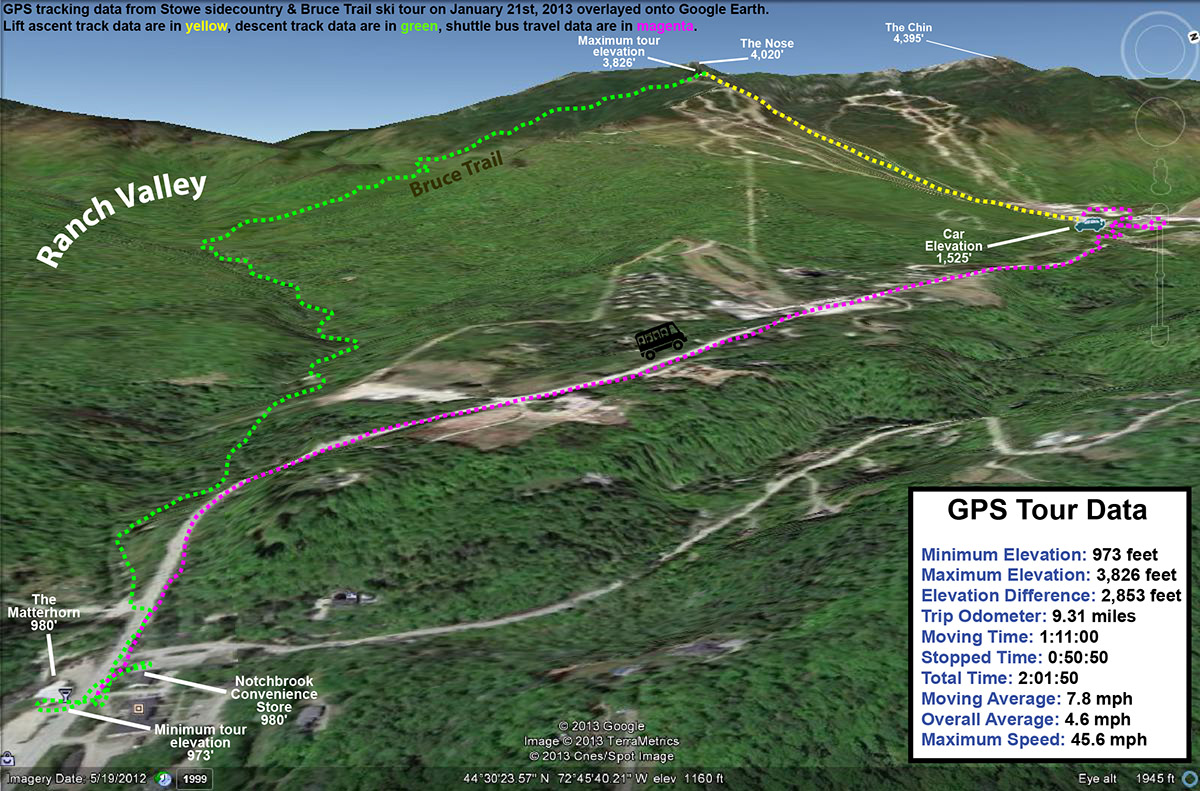
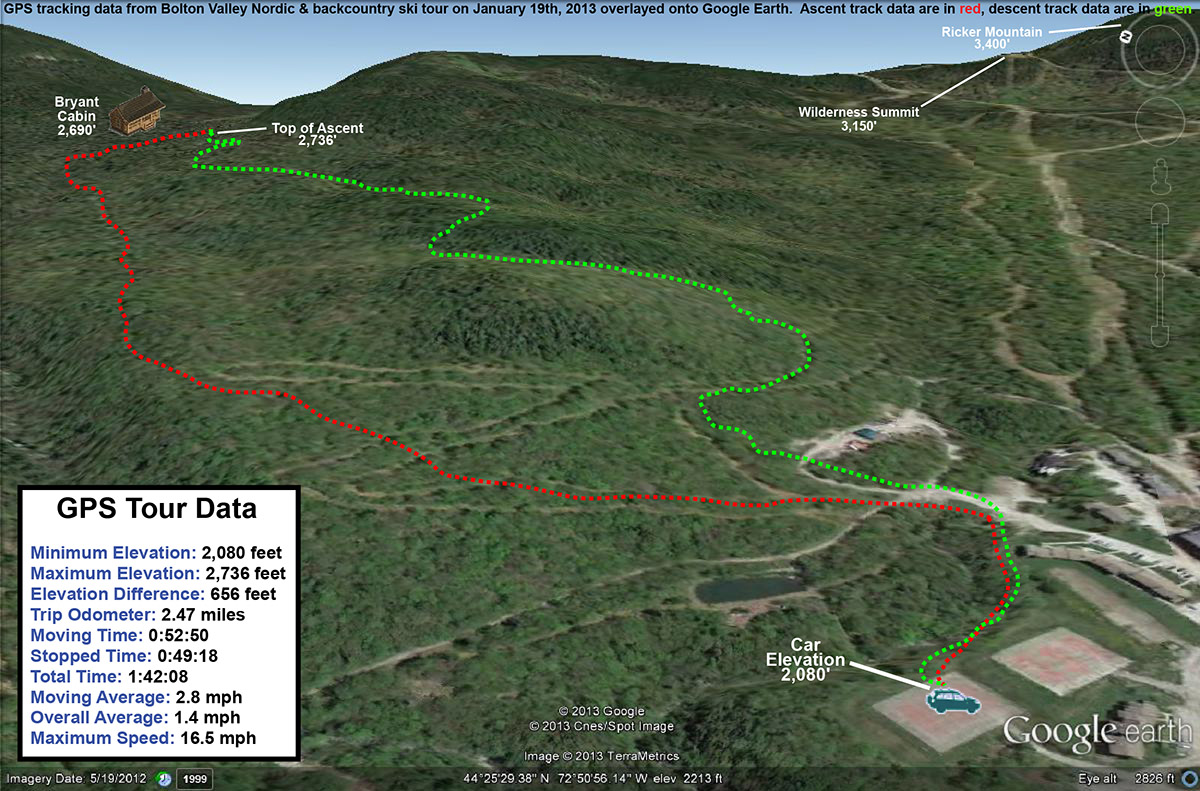
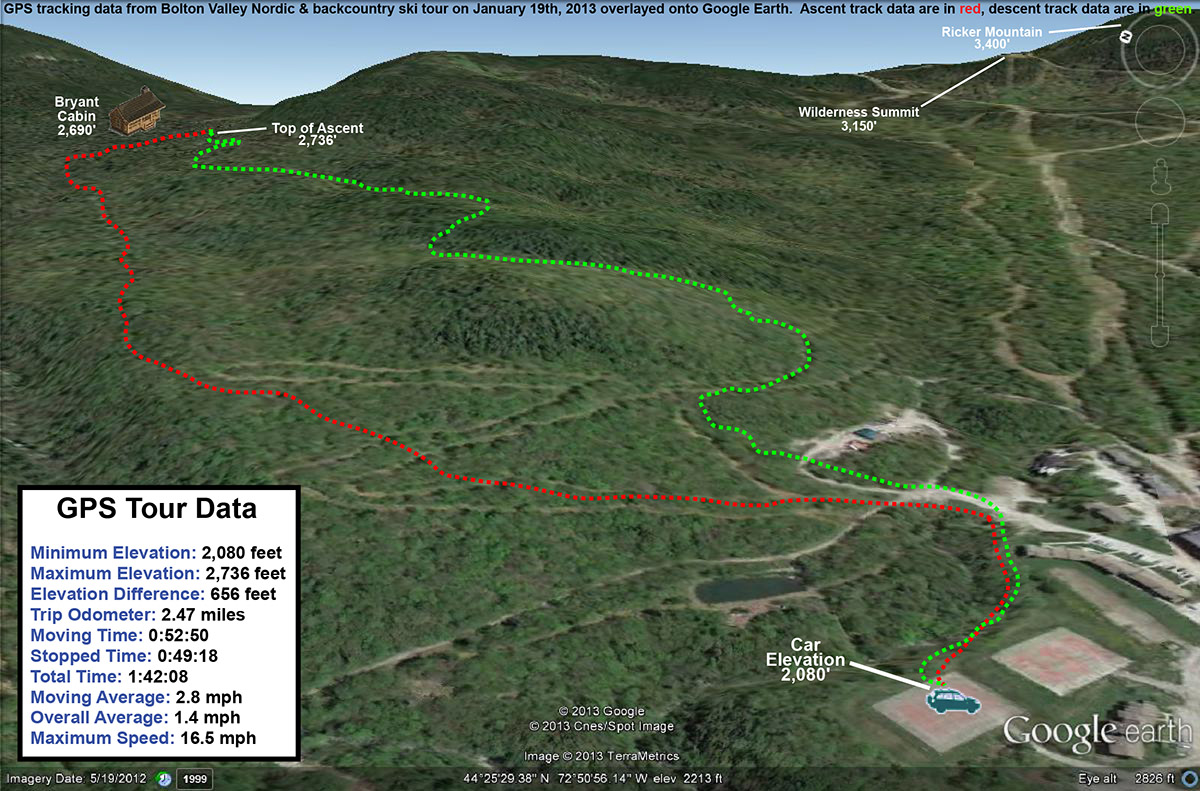
GPS tracking data for today’s Bolton Valley Nordic/backcountry tour – click for full size map
It was getting close to 5:00 P.M. before I was done with my tour, and now that we’re over a month past the solstice, I’m definitely noticing (and thankful for) that longer light. We’ve also got some warmer temperatures coming in the next few days, with a dramatic change in the weather pattern this week. A storm is coming in tomorrow that is forecast to deliver a modest 2-4” type of snowfall, but that is going to feel like a lot after only arctic dustings over the past week or so. We’re also expected to go above freezing with the next round of the storm as it cuts to the west, but hopefully we’ll get some additional snow on the back side. We could be into a more active pattern going into next weekend, which would be nice to build the snowpack after these January doldrums. With that said, I’ve certainly got a new found respect for what these arctic weather conditions can do for the snowpack, so if we do get another round of that weather, the skiing could be good as long as we can get at least some snow to go with it.
Some of the Northern Vermont ski areas have picked up close to (or in the case of Jay Peak, substantially more than) a foot of snow in the past seven days, and while that’s actually a fairly modest pace for snow accrual in the mountains this time of year, it’s helped to get surfaces back to packed powder since they hardened up last week. The snow has generally been dry and fluffy, so even with all that accumulation it hasn’t been a thorough resurfacing for all slopes. However, my explorations Saturday on the Bolton Valley Backcountry Network revealed that the powder is building and there are some nice turns to be had. Temperatures were expected to be in the single digits in the highest elevations today, so it seemed like a good opportunity for some sidecountry exploration instead of riding lifts. And, since Claire and I have been talking about bringing our Stowe ski group for a trip on the Bruce Trail one of these days, this seemed like an excellent opportunity for some reconnaissance. There’s no doubt that everyone in the group is ready for the skiing on the Bruce, but I still wanted to familiarize myself with the route to ensure that the trip would go smoothly with all the boys in tow.
“In general, I found 6 to 7 inches of powder down to the 2,000’ elevation, and at some point below there it dropped down more toward the 5-inch range.”
Temperatures hovered right around 10 F all the way to the base of the resort, and there was sun and no wind, so it wasn’t feeling too frigid at the point. The resort had snow guns going on various trails, no doubt taking advantage of the temperatures to bolster base depths that were probably brought down a bit by the warmth earlier in the month. I rode the Fourrunner Quad with a guy who had already been out for some runs, and he said the conditions were quite good. Listening to the turns of the skiers below us, it did sound pretty quiet. I could see the occasional icy spot, but the surface seemed to be mostly packed powder just as the snow report had indicated. The snow over the past week has definitely been having an effect in terms of softening up surfaces.
“While I’m sure the steeper top sections of the Bruce are great with a good dump of snow, the skiing today was far superior once I got down out of the evergreens and into the hardwood forest.”
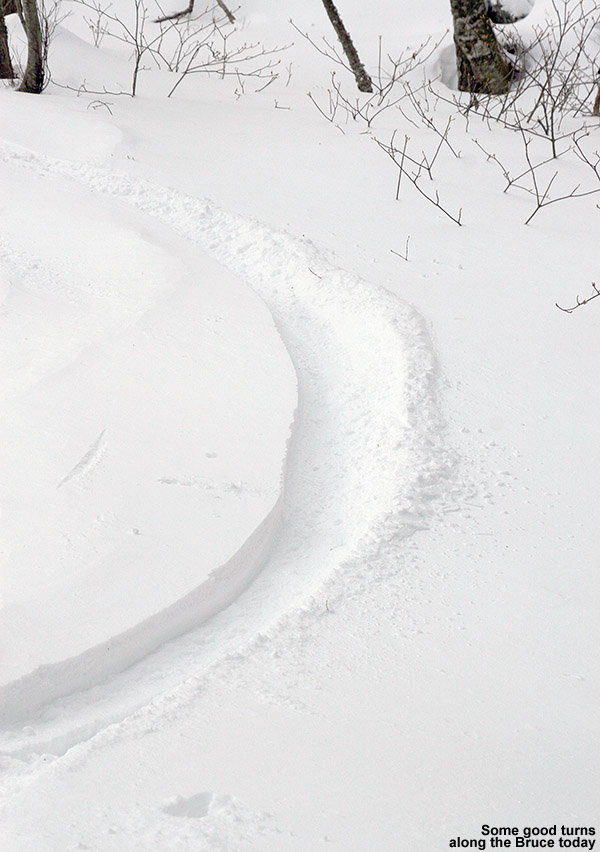
From the quad summit I headed over to the top of the Bruce Trail – a few tracks indicated that some skiers had already skied it today, but I dropped in via an alternate entrance to get an untracked line. The line was pretty steep and I was definitely touching down on the subsurface, but I could tell that I’d be able to get in some good powder turns on some lower angle terrain. The top part of the Bruce wasn’t really all that inspiring today – it’s pretty steep, a lot of pitches face southward, and it’s narrower than I’d thought it would be. I’d say it’s only 10 to 12 feet wide on average in the upper sections, which means that in reality it’s going to be tracked out and packed down after just a few skiers hit it. With its somewhat southern aspect making for spots of poor coverage here and there, it skied even narrower today. The snow was generally skier packed, so my fat Telemark skis were indeed feeling slow edge to edge, and I had to throw in a good number of alpine turns to fit in some of those small spaces dictated by the trail width and coverage.
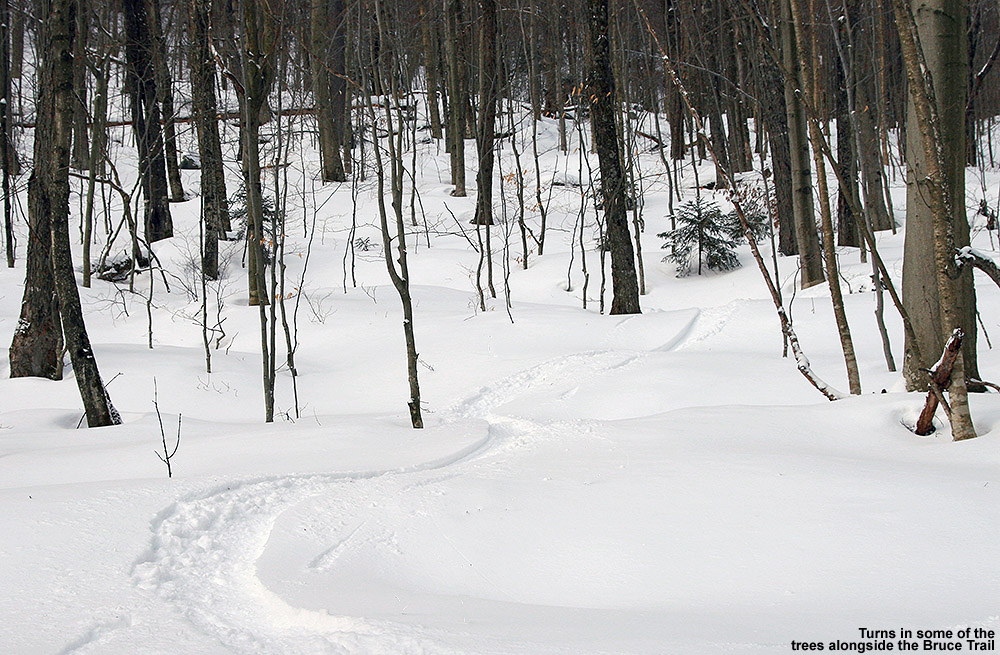
Catching turns down in the lower elevations among the hardwoods
While I’m sure the steeper top sections of the Bruce are great with a good dump of snow, the skiing today was far superior once I got down out of the evergreens and into the hardwood forest. The trail is notably wider in that area, and there are a lot more glade options for venturing off the sides of the main route. In general, I found 6 to 7 inches of powder down to the 2,000’ elevation, and at some point below there it dropped down more toward the 5-inch range. All those depths were definitely enough for some nice powder turns on moderate angle terrain though. With the narrow nature of the Bruce Trail in the top sections, it’s really not a trail that’s going to offer up much in terms of fresh powder, so those looking for a sidecountry experience with real untracked snow would probably be best served by using the Bruce as a jumping off point for explorations of the Ranch Valley. The snowpack isn’t even especially deep right now (right around the 40” mark), but I could see a multitude of ski options all around during my descent. I noted a couple of potential areas for exploration up in the evergreen areas, but choices really exploded once down in the hardwoods. It would be easy to make a day of it out there, or, ski the resort in the morning and then tour out in the Ranch Valley in the afternoon and finish off the day by skiing out to Route 108.
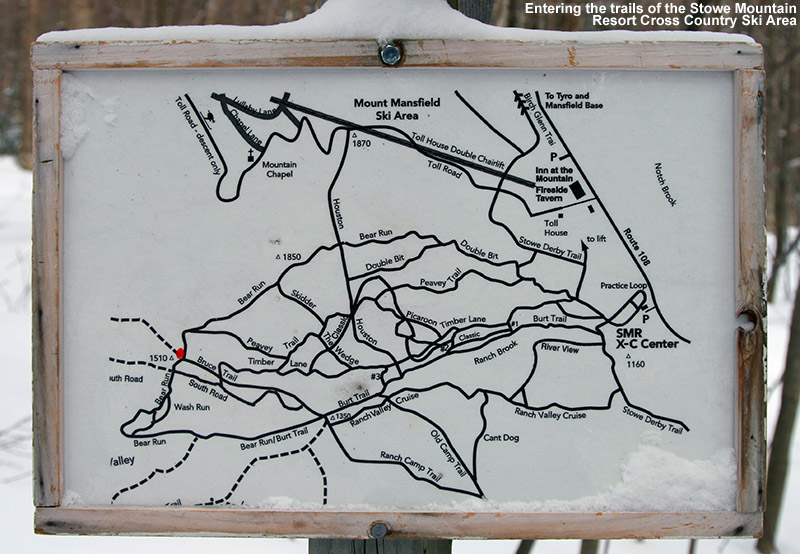
Stowe XC Map – Click for full size image
At around the 1,500’ elevation, I entered the trails of the Stowe Mountain Resort Cross Country Ski Center. This is the part I’d been concerned about in terms of making the correct choices to get out to Route 108 and the Matterhorn. It turns out that it’s much easier than I’d thought; you simply stay on the Bruce, and Burt Trails, following the signs that say “Ski Lift”. Even though you may not be planning to head back to the Toll House Lift, those “Ski Lift” signs are the way to go. Eventually you’ll get to a junction where following the “Ski Lift” route is a very obvious (and somewhat arduous looking) uphill, so you won’t want to go that way. By that point there are signs that indicate “Route 108”, and those will get you right out to the Matterhorn area. At every intersection you essentially go straight through, so in a worst case scenario, go with that. The trek through Stowe’s Nordic trails, and a small portion of the trails that belong to the Trapp Family Lodge Cross Country Ski Center, is slightly downhill, but there’s plenty of poling and skating to be done. I was happy to have my Telemark gear, even if I looked funny with my skis being three times the width of the other Nordic skiers ambling around on the trails. I generally took it slow and enjoyed the scenery, which included some marvelous views of the Ranch Brook. The brook had that winter look with some flowing water, but also lots of ice, and snow pillows covering the rocks.
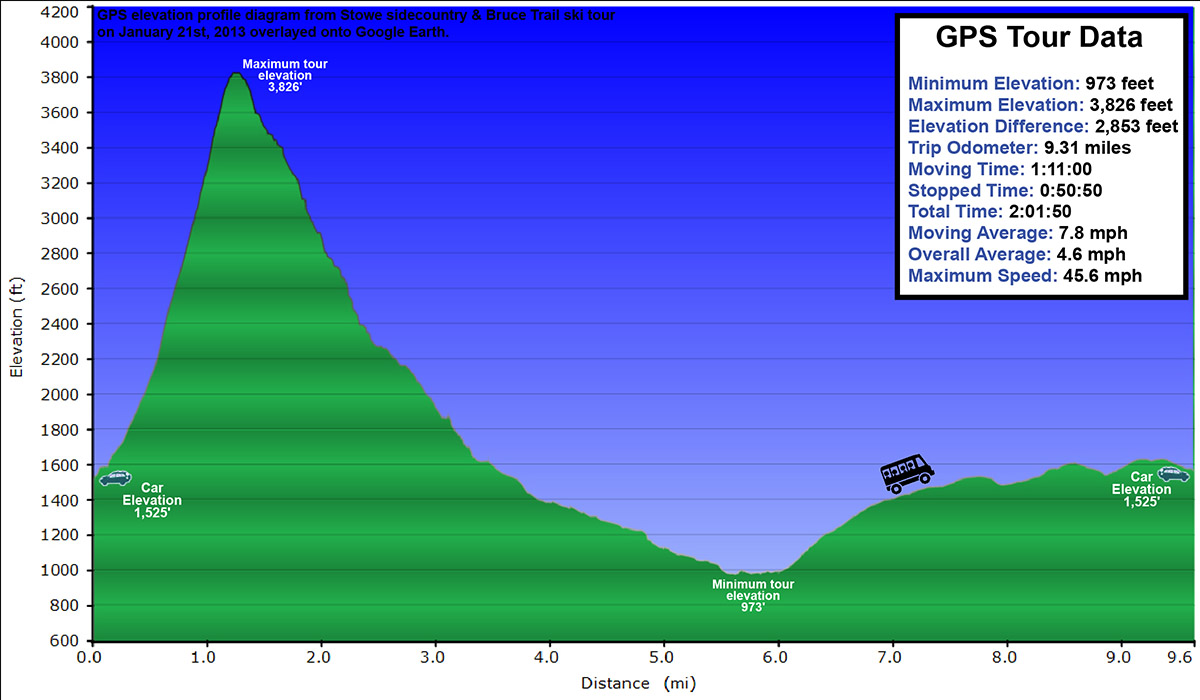
Elevation profile of today’s tour – click for full size image
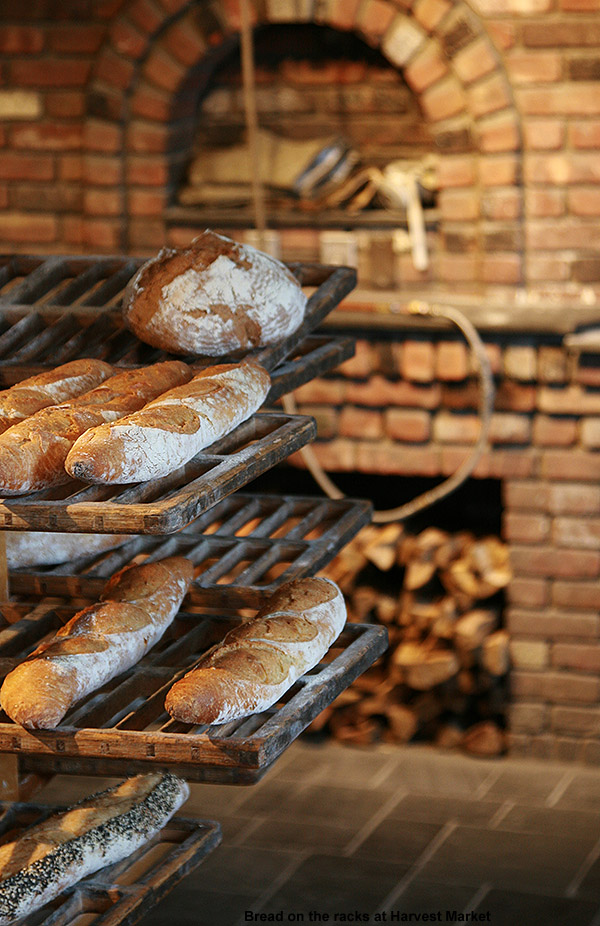
The final leg of the descent on Ranch Brook Road brings your right out on the “Ski Inn” driveway, next door to the Matterhorn, and across the street from The Notchbrook Convenience Store. I had time before the next uphill Mountain Road Shuttle arrived, so I stopped into the Matterhorn to get some sushi… only to discover that they don’t have sushi on Mondays. Clearly I’m going to have to hit the Bruce again with the boys on a different day so that we can finish that part of the adventure. So instead, I popped across the street to the store and got a snack before catching the shuttle back up to my car in the Mt. Mansfield lot. One thing I should note about the shuttle – the ski slots on the outside are still fairly old school, so if you’ve got fat and/or twin tip skis, you might have to bring them on the bus with you. Apparently that happens a lot, because the driver immediately knew what my issue was when I inquired. Missing out on the sushi, I did stop off at Harvest Market for a couple of samosas on the way home, and that definitely filled the void. So, today’s outing offered up some good turns in the powder, and was certainly a successful reconnaissance. The route down to the Matterhorn is easy, and I can tell that the biggest hurdle is going to be getting the boys through the flatter terrain at the end of the run. If that’s the toughest part we have to deal with though, it should be a lot of fun.
Harvest Market
Weather-wise, the day turned out much warmer than the forecast seemed to suggest – it was 20 F once I was back down in the valley, and before I’d realized that, I couldn’t figure out why it felt so comfortable. The sunny skies from earlier in the day had clouded over ahead of another small snowfall event that’s supposed to hit us tonight into tomorrow – these are the sorts of storms we’ve got for now until something bigger comes along, but at least we’re getting something.
Today’s Tour viewed in Google Earth – Click for full size image
Heading off into the powder below North Slope today
It was a lot of fun skiing in the soft snow and warm temperatures last weekend, but winter is definitely back now. Temperatures dropped down closer to seasonable levels at the beginning of the week, and then the bottom fell out toward the end of the week as we dropped below zero F Thursday night with an arctic frontal passage. Fortunately, we’ve also had some modest shots of snow to start freshening the snowpack, and temperatures were back up to around 30 F in the mountains today, so it did seem like a good opportunity to get out for some turns and exercise. Stowe is reporting 8” of snow since Wednesday, and the skiing looks great based on the pictures that Powderfreak posted in the ski thread and the Northern New England thread at the American Weather Forum today. Bolton Valley is also reporting 5” of new snow during the period. Although I’m thinking of waiting until we hit roughly the one foot mark before checking out the lift served terrain, it did seem like we’d seen enough new snow in the past few days to provide some decent backcountry turns.
“…I found 3 to 4 inches of fluff down at the Village level, and that gradually increased to the 4 to 6 inch range by the time I got up to the Bryant Cabin at around 2,700’.”
With all that in mind, I decided to hit the mountain for a quick tour up to the Bryant Cabin and back through whatever terrain seemed fitting for the conditions. We’d reached the mid 30s F down at the house (495’) when I headed out around 2:00 P.M., but up in the Village at 2,100’ it was just 31 F. There certainly hasn’t been enough snowfall yet to really resurface the slopes and get the on piste conditions back to normal, so I couldn’t believe how the Village parking lots were virtually full. I wasn’t even able to get a parking spot in the upper tennis court lot like I usually do because it was full, but the lower tennis court lot had a decent number of spaces, and I was still able to park trailside along Broadway. The resort was hopping though, so I guess the holiday weekend and the comfortable weather are enough to make people really want to get out there. Overall that’s great for the resort of course.
“Indeed the turns in the powder were silky, especially when aided by the width of my AMPerages, and it was nice to feel that float again.”
In terms of unconsolidated snow above the old base, I found 3 to 4 inches of fluff down at the Village level, and that gradually increased to the 4 to 6 inch range by the time I got up to the Bryant Cabin at around 2,700’. Coverage on the Bryant Trail was generally fine, although a couple of the stream crossings had only recently filled back in after presumably being blown out a bit with running water during the warm spell. Traffic out in the Bryant area was pretty light once I was up above the Nordic trails – I saw a couple of skiers descending and a couple groups coming down on snowshoes. The air was generally calm, although you could occasionally hear some gentle gusts of wind up in the peaks. We’ve got another system and arctic frontal boundary coming through tomorrow, so there was that feeling of being between systems.
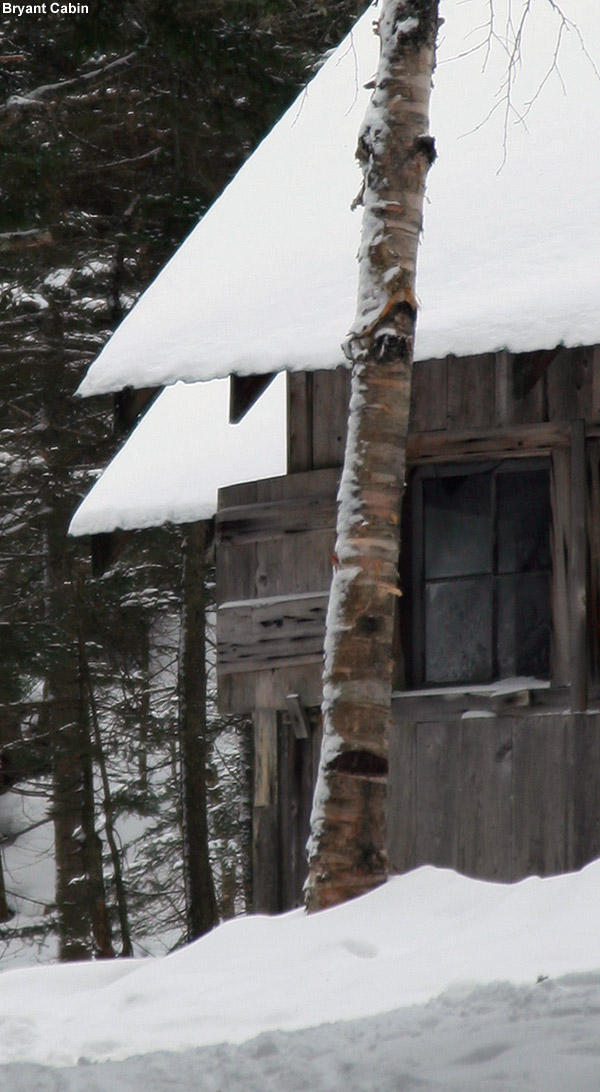
Bryant Cabin
There was nobody in the Bryant Cabin area when I arrived there, and it was very quiet as I made my way past and stopped at the top of Gardiner’s Lane. I could see some of the glades above me, and the look of the powder up there was very appealing, but I could tell by the tracks of a couple of other skiers up there that the new snow wasn’t quite deep enough to really make the turns bottomless. As I was stripping off my skins, I heard a little noise coming from above me in the Birch Loop direction, and soon another backcountry skier passed by and headed down Gardiner’s Lane. I’m not sure what he’d been skiing up above, but he probably had a similar plan to mine for the terrain below – there are a lot of nice mellow options off Gardiner’s Lane that would work really well with the conditions.
The powder is building.
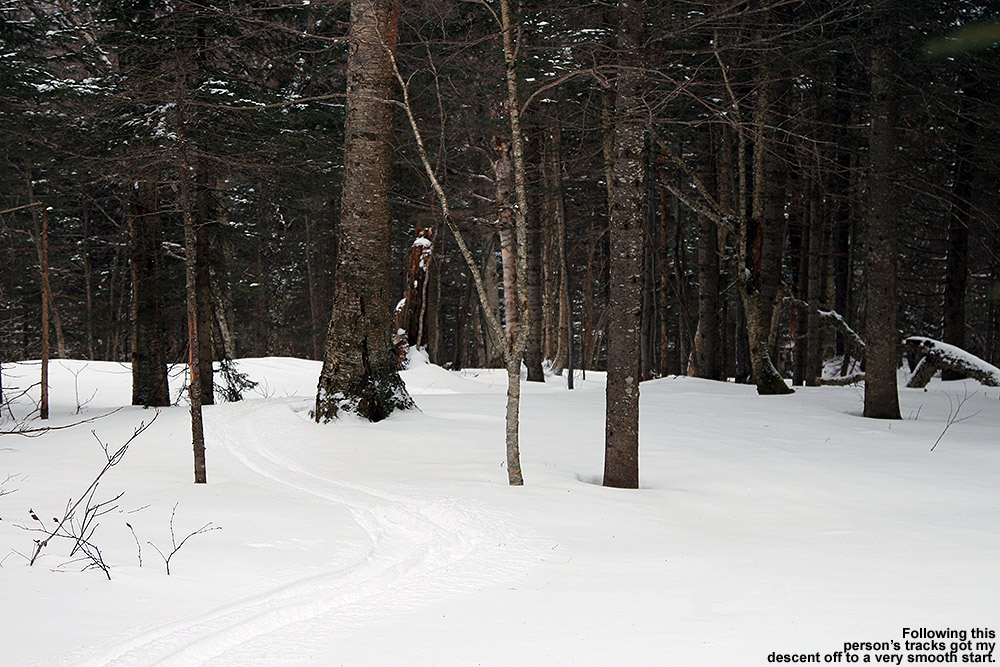
Conditions on Gardiner’s Lane were packed, and a little bumpy in spots. At the junction with North Slope, I headed up a bit to catch a nice mellow line that I knew, and I’m glad that I did. I could see that another skier had taken in before me, and the tracks left behind suggested some nice turns. Indeed the turns in the powder were silky, especially when aided by the width of my AMPerages, and it was nice to feel that float again. Back on Gardiner’s Lane, I had a feeling that I was in the zone of another glade I knew, and figuring that Gardiner’s Lane itself would have seen a fair share of traffic, I decided to head on that lesser used route. Only one other skier had passed through there, and the snow was good, but the pitch was too steep to avoid contacting the base snow. Below there I followed a set of tracks to an area I’d never been, and found a nice long glade that brought me all the way back down to World Cup. It’s got to be one of the longest glades I’ve seen out there. I’m not sure how new it is in the grand scheme of the backcountry network, but it’s new to me; I can’t wait to show it to E and the boys – especially with deeper powder. Someone did some nice work in there. The glade starts off with some mellow terrain that was great for today’s conditions, and then it steepens out to more of an intermediate pitch. I was even able to finish off with a run on the Telemark Practice Slope, which did have some irregularities in the subsurface snow due to previous skier traffic, but still delivered some nice turns – even a few in which I was able to stay floating in the powder.
GPS Track of today’s tour on Google Earth
Overall I’d say that that part of the run in the new glade was a good description of the general conditions out there – you can get some bottomless turns (especially with the help of fat powder boards) on the mellower green-style terrain, but on intermediate pitches and above you’re going to be touching bottom a lot. It was definitely worth a tour out there today though, and if we get a few more inches as the next system passes through tomorrow, it’s going to be even better.