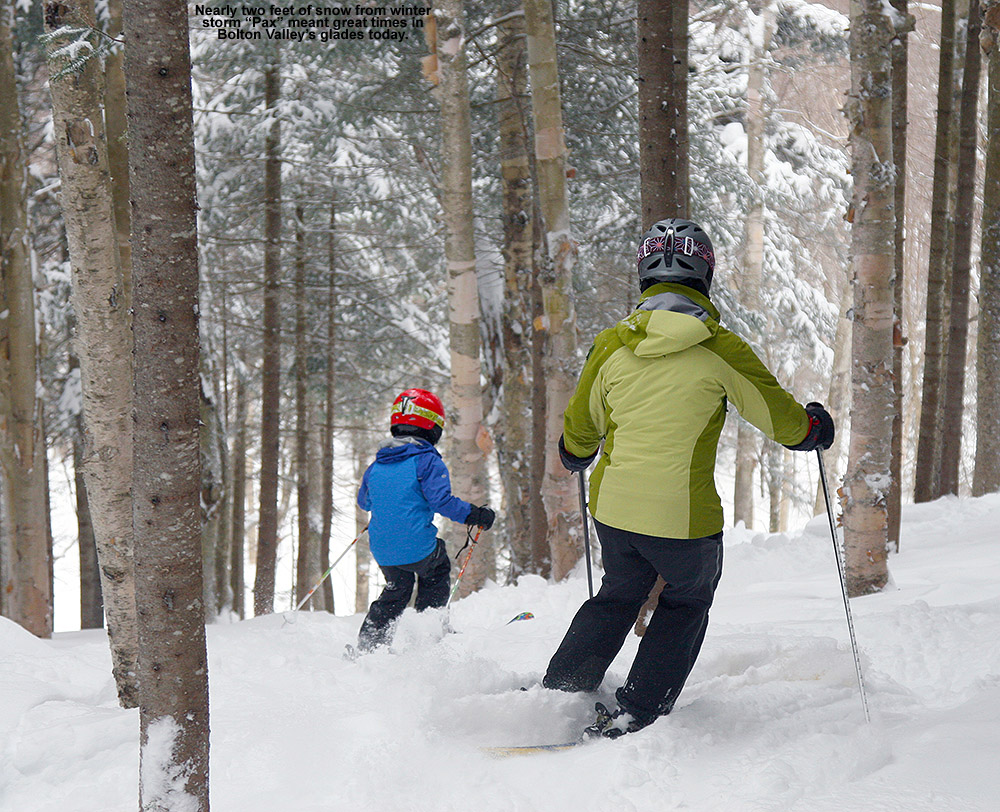
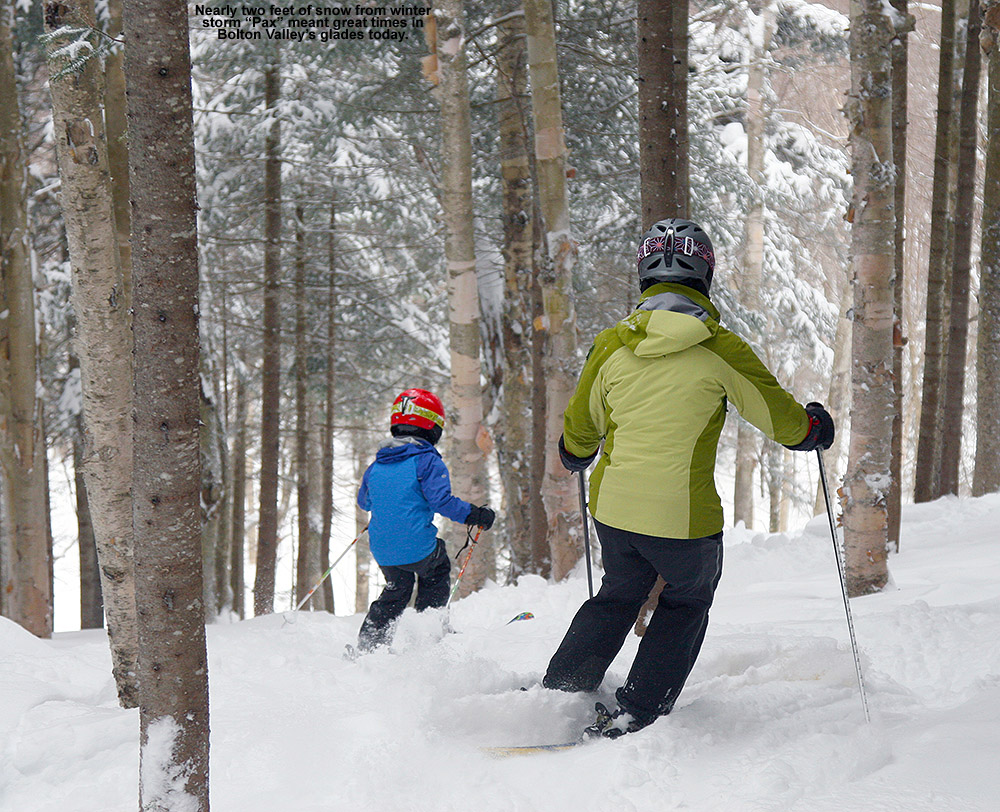
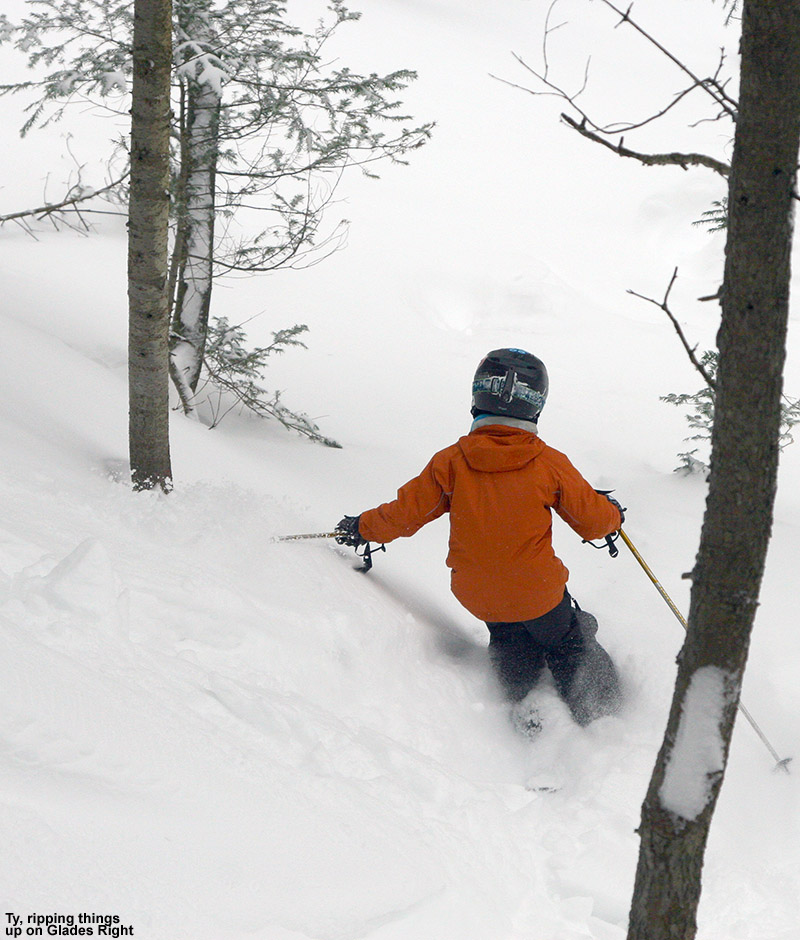
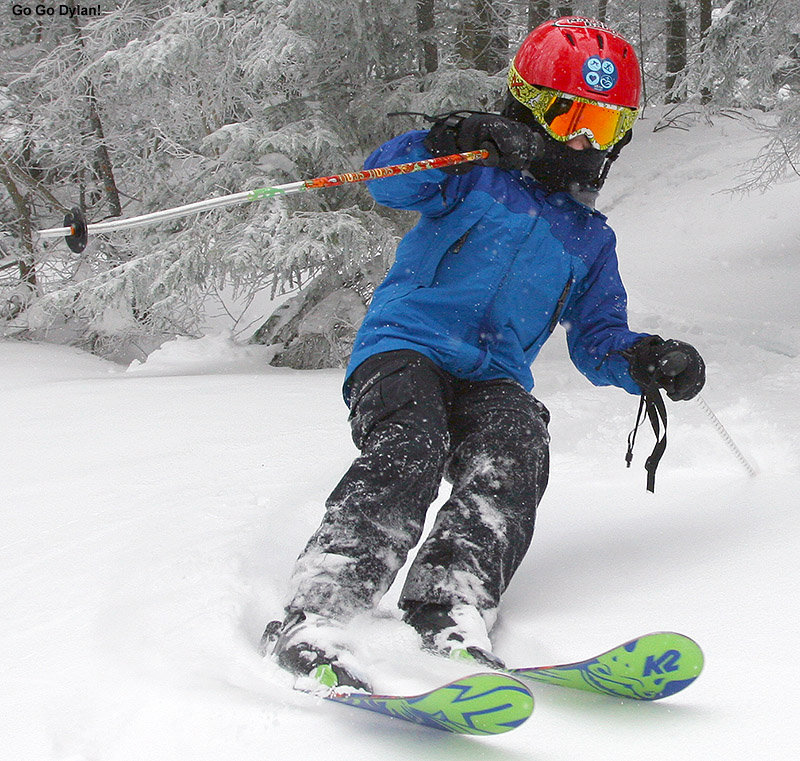
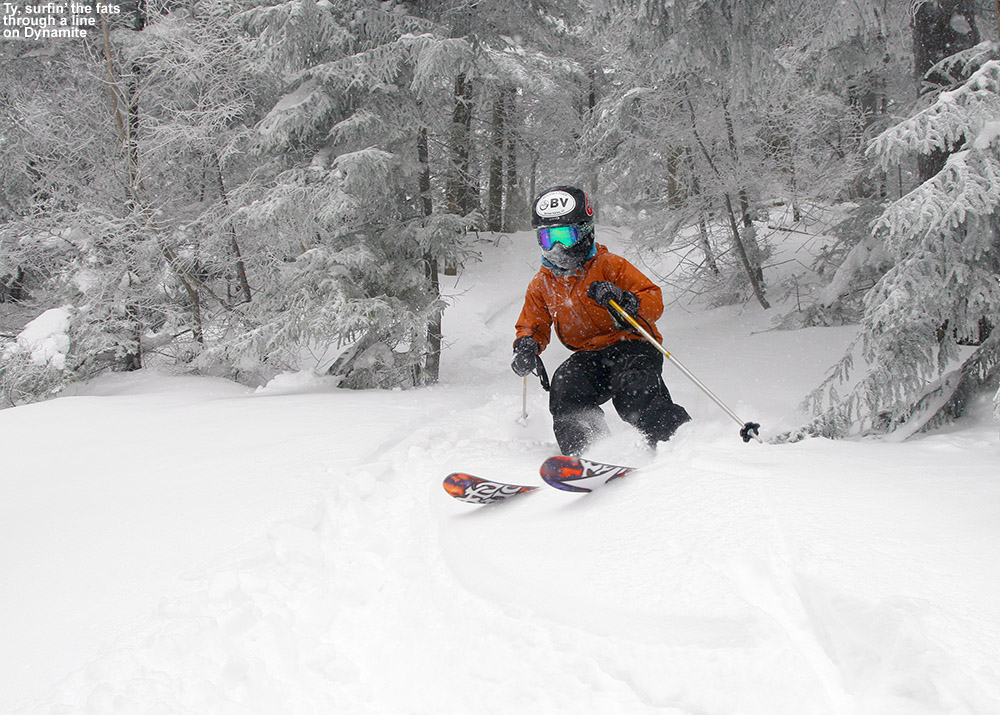
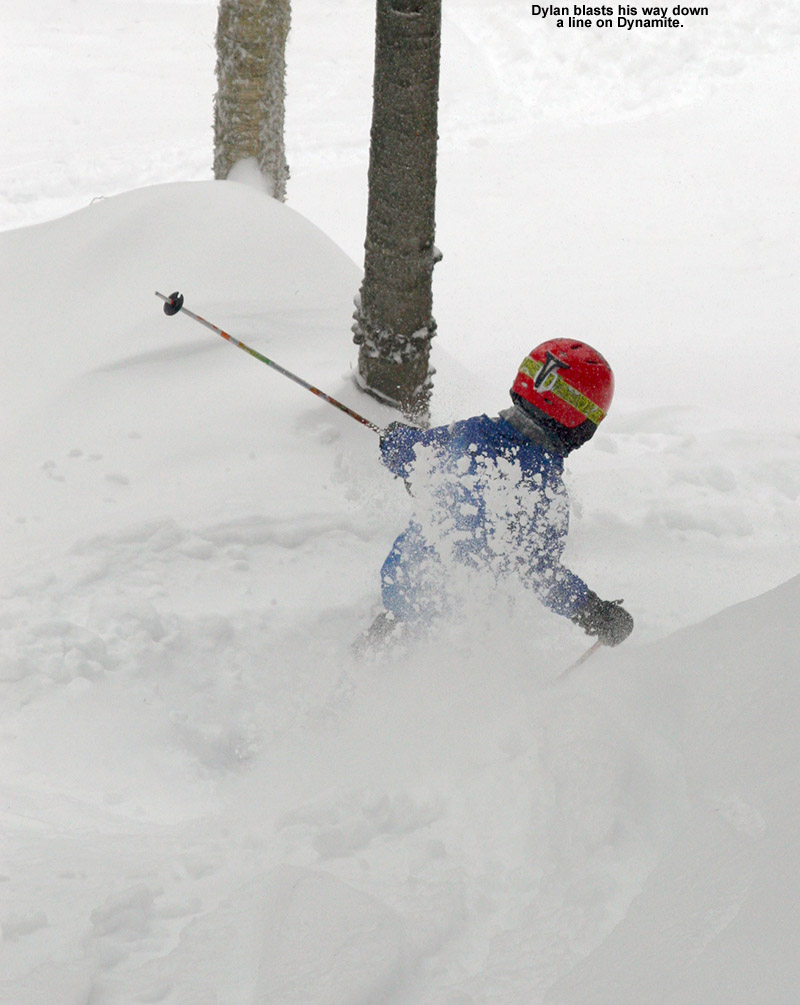
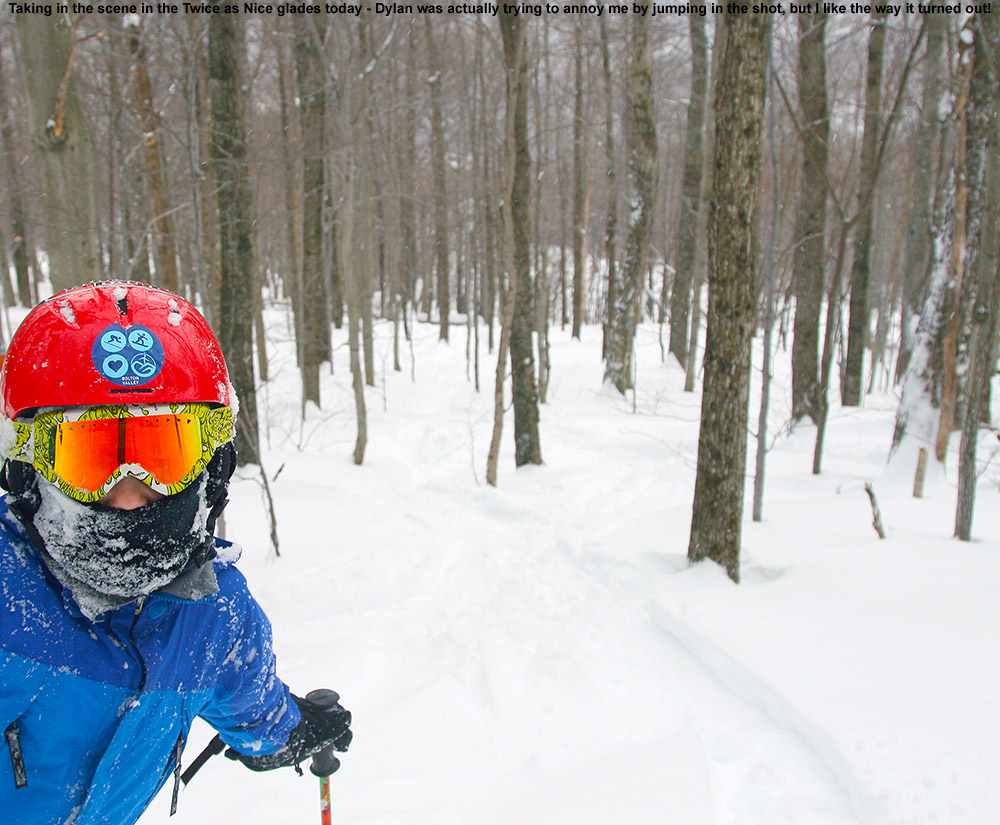
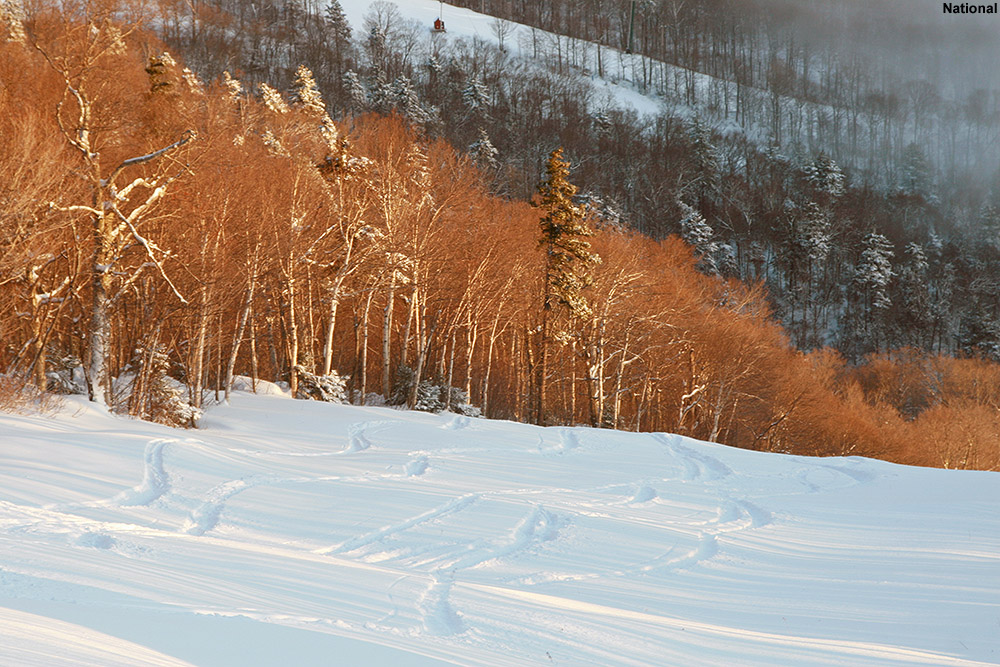
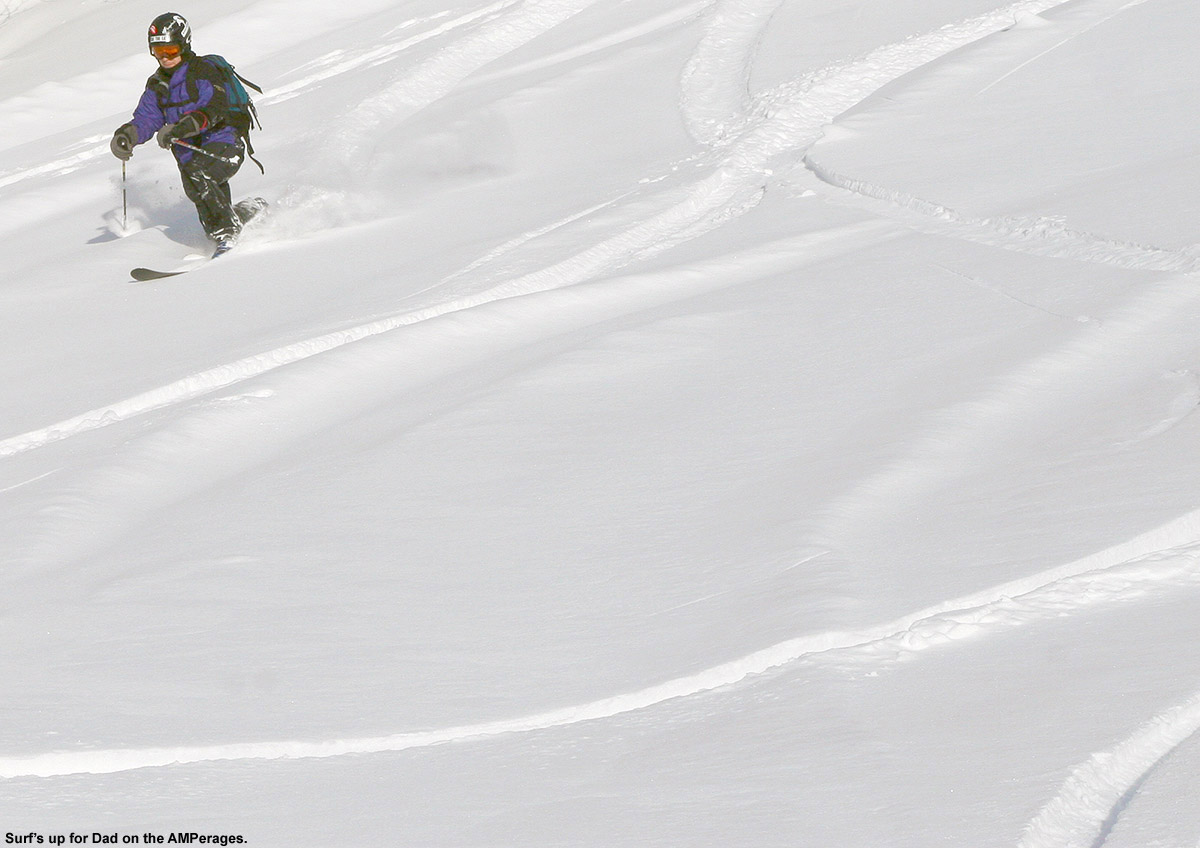
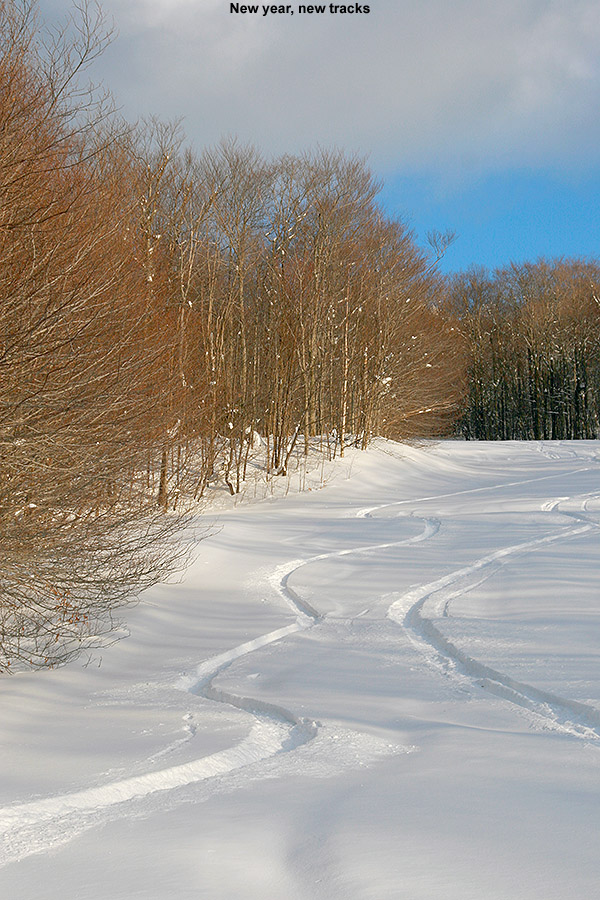
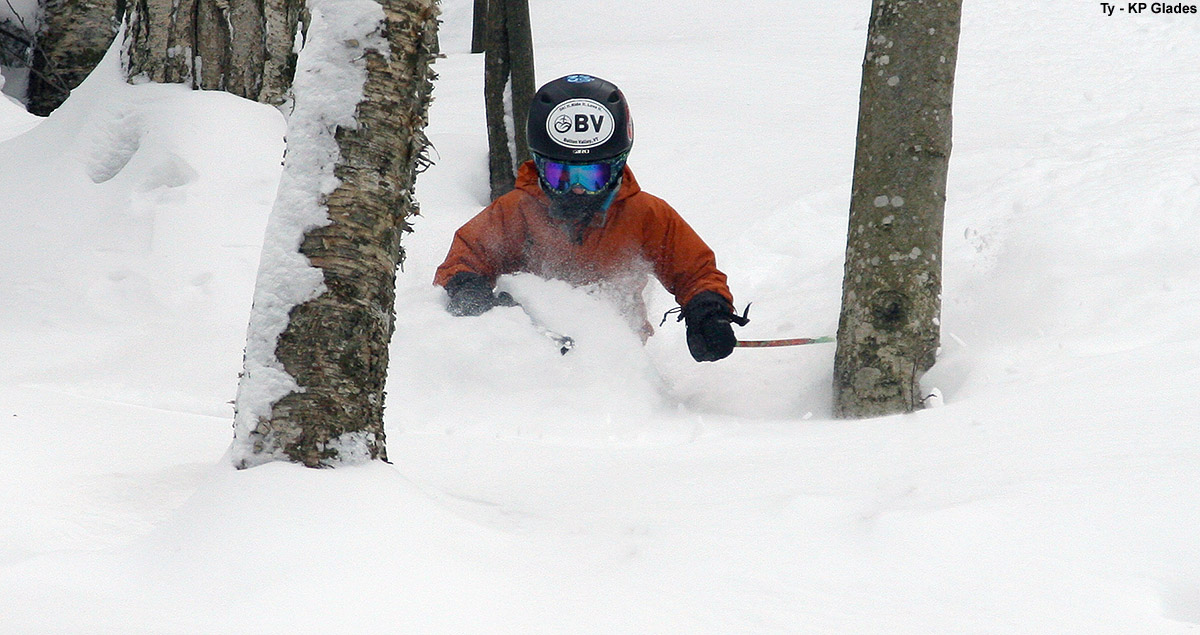
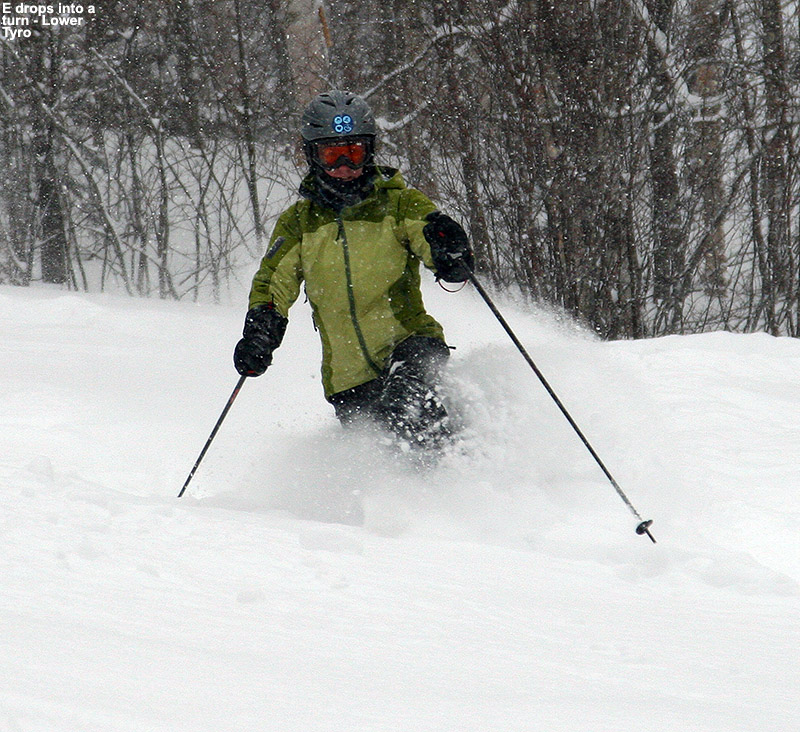
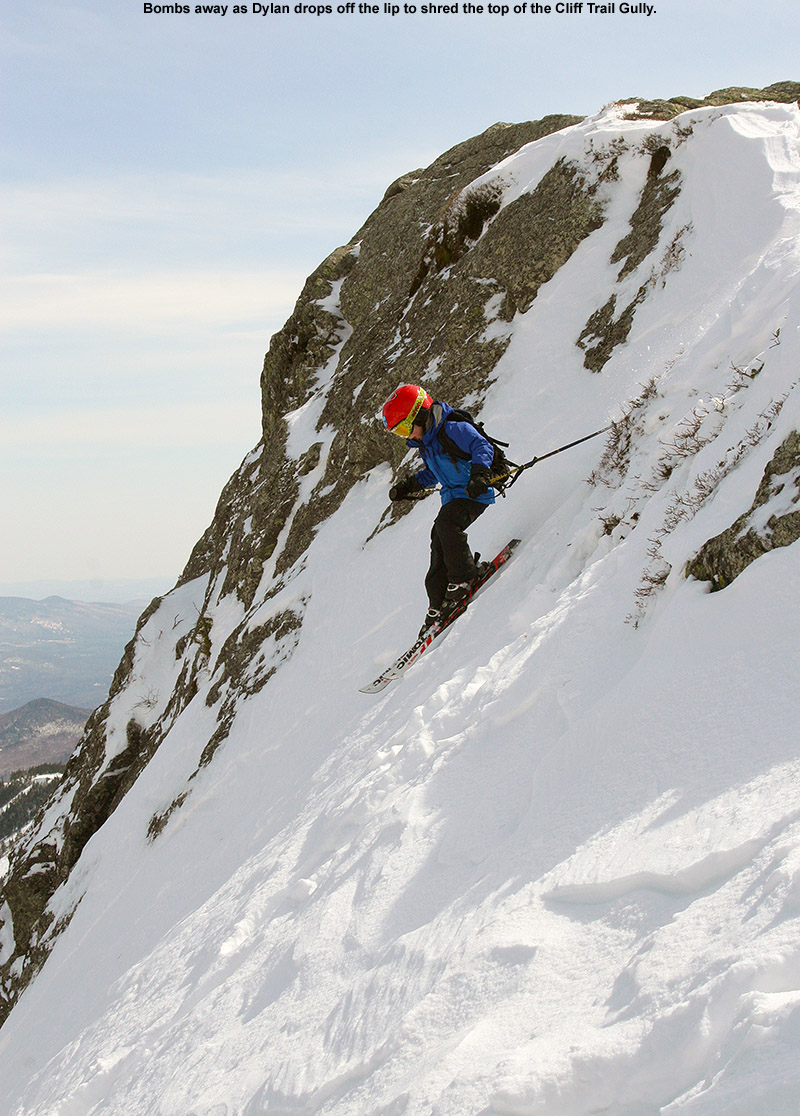
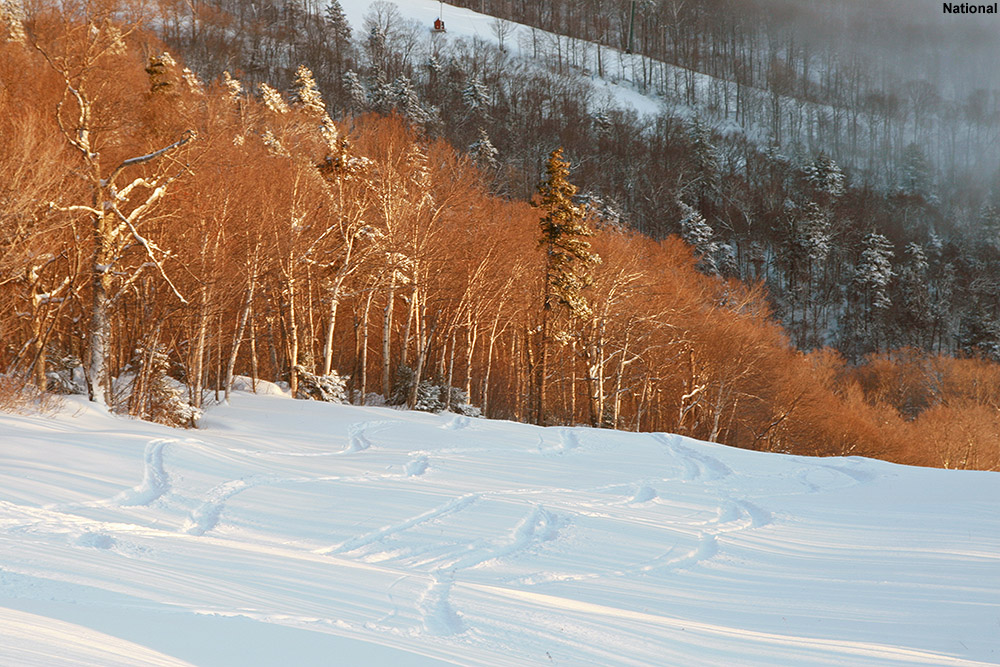
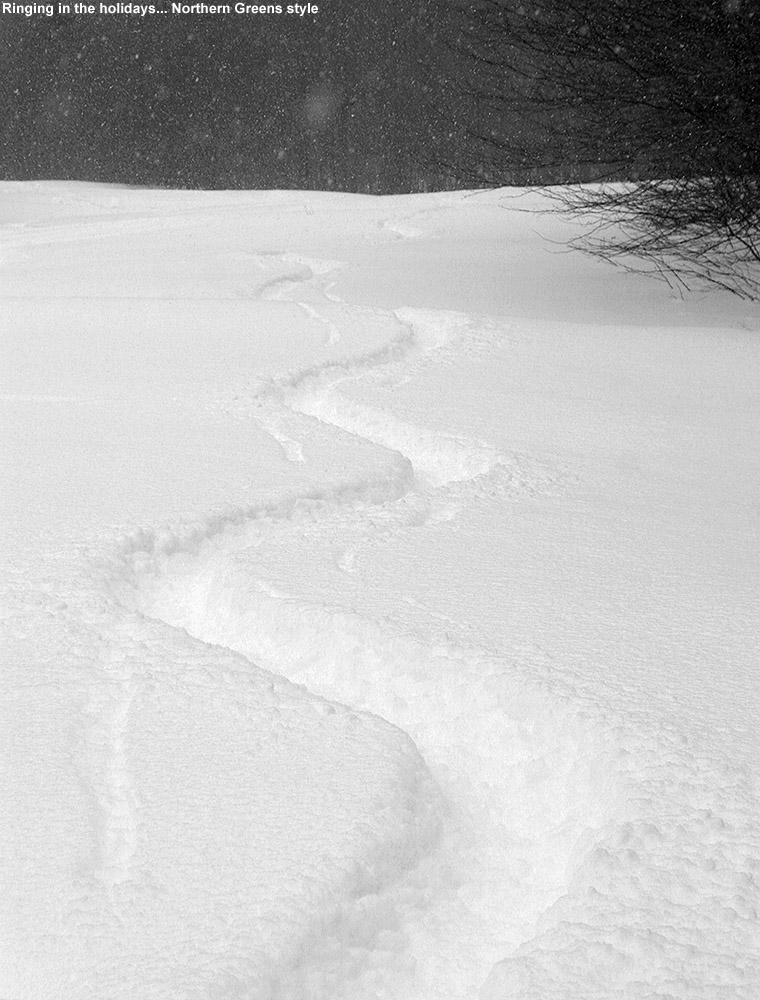
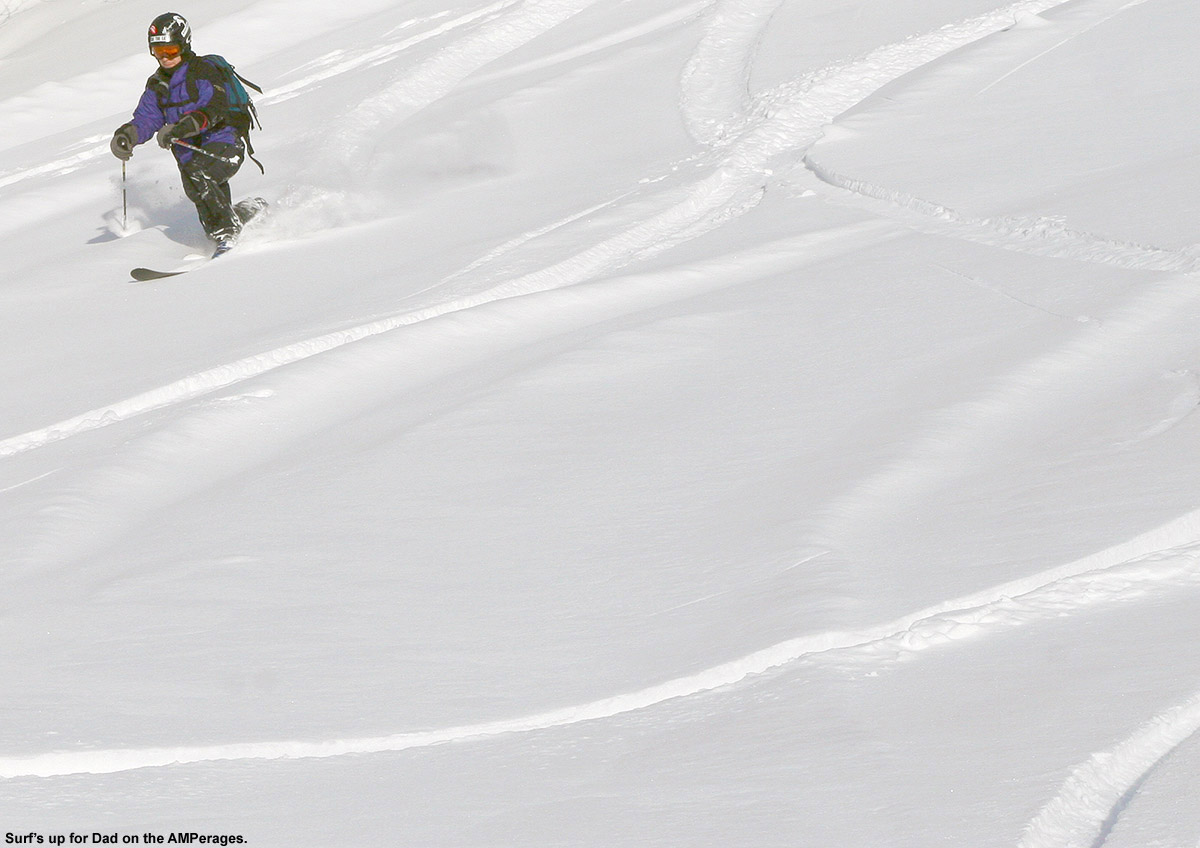
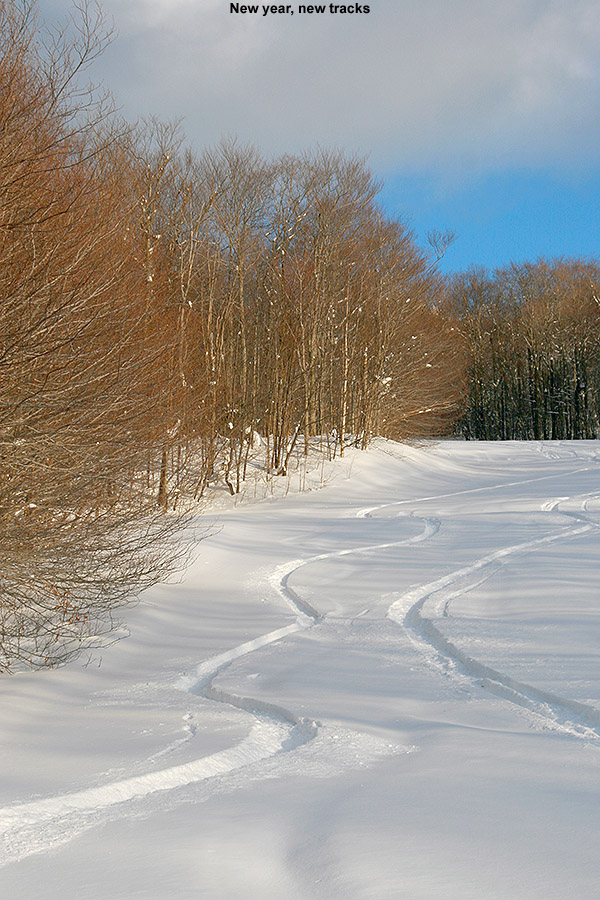
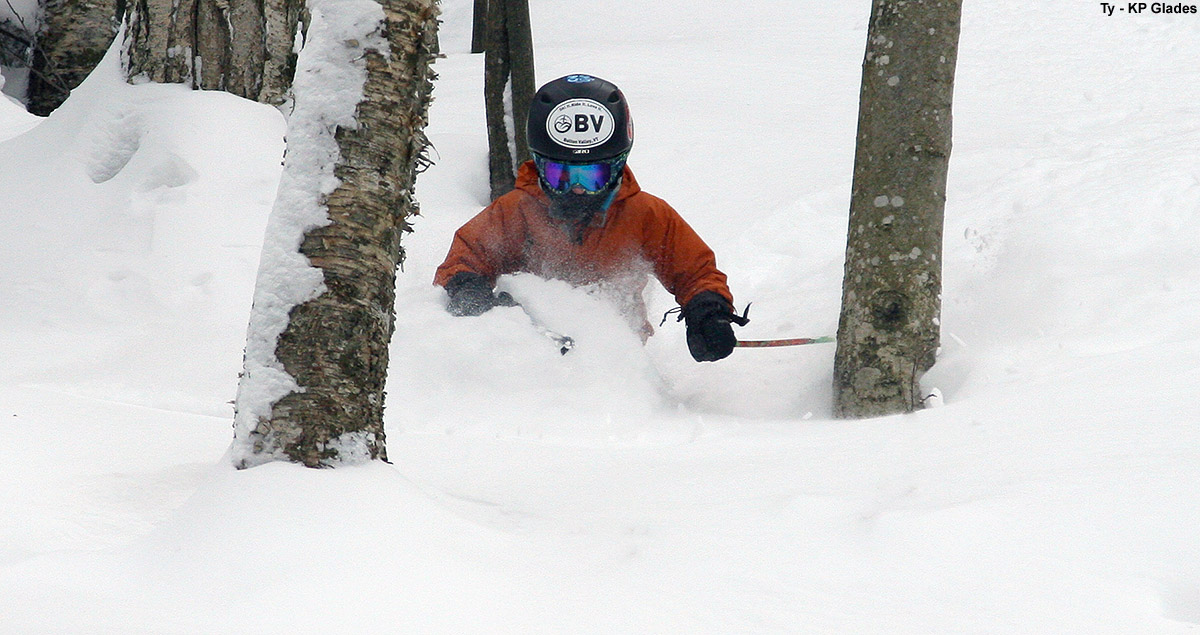
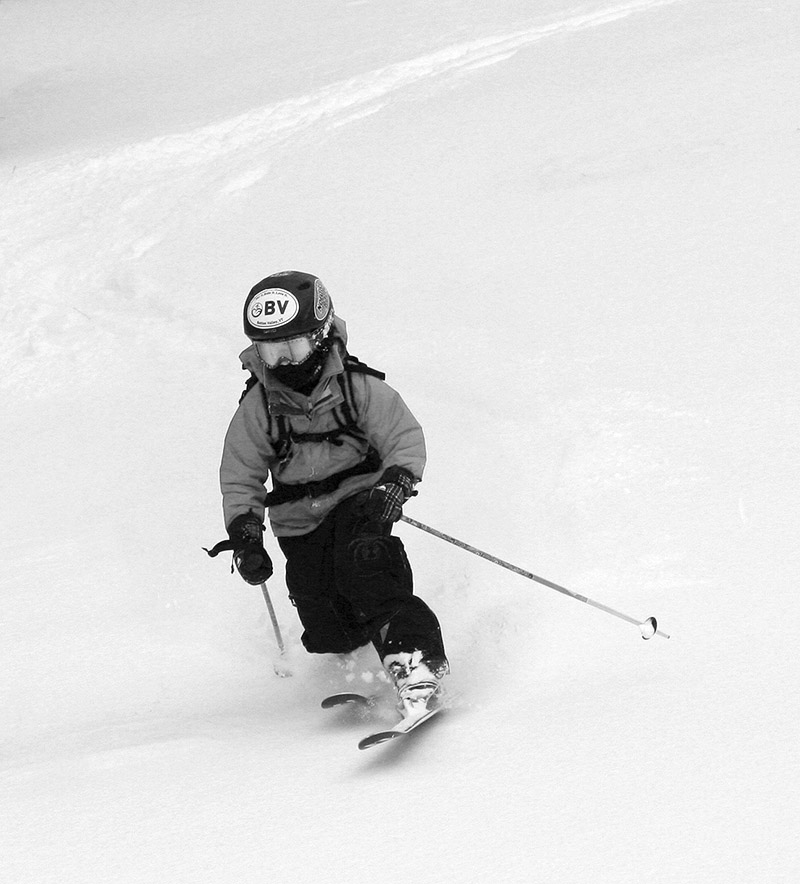
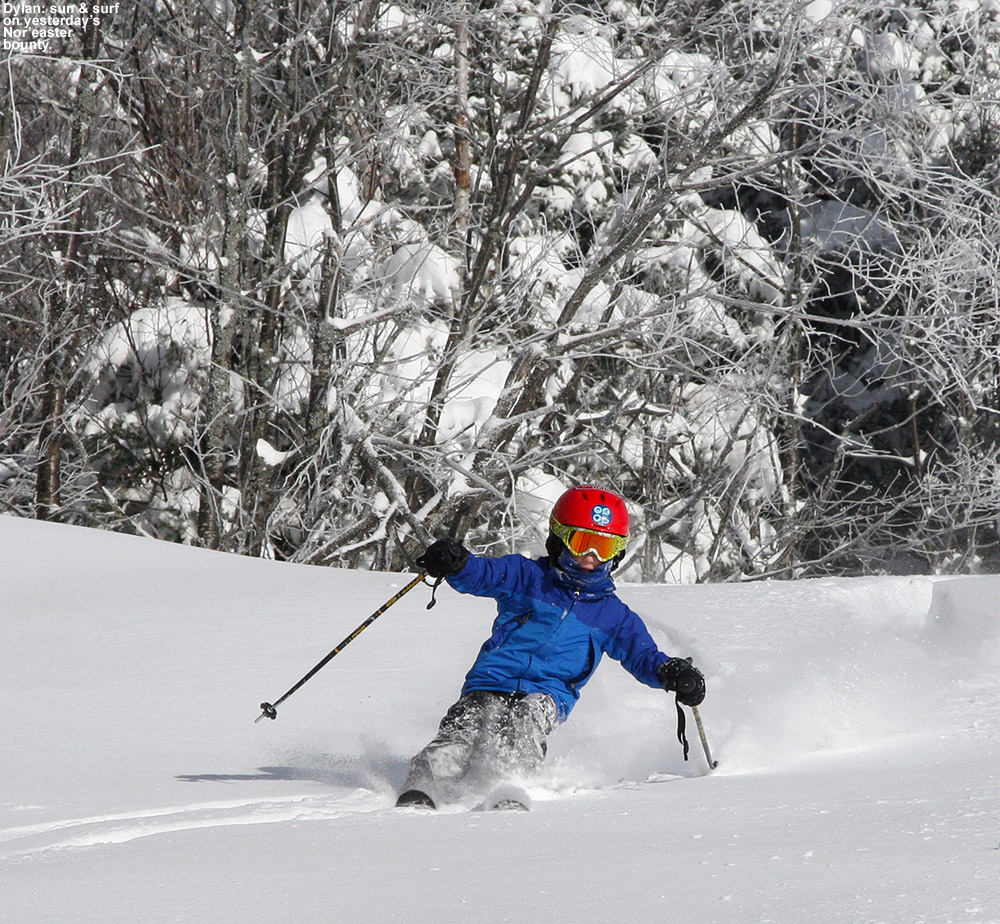
Dylan bounding down through some of the powder from our recent big storm cycle at Bolton Valley today
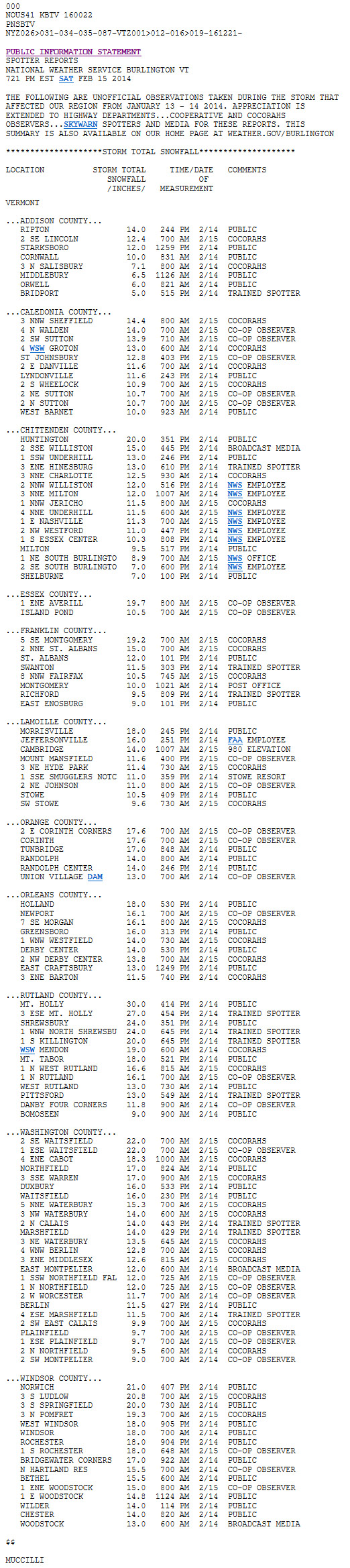
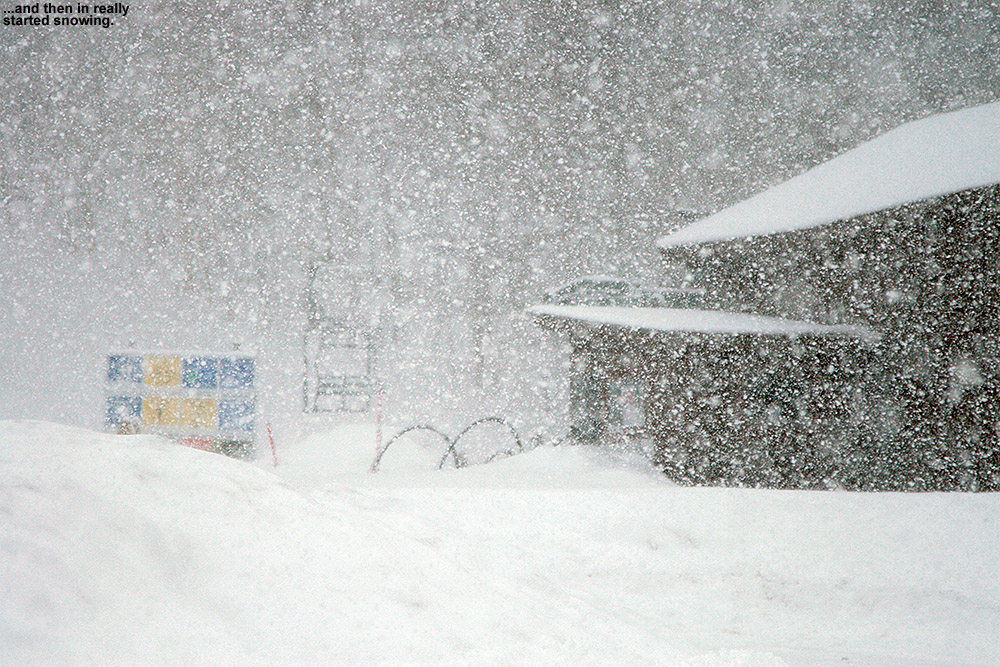
Winter storm “Pax” affected Northern Vermont on Thursday and Friday this week, dropping up to 29 inches of snow on the ski resorts along the spine of the Green Mountains. We haven’t had much in the way of large storm cycles up in the Northern Greens this season, so this was our largest to date, and it showed some interesting distributions with respect to snowfall density. Some areas received extensive periods of large, fluffy flakes, and other locales had some very fine flakes that fell as very dense snow. For instance, the first round of the storm at our location on Thursday night delivered some very dense, 13% H2O snow. That’s actually just what the snowpack needed for building. Whether the snow was dense or not, in the end, the mountains received well over an inch of liquid, and that liquid equivalent was really what was necessary to bolster the natural snowpack. It was enough snow that Bolton Valley had finally opened all the terrain at Timberline, and we were psyched because that had been an inordinately long time coming this season.
“Winter storm “Pax” affected Northern Vermont on Thursday and Friday this week, dropping up to 29 inches of snow on the ski resorts along the spine of the Green Mountains.”
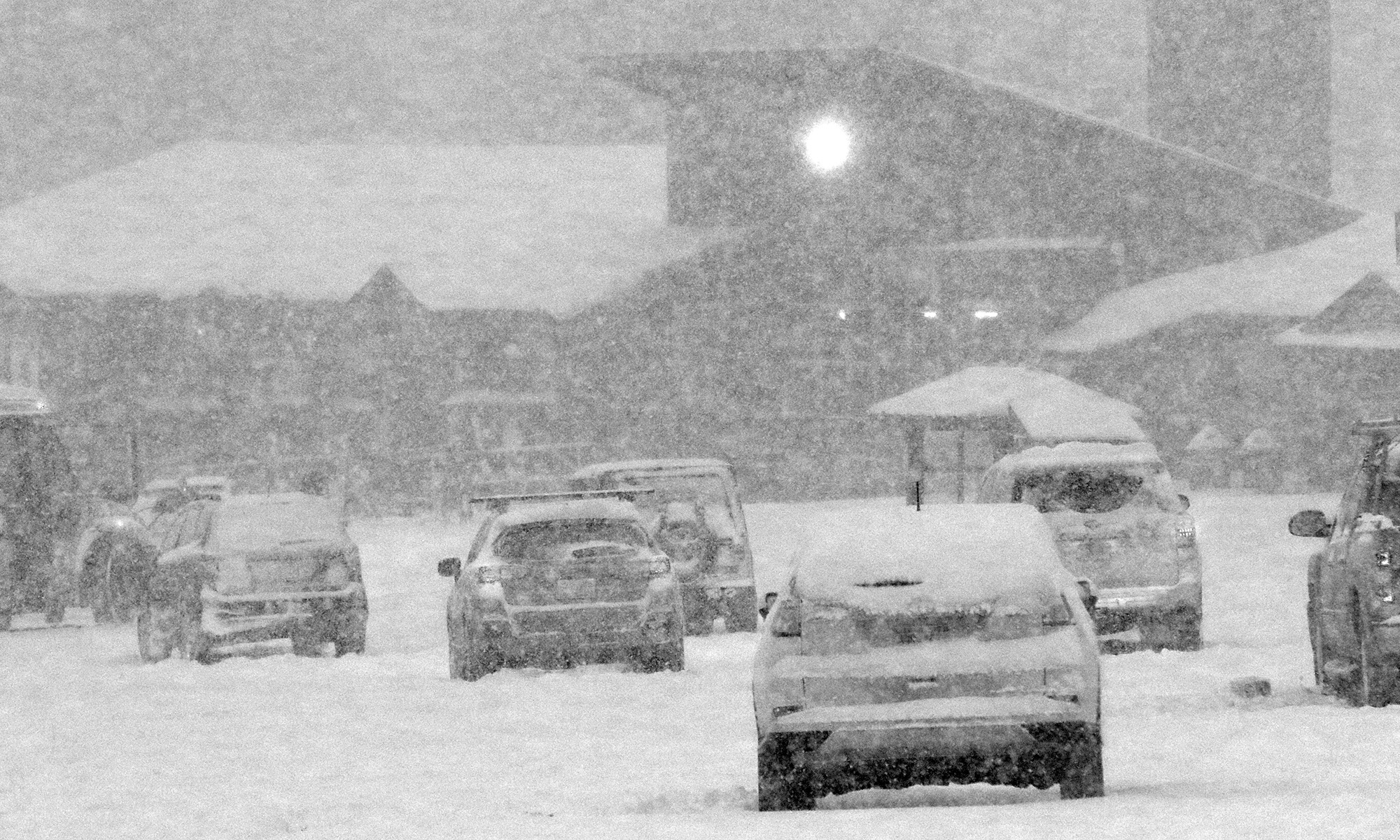
We decided to get a relatively early start on the mountain today, and even though we weren’t expecting the Timberline Quad to open until 10:00 A.M., when we drove by at 9:30 A.M. it was already running, so we pulled right in and parked. There were a couple of dozen cars in the lot, but it was still fairly quiet. That was good, because being a holiday weekend, having the biggest storm of the season just hit, and then having great weather to enjoy it, we were worried about how many people were going to be out. It was business as usual though at Timberline, with no lift queue and just a small group of people out to hit the terrain.
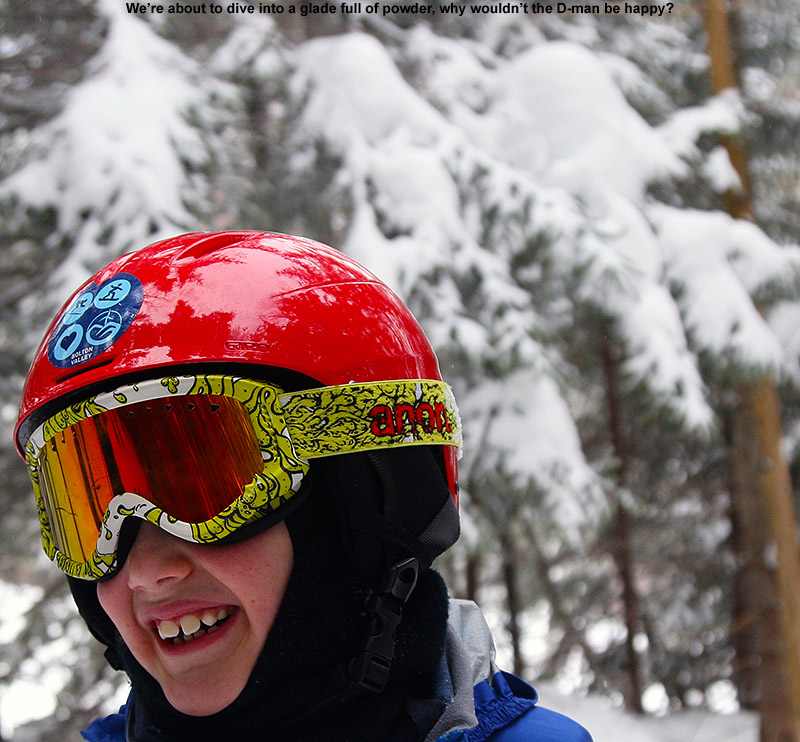
During our first lift ride we could see that the snow looked quite good, and there had definitely been a major resurfacing of the slopes. People had skied the area yesterday, so it wasn’t entirely fresh snow, but there were plenty of untracked areas, and a few more inches had fallen last night to cover even areas that had seen traffic. With almost two feet of new snow having fallen at Bolton Valley, we planned on hitting a lot of the steep off piste terrain that we’d yet to ski this season, so E decided to go with her fat alpine skis instead of Telemark skis. The boys had their powder skis, and I had my fat Teles, so we were ready to tackle whatever Pax had delivered. We had really great weather to enjoy the snow too – the temperatures were in the upper 20s F, there was no wind, and a little snow associated with our next storm system was floating through the air and adding a fresh coating to the slopes.
“The only complaint I’d add about the snow is that it was bit upside down, with some dry stuff underneath a layer of denser snow on top.”
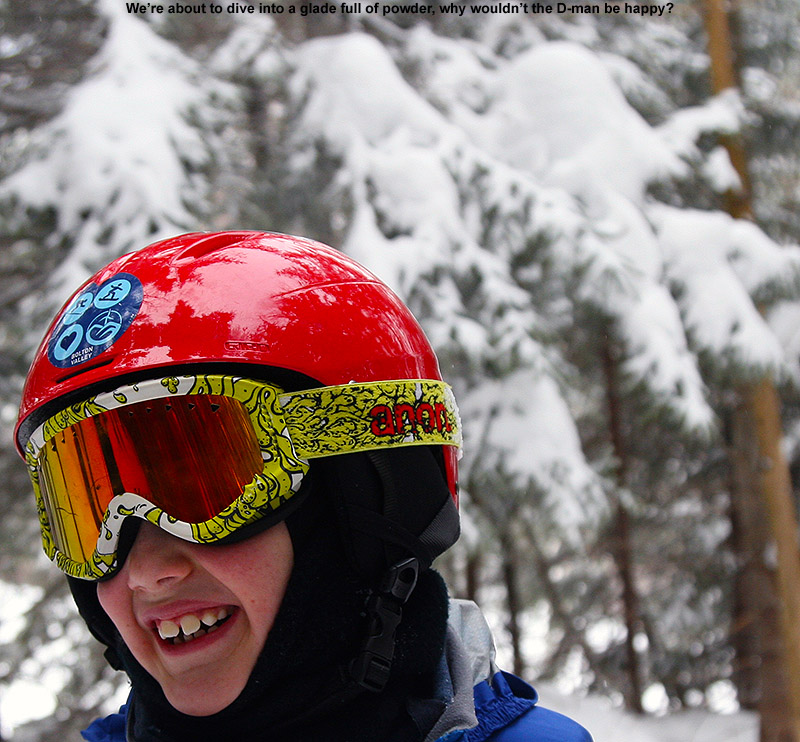
Everyone took turns choosing trails, and E kicked things off with Twice as Nice. That turned out be a great idea for a warm up. The trail was generally tracked, with some untracked snow off to the sides, but there had been such a thorough resurfacing with all the dense snow that it hardly mattered where you went. I was really feeling my AMPerages bust through the heavy snow with gusto, yet at the same time they were light and quick – I was really happy with the combination of skis and snow because everything just seemed to flow. On our next ride up the quad, E commented on how we’d had the entire trail to ourselves for the whole run, except for a ski patroller who seemed to enjoy watching us from the side and generally surveilling the lay of the land in a very casual way. Next up was Dylan’s choice, which was Adam’s Solitude. I’m glad Dylan chose that early, because while the snow was quite good, a few bare spots were already starting to make their presence known. It was easy to see that once the trail received a bunch of traffic, the skiing wasn’t going to be quite as free and easy as what we were experiencing. With the rugged terrain present on Adam’s Solitude, it’s going to take another couple synoptic storms to really get it in shape for lots of skier traffic. The roller coaster section that the boys love at the bottom is already in great shape though, and they had a blast. I really enjoyed mixing in Telemark and alpine turns as the terrain dictated, and today was one of those days where mixing both techniques on the fly just came rather easily.
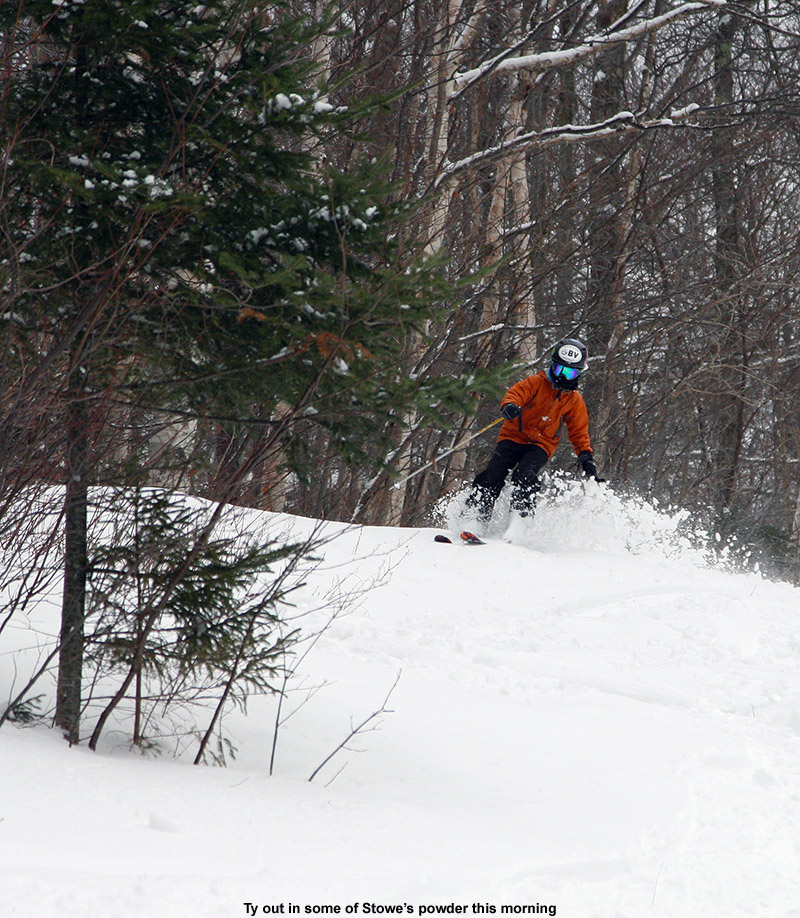
It was off to the main mountain next, where in order to add some fun in getting over to the base of Wilderness, we did a run off the Mid Mountain Chair. I treated E and the boys to a run through Glades Right and Nixon’s; both areas had great snow and coverage, and the boys were impressed. Wilderness was finally running today, and I led E and the boys on an attempted run through Super Snow Hole, but it was tough to find the entrance and we had to settle for regular Snow Hole. There had been very little traffic on Snow Hole, and it could actually use a bit more people venturing in to pack it down a bit with the generous depths of the recent snows. Ty called for a run on Turnpike, with an entry via Cougar, which the boys said they always seem to ski during the Olympics. They made sure to practice their Olympic victory “raising of the arms” at the bottom.
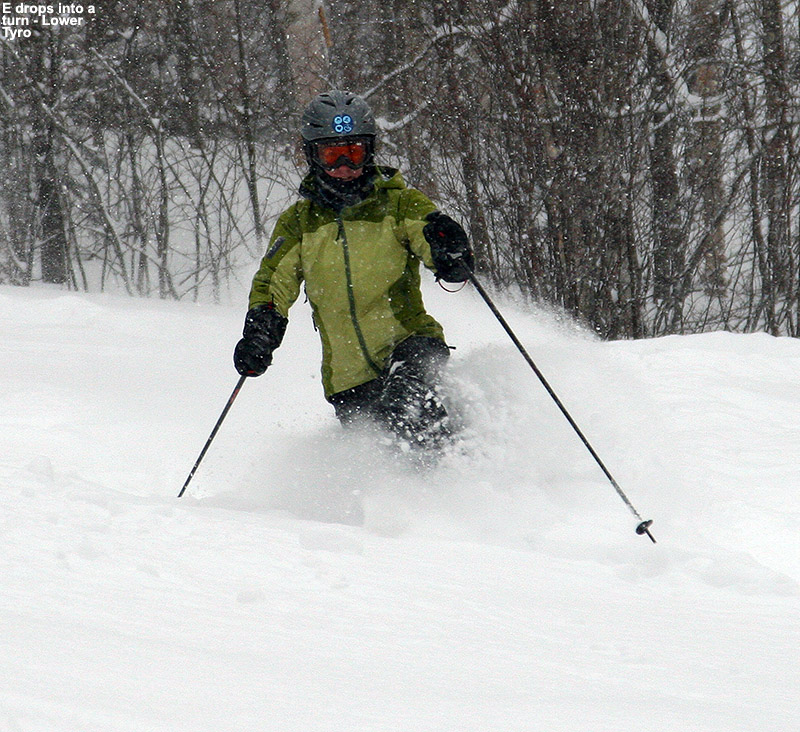
E and Dylan enjoying the great snow out in the glades today
Since the boys had really earned some lunch after the morning’s adventures, especially the off piste venturing around in the deep powder in the Snow Hole area, we got a pie from Fireside Flatbread and some appetizers from the downstairs cafeteria. The lodge was definitely packed, and that’s not surprising on a Saturday of a holiday weekend.
The fat skis were out today, doing their thing in the almost two feet of new snow at Bolton Valley.
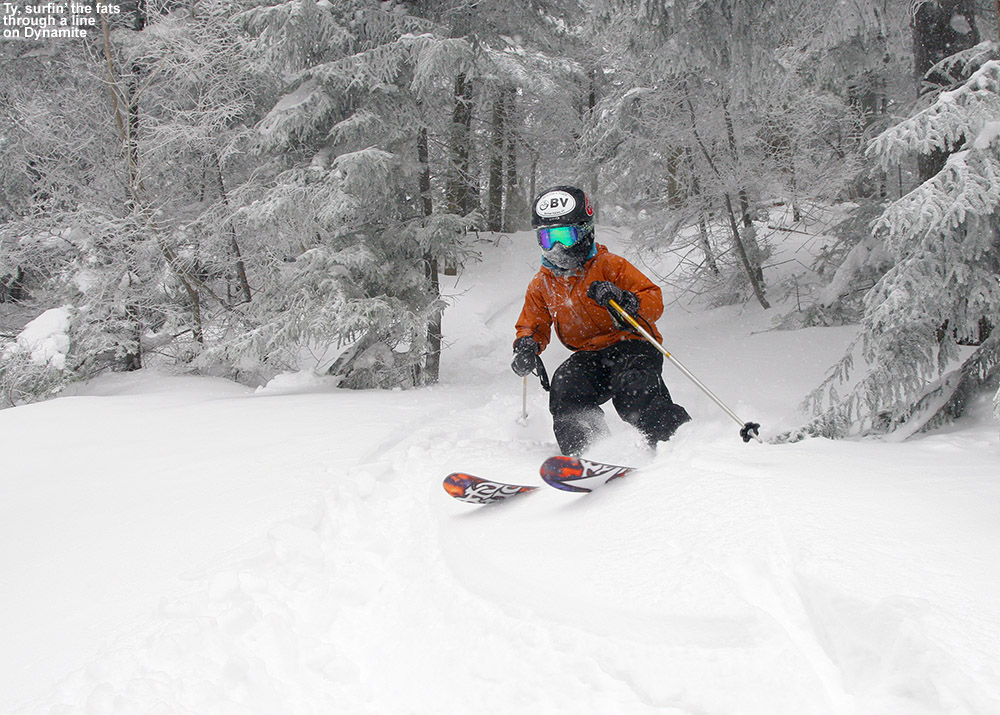
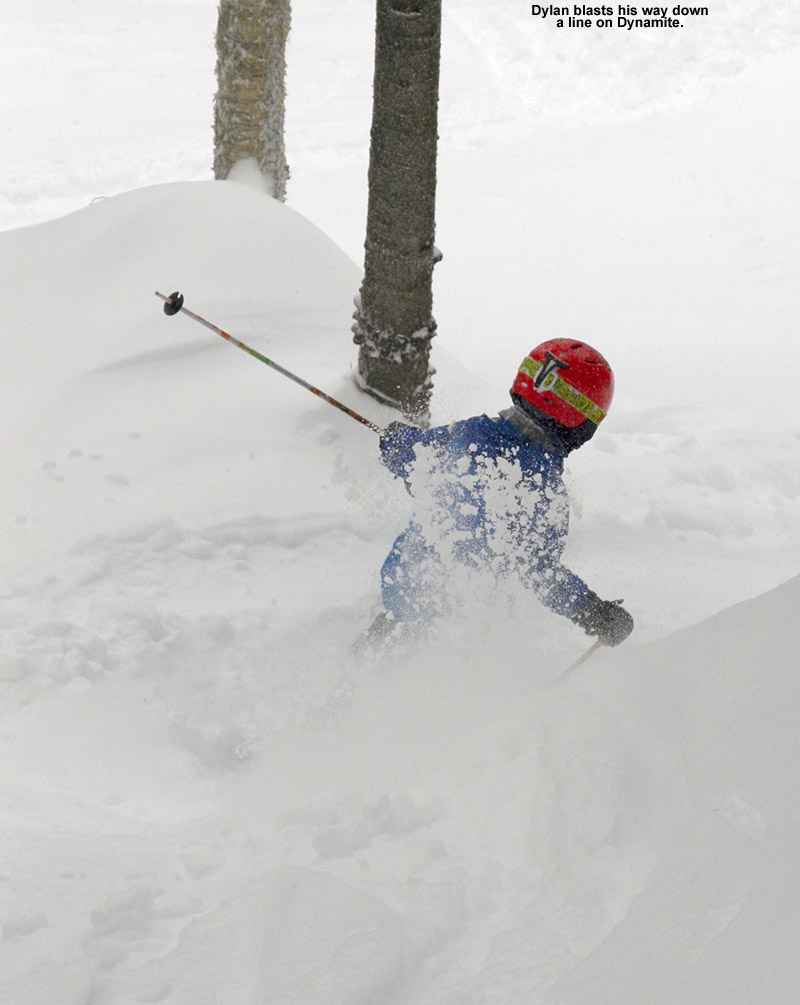
The afternoon started with a run through the “trifecta” of Buena Vista, Dynamite, and Sleepy Hollow. The snow was excellent, and traffic had been fairly light. Dylan requested a run through the Progression Park, and then we headed back toward Timberline to finish off the day. I was amazed that we’d seen Upper Tattle Tale open, and from below it looked somewhat scoured, but Lower Tattle Tale was really good. The Twice as Nice Glades were OK, but still a bit bony, and I’d actually say that they are due for a round of brush clearing. I took everyone down Quintessential, but it definitely needs a couple more storms to really be ready.
You really couldn’t ask for a much better day today, with such great fresh snow and weather. The only complaint I’d add about the snow is that it was bit upside down, with some dry stuff underneath a layer of denser snow on top. At some point there was some dry fluff in there, and then some snow with smaller flake fell on top. You’d sometimes find areas of untracked powder where you could drop right through that middle layer. The fat skis were definitely the tools to help with that though, doing a great job of keeping you floating vs. sinking under the topmost layers of dense snow. In terms of base, essentially everything is skiable, but I’d like to see a couple more synoptic storms to get the base wall to wall on all the steepest and most rugged natural terrain. Being mid February, that should really be expected by this point, but when snowfall is somewhere south of 80% relative to average, and January has multiple warm storms, that steep, natural terrain in the lower elevations just isn’t going to be flawless yet. We’ve actually got some nice fluffy upslope snow falling tonight in association with the next winter storm called “Quintus”; we’ll have to see how much the mountains can pull of the sky to top off what’s out there.
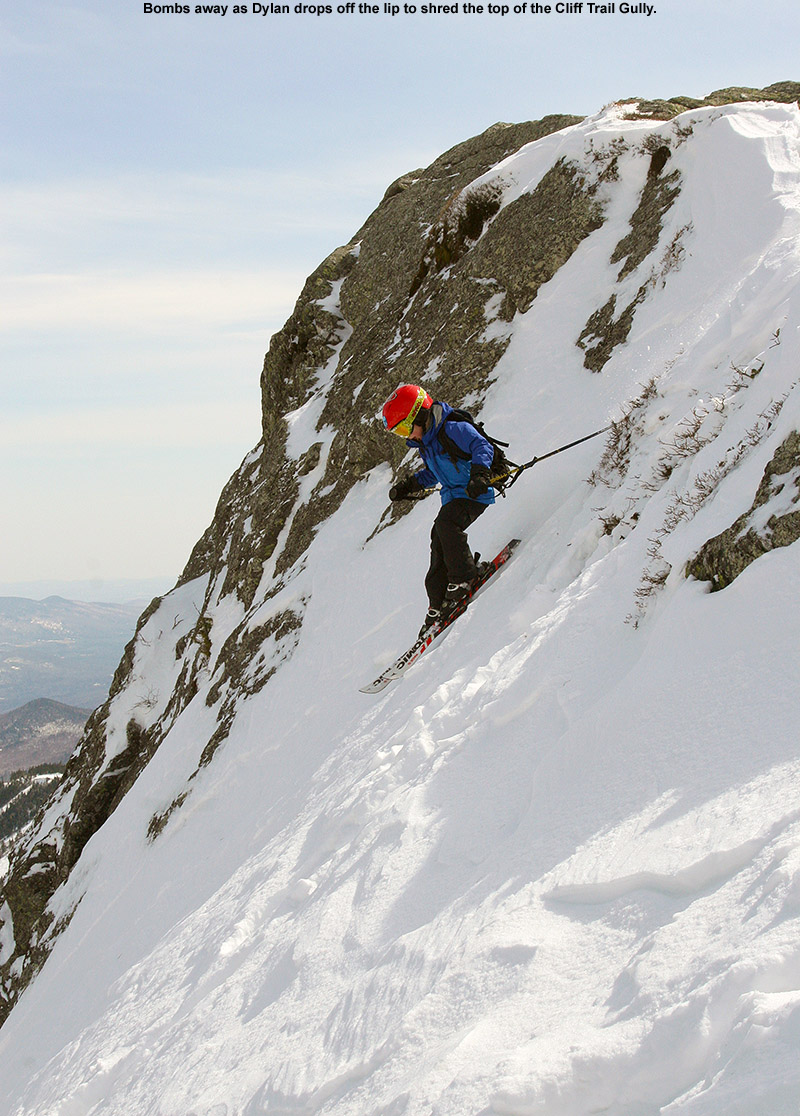
Dylan exploring Mansfield’s deep deposits of powder today
We had a storm last weekend that produced a powder day on Sunday, so we headed out early and spent the entire day at Stowe, but with no fresh snow today, it was back to our more typical afternoon session spent with the BJAMS ski program. We actually arrived a bit earlier than usual so that E could have a special ski instruction session with one of the students on the carpet surface lift, so parking at the base of Spruce Peak was somewhat less hectic than usual. Skies were gray with clouds ahead of a storm coming in tonight, and temperatures were reasonable at around 20 F.
Out and about in the powder today
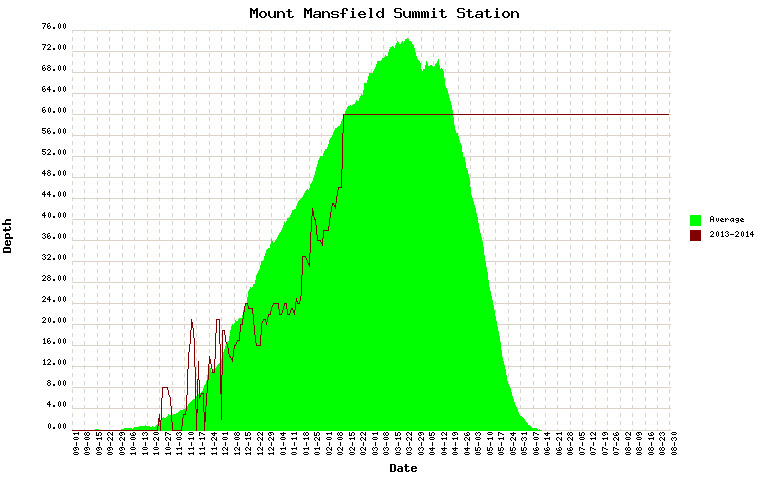
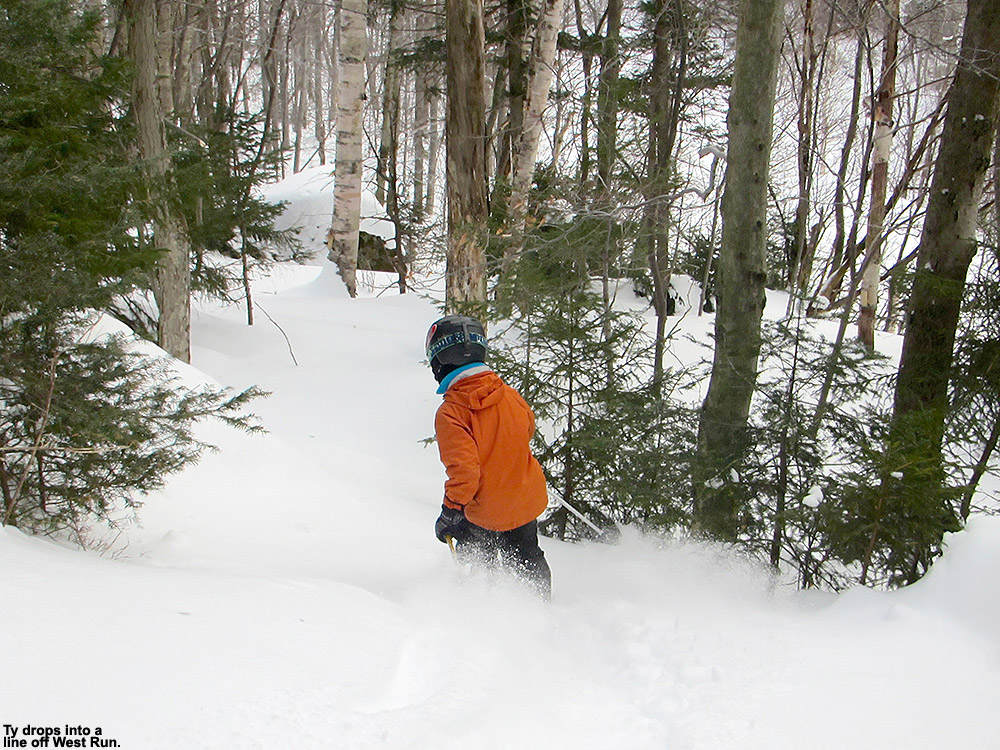
Luc and Jack were away at a martial arts event, so it looked like it would just be Ty, Dylan, and Kenny with me for our session. Kenny still had to eat lunch when we first arrived, so Ty, Dylan, and I headed up Sunny Spruce for an early run. We decided to do a bit of exploring in the trees off West Run, and found the powder there to be right around a foot, just like we’d encountered in many areas at Bolton Valley yesterday. Although the snowpack at the Mt. Mansfield Stake is still around the 40-inch mark, we didn’t find any serious issues with coverage in that area of mixed hardwoods and evergreens.
We hooked up with Kenny and stuck to Spruce Peak for our next run – E wanted us to check in with everyone gathering for the program at 1:00 P.M. to see if anyone else would be joining our group. Kenny was interested in West Smugglers because of the moguls, and he took them on with no problems. I was initially worried about the coverage on West Smugglers due to the fact that it’s all natural snow, somewhat south facing, and relatively low in elevation, but the coverage really was decent. If West Smugglers is doing OK, I had to think that Stowe was close to 100% open, and indeed I see that that’s the case when I check the snow report.
We found out that Ethan was going to join our group for the day, as I was told that he jumped at the chance when offered, so that brought us to four and we headed over to the Gondola for some runs. Dylan’s request was for some “Mac and Cheese” so we headed right there. I filled Ethan in on some of the usual off piste tips that I gave Kenny last week, stay together, get up and out of the way when you stop in choke points, etc. I also let him know how things would go with me as the only coach – we’d have Ty lead since he’s confident enough in his abilities and knowledge of the terrain to do so, and I’d take up the rear. The run was great, and Kenny exorcised some of the demons from last week by conquering some of those tricky spots in the main line we’d been working. Ethan had no problems, and I hadn’t suspected that he would based on his previous trips with our group. Once out onto Nosedive, I worked with the boys on short-radius turns and holding tight, controlled lines along the edge of the trail where there was some quality snow. For the most part, Nosedive was its usually icy self due to manmade snow and skier traffic, so there wasn’t anything different to note there.
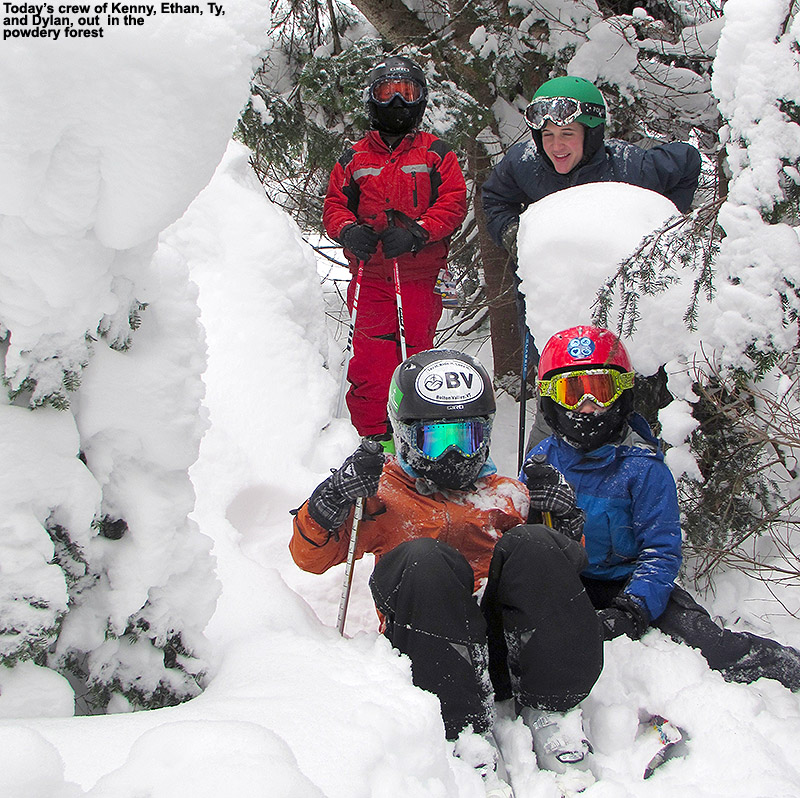
The boys pose for a shot out in the powder below the Kitchen Wall
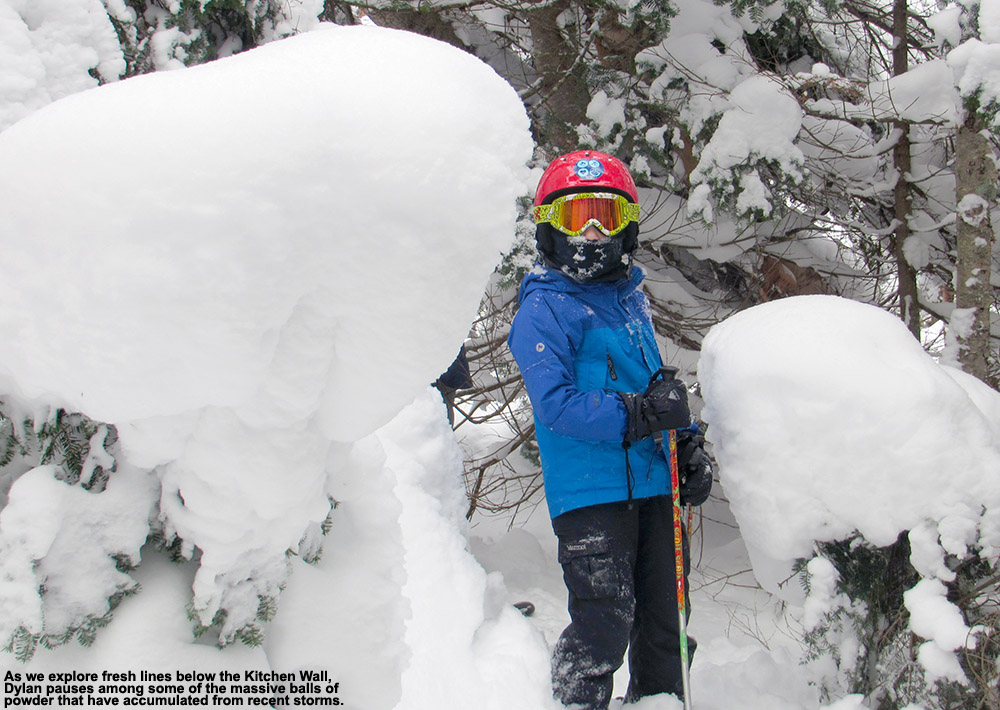
Kenny’s request was also for Mac and Cheese, so we took it again, but this time with a variation. I’d seen lots of untracked powder above our usual main route, so I took the boys on an exploratory session with a higher traverse through the area. I set the track, which turned out to be through a lot of powder. Depth checks typically revealed 20+ inches around there, and if our feet hadn’t been able to inform us of the depth, our eyes could have. Massive balls of fluffy powder sat on all the evergreens, and it was really starting to look like Mt. Mansfield in winter. Even with me setting the traverse track through the forest and multiple people behind me packing it down, Kenny struggled at times getting through the powder. I can see that we’ll have to work with him on that – there are certainly things that you learn about traversing through deep powder in the forest, and ultimately it makes your travel so much more efficient. I can remember when Luc struggled with that at times as well, but after a couple of seasons of exposure, he’s really starting to get it down. We did manage to find some nice untracked and lightly tracked lines with our added traverse, but I could see that we’d be able to get much more if we went farther. We’d worked Kenny hard enough by the time of our descent though, so that was enough deep powder practice for the time being.
Kenny was getting hungry after that excursion, not that he needs any special reason to get hungry to begin with, but we stopped in for some waffles at the Cliff House to take the edge off. Ty’s trail selection was next, and in the same vein as what we’d been doing, he chose straight up Cliff Trail because he loves all the little chutes along the skier’s right. What we’d ended up doing to finish off our runs was to skip past Lower Nosedive and head over to Lower National to work on the bumps. The boys worked on slowing down and staying in control, and I showed them how to avoid any icy patches between the bumps by making tighter, earlier turns that let you stay on the back side of the bump in the good snow.
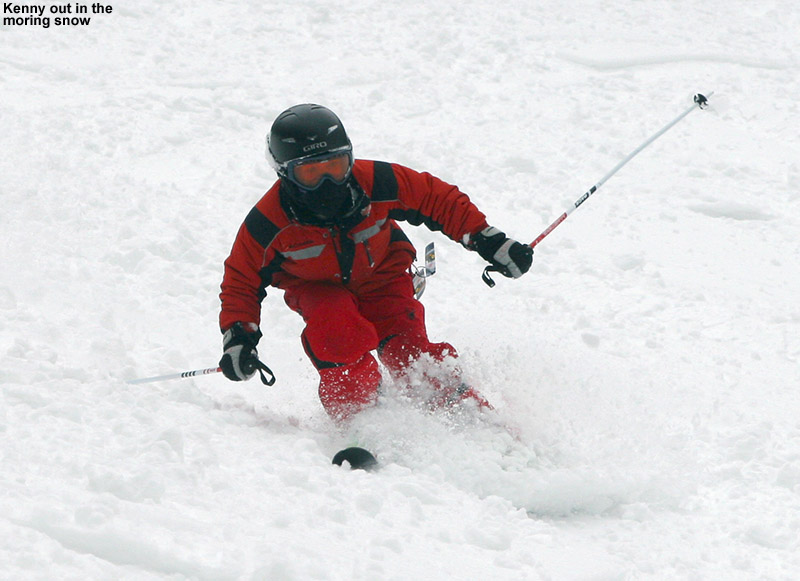
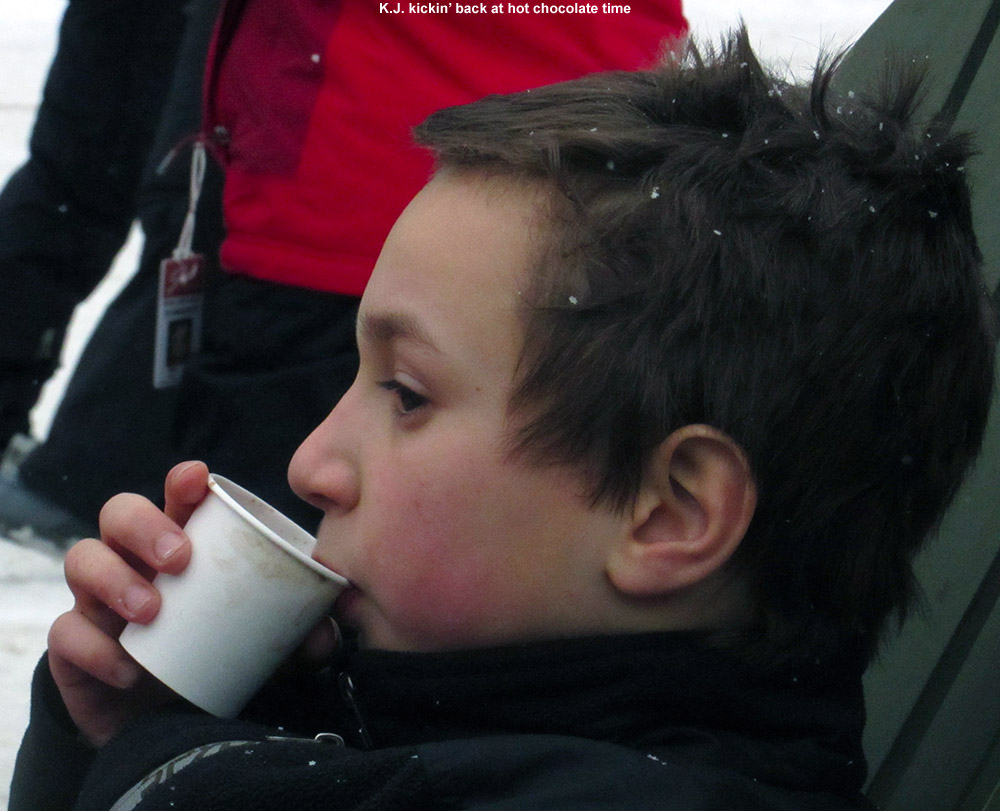
Ethan called for a run to the Spruce Village fire pit for s’mores and hot chocolate, so we ended our Mansfield day after that run. After some fire pit time and some good snacks, we got a couple more runs on Sunny Spruce, including last chair. Ty and Kenny raced to the bottom by different routes in an exciting finish to the day. Snowfall was actually just starting to appear as we were leaving the mountain, and we’ve had light snow here at the house this evening, so it looks like the mountains will have a light refresher for tomorrow.
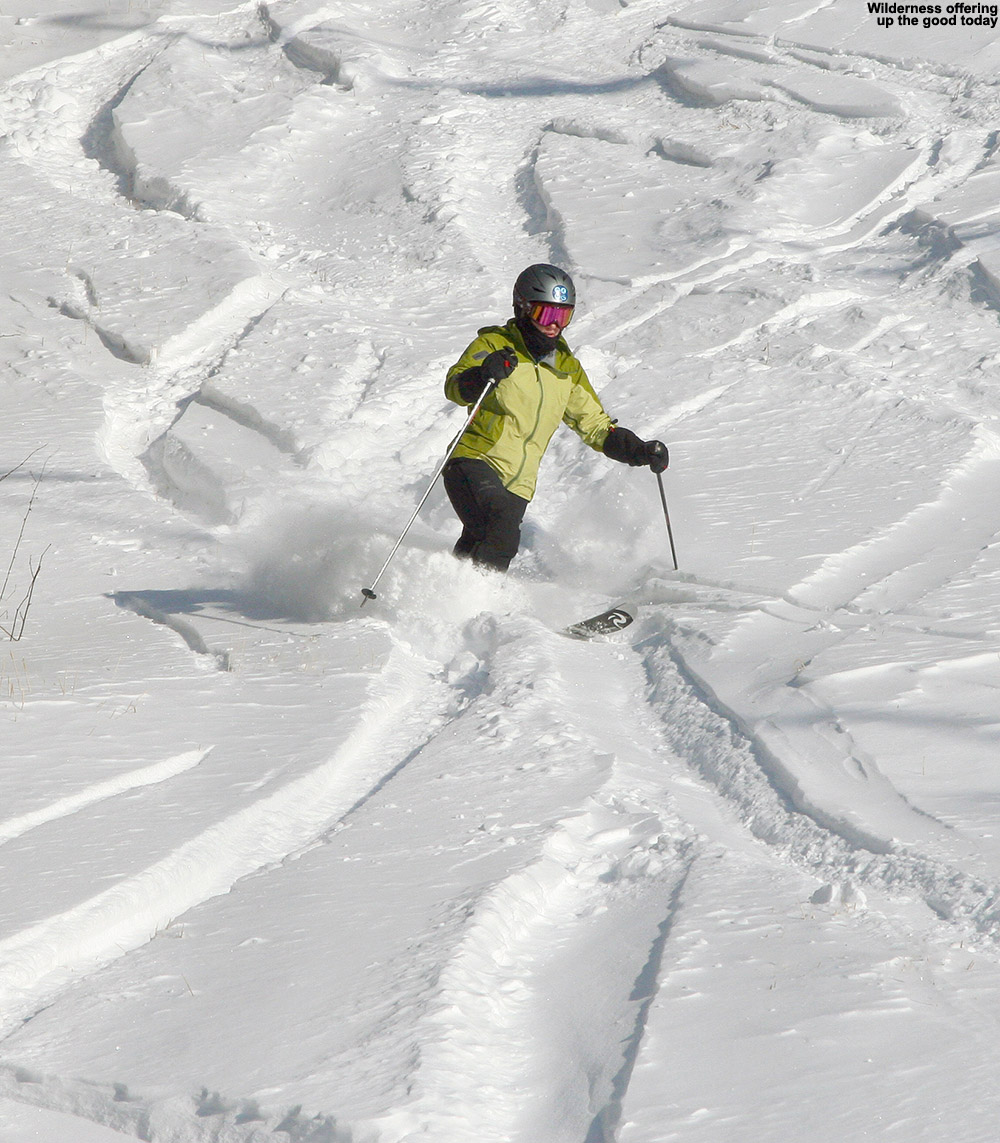
Conditions are still below average for this time of year around here, but Wilderness delivered great snow today as it often does.
With over half an inch of liquid equivalent delivered, our midweek winter storm, “Nika”, was certainly a mini boon for the local slopes. I checked out the fresh snow on Wednesday and Thursday, but today was our chance to see how conditions fared now that things have settled a bit, and traffic and grooming have worked the new snow into the base. There’s no question that the recent shot of moisture from Nika provided a bump in snowpack for Bolton Valley – many additional trails have come on line, and as of this morning, the only areas that patrol haven’t opened are upper Wilderness and the natural snow trails of Timberline.
Of course the fact that we’re approaching mid February and even having to talk about those areas not being open speaks to just how poor a January the area had to endure. The snowfall data that I monitor at our house parallels the local mountains quite nicely, especially in mid winter, so my numbers provide a very good sense of how it went for the ski areas of the Northern Greens. With just 15.8 inches of snow, this past January was the lowest in my records by a notable margin. Granted, I only have eight seasons worth of data, but this past January wasn’t just lower than any January in my records, it was lower than any December, January, or February in my records. Looking at all those months puts a lot more into the data set, so for January to come in well below all of the other months is quite notable. And, the statistics back that up, with this January being a whopping 1.86 standard deviations below the midwinter monthly mean of 39.4 inches, putting this January in THE BOTTOM 3% OF ALL MIDWINTER MONTHS according to my data set. So if you felt that January was horrendously low with respect to snowfall in the Northern Greens, you were correct.
Fortunately we’re on to February now and the past week was at least somewhat average with respect to snowfall. E took a look at the Bolton Valley Web Cam and noted that there wasn’t much of a line at the Vista Quad, so after a quick lunch, we headed up to the mountain. Timberline had a good number of cars, and the Village lots were near capacity, so clearly the resort had a lot of visitors – I dropped E and the boys off at the Village Circle and had to park in the bottom tier of parking down near the recreation center.
After they’d taken a couple runs on Snowflake, in which Ty really seemed to be getting some nice air in the terrain park, I met up with E and the boys and we headed up the Vista Quad for a run on Spillway. That was Dylan’s choice, and I was optimistic that the ridge on the skier’s right would yield some good snow, but it was definitely underwhelming. I found soft snow in a few spots, but in general there wasn’t much of it and the hard, manmade snow predominated on the left side of the ridge and even made its presence known on the right side of the ridge. It wasn’t until we neared the connection onto Sherman’s Pass that we were able to get into some good powder on the edges, and then the Vista Quad Liftline below held soft natural snow as well. The snow we’d experienced up on Spillway had him calling for some trees, which was timely, because that was the plan.
Although the trees are still a bit lean for this time of year, there are lots of good areas to be found
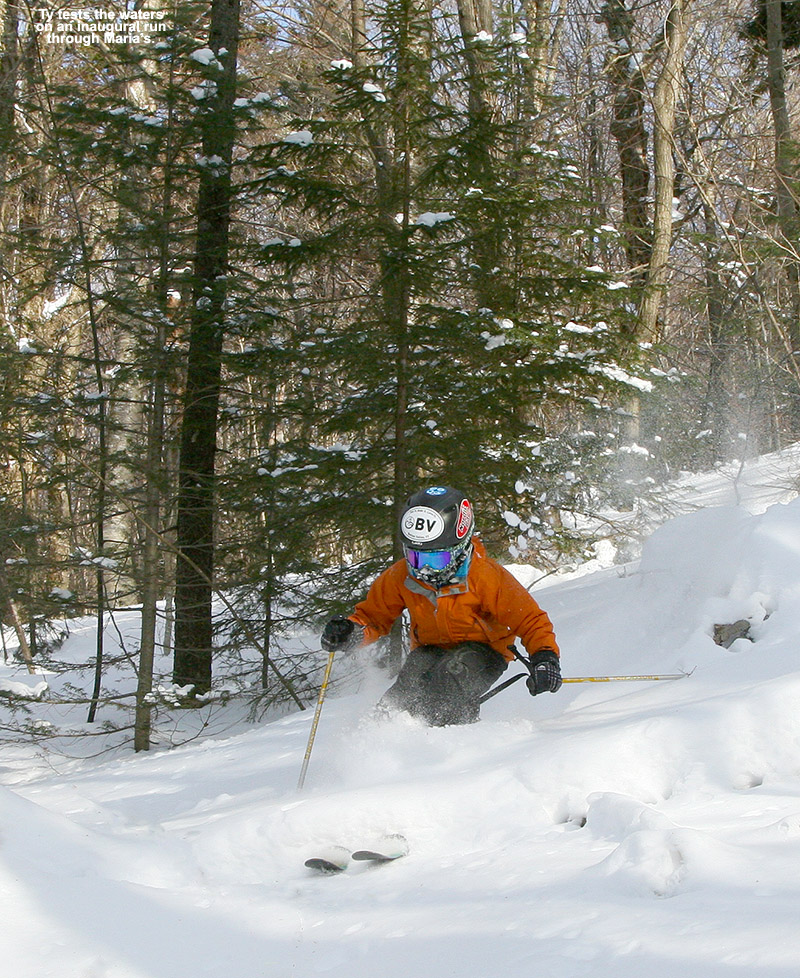
The next run was my choice, and with the recent opening of the Cobrass suite of trails, I decided we should check out Cobrass and head to Maria’s for some soft snow in the trees. The snow on Cobrass was just horribly icy, and we couldn’t get down it fast enough. Even the skier’s right, where soft snow often holds, was meager like we’d found on Spillway. Either the trails with snowmaking have seen too many skiers or not enough natural snow, or perhaps a combination of both. Fortunately, the snow off piste was blissfully soft, with generally about a foot of powder on Maria’s. The only problem is that the base is still lean – we need another big synoptic storm, this time with an inch or two of liquid equivalent to really get the off piste terrain into prime, midwinter form. The snow depth at the Mt. Mansfield stake is just above that 40” mark, so as one might expect, the off piste skiing is in play, but you can’t rely on everything to be covered yet. You still need to take it cautiously in general. Maria’s did offer up some nice shots of powder, and we found some nice deep shots, but until we get another storm or two you just won’t be able to go top to bottom with full confidence.
With the snowmaking terrain generally too firm, and the off piste terrain passable but not ready for prime time in all areas, our next course of action was obvious. It was time for a run over at Wilderness. Before we could do that though, Dylan needed to warm up his toes, so we took a break for a bit in the lodge. The boys got some snacks, and everyone warmed up for what we planned to be our last run. From the top of the Vista Quad we took Alta Vista, and I was pleasantly surprised that there was a lot more soft snow available on the side there than what we’d experienced on Spillway or Cobrass. I’d say it was simply due to lower skier traffic, because it seemed like very few people had skied there. We connected over to Wilderness and got some nice powder on the Wilderness Lift Line, which was followed up with an excellent run down Turnpike. Boy that Turnpike just always seems to deliver.
So, there’s certainly some decent skiing out there thanks to the recent storm “Nika”, but overall things are certainly subpar for February in Northern Vermont. We’re definitely keeping our eyes peeled for that next big synoptic storm that could get things closer to average – based on the current depth at the stake we need about a foot to a foot and a half of base depth increase to get there.
Out at Stowe today enjoying some of the overnight snow
Our latest modest snowstorm delivered as expected overnight, with 5 inches reported in the upper elevations at Stowe this morning. That was enough to get us to head out for a relatively early start today, so we met Jeff at the Children’s Adventure Center to get Kenny and Liana, who planned to join us for some skiing during the morning before our afternoon BJAMS ski program. We had some breakfast at the Great Room Grill to fuel up (I got to try one of their highly talked about breakfast sandwiches), and by the time we were done eating, all the lifts on the mountain were open.
The snow from this storm was fairly standard in terms of density, but I’d heard that the driest and lightest snow would be found in the higher elevations. We therefore decided to head over to the Gondola instead of making runs on Spruce, where much of the terrain is at lower elevations. Although it was Super Bowl Sunday, there were plenty of people out on the slopes in the morning, and the queue for the Gondola was several minutes long.
“Indeed the snow had plenty of liquid in it and the mountain had seen a decent resurfacing, at least outside the high traffic areas.”
From the Gondola summit we took a run that featured plenty of time on Switchback, and there was a lot of good snow. Indeed the snow had plenty of liquid in it and the mountain had seen a decent resurfacing, at least outside the high traffic areas. The sides of the trails held great snow, and E and I worked with everyone on short radius turns that could keep them in the good snow. We followed up that first run by working our way over to the Fourrunner Quad, where we skied Hayride, got into the Chapel Woods, and got into plenty of other stuff.
Kenny getting after some of today’s fresh snow with gusto
What I quickly noticed in the morning was that Kenny and Liana had improved their skiing a lot since I’d last hit the slopes with them – they’re now skiing in one of Stowe’s programs on Saturdays as well as our usual Sunday program, and that’s meaning a lot of time on snow. In Kenny’s case, it meant a dramatic enough improvement that he’d be comfortable skiing with our group on Sunday afternoon. I spent much of the morning assessing what he would need to work on to really bring his skiing up to that next level, and that included slowing down and making both more and shorter-radius turns, separating his upper and lower body even more, and keeping his hands up for more centered balance. By the end of the morning I was confident that he’d be able to ski with our group, especially since I knew we wouldn’t be going anywhere too crazy because the snowpack just isn’t quite ready yet.
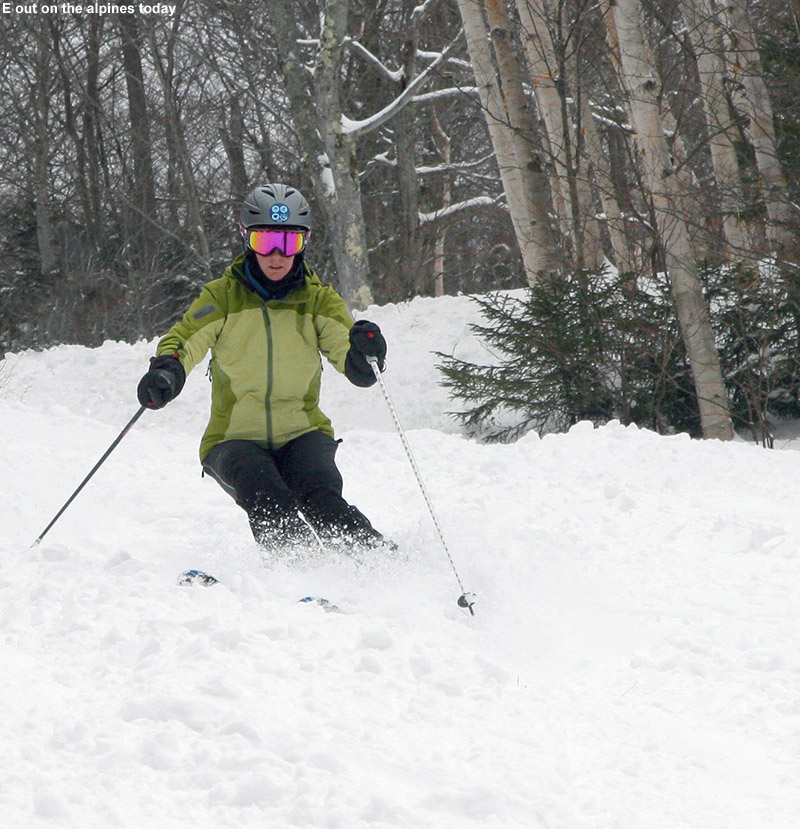
Even E got to get out and enjoy some of the fresh snow before her ski program duties today.
The morning had already been quite a workout, so we headed back to the Great Room Grill for some lunch, and then jumped into afternoon ski program to continue tracking down good snow. Luke joined out group with Ty, Dylan and Kenny, and we headed off for more fun on the Gondola, Quad, and Triple. We had a couple of good runs through part of the Nosedive Glades, which are definitely ready for prime time. Kenny definitely held up fine with today’s runs, and I think that he’s really going to have the opportunity to keep working on advanced techniques if he can keep following the other members and noting the techniques that they use to tackle steep and often tight terrain.
Next up on the weather front is the potential for another modest system in the midweek timeframe. We’ve still yet to have a really notable storm this far north this season, but these modest storms are definitely helping to build the snowpack, even if they do so at a slower pace.
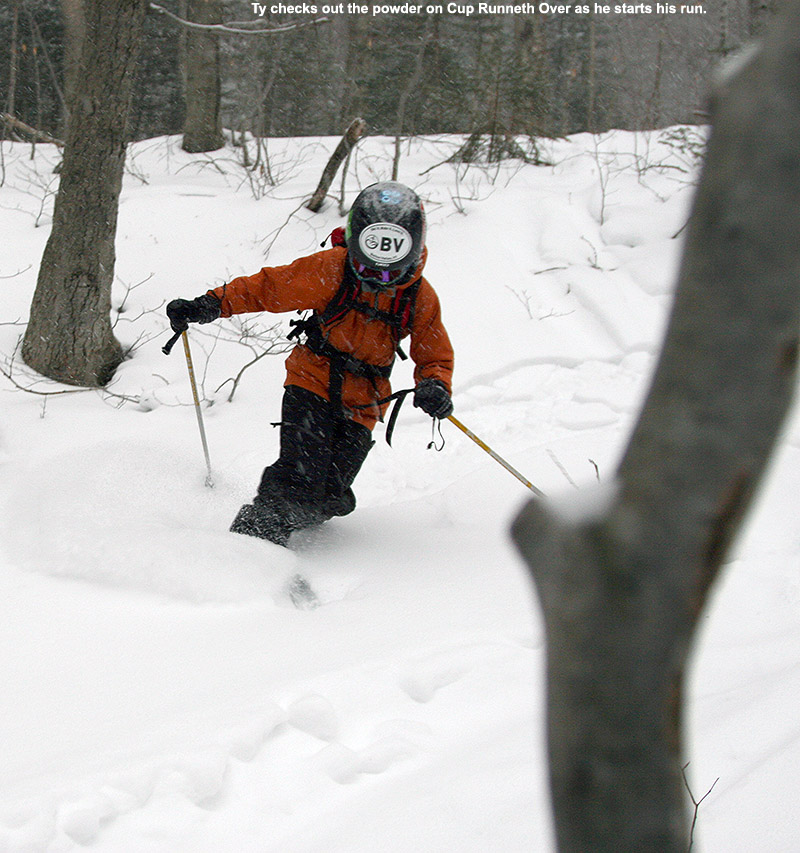
Out for a short tour on Bolton’s Backcountry Network today to get some powder turns with the boys
Down at the house, snow from our current storm was just starting to fall around 3:00 P.M. today when I headed up to Bolton Valley with the boys. E had headed off to get some work done at school, so it was just the guys at home, and I figured that we should get out and enjoy the snow for a bit. After getting a closer look at the Cup Runneth Over glade on Sunday, it seemed like a nice, short touring option to try with the boys.
“Skiing in the upper section of the glade was pleasant. Even though there were a number of sets of tracks, there was still untouched powder around, and a good 6+ inches of it.”
The temperature was in the mid 30s F at the house, and the flakes that were falling here and there quickly began to intensify into a steady light snow as we headed down the Winooski Valley through Bolton Flats. Looking out ahead of us toward the west, we could see that that more intense snow was heading our way. With the marginal valley temperatures with this event, the mountains are expected to do notably better with the snowfall, and indeed that was borne out as we headed up the Bolton Valley Access Road and got into sub-freezing air. Snow was already accumulating on the road above ~2,000’, and the snowfall was much more intense up in the Village. The boys quickly covered up with their hoods as we got out of the car and into our gear, because the snowfall would quickly wet you down if you didn’t get yourself under something waterproof.
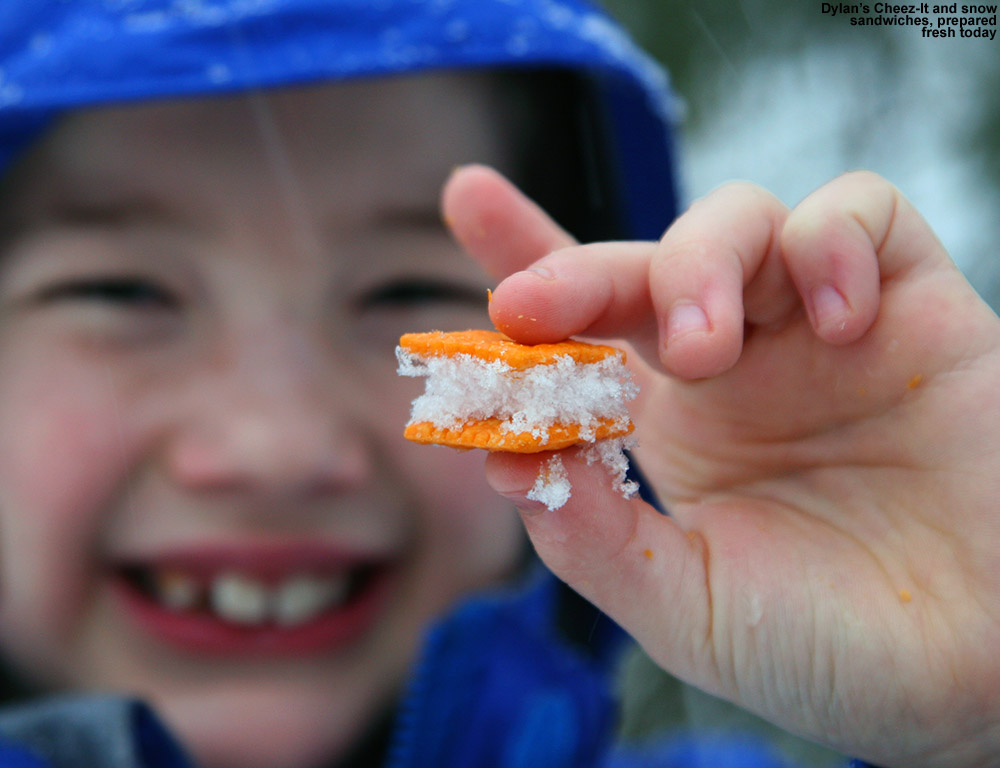
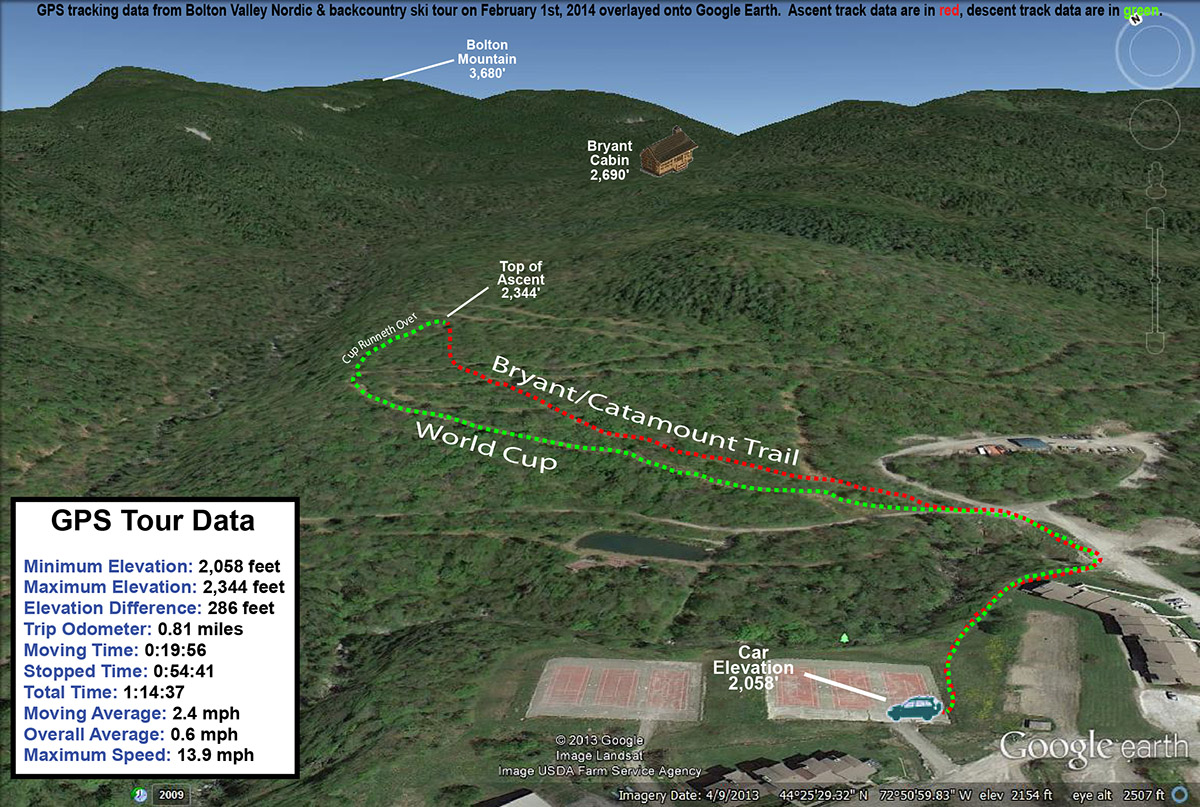
Lights were starting to come on for the alpine trails, and skier traffic was scant on the Nordic network as we skinned along World Cup and then Bryant. The boys hardly believed me when I told them that we were in for just a few minutes of climbing before we’d reach the start of our descent. Indeed that was the case, and we stopped along Bryant at the entry spot I’d seen for the upper section of Cup Runneth Over on Sunday. We relaxed and hung out along the top of the Glade, enjoying the snowfall and the comfortable temperatures just below freezing. Dylan immediately dove into his pack for some snacks, and ended up creating sandwiches comprised of Cheez-It® crackers with snow in the middle. One lone skier passed by us as she made an ascent up Bryant, but, aside from her, all we saw were a couple other Nordic skiers and a guy on snowshoes. With the fairly late hour, it wasn’t surprising that we didn’t see many people.
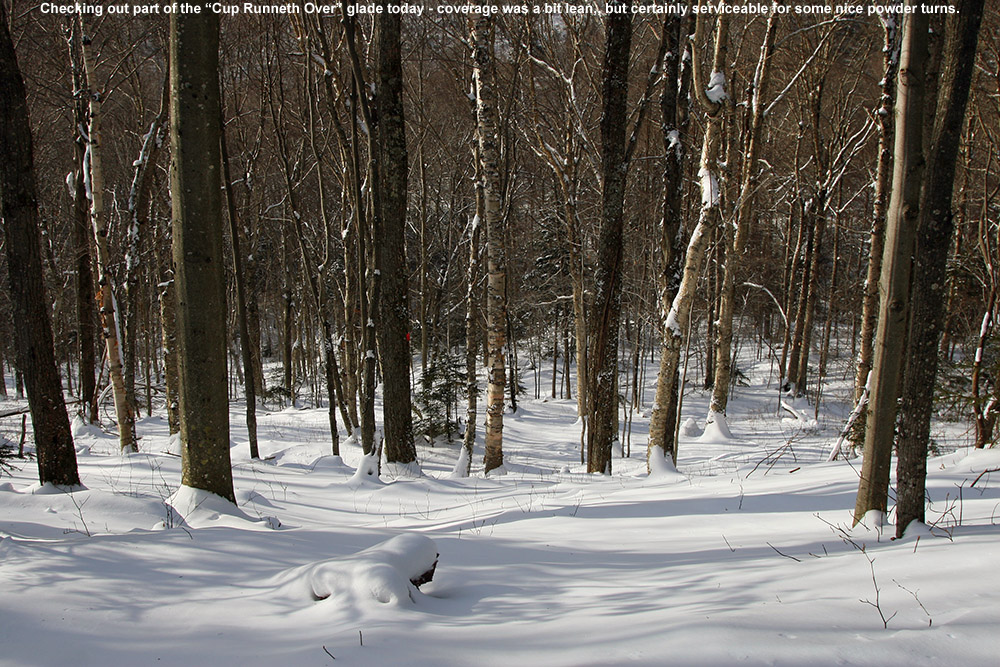
Skiing in the upper section of the glade was pleasant. Even though there were a number of sets of tracks, there was still untouched powder around, and a good 6+ inches of it. The boys practiced some Telemark turns and stopped down at the intersection with World Cup where the glade starts to dive down a steeper slope. I began the steeper descent, but after I’d made a couple of turns, the boys asked if they could ski World Cup and work on their Telemark turns; they just weren’t feeling confident enough with their turns to take on the steeper part of the glade, and that was probably a good choice for them because I did find the coverage a bit bony. They were definitely enamored with the clean, groomed look of World Cup, made all the more enticing with the coating of fresh snow that was approaching an inch by that point. The boys certainly had a lot of fun on World Cup, trying different variations on their Telemark turns as they pushed around some of the fresh snow.
The GPS tracking data from today’s short tour with the boys plotted on Google Earth
Once we were back at the car, I decided that boys could get a snack at the Bolton Valley Deli & Grocery, and we ended up also grabbing a couple of pizzas at Fireside Flatbread to take home for dinner. I’ve wanted to make use of having the pizza right there in the lodge for a while now at the end of one of these evening tours, and today it worked out perfectly. We had it in hand in roughly 10 minutes, so the guys at the oven were right on top of it.
We headed down from the mountain around 5:30 P.M., and roughly an inch of new snow seemed to be the total at that point, with continued moderate snowfall. This is a storm where areas farther north are expected to get more snow, so we’ll have to see how Stowe does overnight, but there could be some nice skiing tomorrow if the snow keeps up for a while. And the pizza from Fireside Flatbread was excellent as usual – their crust is one of my favorites anywhere.
The backcountry season is definitely underway at Bolton Valley now.
After our fresh snow and reprieve from cold temperatures yesterday, today it was back into the arctic air with highs predicted to be in the single digits F or even hovering around zero in the higher elevations. And of course that didn’t factor in the wind, which brought the effective temperatures down well below zero. Since that was the forecast, E and Claire cancelled our BJAMS ski program at Stowe today; there’s just no reason for dozens of kids to risk frostbite, especially when many of them are so focused on learning to ski that they’re oblivious to what’s going on with their skin.
“Many, many glades have been included on the latest version of the backcountry map, and there are now more than two dozen of them on there.”
Temperatures were in the low single digits when I arrived in the Village, but as I parked down along the edge of Broadway I could see that the Nordic scene was definitely hopping. Numerous skiers swished by as I prepared my gear, including three patrollers heading off to monitor the trails. I definitely felt cold as I geared up, but once I started moving, that welcomed warmth of activity quickly came on, and I rapidly found that pleasant temperature balance between movement and winter cold. Checking the powder depth near the base of the network at ~2,100’ revealed 7 inches, which was encouraging.
“That actually made for quite a unique tour overall, one that brought me from the Nordic/backcountry network back to the alpine network.”
I started out with only a vague plan to head up to Bryant Cabin and assess the state of coverage on the trail network, so that gave me the opportunity for some exploring along the way. For a while I’ve wanted to check out the glade called “Cup Runneth Over”, which I’d read about a while back on the Bolton Nordic Blog, so this seemed like the perfect opportunity to do it. I had printed out Art’s directions to the glade on a piece of paper that I keep in my backcountry pack, and with the help of those and a little poking around, I quickly found it. The coverage looked a little on the lean side, but as I glanced around, I could see that not only does the glade drop below World Cup, it starts up above it – and there was a track on that upper section that clearly showed how the snow was sufficient for turns. I skinned up through that upper section of the glade until it reached the Bryant Trail, and made a mental note of that upper start point for future reference. I can’t believe how many times I’ve passed by that spot on Bryant and never noticed the glade starting off to the left, but that’s what exploring is all about.
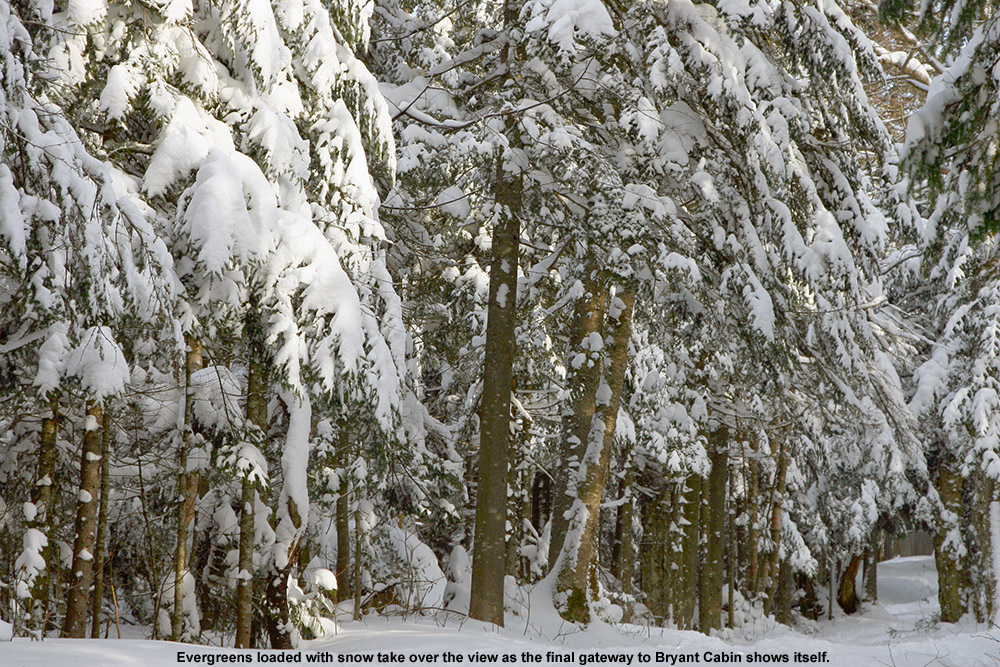
The evergreens were choked with snow today on the upper sections of the Bryant Trail.
It was indeed nice to finally get to see part of Cup Runneth Over, but I wanted to keep exploring, so I merged onto Bryant and headed upward. I noticed what looked like some open trees in the forest below Possum, and did a quick tour through the area to see what it offered. The terrain there really needs no glading, as the natural make-up of the forest would lend itself to plenty of turns. The pitch is such that it would be great after one of those events that deliver 4 to 6 inches of light powder over a smooth, firm base. Much more than that amount of snow though, and the pitch is just not there – even today it would have been slow with the 7 or 8 inches of medium weight snow atop the snowpack, but that was also in part due to the snow being slow because of the cold temperatures. Continuing upward on Bryant, I saw tracks on fairly steep lines like A1A, JJ’s, and Big Blue, and the coverage certainly looked sufficient. I eventually got into the areas of protected evergreens that really hold the snow, and you could see that they were choked with powder. Up at the Bryant Cabin at ~2,700’ I found the powder to be in the 8 to 9-inch range.
“The snow had settled a bit more, some wind had affected it in spots, and it was slow due to the cold temperatures, so while fun, it couldn’t compare to yesterday.”
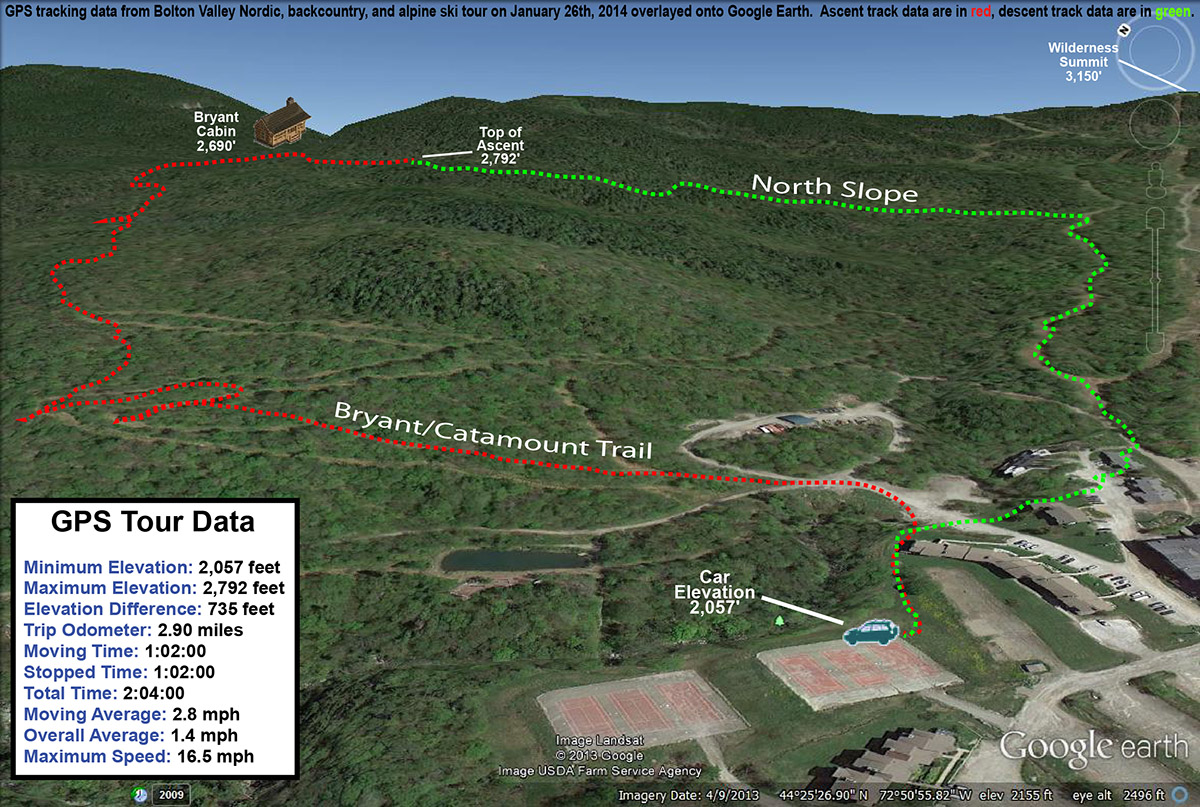
I decided to continue my tour out along North Slope, and when I finally hit one of the local high points I stopped to take off my skins and have a break with some of the hot soup from my pack. The scene was peaceful, although I could occasional hear the hoots and yelps of other skiers around on the network. I began to descend on North Slope, and actually decided to ride it all the way out to the end because I’d never done that. There are actually a couple of notable uphill sections that require a few minutes of work, but it wasn’t enough that I needed to put my skins back on.
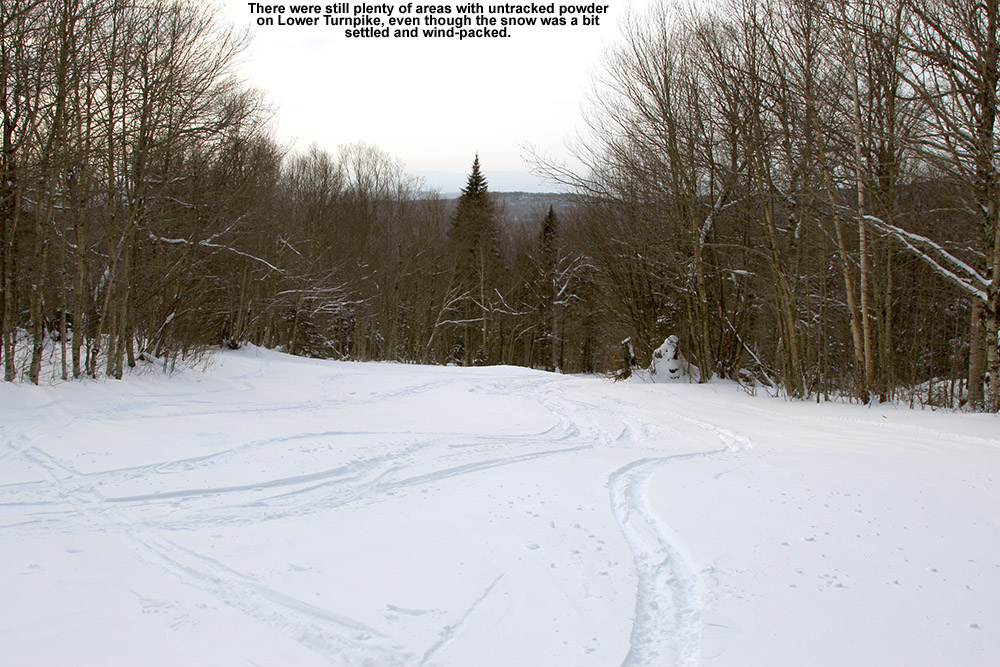
Finishing off today’s tour on Lower Turnpike
Although I saw some good potential in some of the glades, I stuck with my plan to run North Slope all the way out to Lower Turnpike and ski down there, because after yesterday’s experience, I knew it was a sure thing in terms of coverage. That actually made for quite a unique tour overall, one that brought me from the Nordic/backcountry network out to the alpine network. Most of the time I’m using the lifts and going the other direction, so this was a fun change. North Slope has a nice little connecting trail with Lower Turnpike that I’d never seen. There were only a few tracks on Lower Turnpike, so there was plenty of fresh snow, but it didn’t ski nearly as beautifully as yesterday. The snow had settled a bit more, some wind affected it in spots, and it was slow due to the cold temperatures. So while fun, it couldn’t compare to yesterday. I finished off my run with an interesting route through the Village below the Liftline Condos – it actually turned out to be a pretty slick connection with some backyard powder turns that dropped me right down onto Broadway.
The GPS/Google Earth map of today’s tour from the Nordic/Backcountry Network back to the alpine trails
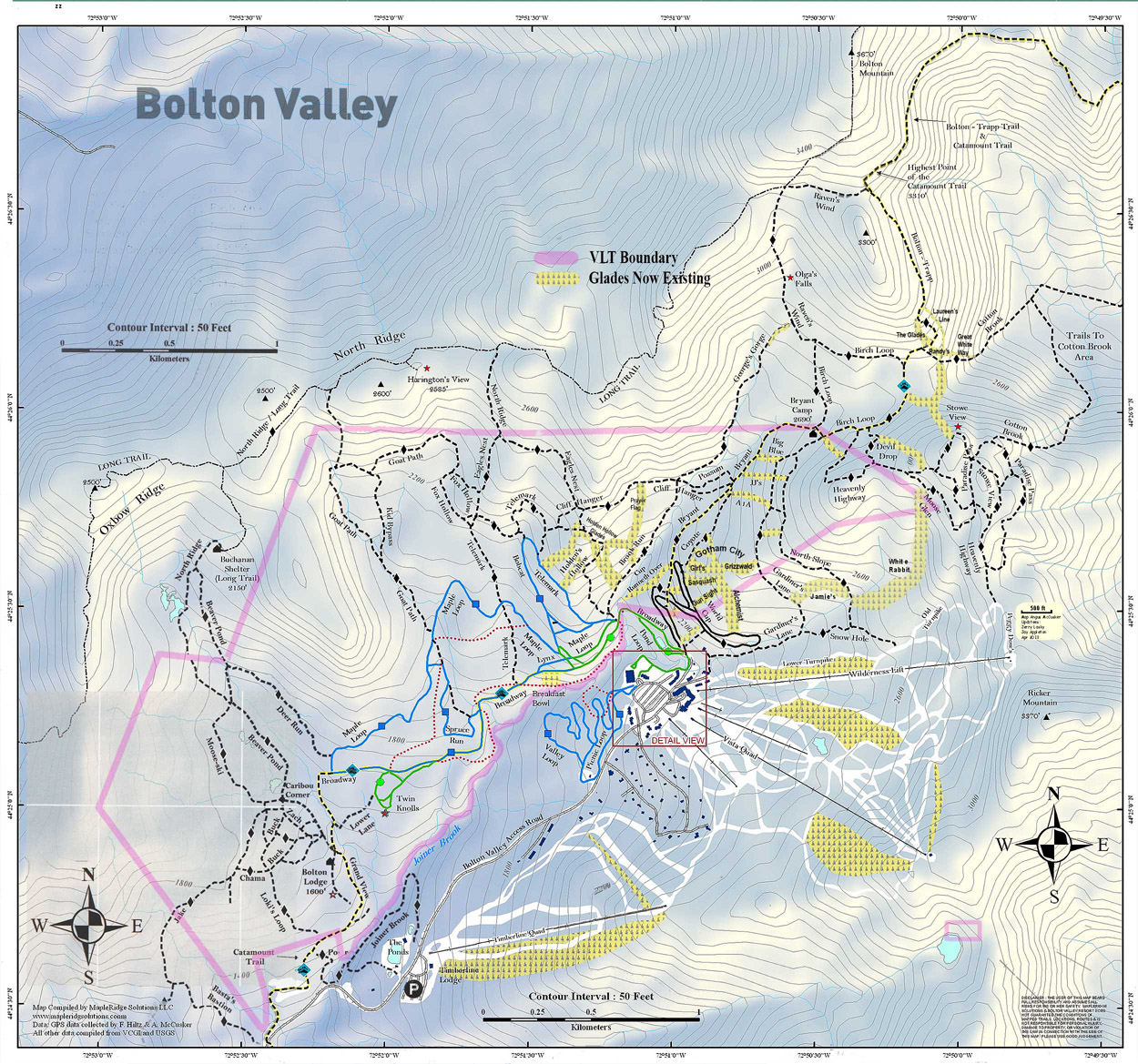
Another great discovery came this evening, when I visited the new Friends of Bolton Valley Nordic & Backcountry website while writing up my report. I checked out the map of the network that they have available, and it’s the most expansive I’ve seen yet. Many, many glades have been included on the latest version of the backcountry map, and there are now more than two dozen of them on there. It really gives one an idea of just how expansive the opportunities are out on the trial network, and it’s going to be great to see how things go with the new, clearly energized, participation in maintaining the area. As for the trails, everything I saw today looked to be in excellent condition. And, with the snowpack below average for this point in the season and just getting to sufficient levels for backcountry skiing, I’d expect that problems would be relatively easy to see. Thanks to all the folks that worked on the trials this season, and put out that great new map of the backcountry network!
The updated map for Bolton Valley’s Nordic and Backcountry Network now has more than two dozen glades listed
Yesterday E had her training day for our school’s ski program at Stowe, and boy was it cold – it was below zero F for the entire morning. I’d sent E off with plenty of hand and foot warmers, and she made use of them. She actually cracked the lens in her goggles toward the end of the morning, but by then everyone was just about done anyway. I don’t think there were many takers for afternoon turns once the requisite training items were covered in the morning.
Things were a little different for my training day today – temperatures were rising through the teens F, and oh yeah, there was a bit of a snowstorm in the intervening period. This storm was one of those that comes out of the Ohio Valley and redevelops off the New England coast, and it brought up to 19 inches of new snow for the Vermont ski areas. Snowfall totals were a bit lower for the Northern Vermont ski areas, generally approaching a foot, but as my snow analyses had shown, there was plenty of liquid equivalent in the snow; as of this morning, we’d picked up close to ¾ of an inch of liquid in the snow and the density was close to 10% H2O. The snow was of course quite dry with the cold temperatures in the area, but it certainly wasn’t fluff that might be prone to blowing away.
“The snow depth at the Mt. Mansfield Stake isn’t quite to that 24” mark yet, but people are definitely starting to ski those areas of early season trees.”
For today’s training session, Claire assigned me to the level eight group, and when the instructors were dividing up the trainees in that group, they further broke them up by those who had already skied five days or more, and those who hadn’t. Although I’d yet to ride a ski lift this season, I’ve been out several times already, so I joined the former group, with Steve as our instructor.
“During today’s session, Steve brought us into Sunrise Glades, Birch Glades, and Lower Gulch Glades, and they were all in
pretty good shape.”
With all the new snow, Steve’s plan for the day was to let us ski a lot. Instead of working on drills, he wanted to work on group management (i.e., how do the coaches effectively manage their groups of students on the slopes) in between the skiing. This was actually a nice change of pace, since E and I have had plenty of sessions with drills for both us and the students over the past few training sessions. One new group management technique that I learned today was for brining the kids into new areas of trees. What Steve likes to do is to show the students the entrance to the glade, but instead of entering that first time, he goes around to the exit of the glade via the trails. That way, the students know what is in store, and are ready with a little more directional orientation for when they actually do ski the glade. We talked a lot about strategies to use when bringing the kids into the trees, and it was a good fit for the trainees in our group, because many worked with the advanced students and were indeed doing a lot of off piste skiing. Steve also worked on the partner strategy for ensuring that everyone is accounted for at each stop. We actually had a real-time demonstration of its effectiveness, since my partner John had misheard our lift destination on one run and ended up at the Gondola instead of the Fourrunner Quad. Since we knew he was missing, I was able to run over to the Gondola and retrieve him.
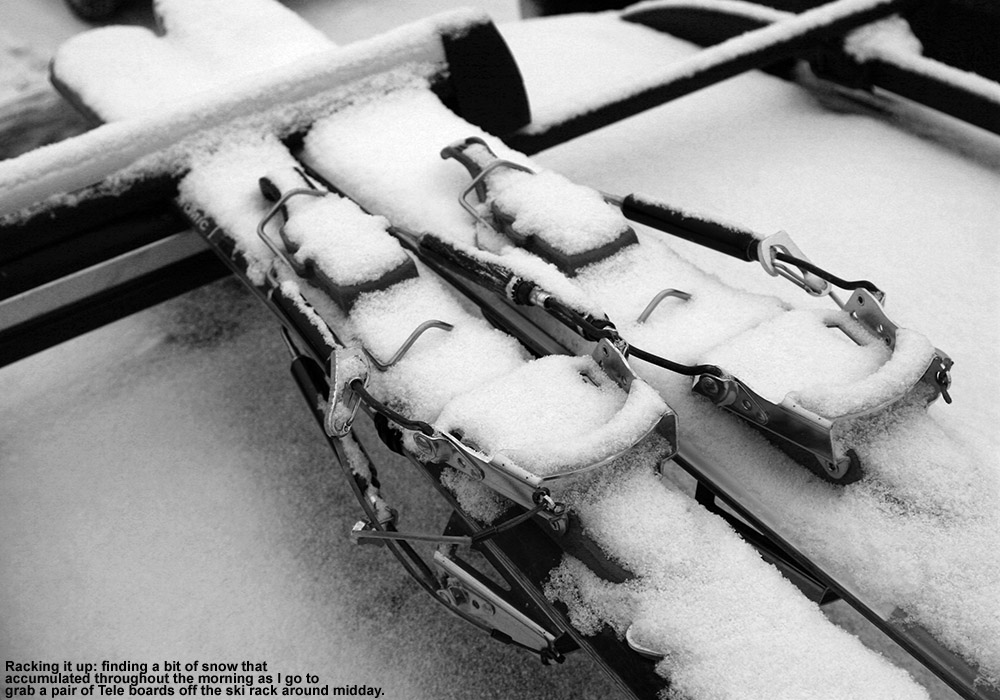
Grabbing the Tele boards for some afternoon turns
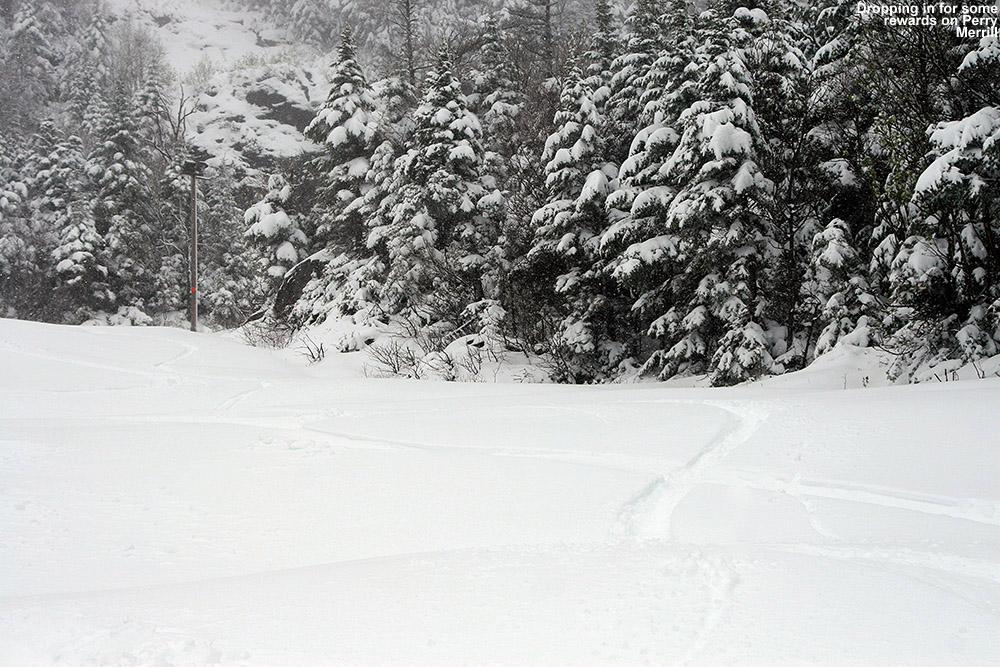
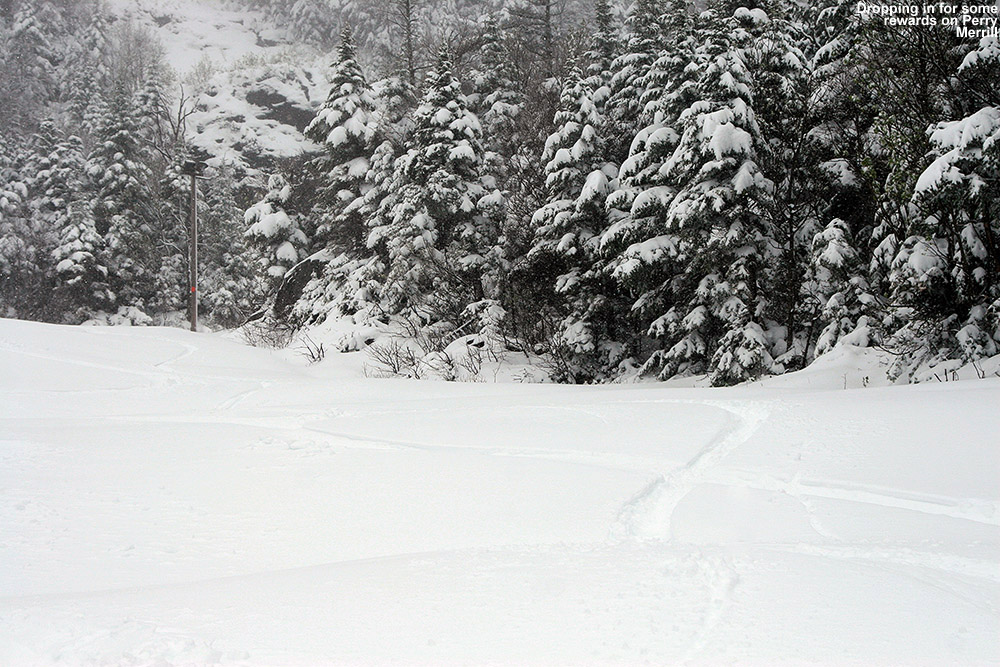
In terms of conditions, naturally they were best early on – we had a couple of great runs down Perry Merrill with good packed snow, and chowder and powder off to the edges. It was nice that Steve just let us rip it up. I generally found 12” of powder whenever I looked in undisturbed places, which is presumably the combination of snow from this storm and that frontal passage the other day. The snow depth at the Mt. Mansfield Stake isn’t quite to that 24” mark yet (22” as of this evening’s report), but people are definitely starting to ski those appropriate areas of early season trees. During today’s session, Steve brought us into Sunrise Glades, Birch Glades, and Lower Gulch Glades, and they were all in pretty good shape. If you were going for lines of fresh powder, you wanted to be on your guard a bit since there are still some obstacles about, but in many spots it was hard to tell that it was so early in the season. In areas that had seen skier traffic and had packed snow, you could just ski it and really didn’t have to worry about coverage issues. In any event, it was definitely nice to be back in the trees. Indeed those runs listed are the more moderately pitched, well maintained glades that are amenable to these earlier visits, but they’re very low on the mountain and that says a lot about the current state of the snowpack.
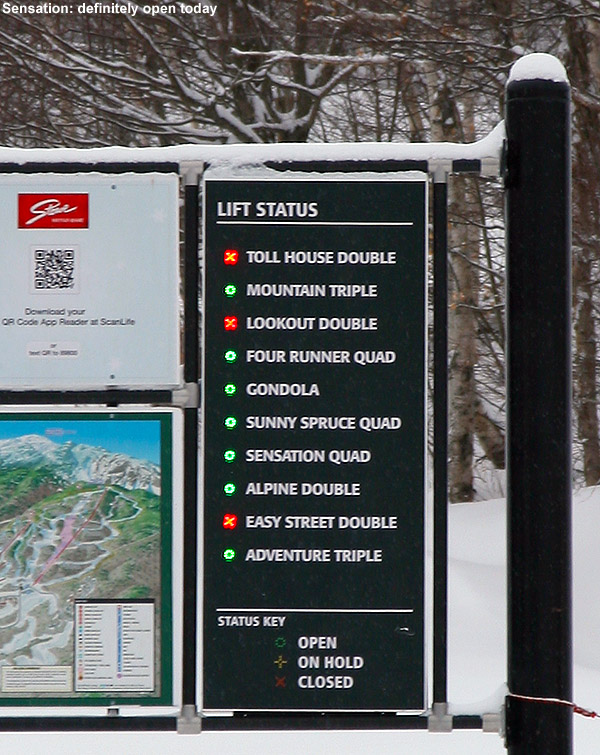
After some lunch and paperwork at the Great Room Grill, Steve said that we were done, but that anyone who wanted to could meet with him at 1:00 P.M. and work on identifying weaknesses in student’s ski technique and how to remedy the situation. Having done a lot of that over the past few sessions, I decided I’d just grab a pair of my Tele skis from the car and take a final run or two before heading home. I was just going to grab my mid fats and head back over toward the Chapel Glades, but then wondered if the Sensation Quad was open – if it wasn’t, it might be a nice place to earn some turns. With that in mind, I grabbed the fat boards off the rack, finding everything covered in a layer of new snow that had fallen during the morning. Once I checked in at the lift status board at the Spruce Peak Base, I saw that indeed the Sensation Quad was running. That meant that the terrain over there on Spruce would likely be pretty packed out, but I decided to just go for it instead of making yet another trip back to the car.
I took a trip up the Sunny Spruce Quad and made my way over toward the base of Sensation. There were actually very few people over in that area, but in terms of traffic, the damage had been done earlier in the day. There were still pockets of powder off to the sides of trials, but with Main Street closed for snowmaking, terrain was limited. Even the hiking terrain above the top of Sensation was tracked up, so people had clearly been doing what they could to get some powder with the limited acreage that’s currently available on Spruce Peak. In spots where the snow surface was down to manmade snow, the fat skis were definitely a poor tool for the job. I ended up just going with alpine turns in the areas where the snow was firm like that, because getting the fat skis on edge in a Telemark stance in those areas felt like trying to get a snowboard on edge on icy terrain. They’re just not meant to do that well. I will say that I notice the deficiencies of fat, rockered skis much less when I ski them alpine, so that may be one reason that so many people are willing to use them as more all around skis (or they just go in with the recent marketing trends and figure that’s the way it is). With my legs cooked from the morning’s runs, I was very ready to call it a day after that trip to the bottom. I really would have liked to venture over to the snowfields above Meadows for some powder, but they had that area roped off because of snowmaking below. It was looking so good in there with the tracks from when it had been skied – hopefully I can get in there on my next Stowe powder day.
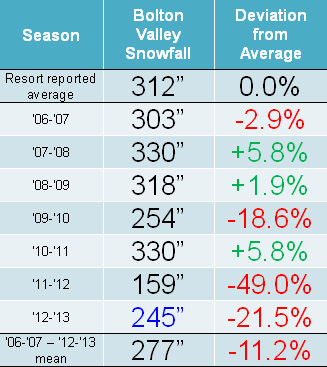
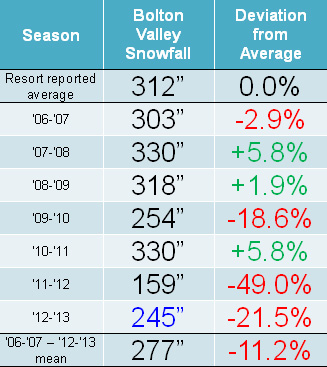
Snowfall: Compared to the snowfall-deficient 2011-2012 Ski Season, the 2012-2013 Ski Season was certainly a step up, but it was still generally below average for snowfall in the mountains of Northern Vermont. It was Bolton Valley that seemed to fare the worst of the northern resorts along the spine of the Green Mountains, perhaps due to their west slope location and this season’s dearth of upslope snow; they reported just 78.5% of their average snowfall. Heading northward, Stowe and Smugg’s fared a bit better at around 85% of average, and Jay Peak reported roughly average snowfall. Down at our house in the Winooski Valley, snowfall was 88.6% of average, so not too shabby by most accounts, but a bit below the mean like some of the local mountains. These past two seasons have actually been the first pair delivering back-to-back below average snowfall in our area since we started keeping track in 2006. Those numbers can be seen in both our Waterbury Winter Weather Summary Table, and the table of Bolton Valley annual snowfall below; this past season’s snowfall is highlighted in blue:
Low snowfall last winter meant back to back seasons with below average snowfall at Bolton Valley.
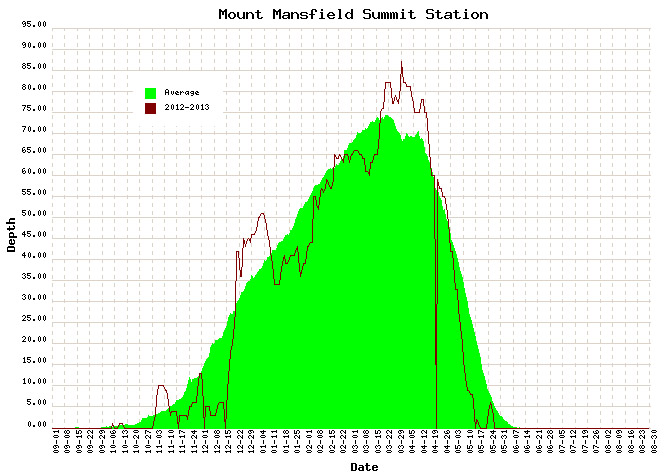
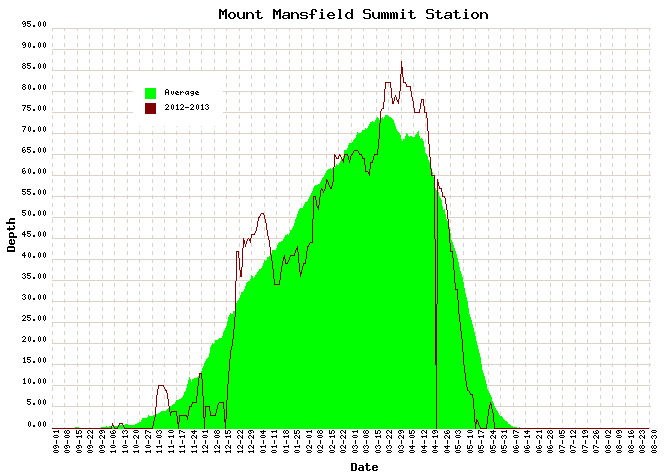
Snowpack: Aside from the spikes associated with a couple of early season storms, the mountain snowpack was below average going into mid December. That changed quickly though, with the onset of all that new snow during the second half of the month. The above average snowpack achieved during the holidays didn’t actually stay that way during January’s warmth and lack of storms. After consolidation, the snowpack generally trundled along at or below average through February’s continuation of relatively low snowfall. From mid February to mid March, the snowpack sat there essentially stagnant for an entire month; to wit, on February 21st, the snowpack was at 65”, and roughly a month later on March 18th, it was still at 65”, without any notable consolidation of more than a few inches. The late season stretch from mid March to mid April represented a nice rebound for the mountains however, with some quick gains from the big Northern New England March storm getting it above average, and the snow depth staying at least modestly above during the period.
Two periods stood out this past season for above average snowfall: The holiday period and mid-March through the end of April.
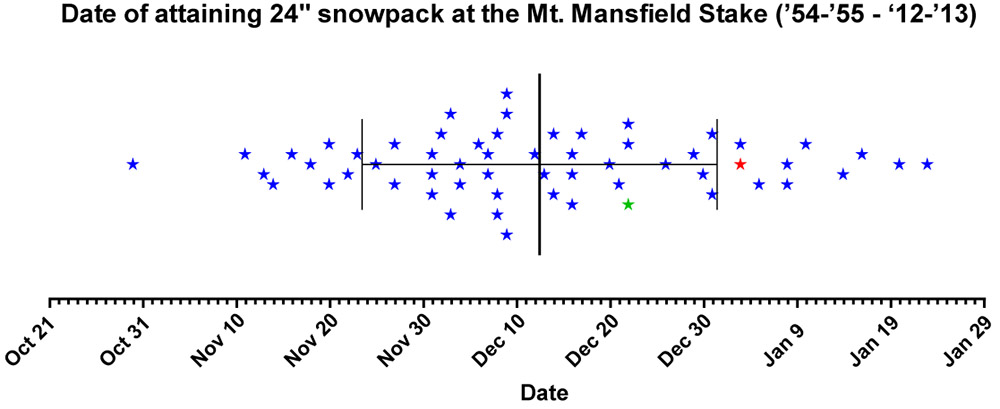
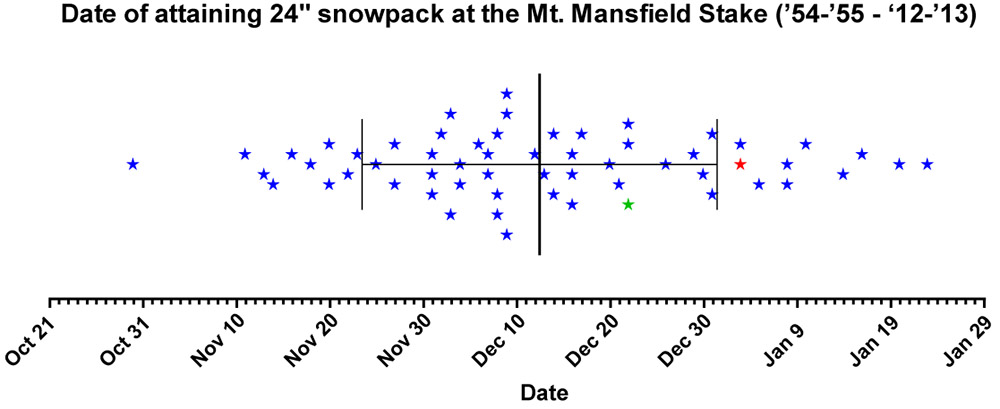
Tree Skiing: One metric used as a rough guide for the start of off piste skiing in the Northern Green Mountains is the point at which the snow depth reaches 24” at the Mt. Mansfield stake. For those unfamiliar with how this metric was established, it’s described in some detail in the 2011-2012 ski season summary. With the incorporation of this season’s data, the mean date remains at December 12th ± 19 days, with an average depth at the stake of 25.9 ± 2.7 inches. After the very slow start in 2011-2012, in which the 24” depth wasn’t attained until January 3rd (more than a standard deviation later than the mean), this past season was notably earlier. The plot below shows the date at which 24” was obtained for each season since 1954, with 2011-2012 shown in red, and 2012-2013 shown in green:
Each star marks the date of attaining a snow depth of 24 inches at the Mt. Mansfield stake, covering all years since 1954. Although still a bit later than average, reaching a depth of 24 inches at the stake this past season (green star – Dec 22) occurred much earlier than the previous season (red star – Jan 3). The mean date for attaining a depth of 24″ is marked by the large vertical bar in the center of the plot, and the smaller bars indicate the range of one standard deviation above and below that mean.
This past season, the date (December 22nd, Depth=28”, Green Star) was still later than average due in part to the slow first half of December, but unlike last season it was well within the 1 S.D. bars (thin vertical black lines). Note that the 24” mark is being used as an indicator of when the first forays into appropriate off piste/tree skiing terrain typically start in the Central and Northern Greens. In terms of empirical tree skiing observations, personal experience again lends some support to the use of 24” mark this season, as we began venturing into the trees the very next day on December 23rd at Bolton Valley. It should be noted though, that while the 24” mark was attained on December 22nd this season, the 40” mark was attained the very next day on December 23rd. The 40-inch rule (i.e. reaching a depth of 40” at the stake), is used as an indicator of when most off piste/tree skiing around here is ready to go. Although I haven’t looked into the data, this season has got to represent one of the quickest ascents from 24” to 40” – it’s interesting to note however that after rising to 42” of depth on December 23rd and 24th, the snowpack settled back to 36” for a couple of days before rebounding to 45” on the 27th.
Snow Quality: As an monitor of snow quality for the season, the chronological list of our ski outings has once again been compiled, with those days in which we were skiing powder indicated by a P, and those days in which powder skiing wasn’t available indicated by an X. The availability of powder suggests a fairly high level of snow quality, and the absence of powder generally indicates that temperatures rose above freezing at all elevations. Each listing below represents a link to the full report where images and more information from the outing can be obtained. Outings with an X may still be providing decent skiing such as wet snow, corn, etc. (or else skiing was typically avoided) but aside from the spring period, there’s going to be a price to pay in terms of snow quality associated with these episodes when temperatures eventually cool back down. The pattern of snow conditions in the Northern Green Mountains was fairly typical this past winter, with those days lacking powder skiing showing up in three distinct periods: 1) the early season with its usual temperature fluctuations, up through mid December before the weather pattern changed and the cold weather stabilized, 2) a thaw period in mid January, and 3) the period starting in mid March where spring weather began to make inroads. However, with the way the weather patterns this past spring continued to provide cool temperatures and snowfall, powder skiing generally dominated until mid April. Having analyzed the skiing in this way for the past three seasons, a surprising level of consistency is noted, with an overall average of close to four out of five days providing powder, despite notable differences in the demeanor of these recent ski seasons. The 2010-2011 season, which was above average in snowfall, provided powder on 78% of outings, the 2011-2012 season, which was well below average in many ways, revealed the same 78%, and most recently the 2012-2013 season, which was slightly below average in this area, produced a very similar 77% of outings with powder. The percentages don’t take into account differences in the number of outings each season, but with all three seasons falling into the range of 50 to 60 ski outings, differences in the sample sizes aren’t huge. The list of categorized ski outings with links to their full reports follows below:
The detailed month-by-month synopsis of the season is next:
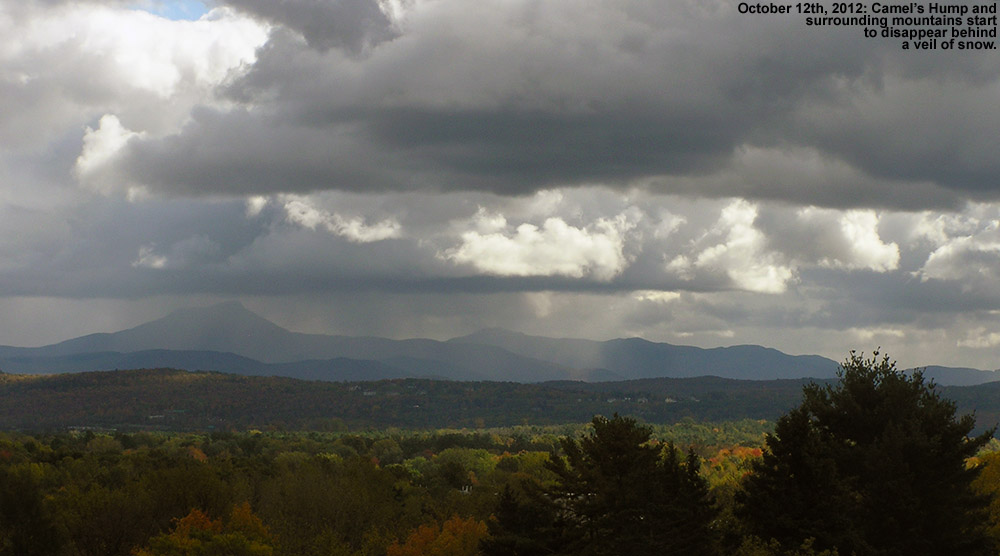
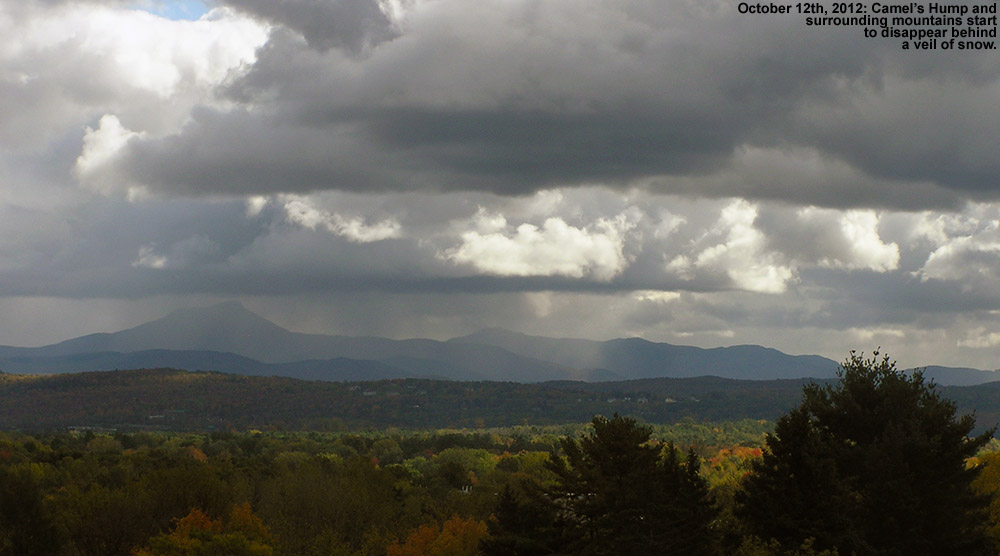
October: It wasn’t an especially snowy October to kick off the season; we had five rounds of snow in the mountains, and the third one even dropped accumulations to the lowest mountain valleys, but none of the storms were huge dumps, and we had just a tenth of an inch of snowfall down at the house for the month. October’s first snowstorm started up on the 7th, with snowfall being reported at the top of the Mt. Mansfield Toll Road in the afternoon, and by the next morning Powderfreak sent along his picture of 4” of accumulation at the top of the Stowe Gondola. I also got a shot of Mt. Mansfield later in the day with its first accumulation of the season. It didn’t seem like quite enough snow to tempt me out to ski, but the FIS boys hit the snow and provided a thorough report of the turns. The second storm delivered some accumulation on the 11th, with a snow line up around the 3,000’ level and less than an inch of snow found up on Mt. Mansfield. The third storm was the one that finally touched the lower valleys with some minimal accumulations, but in terms of mountain accumulations, I don’t think it was anything more than junkboarding material. The 4th (on the 14th of the month) and 5th (on the 16th of the month) storms of October also appeared to be pretty minimal and generally flew under the radar in terms of discussion. So while it wasn’t a great October for natural snow skiing (with nothing like the back-to-back larger storms at the end of October during the previous season), some folks made some turns and there were several smaller rounds of snow to keep the peaks white.
April: Despite the somewhat slow increases in the snowpack during the heart of the winter, the gains made during the latter half of March meant that the snowpack was at least modestly above average heading into April, and it quickly reached a peak of 87 inches at the Mt. Mansfield Stake when the first storm of the month dropped a foot of snow at Stowe on April 2nd. I was up at Bolton Valley that day for a ski tour, and I got to witness some impressive snowfall rates as the storm crashed into the higher elevations. The alpine terrain above tree line on Mt. Mansfield was in good shape, consistently providing excellent outings during that first part of the month. Cool temperatures with additional snow meant that the snowpack stayed at an above average level right through the month, and another storm on the 12th saw Ty and I enjoying close to a foot of dense powder out in the Bypass Chutes at Stowe on the 13th. The skiing gradually transitioned to full on spring conditions after that weekend as the active pattern waned, and an impressively long stretch of clear weather moved in and stuck around well into May.
May: For most of May, there wasn’t much to talk about in terms of new powder, especially with the extended period of incredibly clear weather that carried over from the end of April and lasted a fortnight, finally ending on the 10th of the month. There was some mighty fine spring skiing right through that period with all the sun and warm weather, even if it did cause the snowpack to decrease a bit faster than it otherwise might have. The tranquil period of warm weather allowed the Mt. Washington Auto Road to open on the 10th of the month as well (definitely on the early side), but since unsettled weather had just returned at that point, we didn’t get to make our spring pilgrimage to the snowfields until the 18th. To really cap the month off well, Northern New England and the Adirondacks were rewarded with a Nor’easter over Memorial Day Weekend, which delivered roughly 3 feet of powder to Whiteface and nearly 2 feet to Mt. Mansfield. Excellent powder turns were made while the valleys were almost fully leafed out for the spring. We didn’t actually head out for any June turns beyond that, but the skiing over Memorial Day Weekend had been so good that it hardly mattered – it was just a few short months until the snows of fall would be returning.
So what about the overall feel for the quality of the ski season in Northern Vermont? Well, much like the snowfall numbers suggest, it feels like it came in a bit below average, even if not horribly so. The mountain snowpack (as gauged by what was seen at the stake on Mt. Mansfield) had its ups and downs, and on balance it probably gets rated in a similar manner to what the slightly subpar snowfall would suggest. Being frequent Bolton Valley skiers and living down below the mountain in the Winooski Valley, our perspective might be skewed a bit downward with the resort receiving just 78.5% of their average snowfall. Having the north miss out somewhat on a couple of big regional storms, while watching a horrid valley snowpack (see the 2012-2013 Winter Weather Summary for details) that kept ski routes to the lower valley bottoms essentially off the table, certainly didn’t win the season any extra points. It seems that 2012-2013 ultimately sits in the lower half of ski seasons and won’t be remembered as anything epic, but it also appeared to hold onto a decent level of powder availability (77%) based on our experiences, and that means there was still a pretty decent amount of good skiing. The fact that even the poor 2011-2012 Ski Season was able to hold onto a powder percentage in that range is also reassuring in that regard, suggesting that there is indeed a certainly level of reliability that can be expected in these seasons where snowfall/snowpack is below average.
We’re pleased to announce the completion of our Bolton Valley Photo Gallery for the 2012-2013 ski season. This year’s gallery is our largest to date, with over 270 images documenting this season’s ski adventures indoors and out, in the front, side, and backcountry, under blue skies and flake-dumping maelstroms at Vermont’sBolton Valley Ski Resort. Continue on to the thumbnail images below and browse away! Detailed reports are associated with every photograph in the gallery, so if you find a scene that sparks your interest, simply hover over the thumbnail image to get the date, and head to the archives on the right side of the page to read the full report. We’ve also got similarly extensive galleries from the past several ski seasons, representing nearly 1,600 photographs from around Bolton Valley, and these can all be found at our J&E Productions Photo Galleries Page. We’ll also have our full 2012-2013 Ski Season Summary coming out later this summer, so stay tuned for that update as well.
We almost did a little skiing at Stowe on Thursday this week, but it was just starting to rain when we stopped in at the mountain around midday, and with E and the boys a bit under the weather, we decided to hold off. The weather was much better today, so we headed up to Mansfield in the afternoon to make a few turns. Temperatures were up around 50 F in the mountain valleys, and the sky was a mix of clouds and sun, so it seemed like a reasonable spring skiing day. It was only in the 40s F at the base of the mountain, but that was still more than warm enough to soften up the slopes.
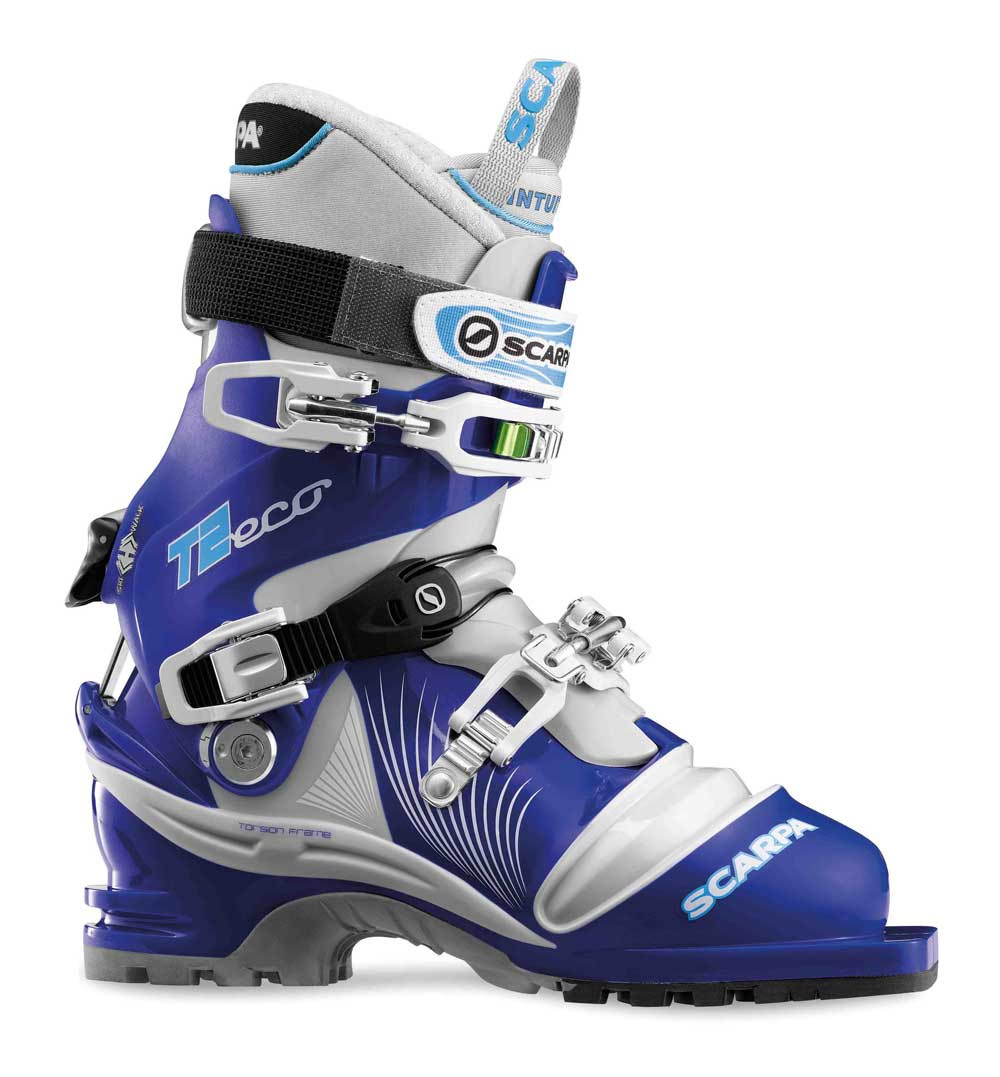
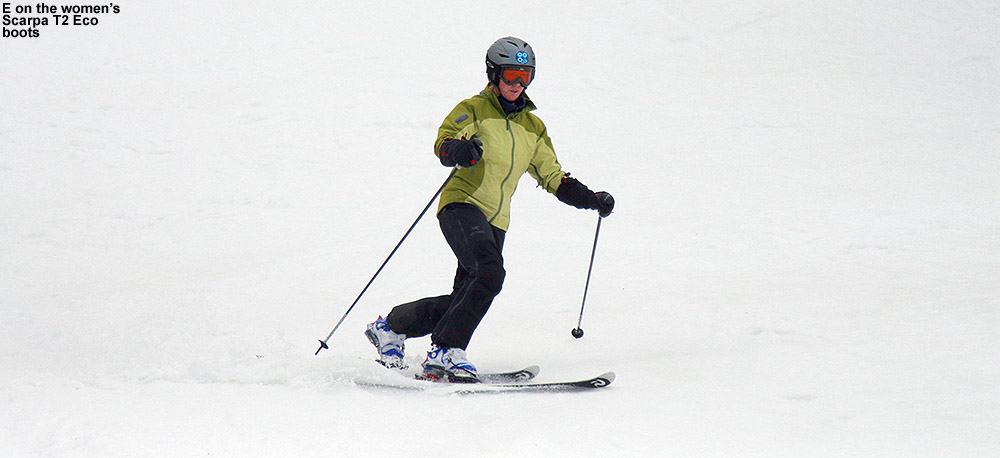
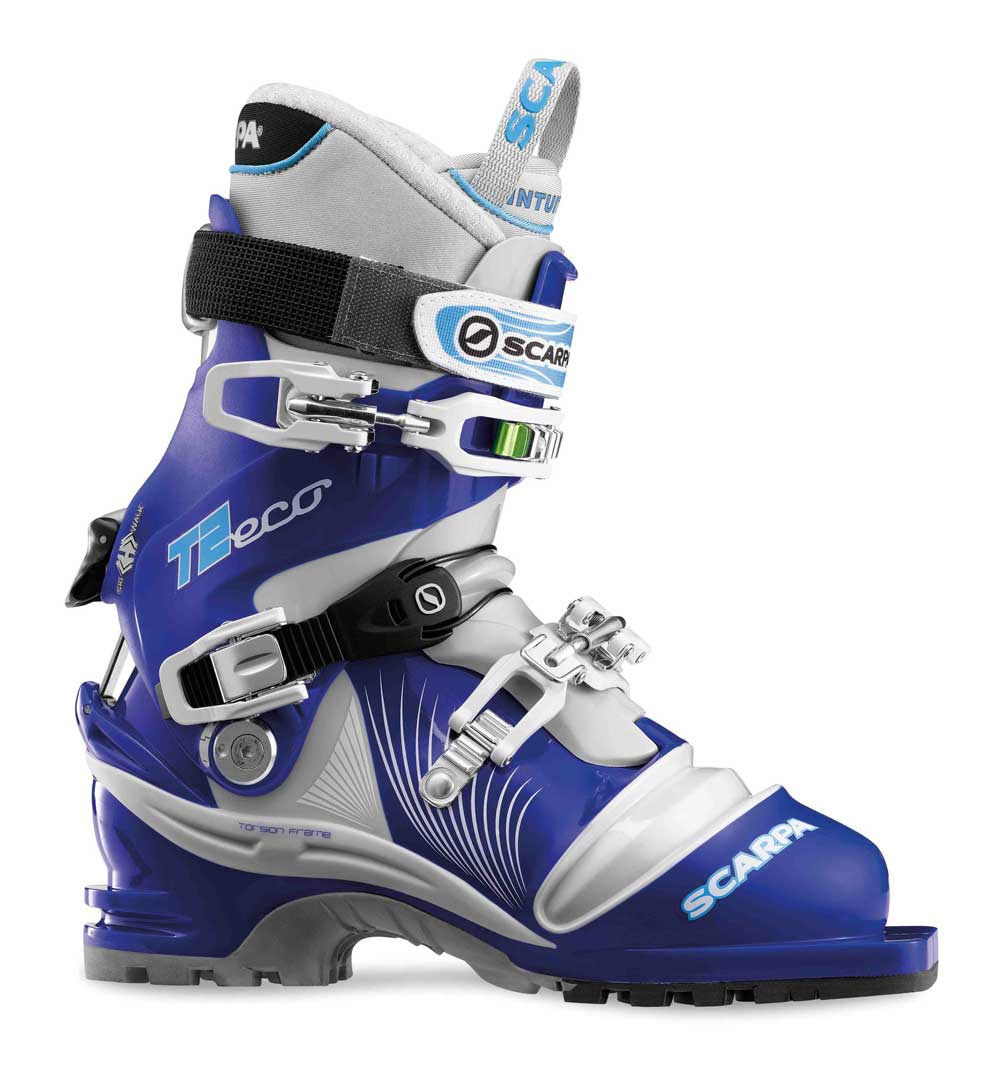
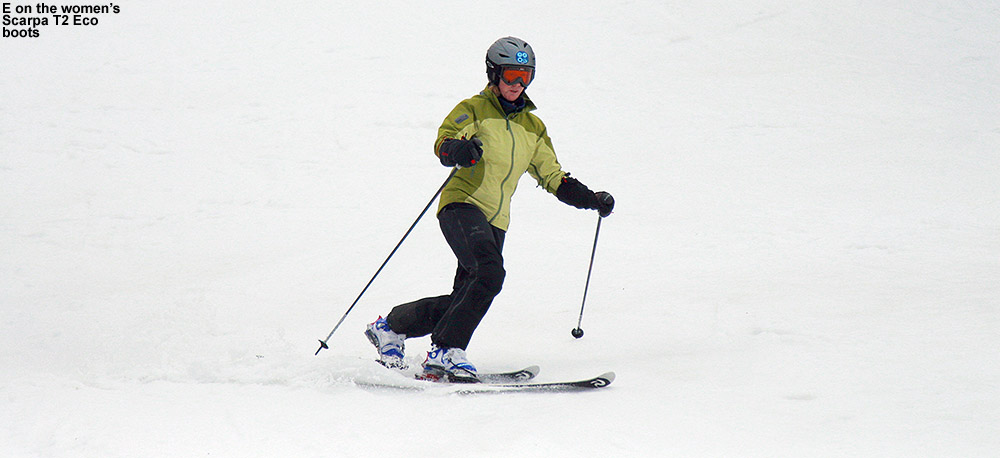
One item of note today was that it was E’s first chance to try out her new Telemark ski boots that she bought a couple of weeks ago. After almost six seasons of using the $50 boots that she picked up at the South Burlington Ski Swap, it was finally time to up the fit and performance level of her Telemark footwear. Her boots had always been just a bit on the large side, and she’d just either worn some thicker socks or dealt with the minor inconvenience, but when she got some fatter Telemark skis this season (Black Diamond Element) with a width of 115 mm underfoot, the fit became a real concern. There weren’t any serious issues in untracked powder, but as firmer or more uneven surfaces were encountered, the slop in the boot was clearly making things difficult. Relative to a narrow-waisted ski, getting a wide ski like that on edge takes more pressure, and if you don’t have a snug fit in your boot, you’re potentially going to have problems when you encounter groomed or other firm surfaces. Since I have the standard, slightly stiffer version of her ski (Black Diamond AMPerage) I could feel the extra force required to get the ski up on edge when encountering groomed surfaces, but I found the inconvenience fairly trivial in a good-fitting boot. With that in mind, E got a gift certificate from Outdoor Gear Exchange for her birthday last month so the she could go and get the boot that she liked best without thinking about the price; she’s more than paid her dues the past six seasons in her current boots. E’s birthday has always been timely for ski-related gear, and as is typical, all the current boots are on sale now that we’re near the end of the ski season. After a solid boot-fitting session with one of the associates, she found the Scarpa Women’s T2 Eco to be the perfect fit. It’s a three-buckle boot with a power strap, similar to my Garmont Garas. It looks like they’ll be a great boot for the combination of lift-served and backcountry skiing that we do. It’s also interesting to note that Scarpa T2s were the Telemark boots we tried back in 2002 at Lost Trail Powder Mountain in Montana on our first day of Telemark skiing ever. We had no other reference at that point, but liked the boots a lot.
“As for conditions on the hill, they were a mixture of corn snow bordering on loose granular at the very top, which blended to a softer corn snow below.”
As for conditions on the hill, they were a mixture of corn snow bordering on loose granular at the very top, which blended to a softer corn snow below. I enjoyed the snow a lot, being able to really bite in and carve, although Ty and Dylan felt like they were being pushed around in the soft snow at times. The major downside I found today was that it wasn’t quite warm enough to really soften up the subsurface to where I like it, so there were occasional encounters with firm patches. Both boys were still feeling the effects of being under the weather this week and they didn’t really have their usual levels of energy. With the combination of low energy and what they found to be challenging snow, they ended up going pretty minimal on the number of Telemark turns they made. They stuck with alpine most of the time, but at least they got a bit of Tele practice and were out in the fresh air.
“Those were
some very
smooth turns.”
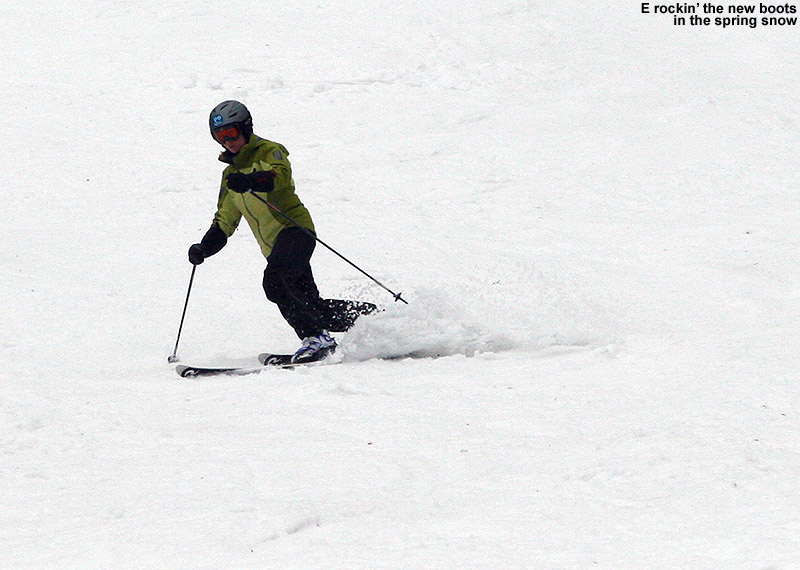
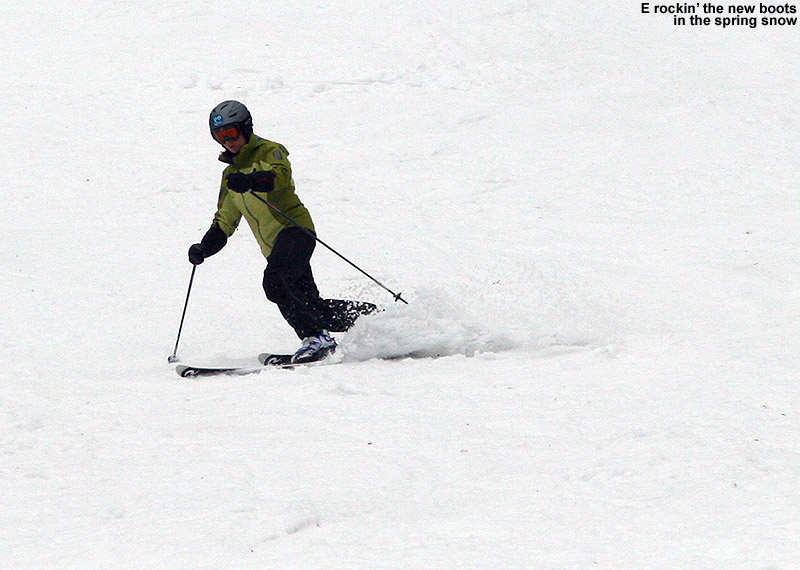
E immediately noticed the security and stability in her new boots. They were noticeably harder to flex than her old boots, but of course these are new, and her old ones must have seen a decade worth of ski seasons… and they had cracks in the bellows as well. The rigidity and support in her new boots must be light years ahead of what she had. E was quite impressed with the increased control she had with the new boots, she said that she could feel the soft snow wanting to push her skis around, but she could overpower that more easily and direct her skis wherever she wanted. She said that she couldn’t do that to nearly the same degree with her old boots.
The new boots in action
By our second run, temperatures seemed like they were cooling, because the snow was beginning to tighten up near the summit of the Fourrunner Quad. By that point the boys had had enough skiing anyway, as they were feeling tired. One can always tell when Ty is tired, because he’ll take a seat or lie down when we stop on the trail. He used to do that a lot when he was much younger since he didn’t have any stamina, but if we see it frequently now, we know he’s getting tapped out. We did finish that next run on quite a high note by catching some untracked corn snow on Lower Gulch. Those were some very smooth turns. On a weather-related note, we were very surprised to find that it was actually snowing at times this afternoon, despite the fairly warm temperatures. Clearly some colder air has moved in at the higher elevations to support the snow we saw, because that’s the only type of precipitation that fell.
So E had a great experience with her new boots today, and I think it’s going to be interesting as she tries them out under different conditions, and eventually on her fat, powder skis. It seems like they’re going to give her much more control, but we’ll just have to see what the combination of boots and skis is like. I realize now that after checking them out more closely, that her old boots are actually only a two-buckle model with a power strap; they seem like they might be some Scarpa T3s, and an old well-used T3 from a decade ago is going to be a dramatically different boot than a modern T2. I’m sure we’ll have more boot updates as we move ahead in the spring skiing season.
 It was off to the main mountain next, where in order to add some fun in getting over to the base of Wilderness, we did a run off the Mid Mountain Chair. I treated E and the boys to a run through Glades Right and Nixon’s; both areas had great snow and coverage, and the boys were impressed. Wilderness was finally running today, and I led E and the boys on an attempted run through Super Snow Hole, but it was tough to find the entrance and we had to settle for regular Snow Hole. There had been very little traffic on Snow Hole, and it could actually use a bit more people venturing in to pack it down a bit with the generous depths of the recent snows. Ty called for a run on Turnpike, with an entry via Cougar, which the boys said they always seem to ski during the Olympics. They made sure to practice their Olympic victory “raising of the arms” at the bottom.